Elvis Presley (1935 – 1977) popularized the song “In the Ghetto” written by Mac Davis in 1969. The following TikTok video, featuring an artist with whom I am not familiar, is better—in my opinion—than any other rendition I’ve heard. Such depth! Such raw passion! Such strength! Such vulnerability!
The modern-day play “J.B.,” authored by Archibald MacLeish (1892–1982) and published in 1958, portrays a modern rendition of the Biblical character, Job, someone who became a pawn in a battle between God and Satan. God “allowed” all kinds of misery (sickness, loss of reputation, loss of wealth, and loss of children) to befall his faithful servant, Job. In MacLeish’s telling, we see that J.B. (like the biblical Job) undergoes setback after setback. In the end, J.B. comes to the realization that “He [God] does not love. He is.” Sarah, his wife, responds, “But we do. That’s the wonder.”
We (humans) spend a lot of time talking, singing, and writing about love. Sometimes we even claim to behave in loving ways. Yet, just what is love? Why do we love? How do we love?
A year or so before the November 2020 U.S. presidential election, a private Facebook group now titled “Wives of the Deplorables! Go Vote!” came together because many women were distraught about the political ideological rift between them and their husbands—a rift that became more evident as Election Day 2020 drew nigh. Women, stunned and disappointed by the Trump-like behavior (angry, petty, and argumentative) of their Trump-supporting husbands or partners, encouraged each other virtually as Biden (now President-elect) moved closer and closer to winning the White House.
From the group’s private Facebook page: “This is a group created after a CNN report about the wives of Trump Supporters. This is not a politically affiliated group….This females only group is created to support each other and help women share their thoughts.”My sister Betty joined the group. Her Trump-supporting husband, she said, had been brainwashed by Fox News. One need not have a Trumpster spouse to be part of the group, but one must be supportive of the members who are upset, even devastated, by having become the target of their partner’s anger and rage when they discover “their women” voted (or planned to vote) for Biden. Thanks to her invitation to join the group, I have been able to get a glimpse into the lives of these 2,000 or so members who feel demeaned—and yes, even hated, by their spouses. The group remains active post-Election.
No matter how much we may want absolute control over our own lives and destiny, most of us realize that’s just not possible. Life itself is chaotic—both on a global and individual level. War, famine, drought, earthquakes, tsunamis, pandemics, poverty, sickness, ignorance, disability, divorce, and ultimately death comes calling for everybody living on planet Earth—a planet which will no doubt eventually die as well.
How do we maneuver through such dire straits? Can we make sense of and find meaning in our day-to-day chaotic existence both as members of individual families/communities and as global citizens? Perhaps so, however, it’s impossible to tackle the tumult all at once. Hence, the title of this essay—“Frame the Chaos.”
Thanks to my former colleague Dr. Cliff Edwards for this phrase, gleaned from his reading of Gilles Deleuze, French philosopher (1925-1995). “Chaos is defined not so much by its disorder as by the infinite speed with which every form taking shape in it vanishes. It is a void that is not nothingness but a virtual, containing all possible.”
The phrase, “separation of church and state,” crops up frequently in conversation these days. I hear it most often when someone wants to clinch their argument on a politicized subject. Lately, it’s been concerning one’s “right” to an abortion. “It doesn’t matter what your church says, we have separation of church and state in this country.” That phrase, though, is not in the Constitution. It was Thomas Jefferson (1743-1826) who paraphrased the Constitution in a letter to the Danbury Baptists, “…building a wall of separation between church and state.”
The first part of the 1st amendment states: “Congress shall make no law respecting an establishment of religion, or prohibiting the free exercise thereof….” All manner of questions have been raised with this statement. What does it mean to establish a religion? What is religion? Is religion something intrinsically good? Most Americans think of religion in terms of God. What/who is God?
I’ve been told that most children in the United States learn to write haiku in third grade. At the very least they learn that haiku is a traditional poetic art form using seventeen syllables divided into lines of 5 – 7 – 5. The idea is to capture a moment in time. The famous Japanese poet/priest, Issa (1763-1828), focused on creating haiku using his love for nature in the process.
I did not grow up in the American school system, so it wasn’t until I took an undergraduate Zen Buddhism course that I learned to appreciate and have fun with creating this particular kind of poetry.
In the following haiku, I try to capture the moment I experienced the natural scene in front of me. Taking a photograph and then writing an accompanying haiku can be a meditative exercise. I keep striving to make that exercise a daily happening.
Ominous dark clouds Follow me around the lake Pushed by a brisk wind
I remember a poignant conversation with my sister when our children were young. Our biggest fear at the time? How would we ever manage if one (or several) of our children refused to speak to us as they grew into young adulthood? Stories swirled around our social circles about a son or daughter who wanted nothing to do with their family of origin. These estranged children frequently put physical distance between themselves and their parents.
That fear eventually became my reality. I despaired.
Like many parents, I lacked experience and maturity while raising my children. I didn’t have the wisdom to understand, trust, and apply the message of the Lebanese-American writer/poet, Kahlil Gibran (1883-1931). Had I done so, not only would I have avoided a lot of grief, but my children would probably have had an easier transition from childhood towards independent adulthood.
This was originally posted on March 12, 2014. It was Esther’s first FAR post.
Recently, I got involved in a conversation about abortion. It happened on Facebook when a relative posted that her heart hurts when she considers her “sweet baby girl” and how the law (Roe v. Wade, 1973) in the United States gave her the choice as to “whether [or not] I would have her killed.” She’s sincere. Many of her friends “liked” her post and, with few exceptions, commented in agreement. I was one of the exceptions.
March celebrates Women’s History Month–a month to remember the accomplishments of our foremothers, noting their work helping to secure for us (their progeny) certain rights, most notably the right to vote (Elizabeth Cady Stanton, 1815-1902) and reproductive rights (Margaret Sanger, 1879-1966). Support for abortion nowadays almost always falls under the rubric of “women’s reproductive rights.” So when we hear, “It’s my body and I’ll decide what I’ll do with my own body,” the speaker is giving voice to what many consider to be a fundamental right–the right to be autonomous and exercise free agency over one’s own person.
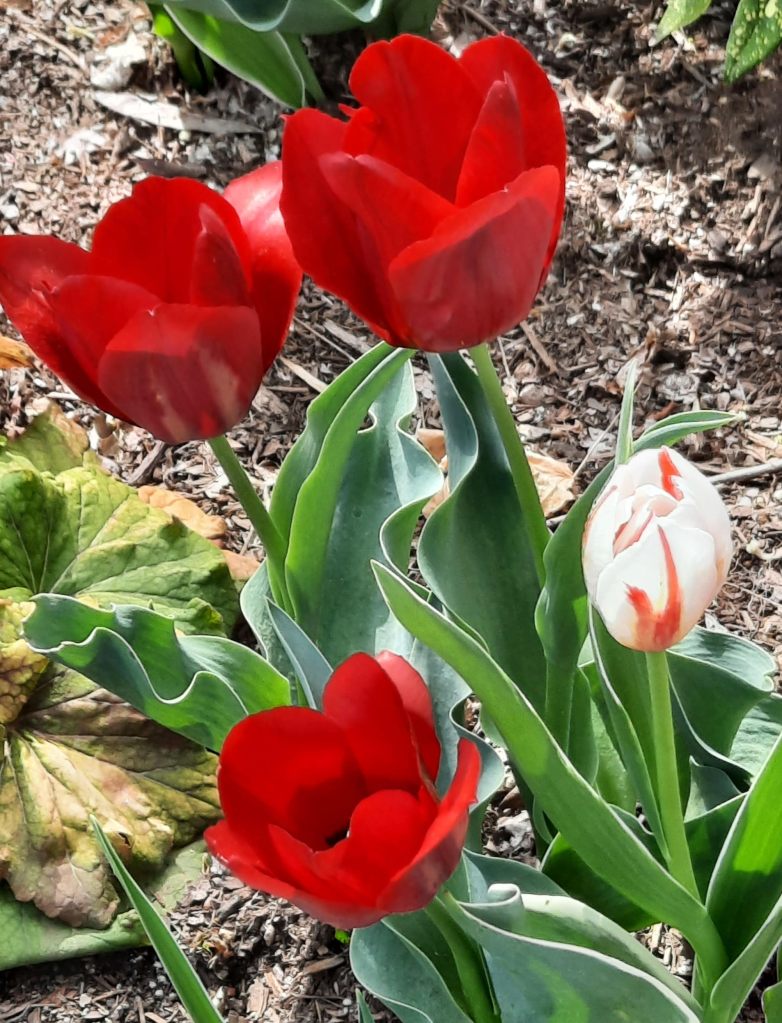
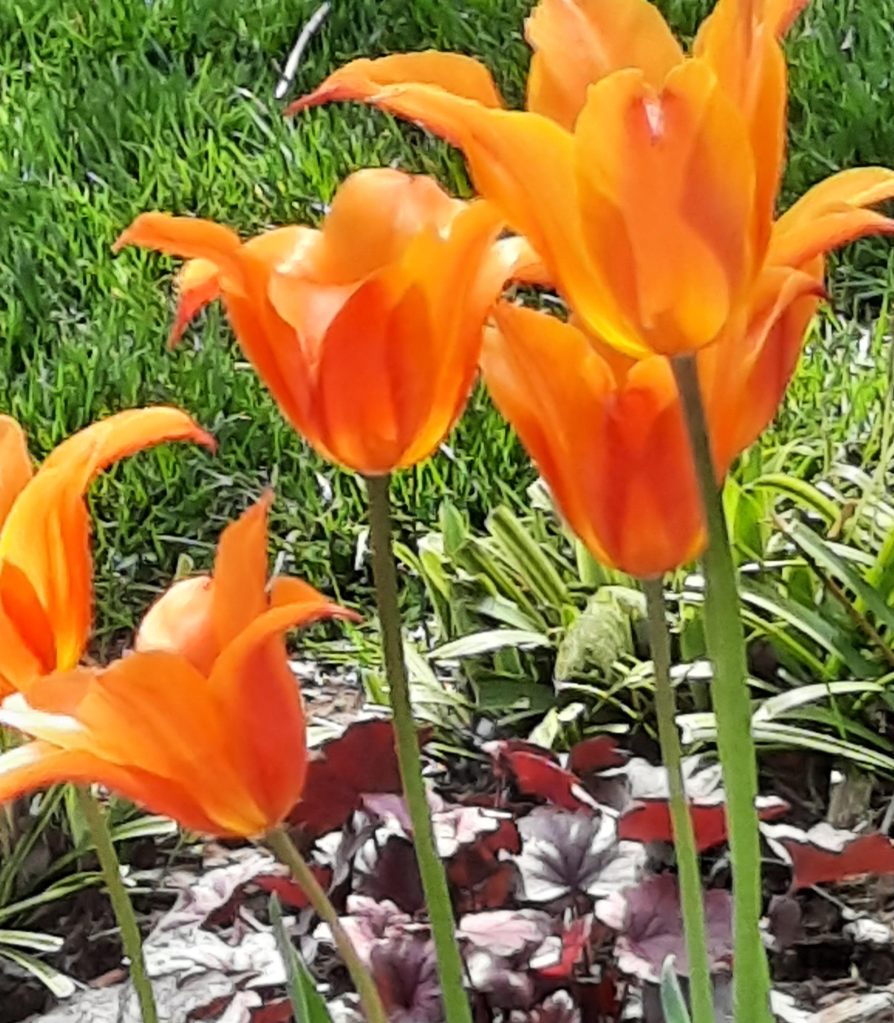
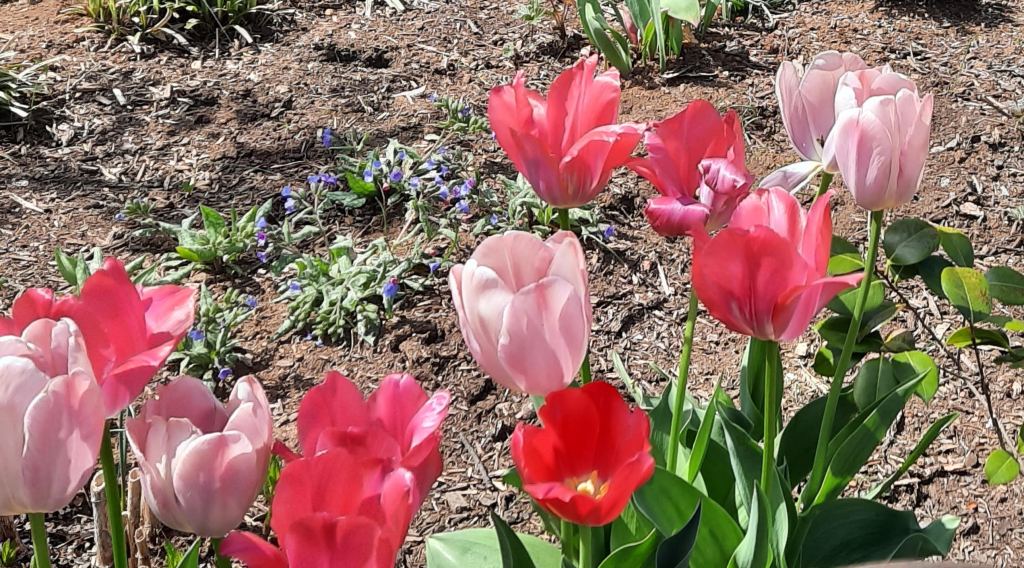
I’ve been blown away this Spring by the abundant beauty and sheer number of tulips planted throughout Roanoke, Virginia, a city I’m beginning to think of as “home.”
If I were to pick a favorite flower, it would be the tulip, yet I find it impossible to look at a tulip without being reminded of my religious upbringing regarding “salvation” as represented in the acronym of Calvinism’s “Five Points.” Each tulip displays five petals in its flower. Each petal stands for one point.
T=Total Depravity
U=Unconditional Election
L=Limited Atonement
I=Irresistible Grace
P=Preservation and Perseverance of the saints.
When my (now ex-) sister-in-law delivered her first baby one Spring, I gave her a pot of tulip plants, reminding her that T-U-L-I-P was the basis of our faith. The plant didn’t live to the following Spring, portending perhaps my future abandonment of T-U-L-I-P doctrine—doctrine being an interpretation of Scripture. T-U-L-I-P lays out an understanding of soteriology (doctrine explaining human salvation) hammered out by the French theologian John Calvin (1509-1564) and developed further by his Protestant followers.
Calvin had pushback to his five points from Dutch theologian Jacobus Arminius (1560-1609) and his disciples who disagreed vehemently with Calvin. Both Calvinists and Arminians claimed to be Christian, believing Christ to be the ultimate sacrifice for sin and necessary for blissful, eternal life. The discussion/debate remains an intramural one.
Seeing and engaging the world through a T-U-L-I-P lens does damage to the human spirit. It’s especially harsh on those people who have been systematically marginalized throughout patriarchal history—women, the LGBQTIA+ community, poor people, and Black/Brown people (especially in the US). After all, marginalized people have been considered “depraved” (first leaf of the tulip) by those who have power in our hierarchical society to develop and enforce doctrine that keeps the status quo for those in the upper echelons. But, I’m getting ahead of myself.
What is salvation? How does it happen? Who gets to be saved? Why are some saved and not others?
Today these questions don’t plague me as they once did. I find them curiously interesting, but not personally relevant. Nevertheless, these very questions and T-U-L-I-P, as a viable explanation for the human condition, used to hold me in their grip, crippling me while sucking joy from living in the here and now.
A brief explanation of T-U-L-I-P:
TOTAL DEPRAVITY—Not only have human beings inherited original sin (sin being the transgression of divine law), but are totally incapable of doing any good whatsoever without God’s intervention and help. Sin has infiltrated our thinking, emotions, and will. Only God can break through that murkiness before we can receive the free gift of salvation accomplished by Jesus’ death and resurrection.
(The following four points are dependent on the “truth” of the first point.)
UNCONDITIONAL ELECTION—God chooses who will be saved (the “elect”) for his own purposes, not based on anything an individual may or may not do. Nevertheless, we humans are responsible to see/believe the “truth.” (Huh?)
LIMITED ATONEMENT—Christ (the ultimate sacrifice for sin) did not die for everybody—only for those “elect” that God gave to Christ. Not everybody can be or will be saved.
IRRESISTIBLE GRACE—Those whom God “elects” to salvation cannot ultimately resist the offer or internal call of God’s grace for salvation.
PERSEVERANCE (AND PRESERVATION) OF THE SAINTS—Once Christians have been saved they cannot lose their salvation. God will see to it that the “elect” will persevere in the faith to the end.
So, why is this at all pertinent? Because our religious communities’ theological doctrines (handed down from our ancestors) have seeped into the social fabric of society. How often have we (those humans not “equal” to other humans) been told we don’t know things, don’t measure up, and will never achieve? We are lacking in countless ways and only our “betters” can enlighten and save us. (This is one way “total depravity” has worked into the interstices of society.)
T-U-L-I-P, Re-imagined:
Instead of Total Depravity, might we consider Total Perfection? We come into the world completely vulnerable and gradually learn to navigate our particular circumstances through the various communities we belong to. We express ourselves within the boundaries of our humanity. We love, hate, cry, get angry, and express joy. In much of Buddhist thought, these emotions are just that—emotions. We retain our perfection while being “angry Buddha,” “sad Buddha,” or “happy Buddha.” Emotions are not a moral issue. We are perfect in our humanity.
What about Unconditional Love, not Unconditional Election? What if we were to give ourselves and those who cross our path unconditional love? No judgment, no agenda to mold people into this or that—only acceptance of our perfect humanity?
Why not Limited Experience instead of Limited Atonement? We are human and bound by what we often call “laws of nature.” We fall at times. We forget what we need to be doing. Ideally, our family and community are supportive in ways that teach and encourage us, not limiting or withdrawing their support as we explore our environment.
Let’s talk about Irresistible Beauty, not Irresistible Grace. Beauty surrounds us. Beautiful art arrests us every day—both in the natural world and in the art humans produce. Navajo people focus on walking in beauty, meaning walking in harmony with all things—people, objects, animals, and life itself!
Pensive Perseverance rather than Perseverance (and preservation) of the Saints although the latter sounds good as long as “saints” refers to all people traversing the earth. Pensive (or critical thinking) Perseverance will enable us to flourish as we discover our own path.
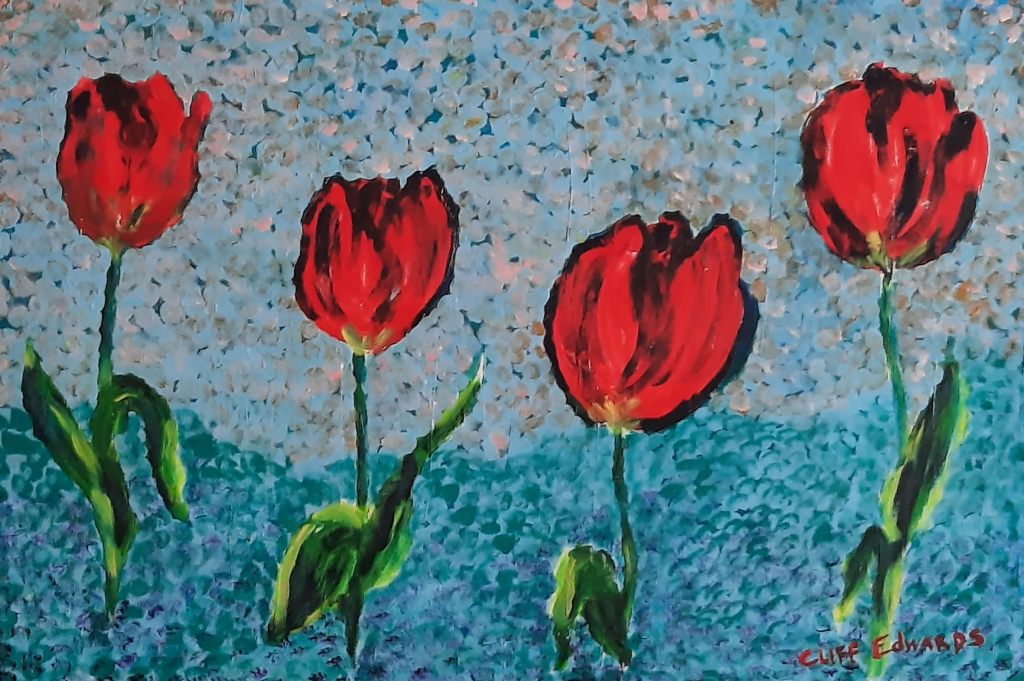
My revision of Calvin’s acronym doesn’t answer all of life’s BIG questions, however, I do think a revised version of T-U-L-I-P—one that doesn’t straight-jacket our humanity would better nurture and sustain us on life’s journey. Perhaps we can begin with contemplating, planting, and even painting the earthy, garden-variety tulips that flourish in the springtime!
Painting by Cliff Edwards
BIOEsther Nelson is a registered nurse who worked for several years in Obstetrics and Psychiatry, but not simultaneously. She returned to school (Virginia Commonwealth University, Richmond, Virginia) when her children were in college and liked it well enough to stay on as an adjunct professor. For twenty-two years, she taught courses on Human Spirituality, Global Ethics, Christian-Muslim Relations, Women in the Abrahamic Faiths, and Women in Islam. She is the co-author (with Nasr Abu Zaid) of Voice of An Exile: Reflections on Islam and the co-author (with Kristen Swenson) of What is Religious Studies? : A Journey of Inquiry. She recently retired from teaching.
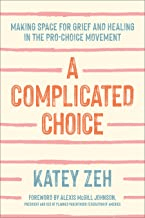
Katey Zeh, an ordained Baptist minister, CEO of the Religious Coalition for Reproductive Choice, and a contributor to this Feminism and Religion (FAR) blog recently published her newest book, A Complicated Choice Making Space for Grief and Healing in the Pro-Choice Movement (Broadleaf Books, 2022). Not only does Zeh push back against those individuals who are dead-set against giving space to pregnant people to make their own decision about whether or not to carry a pregnancy to term, she dares to imagine a world where people are not just free to easily access an abortion procedure, but are also given the support to grieve (if need be) and heal without being bogged down with shame heaped on them by the larger society.
One of the strengths (given the current religious-political climate in the U.S.) of this slim volume is that Zeh uses Christian Scripture to illuminate the way for pregnant people to embrace their inner knowing, something that helps slough off the stories that our society (collectively) has given them that silences and shames them “from speaking up and speaking out” about their abortions. “There is a culture of silence around abortion, and that silence is shaming and isolating on both a personal and a collective level.” When we break the silence of isolation and give voice to our difficult and painful experiences, we are then free to find healing and wholeness.





 Feminism and Religion