In recent years monotheism has been attacked as a “totalizing discourse” that justifies the domination of others in the name of a universal truth. In addition, from the Bible to the present day some have used their own definitions of “exclusive monotheism” to disparage the religions of others. Moreover, feminists have come to recognize that monotheism as we know it has been a “male monotheism” that for the most part excludes female symbols and metaphors for God. With all of this going against monotheism, who would want to affirm it?
In response to some or all of the above critiques, many modern pagans define themselves as polytheists, affirming at minimum, the Goddess and the God, and at maximum a vast pantheon of individual deities, both female and male, from a single culture or from many, including divinities with animal characteristics. Other pagans define themselves as animists, affirming a plurality of spirits in the natural world. A group of Christian feminists have argued that the Christian Trinity, the notion of God Three-in-One, provides a multiple and relational understanding of divinity.
While also rejecting exclusive monotheism and male monotheism, Jewish poet, ritualist, and theologian Marcia Falk provided a definition of inclusive monotheism that I find compelling.
We have come to a point in the history of our civilisation where our relationship to nature seems to be more of one of destruction than of nurturance and respect. Humankind has steadily distanced itself from nature, our homes are filled with dead things, plastics, metals and chemicals. Everything around us is synthetic and manufactured in factories. Some people live their lives never touching nature – the soil, the plants, the grass. I have even met people who have a deep fear of being in nature. This distancing from nature is a reflection of distancing from our Divine Earth mother, not just as the outside world, but also as the energy of the archetypal Earth Mother within our own psyche.
Many cultures and traditions herald a Great mother, Mother Earth or Mother Nature but our connection to her, especially recently in the Western world, has been severed. In the Greek mysteries, Gaia or Gaea, the Divine Mother, was one of the primal elements who first emerged from cosmic chaos at the dawn of creation. All the later Pantheon of Gods and Goddesses are said to have descended from her initial union with Ouranos (the sky) and Pontos (the sea). Her geneology and her presence in Greek myth is full of complexities, conflicts and contrasts. Her worship in Ancient Greece did in fact decline, for her role was supplanted by the Gods of Olympus. Some scholars such as Harris and Platzner (Greek Mythology: Images & Insights, 2011), maintain that the decline in her worship and the demonizing and slaying of the snake or serpent – one of Gaia’s primordial symbols and a symbol of archetypal feminine energy, represents the death of the sacred feminine brought about by the insidious reign of a patriarchal pantheon of male gods.
Gaia is not only a figure in Greek myth however. In the 1960s, James Lovelock (2000) formulated the Gaia hypothesis. Lovelock states that all life, and all living things on this planet, are part of a single, all-encompassing global self-regulating system (he avoided the word consciousness) which he named Gaia. It is this global system of interconnection that makes our planet capable of supporting life. Further, he believes, if you live in balance with Mother Nature, health and healing are yours; violate Her laws and tip the balance, you pay the price in suffering and disease. Thus Gaia does not only represent the Ancient Greek Mother Earth and the physical planet, she also represents the forces of nature: laws and intelligences that function on every level of the cosmos. She is the very fabric of existence. Glenys Livingstone says it beautifully: “She is the eternal pulse, in which each one of us flows. Gaia is Earth, is Universe, is Ultimate Mystery, is you, is me – She is multivalent.” (from her Essay ‘Gaia as a Cosmic Name‘, 2014)
I recently taught two workshops for women ‘Painting Gaia – Exploring our Connection to the Earth’ based in my belief that disconnection and distancing from nature is an issue that needs attention. We need more than ever, at this time in history to re-connect deeply with the earth and with the feminine – regardless of faith of tradition. This re-connection that will aid in deep ways in the healing of the planet and of the self. If we are not connected, how can we care about the plight of the planet and all sentient beings? And if we are not caring, how can we take action to make a difference?
I am dedicated to taking action, raising awareness and making a difference in the ways that I know how. The intention for these workshops is to connect to Gaia through the process of visioning, painting and inquiry. Our Gaias were birthed from the cosmos and as we brought her into being we deepened our connection to Her, within and without. We also strengthened our commitment to healing the earth in a capacity that is manageable. Some, including myself, expressed feelings of being overwhelmed by all the atrocities we are flooded with on the news and in social media forums. In this context, our goal was to become more mindful of our actions and choices. The workshop also called us to a deep, primal remembering of Her eternal presence, from the cosmos to the core.
It was apparent in our discussions is that Gaia represents paradox – life/death, chaos/order, creation/destruction, beauty/ugliness, peace/fury. Connecting deeply with Gaia is ultimately about living in paradox; we must accept both life and death to truly know her nature. Marion Woodman (Dancing in the Flames, 1996) states that “paradox is the core of wisdom and the core of the goddess”. The balance of both must be held.
In Greek art Gaia was often represented “tamed,” presented as a beautiful voluptuous woman, half risen from the Earth as can be seen here:
Gaia rising from the earth, Athenian Red-figure Kylix, 5th c BCE – image from http://www.theoi.com
Following are two of my recent paintings of Gaia in all her elemental power. I hope you feel and appreciate the difference! Continue reading “Gaia by Jassy Watson”
When I first discovered the Goddess as a young woman, I was drawn to the Goddess of prehistory. I felt Her power and importance through the statues, figurines and shrines that were uncovered, as Her names and stories have been lost to us.
Later I discovered, in the first written tablets found, the story of Inanna, the Sumerian Goddess. Her story covers all the aspects of a woman’s life – the maiden, the lover, the queen, the mother. She brought the gifts of civilization to Her people. She descended into the underworld and was reborn. As Queen of Heaven and Earth, She ruled all. I worked with images of Her for many years.
For me the word “matriarchy” expresses the certainty that “another world” can exist—a world not based in domination and hierarchy or violence and war.
The word “matriarchy” makes people’s hair stand on end as they imagine the mirror-image of patriarchy: societies in which women dominate men, beat men, rape men, hold men as slaves, and demand obedience from men. Some who do not protest very loudly or at all against patriarchy are horrified by the very idea of matriarchy. To be fair, most feminists have also been schooled not to use the “m” word.
Early in my academic career, I read “The Myth of Matriarchy” by Joan Bamberger and learned that the idea of matriarchy gone wrong has been used by men to justify patriarchy. From other academics I learned that in matrilineal societies, uncles have a great deal of power—so therefore there never was a matriarchy. I was also aware that Jungian and other proponents of a “matriarchal stage” in the development of culture have argued that matriarchy had to be succeeded by patriarchy in order for societies to evolve to a “higher” stage. Unlike many of my colleagues I stubbornly held onto the belief that there must have been “a better way” prior to patriarchy. Continue reading “MATRIARCHY: DARING TO USE THE “M” WORD by Carol P. Christ”
My friend whom I teach frame drumming teaches us shamanic journeying. There was an episode in one of my journeys, when, unable to see the way forward, I put the palm of my hand on the ground and went down a hole I was creating to the core of the earth. Since then, this scene came into my mind several times when I was talking to friends about inner truth. Also, the posture itself bears uncanny resemblance to the iconic Buddha posture of touching earth with his right hand.
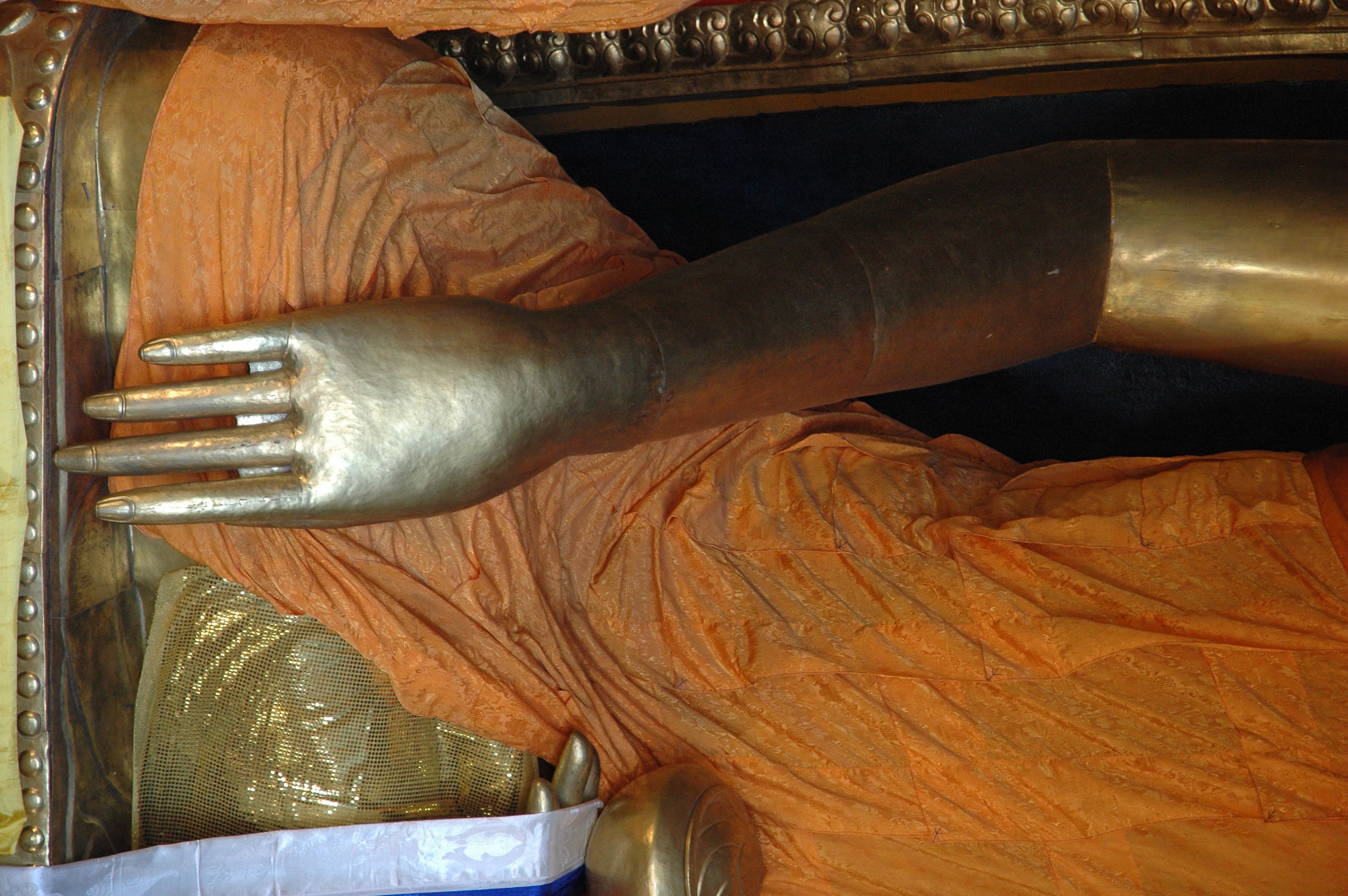
Touch the Earth Mudra
According to a Buddhist legend, on the night of Enlightenment Prince Siddhartha encountered Mara, the Lord of Death, who threw various hindrances the Buddha’s way to prevent him from attaining Supreme Enlightenment. The final challenge was Mara’s claim that the Buddha had no right to be in the seat of Enlightenment. The Buddha then touched the earth with his right hand to call Her as a witness of his past spiritual achievements and his right to gain Enlightenment.
Mary, Mary, quite contrary, how does your garden grow? With silver bells and cockle shells, and pretty little maids all in a row.
From the beginning of horticulture about 8000 BCE or earlier to the present day, weeding has been women’s work. Women, who were the gatherers and preparers of food in traditional nomadic societies, no doubt were the first to discover that seeds dropped at a campsite one year sometimes sprung up as plants the next year. When this discovery was systematized, agriculture was invented, and human beings began to settle down in the first villages and towns.
In the early days of horticulture (the name for the earliest stage of agriculture before the plow was developed), the cycles of planting and harvest and all the stages in between were understood to have been given to mothers by the Great Mother, the Source of Life. The secrets of planting, seed collection, harvest, and food preparation and preservation were all perceived to be “mysteries” connected to the ongoing cycles of birth, death, and regeneration in the universe.
My grandmother Lena Marie Searing who was born on a farm in Michigan must have learned agricultural secrets from her mother, for she not only created a beautiful garden, she also farmed an orchard and preserved its fruits in glass jars that lined her pantry. It was she who taught me and my brothers and cousins to love nature. My mother learned to garden from her mother, but she did not harvest food crops. I think of both of them whenever I work in my garden.
The past few days I have been weeding my garden after heavy rains that left the soil clumpy and moist. I have weeded before, but I have never enjoyed it so much. My garden has matured over the past seven years, and now the weeds are more “under control.” There aren’t so many of them, and as I have now been weeding them out over the years, their roots are shallow.
As I slide a trowel into the earth the weeds lift up and with my fingers I gently pull the plants with their roots from the soil. The weeds are familiar, though I don’t know all of their names. The “sticky weed” has many tough roots, the clover has many fine ones—both are hard to eradicate. Other weeds are easy to pull up and do not reappear again until the next year.
wild chamomile blooming among “weeds”
I am discovering that weeding is a delicate process. Sometimes the roots of plants I want in the garden are entangled with those of the weeds. I work carefully choosing the ones to save and the ones to discard.** I leave poppies, chamomile, yellow daisies, and marigolds where I find them, as I consider them to be wildflowers that will provide beauty in my garden when they bloom in spring. I also take care to “keep the soil in good heart” by not discarding too much of it along with the weeds.
As I weed, I think of the women in my village who harvest greens from the fields, feeling certain that some of the weeds I discard are edible. I marvel at all of the knowledge women have shared and passed down over the past 10,000 years and more, as I realize how little of it I know. My suspicion that some of my weeds could be food is validated when a friend and I order boiled “greens from the mountains” for lunch at a local taverna and are served one of the plants I had thrown into the garbage can.
As I weed, I am reminded of an essay called “Keeping the Soil in Good Heart: Women Weeders, the Environment, and Ecofeminism” by Candice Bradley which was published in Karen J. Warren’s Ecofeminism. Bradley writes that weeding is women’s work in almost all cultures. As I work, I understand that this is so because weeding is delicate work that requires concentration and patience and that must be repeated. Bradley says that in many cultures men disparage weeding as they disparage housework—not considering either to be “real” work.
Horticulture is the most environmentally friendly form of farming, according to Bradley, because it does the least harm to the soil, and because the weeds that are not eaten are burned or composted and turned back into the earth to replenish it.
While weeding by hand has been considered work for women and children, men have generally controlled the plow and its recent successor, the tractor. However, as Bradly states, the plow and the tractor do not eliminate the need for hand-weeding. In many cases they encourage the weeds to regenerate. Women and children still weed.
The chemical gardening and farming industry (“round it up”) is based on the premise that weeds can and must be eradicated. Rachel Carson warned us of the danger this approach to agriculture presents to human and all other forms of life. A by-product of chemical agriculture is that the careful work of women weeders is further discounted.
I do not use chemicals or pesticides in my garden, and I will be out there weeding on a regular basis in the next months. As I put my hands in the earth, I will think of all the women before me who have weeded and planted, weeded and harvested, and weeded again. Blessed be.
*The title of this essay is an homage to Elizabeth Wayland Barber’s Women’s Work: The First 20,000 Years which discusses and celebrates women and weaving.
**I am aware that no plant was born a “weed” and that the designation of some plants as weeds is a by-product of human digestive systems, human taste, agriculture, and the creation of gardens for the celebration of beauty.
A rabbi known as Jesus of Nazareth taught that you should “love God with all your heart and your neighbor as yourself.” Charles Hartshorne, philosopher of relationship and a twentieth century advocate of the “two great commandments,” added that it should be understood that this means that God wants you to love yourself too.
I am grateful to the founders of Feminism and Religion for creating a community of which I am part. I am also grateful to them for introducing me to web skills, including how to create a hyperlink, add photographs to a text, choose search terms, and design a web page. These skills served me well when it came time to design a new website for the Goddess Pilgrimage to Crete.
When I mentioned to a friend that I was looking for someone to design our new website, she responded, “If you want it to represent your vision, you need to do it yourself.” Later, when one of my colleagues suggested an idea for the website that was definitely not part of my vision, I realized that I could not give the job to anyone else. Still, I didn’t think I had the skills to create a website myself. Continue reading “Yes me! Creating a Website for the Goddess Pilgrimage to Crete by Carol P. Christ”
A few weeks ago, after delivering a sermon, a young woman approached me and said she had a question about my sermon. I of course braced myself for the question as I ran my sermon back over in my head trying to remember what I could have said that might have troubled her in some way. As it turned out, hers was a rather thoughtful question, reflective of an insightful theological observation. She said she noticed as I preached that I never used a pronoun for God. She asked if this was intentional. She went on to say that by not using a pronoun for god I forced her to try to image “the way god is, not the way god looks.” I complemented the young woman for her keen observation and astute theological insight. I responded that my avoidance of pronouns when speaking about god was in fact intentional. I explained to her that given the limitations of our finite language in trying to speak of a god who is infinite, that not only are we better served, but perhaps god is also better served when we avoid pronouns, or even nouns when speaking about god. Why, because we should try to speak about god the way in which god speaks to us. And so this begs the question: How it is that god speaks?
The god in which I have faith does not speak to us as a static being. Rather, god speaks to us as a dynamic, restless force in our world. This, for me, is what god’s revelation in Jesus is all about. The gospel of John tells us that in the beginning was the word and the word was with god, the word was god and the word became flesh. Inasmuch as Jesus is the incarnate word of god speaking to us, then for us to speak about god the way in which god speaks is for us to enflesh that very word that became flesh for us. What then does this mean? How are we to speak about god? Continue reading “How is it That God Speaks? by Kelly Brown Douglas”
In a provocative essay and heart-breaking painting, Angela Yarber asked us to consider who Jephthah’s daughter is in our time. Angela reminded us that Jephthah was a heroic warrior in the Hebrew Bible who swore in the heat of battle that if his people won, he would sacrifice the first person he would see on returning home. That person turned out to be his unnamed daughter.
Reading Angela’s post and looking at her holy woman icon of Jephthah’s daughter, my mind turned to the story of Agamemnon’s daughter. In this case, the daughter is named: Iphigenia. Agamemnon had gathered his troops to sail to Troy, but lack of wind prevented them from setting off. According to the myth, Agamemnon was told by the Goddess Artemis that he must sacrifice his daughter if the ships were to sail. He did.


 In recent years monotheism has been attacked as a “totalizing discourse” that justifies the domination of others in the name of a universal truth. In addition, from the Bible to the present day some have used their own definitions of “exclusive monotheism” to disparage the religions of others. Moreover, feminists have come to recognize that monotheism as we know it has been a “male monotheism” that for the most part excludes female symbols and metaphors for God. With all of this going against monotheism, who would want to affirm it?




 Feminism and Religion