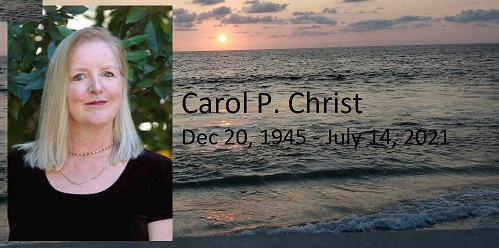
Legacy of Carol P. Christ: What I Celebrate at Christmas

This was originally posted December 28, 2020

Though I have not been Christian for many years, I love to decorate my house for the holidays. I have many decorations that I have collected over the years, including a Hummel angel gazing at the Christ child that was my father’s mother’s and a small crocheted Christmas tree given to me by my mother. My Christmas tree is a living one in a pot, and I usually manage to keep it alive on the balcony or outside for several years. One of my hobbies is collecting ornaments for the tree. Among my favorites are glass icicles and snowflakes crocheted by my friend Alexis many decades ago. There are white doves and brown birds that land on the tree branches and glass balls that have come into the stores again in recent years.

Christmas tree and newly laid carpets

Continue reading “Legacy of Carol P. Christ: What I Celebrate at Christmas”

Deconstructing and Reconstructing Love by Chasity Jones

Note: This is based on a podcast which can be heard here.

“Black love exists and Black women deserve love that does not require pain.”

What is love? What’s love got to do with pain and suffering? Are they related? Pain and love? Must one always be present with the other? In this blogpost I explore pain and suffering through a womanist perspective (centering the perspectives and lived experiences of Black women) and discuss how to live into wholeness and wellness. This is especially important because the Black community/women in particular’s experience in the US (and globally) has been and continues to be defined by pain and suffering. What are the theological implications?

How have Christian frameworks at associating love with sacrifice and pain justified the pain and suffering of Black women? How can we decolonize love so that liberated Black women are empowered to embrace a love that does not hurt first with false promises of rewards later in life or afterlife? Black women, pain does not equal love.

Continue reading “Deconstructing and Reconstructing Love by Chasity Jones”

Legacy of Carol P. Christ: On Believing Things That Are Not True

This was originally posted on August 19, 2019 (when the former guy was President. Although former guy isn’t in power now, Carol’s points are still operative in our world.)

Anyone who is following American politics these days knows that the American President and his acolytes have little respect for what the rest of us consider to be the truth—or at least the best approximation of the truth that we can discern. Last week, while discussing the “lie” of white supremacy that approximately 40% of the American public has bought hook, line, and sinker, I had occasion to reflect again on the relation between traditional religious beliefs and rejection of reason and common sense. As is also well-known the President and his supporters have no respect for factual truth.

Continue reading “Legacy of Carol P. Christ: On Believing Things That Are Not True”

We Endure Abuse to Survive, Part 1 by Karen Tate

I considered myself savvy and educated and an advocate for peace, fairness and equality.  I thought abuse was something that happened to others, not me.  But it was happening to me.  It had happened to me and I didn’t see the danger signs as my life careened off the road.  I became aware abuse and the resulting trauma can happen to anyone.  I came to realize we have to examine all aspects of our lives for both blatant and insidious abuse.  We must recognize it and take steps to eradicate abuse from our lives and society.  That’s where I’ve been on for the last five years and I’m only now able to begin to share that journey.  To write a new book, Normalizing Abuse, and bring my radio show, Voices of the Sacred Feminine, back on the air after a long hiatus.

Part One

If you knew me before my unraveling, you might remember I was the hostess of the Voices of the Sacred Feminine podcast for more than a decade where I had the privilege of interviewing some of the most prominent thought leaders in spirituality, politics and academia. I’d published six books, gave talks at the Parliament of World Religions, the Academy of Religion and various other public and private associations. I had done dozens of interviews and was all over YouTube. I was out there and then gradually I wasn’t. I faded away and became a shadow of my former self.  And for a time I don’t think I cared if I ever came back. I had no motivation or inspiration.  I didn’t open my closet for three years. I didn’t care if I bathed or brushed my teeth. I was dreaming someone was trying to push me into a dark hole in the wall of a building. I’d hear floorboards creaking and feared the foundation of the house I was living in would collapse. I’d wake up with heart palpitations because the latest dream was one where our home had no ceiling or roof. I’d think cars slowly driving by my house were surveillance. 

Continue reading “We Endure Abuse to Survive, Part 1 by Karen Tate”

Carol P. Christ: Weaver of Visions by Beth Bartlett

Author’s Note: Today’s post is the 4000th FAR blog post!  I first became aware of the Feminism and Religion blog when participating in a symposium honoring the life and work of Carol P. Christ in October 2021. I was inspired to write a piece on Christ’s contribution to ecofeminism, that was posted in the FAR blog a year ago today. I wanted to post another piece on Christ on the anniversary of that first post. I’m delighted that it is the 4000th, and so fitting that it is written in honor of Carol Christ, who was such an important part of the FAR blog.

A while ago, a friend asked me what spiritual reading I’d been doing lately. I told him that I’d been revisiting classics from the past. When he asked me who specifically, the first name I mentioned was Carol Christ. Even though he was a minister, he had never heard of her. Sadly, I suspect the same would be true for the vast majority of ministers, priests, rabbis, theologians, and other religious leaders. Yet, I can think of no one who has had a greater influence on my religious and spiritual thought and beliefs.

Continue reading “Carol P. Christ: Weaver of Visions by Beth Bartlett”

Goddess Pilgrimage to Crete – Reborn! by Laura Shannon

Thirty years ago, Carol P. Christ founded her Goddess Pilgrimage to Crete, which she wrote about in her book A Serpentine Path: Mysteries of the Goddess (original 1995 title Odyssey with the Goddess) and in numerous posts on this site over the years. She led over 40 groups of women Pilgrims to encounter the history and sacred sites of the peaceful, egalitarian civilisation of Bronze Age Crete. 

Here, the Goddess-honouring culture of Old Europe survived the longest, when patriarchal Indo-Europeans were taking over in the ‘Kurgan waves’ Marija Gimbutas has described. The sophisticated artworks of ‘Minoan’ Crete show women in positions of honour and authority, and do not depict violence, slavery, or war. People celebrated at ceremonial centres, made offerings at cave and mountain shrines, and worshipped the Goddess in sacred trees and stones.

Snake Goddess, Knossos, Crete, ca. 1600 BCE [photo: Heraklion Archaeological Museum]

As many readers know, before Carol passed away, she asked me to take on the leadership of her Goddess Pilgrimage, and to serve as her literary executor and the director of her Ariadne Institute for the Study of Myth and Ritual. Deeply moved by her trust in me, and guided by very clear dreams I received around the time of her death, I accepted Carol’s request. In October 2022, after a three-year delay due to the pandemic, the Goddess Pilgrimage to Crete was reborn. 

Continue reading “Goddess Pilgrimage to Crete – Reborn! by Laura Shannon”

Legacy of Carol P. Christ:“Ursula Niebuhr, Ursula Niebuhr”: Unacknowledged Co-author of Great Works of Theology?

This was originally posted on August 26, 2019. It fits in with our new project of Unsung Heroines.

A few days ago while watching the movie The Wife, I kept hearing the words “Ursula Niebuhr, Ursula Niebuhr,” in my mind. I knew the reason was Ursula’s unacknowledged collaboration on the work of Reinhold Niebuhr, which I discovered while writing an earlier blog on uncredited co-authors.

I had not been particularly interested in seeing The Wife because I assumed it was the familiar story of the woman who gives up her career interests when she marries. Want to become a rabbi? Marry one. Want to become an artist? Live with him and become his muse. This is a very old story, and for me, not a very interesting one.

Continue reading “Legacy of Carol P. Christ:“Ursula Niebuhr, Ursula Niebuhr”: Unacknowledged Co-author of Great Works of Theology?”

Willful Women, Feminist Killjoys, and Jesus: Reflections on Sara Ahmed’s Living a Feminist Life by Liz Cooledge Jenkins

I’ve been thinking about willful women and feminist killjoys—two main guiding images in feminist scholar Sara Ahmed’s book Living a Feminist Life (Duke University Press 2017).

The idea of the willful woman (or willful girl, or willful person) is something I can easily get behind. The way I understand it, it has to do with women getting in touch with our own wills and being willing to speak and act and live out of our wills. Particularly if these wills turn out to exist in opposition to the things other people might will for us.

It’s about learning to stand up for ourselves, learning to affirm our full humanity in a world that often expects…less. It’s a way of consciously, intentionally being willing to be called “willful” as a negative thing—as in, stubborn, selfish, antagonistic, difficult—because the affirmation of our own wills is worth it.

I like all of this and find it helpful. Be willful. Expect pushback and penalties for it. Be willful anyway.

Continue reading “Willful Women, Feminist Killjoys, and Jesus: Reflections on Sara Ahmed’s Living a Feminist Life by Liz Cooledge Jenkins”

The Problem of Jehosheba: Reading One Biblical Character in Two Different Feminist Ways by Jill Hammer

Tucked away in II Kings 11 is the story of a mother-daughter feud that is personal, political, and ultimately fatal. Jehu, a charismatic military commander, is anointed by Elisha as the next king of the northern kingdom of Israel. Jehu kills the previous king of Israel, Jehoram, and also Jehoram’s mother Jezebel (yes, that Jezebel—the famous/infamous queen). As part of his violent rise to power, Jehu also kills Ahaziah, king of the southern kingdom of Judah. Ahaziah’s death should mean that Athaliah (Atalya), who is queen mother of Judah as well as the daughter of Jezebel, cedes power to a new king and a new queen mother. Instead, according to the Book of Kings, Athaliah has the rest of the king’s sons and grandsons murdered, and seizes the throne for herself. 

All seems lost for the Judean line, except that Jehosheba (Yehosheva), wife of the high priest Jehoiada and sister of the murdered King Ahaziah, saves one of Ahaziah’s sons, along with the child’s wetnurse, and hides them both in the Temple. Jehosehba keeps the boy, Joash, and his nurse in the Temple until he is six years old. At that time, Jehosheba’s husband, the high priest, anoints Joash king, stages a coup, and executes Athaliah as a usurper. Jehosheba’s action saves the Davidic line. The collection of Jewish legends known as Otzar Midrashim lists Jehosheba as one of the righteous women of the Jewish people.

Continue reading “The Problem of Jehosheba: Reading One Biblical Character in Two Different Feminist Ways by Jill Hammer”

Women, Life, Freedom زن زندگی آزادی : Let’s talk about the protests in Iran by Anjeanette LeBoeuf

Trigger Warning: This post deals with violence towards women, violence towards humans, and egregious abuses of power.

Women, Life, Freedom; Zan, Zendegī, Āzādī;  زن زندگی آزادی has become one of the main slogans for an incredibly important and crucial global protest that is taking place right now. For over 2 months, life and death protests are taking place in Iran. The protests are focusing on the perpetual degradation of human rights with women bearing a large brunt. Many have declared the current state affairs as gender apartheid. We need to be talking more about what is happening with the people of Iran and how best to support them. The protests were started after the brutal murder of a woman due to a portion of her hair being visible outside of her hijab.

Continue reading “Women, Life, Freedom زن زندگی آزادی : Let’s talk about the protests in Iran by Anjeanette LeBoeuf”