Masculine: Aggressive/Feminine: Passive: Can We Imagine Alternatives? by Carol P. Christ

Today a couple of friends and I were discussing egalitarian matriarchal values. I stated that in these societies there is no great difference in male and female personalities because both males and females are expected to be as kind and loving and generous as their own mothers. “Oh no I would not want that,” the other woman responded. “I want my man to be masculine–not wishy washy or namby pamby.” This woman soon acknowledged that she did not want her man to be dominant or aggressive. Yet her first reaction was to reject the idea that men might do well to emulate the values of their mothers.

This conversation illustrates the difficulty we have in conceiving alternatives to the way we assign gender roles. Masculine: assertive and aggressive. Feminine: weak and passive.

In fact. being as kind, loving, and generous as mothers in egalitarian matriarchies has nothing to do with these familiar gender binaries. Mothers in egalitarian matriarchies are assertive, but not aggressive, and there is nothing weak or passive about them. Love, kindness, and generosity are not about standing back and letting others walk over you. Instead they are active values that require intelligence, reflection, and strength. Continue reading “Masculine: Aggressive/Feminine: Passive: Can We Imagine Alternatives? by Carol P. Christ”

100 Years After Women’s Right to Vote, Our Feminist Struggle Continues by Gina Messina

The first time I called myself a feminist, I think I was twelve years old. Growing up in a traditional Sicilian Catholic household, misogyny was ever-present. There were clear expectations of me and my brother based on our gender and these ideas were grounded in our religion. I didn’t realize how problematic this was until much later; but by age twelve I was asking questions and knew that it wasn’t fair that my brother could be an altar server and I couldn’t…because I was a girl. 

A few years ago, I experienced a shift in my life. I am not sure how to explain it. Some might call it a midlife crisis; but I’m inclined to define it as an awakening, at least a partial awakening. I won’t foolishly claim that I am suddenly enlightened; however I began to question my own identity as a feminist. Continue reading “100 Years After Women’s Right to Vote, Our Feminist Struggle Continues by Gina Messina”

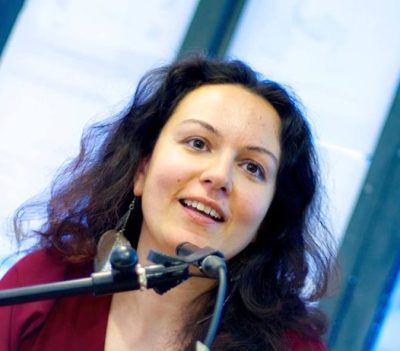
Insights on Sisterhood: An Offering to the Great Goddess by Eirini Delaki

I have been facilitating women’s circles in Europe since 2006. This has involved years of deep, challenging, thankful, and fun teaching and learning. During that time, I have collaborated with different facilitators in the fields of art and spirituality and connected with different cultures, experiences that have reinforced a vision of SISTERHOOD.

Let me clarify that in no manner am I excluding men from these reflections. On the contrary, I believe that many dysfunctional and suffering men have been shaped by women who haven’t managed to stand up for themselves. They harm their children through manipulation while not directly challenging an oppressive system out of fear or a need to feel accepted and to belong.

My students and I are going through an important transition. Most of us come from parents who have spent their lives seeking material possessions, safety, comfort, and success in terms of competition enforced through harsh discipline. Then we moved to the other extreme: we have a reactive attitude towards the previous patterns that is manifested as procrastination, avoidance of tasks that involve responsibility towards ourselves and others, being too permissive, confusing freedom with doing whatever feels right at the moment, and so on. Continue reading “Insights on Sisterhood: An Offering to the Great Goddess by Eirini Delaki”

Matriarchal Politics by Heide Goettner-Abendroth

Today’s blog is a sequel to: “Matriarchies Are Not Just a Reversal of Patriarchies: A Structural Analysis.”

On the basis of modern Matriarchal Studies, we can develop the vision of a new matriarchal, egalitarian form of society. This is called “Matriarchal Politics.”

The path to such a society has to combine matriarchal spirituality with politics, to create another kind of economy and another society. How this can be achieved is clearly portrayed by traditional matriarchal societies. Their economy, politics, social life and spirituality are inseparably connected: their goal is to provide a good life for all and this is assured through their structure and conventions.

Of course, we cannot go back and simply transfer historical patterns to the present.  It is unlikely that we will return to societies based on the blood-relatedness of clans or sole dependence on agriculture. History and its social development cannot be turned backwards. But for our own path into new matriarchal, egalitarian societies, we can gain much stimulation and great insights from patterns which have been tried and tested for millennia. Continue reading “Matriarchal Politics by Heide Goettner-Abendroth”

Call Out Culture vs. Mentor Culture: Which one will save us from the apocalypse? by Trelawney Grenfell-Muir

Have you felt the satisfaction of putting someone in their place? Have you ever felt the rush of power that comes with delivering a cutting set-down? Have you ever felt a glow of pride after making fun of a horrible person or group, and having the people around you laugh appreciatively?

I sure have. In high school, the bully-types in my classes learned not to pick on me to my face, and not to pick on my sister when I was in the room. I got damned good at snide, witty comebacks, and so people stopped messing with me. That kind of success was incredibly rewarding. It was a useful skill I honed over the years, so I could trot it out whenever needed. Rare these days, but my sister still occasionally says, “I’m just glad Trelawney’s in my corner.”

Oh, it feels good to WIN, to experience verbal conquest, and to know I’m justified in using my tongue as a sword, because that person SO deserved it! Ah, the adrenaline, the afterglow, the notch in my belt!

Continue reading “Call Out Culture vs. Mentor Culture: Which one will save us from the apocalypse? by Trelawney Grenfell-Muir”

I’m That Trump Voter You Hate by Trelawney Grenfell-Muir

There are people in my family who believe Christianity to be so inherently oppressive and harmful, that anyone who identifies as Christian is culpable for all of the harm done by all imperial colonization by Christian empires and nations, all harm done to Native Americans, to LGBTQ people, most slavery, racism, genocide, ecocide, and basically almost every problem the world has had for 2000 years.

Theirs is not an unusual view. I encounter this view regularly here in the Northeast US, though most people assign the blame to religion in general. For parts of my family, Christianity is the true evil because it was so popular, and thus the religion most commonly tied to violent and oppressive political leaders and structures.

I also encounter this attitude from feminists, quite frequently. According to many feminists, I am everything that is anti-feminist and misogynist… precisely, solely because I am Christian.

Continue reading “I’m That Trump Voter You Hate by Trelawney Grenfell-Muir”

Scoring the Goals: US Women’s National Team and the Global Growth of Women’s Soccer by Anjeanette LeBoeuf

AnjeanetteIts June and that means Summer Sports. And June 2019 means the Women’s World Cup. The 2019 Women’s World Cup is taking place in France this year and with it means stadiums and pitches (Field) that are high quality. The 2015 World Cup qualifying matches and competition matches were played on unsafe pitches that resulted in some injuries. There are a lot of differences from the 2015 to 2019 World Cups that are a great analogy for the progress of women’s rights, position, and status.

Continue reading “Scoring the Goals: US Women’s National Team and the Global Growth of Women’s Soccer by Anjeanette LeBoeuf”

If Holly Near’s Simply Love Album Were a Musical by Elisabeth Schilling

For many of us, listening to women-loving-women songs is a spiritual experience. That is because somehow it makes us feel seen, puts a sense of hope into our world as well as daydreams of romance. We can understand the challenges and the regret or guilt that comes with disappointing others and ourselves, them for not being who they wanted us to be and for us, not being who we are for far too long. Holly Near’s Simply Love album narrates a story that I might envision as a musical theatre production, and I really wish someone would ask me to write it and then hold the casting call (yeah, I’d want to be in it too, so save me a part). I offer some of my thoughts on two central songs in the would-be musical in hopes of sacred liturgy on a potential stage.

Simply Love has 28 songs and was released (according to Spotify) in 2000. I think the synopsis would be surrounding Cassandra, in a loving relationship with her partner, reflecting on her journey to this place of authenticity. I can imagine how it might be living one’s live in an exploratory way and coming to new revelations later in life.

Continue reading “If Holly Near’s Simply Love Album Were a Musical by Elisabeth Schilling”

Behaalotecha: Lessons and Questions for Feminists by Ivy Helman.

29662350_10155723099993089_8391051315166448776_oThis week’s Torah parshah is Behaalotecha: Numbers 8:1 to 12:16.  By now, much of what comes to pass should sound familiar. The parshah starts with another discussion of leadership and the priesthood.  It then prescribes a second Pesach for those who happened to be ritually unclean for the first one and describes the consequences of not participating in the first Pesach if you had been ritually clean.  Next, the Israelites’ wanderings through the desert are detailed which includes the divine appearing as natural phenomena and the very loud rumblings of the Israelites’ tummies. Finally, the parshah ends with a discussion of Moses’ wife and Miriam’s punishment.

While this Torah parshah contains one of my favorite images of the divine: as a pillar of fire by night and clouds by day, I’ve discussed it many times.  See these posts.  What I want to discuss is the Israelites’ hungry tummies.   Continue reading “Behaalotecha: Lessons and Questions for Feminists by Ivy Helman.”

Re-Imaging Three Marys by Janet Sunderland

The recent #metoo movement, along with young women entering Congress, has pointed to an important question. Why, in this 21st Century, are these achievements remarkable? Why has it taken so long for women to be recognized as capable for these positions? One possible reason is the Christian mythology around women. However, to recreate the way women are viewed, we must re-imagine the women who have been standard-bearers for two thousand years.


Continue reading “Re-Imaging Three Marys by Janet Sunderland”