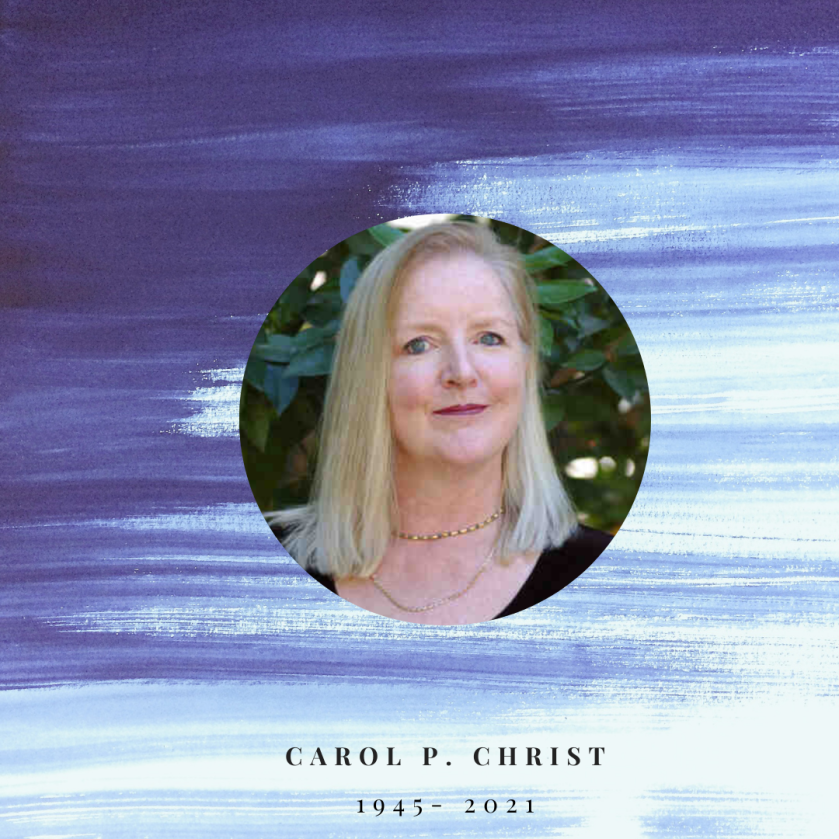
Legacy of Carol P. Christ: Let Us Give Thanks for Feminism and Religion Dot Com

This was originally posted January 6, 2014

Feminism and Religion was founded in the late spring of 2011. Throughout the summer Gina Messina-Dysert hounded me about submitting a blog while I ignored her emails because I didn’t think I wanted to take on a new project.  Gina was persistent nonetheless. Finally I decided that it would be easier to take an excerpt from a book review I had recently written than to explain why I didn’t want to write something for the blog, and so “Exciting New Research on Matriarchal Societies” became my first contribution.

Continue reading “Legacy of Carol P. Christ: Let Us Give Thanks for Feminism and Religion Dot Com”

Legacy of Carol P. Christ: “God is Not a Man, God Is Not a White Man”

This was originally posted February 1, 2016

“The pictures that line the halls speak volumes about the history of racism and sexism and they shape the future in powerful ways.”–Simon Timm

The author of these words recently posted a short video on Youtube entitled “Mirror Mirror on the Wall: The Legacies of Sexism and White Supremacy at Yale Divinity School.”* The video begins with a catchy little ditty with the words, “God is not a man, God is not a white man.” It tracks paintings and photographs of professors and other luminaries in the field of theology on the walls of the Yale Divinity School. By Timm’s count: 99 white males, 6 women, and 3 blacks. The single black woman is counted in both categories.

Continue reading “Legacy of Carol P. Christ: “God is Not a Man, God Is Not a White Man””

For Love of This Life: Carol Christ’s Contribution to Ecofeminist Thought by Elizabeth Ann Bartlett

Journeying with students into the woods to dive deep into our spiritual connections with nature, I would invoke these words from Carol Christ: “There are no hierarchies among beings on earth.  We are different from the swallows who fly in spring, from the many-faceted stones on the beach, from the redwood tree in the forest.  We may have more capacity to shape our lives than other beings, but you and I will never fly with the grace of a swallow, live as long as a redwood tree, nor endure the endless tossing of the sea like a stone.  Each being has its own intrinsic beauty and value….”[i]  How can one listen to these words and not be changed?  Taking in the meaning of these words, paradigm shift happens.  Herein lies the gift of Carol Christ to ecofeminism.

            Ecofeminism posits that the oppression and domination of women, nature, and colonized others are inextricably linked. This is largely due to two aspects of the Western cultural paradigm: 1) mind/body value dualism, and 2) what ecofeminist Karen Warren has called “the logic of domination.” Mind/body value dualism is the creation of an artificial binary of opposites which values everything associated with the mind — spirit, transcendent, men, humans, white-bodied peoples, over everything associated with the body – earth, immanent, women, nature, colonized Others.  The “logic of domination” is the use of this supposed inherent superiority of those associated with the mind to justify their domination of everything associated with the body. As Western culture has spread throughout the world, this value system is now found practically every on earth.

Continue reading “For Love of This Life: Carol Christ’s Contribution to Ecofeminist Thought by Elizabeth Ann Bartlett”

My Life with Goddess (Part One) by Deanne Quarrie

Deanne QuarrieThe Goddess is the “All of Creation.”  She is the Creatress and the Created.  She is the life force of all there is.  She is one, whole, and complete.  Before Her, nothing was. She arose from the Great Void, the source of all potential, giving birth to Herself before anything else had ever been born. She separated the sky and the water, and She danced.  In the ecstasy of Her Dance She conceived of all there is.

In every culture, in every part of the world, the Goddess has been revered as the Birth Giver of all Life.  From the very beginning of time, in our earliest primitive state, we sought to explain the unexplainable by drawing from what we knew.  The female of every species brought forth life; therefore, the Creatrix also had to be Birth Giving Mother and the Great Mother was given Her identity. Continue reading “My Life with Goddess (Part One) by Deanne Quarrie”

Omnipotence: The Ultimate Homage to Male Dominance as Control by Carol P. Christ

The concept of divine omnipotence is the ultimate expression of male dominance as control.  Divine omnipotence is the view that everything that happens in the world happens according to the will of a divinity, who is in control of everything that happens in the world. When someone dies or great suffering occurs, we are told, “everything happens for a purpose,” “it was meant to be,” or “everything happens according to the will of God—or Goddess.” In our recent book Goddess and God in the World, Judith Plaskow and I criticize and reject this view on both rational and moral grounds.

The doctrine of divine omnipotence is widely assumed, not only in Christian theologies, but in Islam and to a lesser extent in Judaism. Moreover, it is also to be found in western metaphysical and mystery traditions and in the many New Age and Goddess theologies based upon them. Thus we not only hear that whatever happens in the world must be “the will of God,” but increasingly that it must be the “will of the Goddess.” Traditional views of divine omnipotence create and fail to resolve the theological conundrums known as “the free will problem” and “the problem of evil.” Continue reading “Omnipotence: The Ultimate Homage to Male Dominance as Control by Carol P. Christ”

Gender in Kabbalah by Judith Laura

Judith LauraI first started delving into both Jewish Kabbalah and Hermetic Qabalah in the 1990s, after friends told me these forms of mysticism included both female and male representations of divinity and therefore were gender equitable. They were right about the first part: Kabbalah/Qabalah contain both divine masculine and feminine imaging and male and female images.  But as far as gender equity goes, to use today’s slang, not so much!
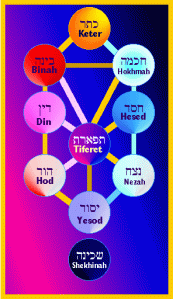
tree of life kabbalah

Though they are both transliterations of the same Hebrew word, as is common I use “Kabbalah” for the Jewish versions, and “Qabalah” for the Hermetic version, best known through its association with the British Hermetic Order of the Golden Dawn, which began in the 19th Century. The word means “that which is received,” with the understanding that it was “received” from ancient times. Though there is one tradition that says Adam was given Kabbalah in the Garden of Eden, the first written material for Kabbalah, Sefir Yetsirah (Book of Creation), is dated to between 200 and 500 C.E. Kabbalistic concepts changed over the centuries, with writings becoming more significant in the 13th century and even more popular in the 16th and 17th centuries.

Beginning with the Sefir Bahir (Bright Book) in late 12th century France, Kabbalah is represented by the Tree of Life, which has round areas transliterated sefirot (Heb. pl.; sing. sefirah) that I think of as fruit and others call “spheres,” but which in the Bahir, are more accurately translated “sapphires.”*  These “divine emanations,” as they are often called in English, are gendered. How equal is the gender representation? Continue reading “Gender in Kabbalah by Judith Laura”

Goddess as Love: From Experience To Thealogy by Carol P. Christ

If theology is rooted in experience, how do we move from experience to theology? In my life there have been a number of key moments of “revelation” that have shaped my thealogy. One of these was the moment of my mother’s death.

In 1991 my mother was diagnosed with cancer. While she was being treated, I realized that I had never loved anyone as much as I loved her. When I wrote that to her, she responded that “this was the nicest letter” she “had ever received” in her life and she invited me to come home to be with her and my Dad.

My mother died only a few weeks after I arrived, in her own bed as she wished. She was on an oxygen machine, and I heard her call out in the dark of early morning. When my Dad got to the room, he tried to turn up the oxygen, but it didn’t help. Then he called the doctor who reminded him that my mother did not want to go to the hospital under any circumstances.

My Dad then sat by my mother’s bed and held her hand.  As my mother died, I felt that the room was” filled with love.” I sensed that my mother was “going to love.” Continue reading “Goddess as Love: From Experience To Thealogy by Carol P. Christ”

A Room of One’s Own: Sacred Women’s Space by Amy Levin

I normally don’t get too personal in my blog posts. I figure if I’m going to take up space on the blog I might as well offer up something other than me, my voice, my body, and instead some good old fashioned commentary on those categories of feminism and religion “out there.”

I’ve been thinking a lot about sacred space over the past year (occupy wall street, Durkheim, the public sphere, Park51) and only recently have I begun to really think about personal sacred space. This week, I haven’t been able to avoid it. My long-time boyfriend and I recently broke up not-so-amicably. In the past few days he has contacted all of my friends and relatives in order to say “goodbye.” I began receiving a swarm of confused questions from close friends, who informed me of the texts, messages, and phone calls they were receiving. While I won’t dwell on the details, as you can imagine, these acts have intruded on my mental and physical space to the point where space in my immediate world has been temporarily possessed by someone else. As dated as first wave feminism is, Virginia Woolf’s salient message in A Room of One’s Own is exactly what I need. I realize that though my affective, physical, emotional, and mental spaces are conjoined and cajoled by my cultural and material surroundings, it’s vital that I feel that, in some way, these spaces are mine. This is what agency is for me. And I would call it sacred. Continue reading “A Room of One’s Own: Sacred Women’s Space by Amy Levin”