

This pretty planet
Spinning through space
You’re a garden, you’re a harbor
You’re a holy place.
Tom Chapin
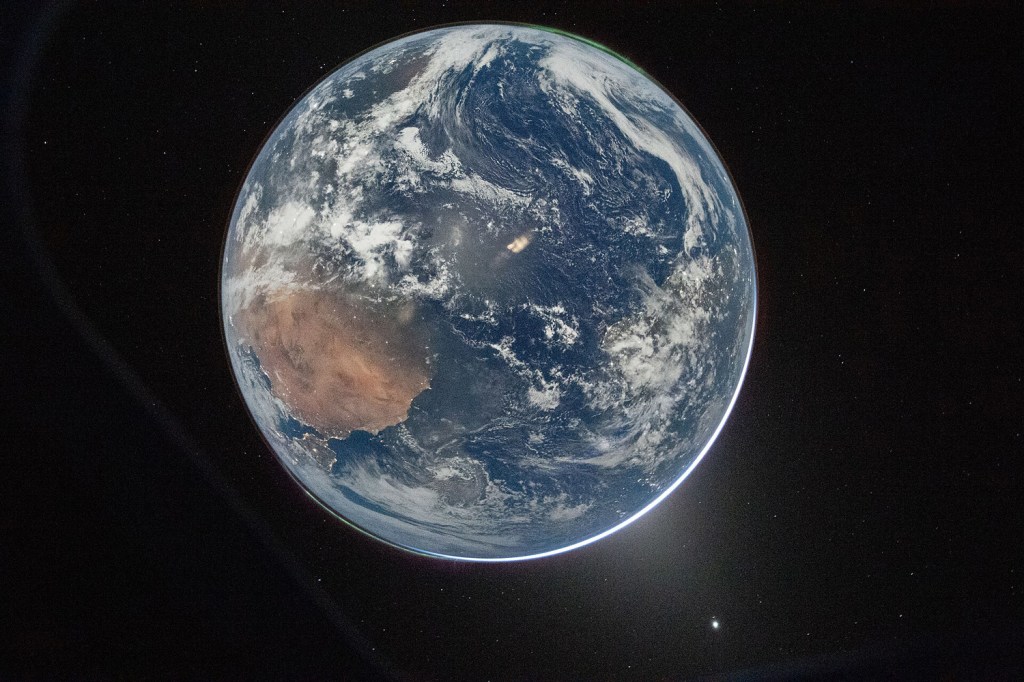
A few weeks ago, NASA successfully launched the second in its Artemis series of rockets. Appropriately named for the Greek Goddess of the Hunt and the Moon, the Artemis mission has the moon as its focus. The first rocket in the series, Artemis I, orbited the moon without a crew. The second, Artemis II, carried a crew of four astronauts to the moon and beyond — the farthest from the Earth that humans have ever traveled – so it’s fitting in more ways than one that it is so named since Artemis was known for her ability to rise to a challenge and aim for a distant target with keen accuracy.
In her masterpiece, A Chorus of Stones, ecofeminist Susan Griffin traced our trajectory to the moon through the intimate interweaving of flight and its uses in war — from the delegates to the Second International Peace Conference overturning of the prohibition against dropping projectiles from flying machines that had been adopted previously at the First International Peace Conference to the research and funding for the development of the V-1 and V-2 rockets at the Nazi Peenemünde Army Research Center during WWII and on to ever increasing enhancement of guided missile systems mostly for purposes of war. Those early days of flight generated an enthrallment with technology that continues to this day, and that Griffin found alarming. In the poetry and scientific writings of the early days of flight she found an expressed desire to escape the limitations of the earth and feared our ever-increasing exploration of space beyond the Earth would lead to Earth’s abandonment altogether.[i] Indeed, the ultimate mission of the Artemis program is to establish a colony on the moon, and talk has swirled in popular culture about the need to establish colonies on Mars should Earth become uninhabitable due to climate change or nuclear annihilation.
Continue reading “Artemis (II) by Beth Bartlett”
