

This pretty planet
Spinning through space
You’re a garden, you’re a harbor
You’re a holy place.
Tom Chapin
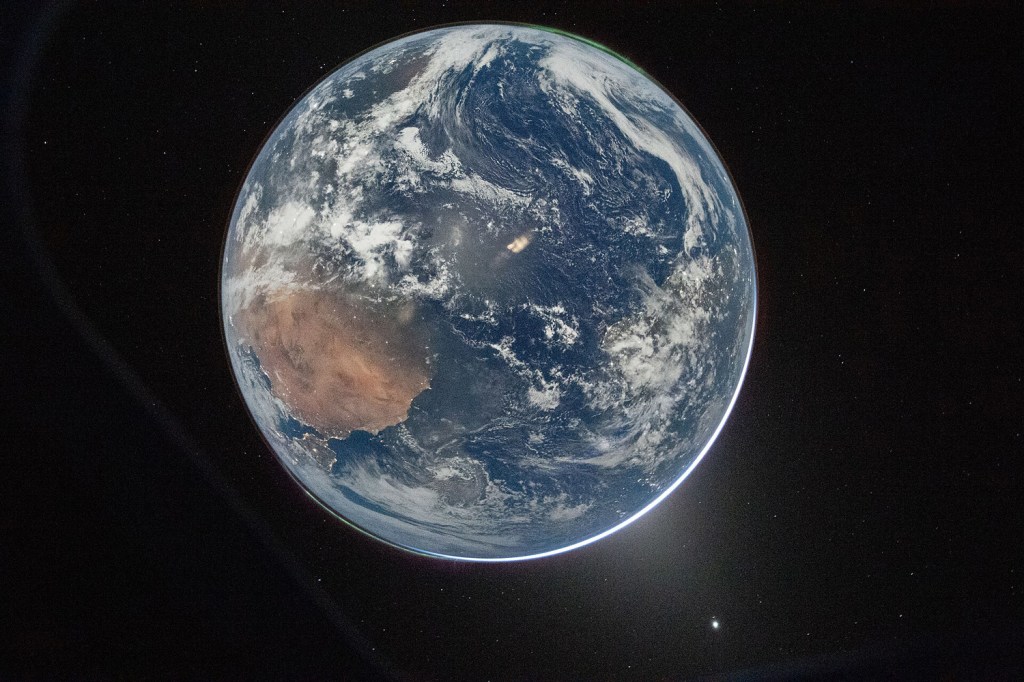
A few weeks ago, NASA successfully launched the second in its Artemis series of rockets. Appropriately named for the Greek Goddess of the Hunt and the Moon, the Artemis mission has the moon as its focus. The first rocket in the series, Artemis I, orbited the moon without a crew. The second, Artemis II, carried a crew of four astronauts to the moon and beyond — the farthest from the Earth that humans have ever traveled – so it’s fitting in more ways than one that it is so named since Artemis was known for her ability to rise to a challenge and aim for a distant target with keen accuracy.
In her masterpiece, A Chorus of Stones, ecofeminist Susan Griffin traced our trajectory to the moon through the intimate interweaving of flight and its uses in war — from the delegates to the Second International Peace Conference overturning of the prohibition against dropping projectiles from flying machines that had been adopted previously at the First International Peace Conference to the research and funding for the development of the V-1 and V-2 rockets at the Nazi Peenemünde Army Research Center during WWII and on to ever increasing enhancement of guided missile systems mostly for purposes of war. Those early days of flight generated an enthrallment with technology that continues to this day, and that Griffin found alarming. In the poetry and scientific writings of the early days of flight she found an expressed desire to escape the limitations of the earth and feared our ever-increasing exploration of space beyond the Earth would lead to Earth’s abandonment altogether.[i] Indeed, the ultimate mission of the Artemis program is to establish a colony on the moon, and talk has swirled in popular culture about the need to establish colonies on Mars should Earth become uninhabitable due to climate change or nuclear annihilation.
However, the perspective the Artemis II astronauts shared from that great distance is not what Griffin had feared — an abandonment of Earth – but rather its embrace. Their view of the Earth provided them with an even greater recognition and appreciation of its preciousness. As astronaut Jeremy Hansen said upon his return to Earth, his distance from the Earth only strengthened his view “that we live on a fragile planet in the vacuum, in the void of space. We know this from science. We’re very fortunate to live on planet Earth.”[ii] Fellow astronaut, Christina Koch, echoed Hansen’s words, “The moon really is its own unique body in the universe. When we have that perspective and we compare it to our home of the Earth, it just reminds us how much we have in common. Everything we need, the Earth provides, and that, in and of itself, is somewhat of a miracle.”[iii] Her words reminded me of the opening lines of the Haudenosaunee Thanksgiving Address, “The Words That Come Before All Else” — “We are thankful to our Mother the Earth, for she gives us everything that we need for life.”[iv]
In such appreciation of and gratitude toward the Earth, Artemis is speaking, for in addition to being the goddess of the moon, she is also the goddess of the wilderness, the protector of wildlife, forests, and mountains, of women and children. She is fierce in her protection and would act swiftly against any who would harm or disrespect those in her care. Hers is the archetypal energy in environmentalists, animal rights activists, tree sitters, water protectors, feminists, social justice seekers, peacemakers. . . .and in those who viewed the Earth from beyond the moon.
Jungian therapist Jean Shinoda Bolen wrote of Artemis that through the lens Artemis provides, “the universe and every element easily become part of a vast oneness; reverence and respect for all nature.”[v] This lens is the same as the one given us through the words and photos and gained wisdom of the winged messengers of Artemis. For despite the fact that as the astronauts ventured into space, on Earth, war was raging, projectiles were being dropped on civilians and oil and gas refineries with wanton destruction of the surrounding soil, air, and waters and the President was threatening to wipe out an entire civilization, from their vantage point from beyond the moon, the Artemis astronauts saw only this vast oneness – one Earth free of all artificial and arbitrary boundaries – and decried the wars and divisions on earth. As the pilot, Victor Glover, said, “ . . . from here you look like one thing: . . . no matter where you’re from or what you look like, we’re all one people.”[vi] Jeremy Hansen added that his journey only confirmed what he had always believed, that “our purpose on the planet as humans is to find joy and lift each other up by creating solutions together, instead of destroying. And when you see it from out here, it doesn’t change it. It just absolutely reaffirms that. It’s almost like seeing living proof of it.”[vii]
…..
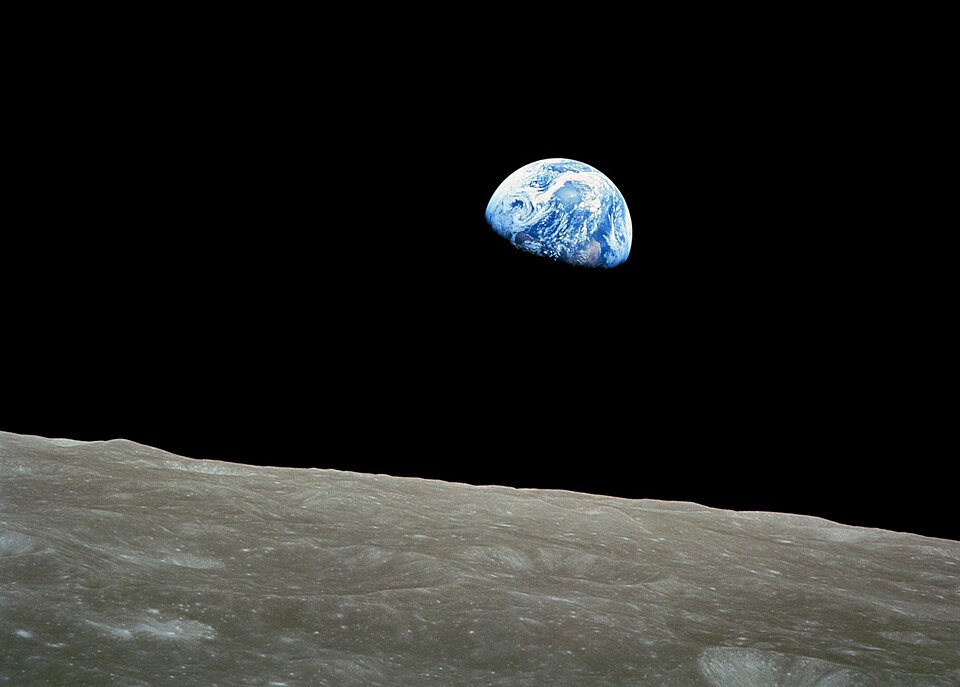
In 1968, the first photo ever taken of the Earth from space by the crew of Apollo 8 as they orbited the moon – “Earthrise” – inspired a world-wide environmental movement and the first Earth Day. My hope is that the astronaut’s words and the exquisite photos of the Earth from beyond the moon that they shared will inspire us with the spirit of Artemis and reinvigorate our efforts to protect Earth, and peace on Earth, in much the same way — informing our lives and our actions to recognize and act upon the awareness of the preciousness of “this pretty planet, spinning through space . . . a holy place.”
References
“Astronauts back on Earth after Splashdown to end moon mission.” Duluth News Tribune, 4/11/26, D8.
Bolen, Jean Shinoda. Artemis: The Indomitable Spirit of Everywoman. San Francisco: Conari Press, 2014.
Forster, John and Tom Chapin. “This Pretty Planet.”Limousine Music Co. & The Last Music Co., 1988.
Griffin, Susan. A Chorus of Stones: The Private Life of War. New York: Anchor Books, 1992.
Kimmerer, Robin Wall. Braiding Sweetgrass: Indigenous Wisdom, Scientific Knowledge, and the Teachings of Plants. Minneapolis: Milkweed Press, 2013.
The 1968 photo that changed the world.
[i] She found this to be especially true of the writings of Filippo Tommaso Marinetti and others in the Futurist movement that arose from a glorification of technology, particularly flight, coupled with an exaltation of war and a loathing of women and feminism.
[ii] “Astronauts back on Earth after Splashdown to end moon mission.” Duluth News Tribune, 4/11/26, D8.
[iii] ‘Just the beginning’: Artemis II crew splashes down after record-breaking moon flyby | Artemis II | The Guardian
[iv] Kimmerer, 108.
[v] Bolen, 121.
[vi] “We’re all one people.” Minnesota Star Tribune. 4/8/26. A4.
[vii] ‘Just the beginning’: Artemis II crew splashes down after record-breaking moon flyby | Artemis II | The Guardian
Discover more from Feminism and Religion
Subscribe to get the latest posts sent to your email.


Thanks, Beth. “From their vantage point from beyond the moon, the Artemis astronauts saw only this vast oneness” “Lifting each other up by creating solutions together” Jeremy Hansen is a Canadian, and all four astronauts were in Ottawa this week at the Museum of Nature, meeting with, and inspiring schoolchildren (who were more interested in their bathroom practices).
LikeLiked by 1 person
Those that EXPERIENCED earth as a precious planet makes sense – BUT recall the PURPOSE of spending this ridiculous amount of money especially while the rest of us are crashing on earth knowingly or not – – As for Artemis there are many interpretations around this goddess and I believe she was used deliberately as a figurehead – in any event she is always associated with the HUNT (patriarchy hides in the wings) – – with the troubles on this planet reaching a screaming pitch while we are enthralled / obsessed with getting into outer space using the moon as our first stop over – what I see is abandonment by most when the going gets rough
LikeLiked by 1 person
Oh, I do understand that Sara. Far better that that money had been spent addressing the problems on Earth.
LikeLike
One of my choirs created a dance for children based on Tom Chapin’s song, “This Pretty Planet.” Making planets out of hula hoops! Also, the song is a wonderful round.
LikeLiked by 1 person
That sounds wonderful. Yes, I’ve sung it as a round, and the recording is of a round. Thanks for sharing.
LikeLike