
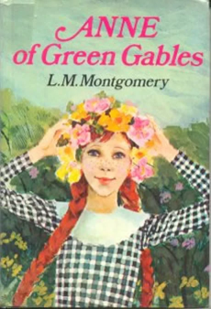
The Creative Divine: L.M. Montgomery’s Anne of Green Gables and Emily of New Moon by Elanur Williams

Montgomery, L. M. Anne of Green Gables. Bantam Books, 1982 edition.

Long before I lived in Montréal, the lands known to the Kanienʼkehá:ka Nation as Tiohtià:ke, Canada lived in my heart. When I moved there as a young adult, the reality beautifully exceeded my imagination; yet in the years before experiencing those landscapes firsthand, they existed for me purely through books. I was an avid reader and an aspiring writer, searching for characters who felt the same strong and sometimes overwhelming pull toward self-expression that I did. I found that mirror in the windswept shores of Prince Edward Island, through L.M. Montgomery’s fiercely imaginative protagonists, Anne Shirley and Emily Byrd Starr. In her Anne of Green Gables and Emily of New Moon books, Montgomery dismantles the rigid, punitive theology of her upbringing and offers a sharp, proto-feminist interrogation of late 19th-century Canadian Presbyterianism. In doing so, she constructs a deeply personal, feminist spirituality that equates creativity and autonomy with the divine.

Continue reading “The Creative Divine: L.M. Montgomery’s Anne of Green Gables and Emily of New Moon by Elanur Williams”

You Are What You Read by Martha Cecilia Ovadia

10298689_10104523891581853_7256973903379376739_nWhen it comes to my family, I’ve always felt different. One of my earliest memories from when I was really young was being told that I felt things too passionately—that I felt too much. What was never said but was implied was that I felt dissent too much, too often, too vocally. It made people uncomfortable. It made my family uncomfortable. When it came to understanding my faith/religious path, my family and I started diverging early on, never really meeting again—at least not for now.

When I was about five, I remember asking why women could not be priests. My mother brushed it aside and said we could be nuns. She was blind to the inherent misogyny behind the same Church that so many of her female family members had built (we come from a long line of nuns and Jesuits). I thought maybe someday I could be a woman priest. I would change it all. I would be Pope Joan. 

When I was thirteen, I started noticing the wealth involved in the Roman Catholic Church, the opulence of the lived Catholic life. When I asked my parents why the Church did not lead in example and live in poverty using its wealth to actively live the gospel, I was told, “ This wealth is a gift to humanity. It is there for all of us, a patrimony to those who open their hearts.” I wasn’t talking about art, I was talking about the RCC’s gold assets—valued in the billions —but it didn’t matter. I’ve seen my family donate to Church building funds my entire life—buildings that were then sold off to pay for the Church’s offenses later on. Still, I thought if I became more involved, with the “right kind of Catholics”, I would be able to change the Church from within.  Continue reading “You Are What You Read by Martha Cecilia Ovadia”