

Moderator’s Note: This was first posted on June 29, 2018 during the first Trump administration. Unfortunately this post is as timely now as it was then. Joyce passed on June 11, 2025. We miss her terribly. Her wisdom lives on.
As so many of us recoil in horror at the Trump administration’s cruel attempts to enforce an impenetrable border between the U.S. and Mexico, I find myself struggling to understand what he and his supporters mean by “borders,” and why they are so invested in maintaining them. The administration’s vicious immigration policy, recently epitomized in a brief tweet on June 19th, 2018—Juneteenth, the day in 1865 when slaves were finally freed throughout the U.S. at the end of the Civil War—“If you don’t have Borders, you don’t have a Country” has sent me back to Gloria Anzaldúa’s visionary 1987 book, Borderlands/La Frontera: The New Mestiza.
Grounded in her experience as a queer mestiza raised in the Texas/Mexico borderlands, Anzaldúa’s bilingual, cross-genre manifesto argues for the transformative role of the mestiza, no longer “sacrificial goat” but “officiating priestess at the crossroads”:
The work of mestiza consciousness is to break down the subject-object duality that keeps her a prisoner and to show in the flesh and through the images in her work how duality is transcended. The answer to the problem between the white race and the colored, between males and females, lies in healing the split that originates in the very foundation of our lives, our culture, our languages, our thoughts. A massive uprooting of dualistic thinking in the individual and collective consciousness is the beginning of a long struggle, but one that could, in our best hopes, bring us to the end of rape, of violence, of war.
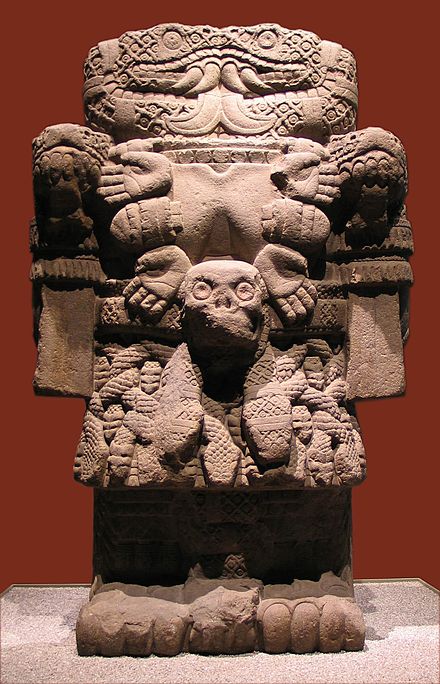
A central image Anzaldúa uses to help uproot the toxic dualism she diagnoses so compellingly is Coatlicue, the ancient Aztec earth goddess who symbolizes “the fusion of opposites,” incorporating “heaven and the underworld, life and death, mobility and immobility, beauty and horror,” and, most importantly, “the eagle and the serpent,” animals that, “like the ocean,” do not “respect borders.”
It is dualistic thinking that creates borders, dualistic thinking that is at the root of the Trump agenda, dualistic thinking that we must work to undo, in ourselves as well as in others. But how?
We must begin, I suppose, by acknowledging the easy comfort we all find in boundaries, of drawing within the lines. “Borders,” Anzaldúa tells us, “are set up to define the places that are safe and unsafe, to distinguish us from them. A border is a dividing line, a narrow strip along a steep edge.” Borderlands, on the contrary, are “vague and undetermined” places “created by the emotional residue of an unnatural boundary”:
The prohibited and forbidden are its inhabitants. Los atravesados live here: the squint-eyed, the perverse, the queer, the troublesome, the mongrel, the mulato, the half-breed, the half dead; in short, those who cross over, pass over, or go through the confines of the “normal.”
Living in the borderlands—whether those between “nations,” “races,” “genders,” “religions,” or “sexualities,” can be uncomfortable, though, as Anzaldúa argues and demonstrates, with respect to gender here, but equally true for nation and race and all the other dualisms:
There is something compelling about being both male and female, about having an entry into both worlds. Contrary to some psychiatric tenets, half and halfs are not suffering from a confusion of sexual identity, or even from a confusion of gender. What we are suffering from is an absolute despot duality that says we are able to be only one or the other. It claims that human nature is limited and cannot evolve into something better. But I, like other queer people, am two in one body, both male and female. I am the embodiment of the hieros gamos: the coming together of opposite qualities within.
Several years ago, I faced within myself the intimate challenge of life in the borderlands. A man I had just started dating, and to whom I was deeply drawn, suddenly announced that he had decided to begin taking hormones, that—at the age of 65, after a lifetime of gender dysphoria—he was ready to transition. Would I join him on the journey? He expected that I would, for, after all, I had spent more than twenty years living as a lesbian, loving women. Surely I would continue to love him as he became the woman he had always felt himself to be.
But I found that I could not, that the categories of “male” and “female” were more rigidly fixed in me than I had realized. For several months I struggled to accept my lover’s transition, still only in the planning stage at that point, trying as hard as I could to visualize a transformation from “he” into “she,” or even “they.” Despite my own bisexuality and theoretical embrace of gender fluidity, I could not, in my body or even in my use of language, come to terms with this challenge to my perception (I had thought him such a “masculine” man!) and sense of self. Ashamed, I abandoned my new friend.
I should have done better. As, of course, should the U.S. and all the other nations and individuals that are currently seeking to enforce national and gender and sexuality and religious and racial boundaries.
But, as Anzaldúa reminds us, we must first honor and acknowledge the challenges we face when we begin to enter the borderlands. And we must have compassion for those who are still too frightened to venture beyond their “safe” spaces. It’s our job, as “priestesses of the crossroads,” to usher them in.
The struggle is inner: Chicano, Indio, American Indian, mojado, mexicano, immigrant Latino, Anglo in power, working class Anglo, Black, Asian—our psyches resemble the bordertowns and are populated by the same people. The struggle has always been inner, and is played out in the outer terrains. Awareness of our situation must come before inner changes, which in turn come before changes in society. Nothing happens in the “real” world unless it first happens in the images in our heads.
In order to transform what is happening at the Mexico/U.S. “border” (and elsewhere) we must first break down the borders within our heads—all the borders in all our heads. Mr. Trump tells us “If you don’t have Borders, you don’t have a Country”; my response today is: “Who needs countries? Who needs genders? Who needs races or competing religions? What we need is Coatlicue.”
Joyce Zonana is the author of a memoir, Dream Homes: From Cairo to Katrina, An Exile’s Journey. After participating in Carol Christ’s Goddess Pilgrimage to Crete in 1997, she served for a time as Co-Director of the Ariadne Institute for the Study of Myth and Ritual. She taught writing and literature at Borough of Manhattan Community College and is currently completing a translation from the French of Henri Bosco’s Malicroix, a novel set in the Camargue.
Discover more from Feminism and Religion
Subscribe to get the latest posts sent to your email.

