

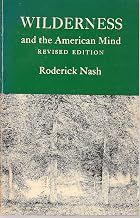
Yesterday I reviewed the book Noah’s Garden. My purpose has been to look at stops along the way of patriarchal influence. Where did these inherited values come from? Wilderness and the American Mind is another book I read many years ago which has stayed with me. It was first published in 1967. A quick check shows that the book has been revised at least five times. I read the first revised edition in 1974.
Nash lays out his primary point in his preface where he says, “Today’s wild country enjoys widespread popularity: indeed the success of wilderness preservation is now threatened as much from a plethora of enthusiastic visitors as from economic development. Yet, for most of their history, Americans regarded wilderness as a physical and moral wasteland fit only for conquest and fructification in the name of progress, civilization, and Christianity.”
Harsh, I know, but true. This is a legacy that continues to influence our society, our minds, and our values. It could be said that this is now especially true with the current administration seeking to sell off as many national landscapes to their wealthy compatriots as possible.
The European settlers may have come here looking for something new amid the restrictions of their homelands, but they were not looking to change their own foundational beliefs. In other words, they didn’t come seeking to learn from the new lands and the people within. They came with already entrenched biases. Biases which still resonate strongly.
“The Europeans knew the uninhabited forest as an important part of their folklore and mythology. Its dark, mysterious qualities made it a setting in which the prescientific imagination could place a swarm of demons and spirits.” [8]
Judeo-Christian tradition was another powerful and formative influence. Nash notes that “the authors of the Bible gave wilderness a central position in their accounts both as a descriptive aid and as a symbolic concept. The term occurs 245 times in the Old Testament, Revised Standard Edition and thirty-five in the New. In addition there are several hundred uses of terms such as ‘desert’ and ‘waste’ with the same essential significance as ‘wilderness.’” [13]
He goes on to say “The story of the Garden and its loss embedded into Western thought the idea that wilderness and paradise were both physical and spiritual opposites.” [15]
Western thought on this is all over the map. Wilderness has also been seen as a place where one can go for “spiritual catharsis . .refuge . . .and spiritual purity.” [17-18]
Confusion reigns with opposing beliefs swinging between the wilderness as a raw resource to be tamed and commercialized living alongside the idea of a romantic setting where revelation was possible and where “the noble savage” lived. Both these visions are cliches and filled with tensions that remain unsolved. They give rise to often incoherent policies.
What I found to be one of the most fascinating episodes that Nash discusses is the creation of Yellowstone National Park. It was established in 1872 and signed into existence by Ulysses S. Grant. Nash connects the ideas behind the founding of Yellowstone with the preservation of parts of the Adirondacks in NY which occurred 13 years later.
He writes, “Yellowstone’s initial advocates were not concerned with wilderness; they acted to prevent private acquisition and exploitation of geysers, hot springs, waterfalls and similar curiosities. In New York, the decisive argument concerned the necessity of forested land for an adequate water supply. In both places wilderness was preserved unintentionally.” [108]
In both cases, politics flew fast and furious. For example, there were the railroad interests which “hoped that Yellowstone would become a popular national vacation mecca like Niagara Falls or Saratoga Springs which resulting profit to the only transportation line serving it. A wilderness was the last thing they wanted.” [111]
The formation of Yellowstone as a national park remained controversial, “Supporters of the bill assured their colleagues that the Yellowstone country was too high and too cold to be cultivated; consequently, its reservation would do ‘no harm to the material interests of the people.’ The strategy was not to justify the park positively as a wilderness, but to demonstrate its uselessness to civilization.” [112]
Even the public wasn’t that excited. “The initial public reaction to the creation of Yellowstone National Park also ignored wilderness. It was praised as a ‘museum’ and ‘marvellous valley,’ an area where people could see the ‘freaks and phenomena of Nature’ along with ‘wonderful natural curiosities.’” [113]
What I find fascinating to think about is the line that can be drawn from biblical passages through to to the European beliefs and onto the imposition of those beliefs. This was/is a belief system that gives permission to remove and/or kill the native population and “conquer” the land in order to bend it their concept of what it means to be “productive.”
When I think of Carol P. Christ’s definition of patriarchy – the intersection of private property, war, and the control of women’s bodies I can see all the seeds in our country’s founding.
She wrote here on FAR: Patriarchy is a system of male dominance, rooted in the ethos of war which legitimates violence, sanctified by religious symbols, in which men dominate women through the control of female sexuality, with the intent of passing property to male heirs, and in which men who are heroes of war are told to kill men, and are permitted to rape women, to seize land and treasures, to exploit resources, and to own or otherwise dominate conquered people
I would add that it not patriarchy isn’t only interested in the fertility of women’s sexuality but of the fecundity of the Earth itself. Eco-feminism in practice!
These two books, yesterday’s Noah’s Garden and today’s Wilderness and the American Mind, illuminate the strains of thought behind our country’s values – control of the Earth. It has many tentacles from controlling women’s bodies along with demanding standards of beauty for both women and the Earth. Men, too.
Private property is another of those structures that gives permission for destruction as it both carves up the land and creates barren soil. If a billionaire wishes to cut down all the trees, if a mine owner wishes to cut off the top of a mountain, if privileged people wish to take over land that they claim is not being utilized, there are few guardrails. In my neighborhood, in some seasons, it is almost impossible to walk our dog among all the lawn signs that announce pesticide, herbicide, other-cides that have been applied. In this, private property is also proving to be a patriarchal tool. As my neighbors blithely go about spreading chemicals, I reflect on the concept of how “I own it, I can do what I want” reinforces a separation from each other, from the community as a whole and from the ecosystems of the Earth.
After reading these two books, I am ever more convinced that patriarchy’s original sin was to separate humanity from the Earth. From there flowed all the rest – war, control of the land, and deep seated desire to goven female sexuality. And today haven’t we all have grown so separate and at such deep odds with each other?
Part of the success of Earth as a living planet is that She has numerous eco-systems that intertwine with each other. If we feel our connections to the Earth deeply enough, we recognize that it is the same with we human beings: differences of culture, language skin color, are all a valued and diverse tapestry. Each culture is an individual eco-system of diversity adding to the collective whole. But when our roots are cut and separated we ourselves are cut off. From the Earth, from each other and ultimately from ourselves. The “curse” I see in the Garden of Eden isn’t the eating of the fruit, it is the destruction of the World Tree itself.
Discover more from Feminism and Religion
Subscribe to get the latest posts sent to your email.


