

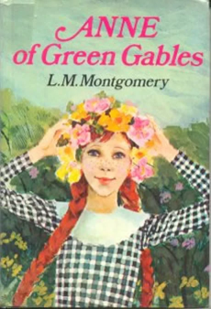
Long before I lived in Montréal, the lands known to the Kanienʼkehá:ka Nation as Tiohtià:ke, Canada lived in my heart. When I moved there as a young adult, the reality beautifully exceeded my imagination; yet in the years before experiencing those landscapes firsthand, they existed for me purely through books. I was an avid reader and an aspiring writer, searching for characters who felt the same strong and sometimes overwhelming pull toward self-expression that I did. I found that mirror in the windswept shores of Prince Edward Island, through L.M. Montgomery’s fiercely imaginative protagonists, Anne Shirley and Emily Byrd Starr. In her Anne of Green Gables and Emily of New Moon books, Montgomery dismantles the rigid, punitive theology of her upbringing and offers a sharp, proto-feminist interrogation of late 19th-century Canadian Presbyterianism. In doing so, she constructs a deeply personal, feminist spirituality that equates creativity and autonomy with the divine.
Anne Shirley and Prayer as Feeling
In Anne of Green Gables, the religious landscape of Avonlea is governed by a dogmatic, austere theology that prioritizes duty and decorum, a worldview that is guarded by the community’s matriarchs, Marilla Cuthbert and Rachel Lynde. When Anne arrives at Green Gables, Marilla demands a bedside prayer, yet Anne’s spirit resists. She looks out the window at the blossoming cherry trees and declares that a proper prayer should involve going out into a field, looking up into the sky, and just feeling. Anne’s spirituality is fundamentally relational, and by seeking the divine in nature, Anne claims the right to define her own relationship with the sacred. Her imagination becomes a tool of spiritual resistance, transforming Avonlea into a vibrant space of joy and beauty. I, too, found my faith outside the bounds of traditional dogma. Growing up in a religiously pluralist home, I was free to explore many different faiths and embraced how there are many ways to understand the universe and our place in it. Yet, like Anne, I discovered that I felt closest to a higher power through emotional intensity, friendships, and immersive experiences in the natural world.
Emily Starr and The Divine “Flash”
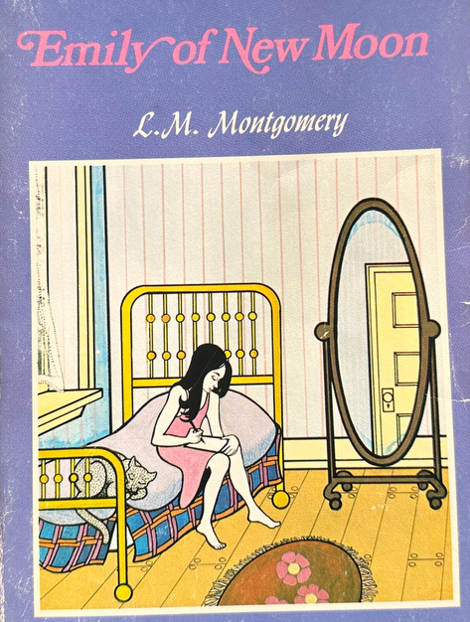
I find Emily Starr’s conflict with traditional religion in Emily of New Moon to be sharper and more explicitly feminist. Emily is raised by the proud, conservative Murrays of New Moon, who embody a rigid brand of Presbyterianism that demands conformity. For the Murrays, a woman’s destiny is entirely domestic, and any deviation is viewed as a dangerous moral failing, to which Emily’s primary defiance is her identity as a writer. She possesses what she calls the “flash,” a fleeting moment of transcendent, spiritual ecstasy that fuels her creativity. Emily experiences this as a divine gift: “It was a wonderful thing… it seemed to open a door in the air and show her a glimpse of another world—a world of breathtaking beauty and satisfying perfection.”
However, the patriarchal structures around her seek to suppress this gift. Her writing is mocked and labeled as an idle, ungodly vanity. Yet, by framing Emily’s creative drive as a spiritual calling, Montgomery makes a radical theological statement: a woman’s intellect and artistic ambition are not sinful deviations from her “natural” role but are instead direct expressions of the divine image within.
Dismantling the Domestic Fate
In the late 1800s, the church heavily reinforced the “Cult of True Womanhood,” which restricted a woman’s spiritual and social value to the domestic sphere. Both Anne and Emily fiercely reject these limitations. Anne pursues higher education at Queen’s Academy, proving herself the intellectual equal (and often superior) of her male peers. Emily explicitly rejects the traditional path of a compliant marriage if it means sacrificing her autonomy or life as a writer. There’s so much out there written about L. M. Montgomery and her many books; upon rethinking these themes over a century later, I find that her children’s books continue to remind us that the intersection of feminism and faith can be a space of reclamation and unbreakable autonomy.
Sacred Kinship
In both, the subversion of patriarchy extends beyond individual artistic expression into the realm of kinship. The rigid church structures of Prince Edward Island demanded strict adherence to gender binaries and heterosexual destiny. Yet, Montgomery’s worlds are defined by alternative spaces of love and community. Anne’s life not saved by a conventional romantic rescue, but by her placement in an unconventional, non-reproductive household with Marilla and Matthew, and later sustained by her devotion to her “kindred spirits.” These relationships, often intensely emotional friendships between women, are treated by the text as holy. By portraying these non-traditional, queer-coded spaces of intimacy as places of profound grace, Montgomery suggests that the divine thrives within the very relationships and identities the patriarchal church sought to diminish or ignore.
I want to take a moment here and acknowledge the ways in which this sacred kinship is not confined to the 19th-century Maritimes; it continues to adapt and bloom across time and geography. Having lived near Philadelphia as a child and again in my mid-twenties, where I completed my student teaching in North Philadelphia, Philadelphia’s streets are deeply woven into my own story. Anne of West Philly, a modern graphic novel retelling by Ivy Noelle Weir and Myisha Haynes, is one of my absolute favorite reimaginings. By transplanting Anne Shirley into an urban foster care system and setting her story against the backdrop of West Philadelphia’s vibrant, diverse neighborhoods, the adaptation breathes fresh life into Montgomery’s core themes. The “vibrant theology of joy and beauty” Anne brought to Avonlea becomes, in West Philly, a community-driven resilience.
The Complicated Domesticity of Adulthood
For a time, I felt betrayed by Anne’s adulthood. Like many readers, I watched her grow up and felt she was capitulating to the very domesticity she had fiercely resisted as a child. Years later, my own life caught up to that domesticity. I have now been home with my child for almost two years. Inevitably, during this season, my presence in the outer world has narrowed; I am closely tethered to my home, my days entirely defined by caregiving. I rarely have time to write, and when I do, it is in stolen moments. Lacking a desk or a designated workspace, I write on the floor next to the bed of my sleeping child. Yet, I’ve come to realize that this kind of labor is creative, too, another facet of the artist’s way, if we let it be. It is from this vantage point that I re-read Anne’s adult years and begin to see another internal strategy. Could it be that Anne does not surrender to the patriarchy, but instead subverts it from within? In Anne of Windy Poplars and Anne of Ingleside, Montgomery populates Anne’s world with alternative matriarchal networks, like the household at Windy Poplars, run entirely by unconventional women outside the bounds of traditional marriage. Furthermore, as a mother at Ingleside, Anne rejects the punitive, patriarchal parenting of her era, which relied on breaking a child’s will. Instead, she treats her children’s imaginations as sacred.
The Bifurcated Path: Anne’s Nursery vs. Emily’s Alpine Path
The contrast between Montgomery’s heroines in adulthood highlights the diverse strategies of proto-feminist resistance available at the turn of the century. While Anne subverts the domestic sphere from within by altering the theological framework of motherhood, Emily Starr’s trajectory in Emily’s Quest represents a direct, uncompromising battle for artistic autonomy. Emily explicitly rejects the traditional domestic timeline; she does not compromise her writing, and she survives the psychological sabotage of patriarchal figures who attempt to gaslight her out of her creative calling. When Emily burns her first manuscript, her subsequent physical illness serves as a stark theological metaphor: to stifle a woman’s creative divine is a form of spiritual death. If Anne demonstrates how to expand the margins of orthodoxy from the inside, Emily represents the radical act of carving out an entirely autonomous kingdom on the outside.
In Emily Climbs, Emily is presented with an enticing career opportunity: the urban editor Miss Royal offers to whisk her away to New York City to launch her into the literary elite. Culturally and commercially, New York represents the patriarchal “center” of validation and power. Yet, in a fiercely subversive choice, Emily rejects the metropole, choosing to remain at New Moon. Far from a timid retreat into domestic safety, this refusal constitutes a radical rejection of the commercial, male-dominated publishing world. Emily recognizes that her divine “flash” is inextricably tethered to the marginalized, pastoral soil. By claiming her bedroom at New Moon as her ultimate studio, Emily asserts that a woman does not need patriarchal, urban structures to validate her genius. She can enter the literary landscape entirely on her own terms.
Sitting in my own room decades later, trying to carve out my own voice, I am reminded of Emily’s choice.
BIO: Elanur Williams writes from Dublin, Ireland. She holds an MPhil in Children’s Literature and a MS Ed in Literacy Studies. She is a teacher who specializes in reading and writing instruction, as well as a poet whose work has appeared in Eunoia Review, the Ekphrastic Review, Halfway Down the Stairs, and Cosmic Daffodil, among others. Above all, she is inspired daily by her daughter, whose presence imbues her life with joy, magic, and a sense of limitless possibility.
Discover more from Feminism and Religion
Subscribe to get the latest posts sent to your email.


Elanur, I love this! I discovered Anne Shirley and Emily when I was an adult and I delighted by them and in Avonlea. I too felt betrayed when Anne became the “perfect” wife and mother, so thank you for helping me see that Anne was changing the system from the inside out.
I also understand how hard it is to carve out time when one is a caregiver. I’m caring for my elderly mother who lives with me and has Alzheimer’s. It is exhausting and I feel like I’m losing myself at times, but I’m glad I can be there for my mother. Anyway, I’m glad you’re still finding time to write. Blessings
LikeLike
It means a great deal to hear that my piece resonated with you, and I am sending you so much strength and kindness as you navigate life as a caregiver for your mother. Many blessings to you as well
LikeLike
Thank you so much! Blessing, Linda
LikeLike