

In the first post in this series, I paid homage to Carol Christ’s 1978 clarion call “Why Women Need the Goddess,” which explains how the Goddess helps women overcome the profound wounds of patriarchy. And I began laying out my view of the five ways Goddessness can help ALL of us—not only women—to navigate the death-throes of patriarchy we are currently enduring.
My thoughts in these posts are based in Five Directions, a Goddess-centered approach to living that has been refined through my lifetime of writing and research, healing work, teaching, and witchy ritual practice. Whether used in ceremony or as a template for thought, the GoddessCircle starts in the South, direction of the Will, and turns counterclockwise (widdershins), in the feminine direction. Like Sacred Circles in traditional cultures worldwide, the GoddessCircle involves correspondences with many aspects of the world— including the potent ceremonial tool of poetic meters. The GoddessCircle’s Five Directions (South, East, North, West, and Center) and Five Elements (Fire, Air, Earth, Water, and Matrix) hold space for Will, Mind, Body, Heart, and Spirit—honoring all these parts of us equally and guiding us to cultivate the parts we have overlooked or forgotten.
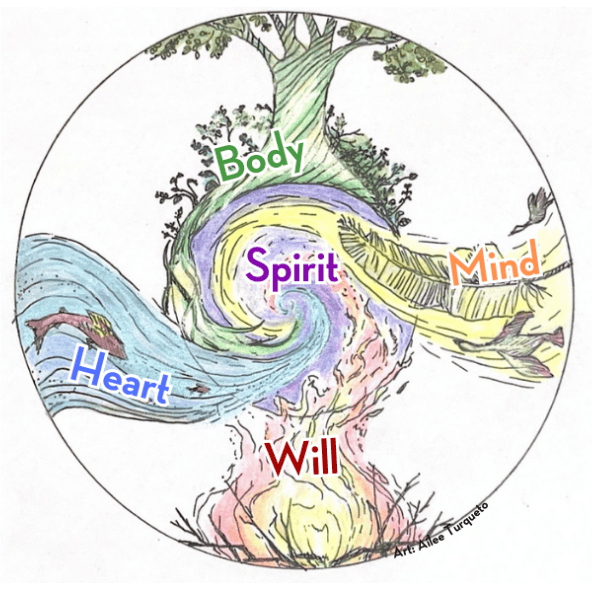
My post about the Will explains the usefulness of the GoddessCircle in rethinking our approach to the Will in these current autocratic times. In this post, I will consider the next Direction in the GoddessCircle: the Direction of Mind. As patriarchy destroys itself, its desperate violence, greed, and domination manipulate Mind more and more for their own ends. Lies become shameless weapons of force; belief and justice are exchanged as bribes and payoffs; deepfakes exploit common sense for abusive control. The overall result is that the trust in reason that underlies our justice system and political contests—the same trust that shone, during the Age of Enlightenment, with the proud hope of humanity emerging from tyranny—is now revealed as thoroughly fragile and vulnerable to corruption. Humans are not Men of Reason after all; in fact, it turns out that machines think far better than we can.
The situation seems desperate. And it is. But — only for patriarchy!
Wonderfully— gloriously—and just as we discovered with the Will– a Goddess-centered approach to Mind can be just what is needed for dealing with the chaos of these unprecedented times. But we will need to approach it carefully, laying aside our fears and prejudices against a part of us that is prone to misunderstanding.
Mind can be especially tricky to reclaim as part of a Goddessful approach to life because patriarchy teaches us to identify with Mind as final authority and judge, to act as if we value its input over that of other parts of ourselves. In poetry only the Iambic meter, Meter of the Mind, is used in the influential poems that our culture considers “great”; other meters (until my students and I began reclaiming them!) were reserved for children’s verse. And Mind is so easily indoctrinated by patriarchal education that our own thoughts can easily betray us. We let Mind judge our Bodies and second-guess our Wills and Hearts; we allow ideas fed us by patriarchy to undermine even the intuitions of our Spirits (in some spiritual circles, the word Mind is even used as a synonym for Spirit). No wonder that some of us on the Goddess path have come to distrust Mind as cold or rigid.
This is a costly mistake. We need all aspects of the GoddessCircle equally for the great work ahead, leading humanity out of the wreckage of patriarchy into sustainable, joyful new ways of living. Mind is a powerful and necessary ally of truth—especially the truth of Goddessness that is so evident to common sense. By discounting Mind, we dilute intellectual standards, weaken communication, and lose objectivity. And even worse, we lose Mind’s help to achieve the goals of our Wills, Bodies, Hearts, and Spirits.
So how can we come to trust our Minds, to make relaxed use of them without falling into patriarchal mind-traps such as rumination (a psychological term for unproductive repetitive thinking)? The key is to remember that the Five Directions—Will, Mind, Body, Heart, and Spirit—are all equally important. Each deserves one-fifth of our trust—20%—and no more. It is only when Mind oversteps its boundaries—when it tries, for example, to overthink or control the Will, criticize or undermine the Body, second-guess the Heart, or exploit the Spirit— that it should be distrusted.
The best way I know to keep an eye on the balance of the Five Directions in any given situation is through a simple counterclockwise check-in. Here’s an example from a workshop I taught recently. A participant I’ll name Summer had inherited some land and had been stuck for months in an agony of self-criticism and self-doubt. When she checked in for the first time with each of the Five Directions equally, she reported that her Will passionately desired to keep the land. Her Mind was ruminating about what could go wrong, telling her over and over that selling it was the only sensible course. Her Body’s survival sense told her that selling it was necessary. Her Heart loved and wanted the land in her life. Her Spirit was inspired to use it for her healing work.
But Summer had not been getting accurate information from all her Five Directions. She had been giving her Mind far more respect and attention than any other part of herself, about 55% instead of its proper 20%. Due to the Mind’s dominance under patriarchy, this is a common pattern. Summer assumed that Mind deserved the vast majority of her respect because it was rational, serious, realistic, objective, and logical, therefore necessary and important; therefore it knew best. Mind took Body’s side, another common dynamic, and Mind and Body ganged up with 75% of Summer’s trust and attention, shrinking Will, Heart, and Spirit and lumping them together as unrealistic, irrational, subjective, trivial, unnecessary, unimportant, and silly (do you catch any gender stereotyping in all these italicized common labels?). Summer found herself at the mercy of Mind’s outsized ruminations, unable to make a clear, informed decision, until she invited all the Five Directions into equally important places in the GoddessCircle.
So how does a Goddessful mind behave? What is Mind like when it is occupying its rightful 20% and no more? Without allying with Will, Body, or Heart, the Mind doesn’t incite fear, anger, desire, or worry. It designs sequences of actions to achieve various intentions, projects the outcomes of various courses of action, perceives the objective reality of stituations, solves problems, and weighs possibilities. And it does all these things without shaming, criticizing, guilt-tripping, or bullying your other parts.. It leaves desire to the Will, instinct to the Body, emotion to the Heart, and intuition to the Spirit.
On its own, in balance along with a fully realized Will, Body, Heart, and Spirit, Goddess Mind is simply about usefulness: peaceful observation, understanding, and problem- solving, doing its own part without attachment to outcome. To imagine Goddess Mind, imagine a matriarchalist Mind that is humble and respectful, offering perceptions, opinions, and proposals as needed, and then stopping. A Goddessful mind offers its perspective to you to combine equally with those of your Will, Body, Heart, and Spirit. Then your thoughts and decisions are yours to create, out of the full scope of your own complete wisdom.
With this Goddessful approach, we can allow Mind to support us with all the good and useful work it is best at while still steering clear of the crazymaking obfuscations of the dying patriarchy. It’s time to trust our own beautiful, Goddessful Minds again. We will need them!
Discover more from Feminism and Religion
Subscribe to get the latest posts sent to your email.


Annie, my Goddessy amazing friend, I Love This!!! and have shared on the divine feminine app (as I do most FAR posts) My mind says I would love for you all to go over there and show some love to the post (no WordPress hoops to jump through). I so get this post! As a former 80% Mind person, I still employ my Mind but over the years have worked hard to get it into balance with my Will, Body, Heart and Spirit! – Caryn
LikeLike
Thank you Caryn! So happy this spoke to you, and I’m excited you will link to it on the wonderful Divine Feminine App!
LikeLike
This approach seems intellectually confusing to me, perhaps because I align myself with the seasons and let them guide me. Of course all of us are different and there is no right way – only many variations on the same basic theme. When you write that ‘Humans are not Men of Reason after all; in fact, it turns out that machines think far better than we can” I feel deeply upset because believing that machines think better than humans do is a lie that it being spread by the collective. This is what the powers that be would like us to believe…. PLEASE let’s not go down that road.
LikeLike
Dear Sara,
I always appreciate your deeply-considered and frank comments, so grounded in the spirituality of nature.
Perhaps in this case, the issue has to do with our definition of “think’ and “reason.” I was using “think” to mean basically a process of pattern-matching, looking for similar cases and putting them together to deduce facts and generalizations. I was using “reason” to mean a way of using thinking to reach or justify certain goals, whether the goals are to buttress an argument or merely to satisfy curiosity. It seems to me, based on my own experience, that AI can clearly now do both of these things as well as humans. And if “better” means faster and/or more thoroughly, it also seems that AI (machines) can do them better than humans.
I do not consider this a threat to humanity. In fact, I consider it a boon to humanity, because it makes clearer and more valuable the aspect of Mind that is unique to human beings: Wisdom. To me, Wisdom is thinking and reasoning that is fueled by passion, informed by knowledge gained from experience, grounded in nature and the body (and as you say, the seasons!), deepened by compassion, and in service to joy. Wisdom is the aspect of Mind that it seems clear machines will never have.
I often post thoughts on FAR that are brand-new and still in process. I’m now thinking I didn’t make these distinctions clear enough above. Because there is no way to go back on FAR and edit, I won’t change anything above–but I will certainly keep your response in mind when I return to these ideas again in later essays or books!
Thanks again for your response, Sara, and I’m curious to hear what you think about this comment also:) –AF
LikeLike
I’m listening to Coyote calls as I read this complex response. I am not sure what i think beyond the belief that AI is dangerous – one antidote to Collective Machine mind is to keep to our personal stories – hard to take over feelings when you are a machine,
LikeLike
Dear Sara,
I always appreciate your deeply-considered and frank comments, so grounded in the spirituality of nature.
Perhaps in this case, the issue has to do with our definition of “think’ and “reason.” I was using “think” to mean basically a process of pattern-matching, looking for similar cases and putting them together to deduce facts and generalizations. I was using “reason” to mean a way of using thinking to reach or justify certain goals, whether the goals are to buttress an argument or merely to satisfy curiosity. It seems to me, based on my own experience, that AI can clearly now do both of these things as well as humans. And if “better” means faster and/or more thoroughly, it also seems that AI (machines) can do them better than humans.
I do not consider this a threat to humanity. In fact, I consider it a boon to humanity, because it makes clearer and more valuable the aspect of Mind that is unique to human beings: Wisdom. To me, Wisdom is thinking and reasoning that is fueled by passion, informed by knowledge gained from experience, grounded in nature and the body (and as you say, the seasons!), deepened by compassion, and in service to joy. Wisdom is the aspect of Mind that it seems clear machines will never have.
I often post thoughts on FAR that are brand-new and still in process. I’m now thinking I didn’t make these distinctions clear enough above. Because there is no way to go back on FAR and edit, I won’t change anything above–but I will certainly keep your response in mind when I return to these ideas again in later essays or books!
Thanks again for your response, Sara, and I’m curious to hear what you think about this comment also:) –AF
LikeLike
And of course, writing words down in the first place is a major disruption of our connection with nature, with the present, with Being….
Please give my love to the coyotes! I am just back from a few months of loon calls…
Ah-oooooooooh!!! Ah-oooo!!!
LikeLike
Your comment “The situation seems desperate. But — only for patriarchy!” made me laugh!
I love what you write about the 20% of attention to each of the directions, and I think especially in education and academia by extension, mind gets 80% or more (resonating with Caryn’s comment above, even coming from a discipline like dance scholarship!). I often draw attention to the the other faculties of mind, including dreaming, intuition, consciousness, not just cognition and analysis which can sometimes feel calculating and cold…
Personally, I work with a slightly different Wisdom Wheel with Heart in the South, Soul in the West, and Spirit in the Centre. Soul is our unique life spark, Spirit is where we are all one. I always see these as maps for the territory of life, not fixed but fluid…
For me “will” however is a fusion of mind, heart and body. In Qi Gong, the will centre sits at the solar plexus, and in a way is a bridge between different centres. That way, it’s seen as a quality that infuses the others, another way to look at it…
I was also very happy to read your comments on AI, something we can collaborate with, with reason, to open up more time for creativity and meaningful connections… I’d love to see more discussion on this!
PS the you can edit your posts if you have access to the WordPress backend where you upload them!
LikeLiked by 1 person
thanks for this richness of ideas! What is the origin of your Wisdom Wheel?
LikeLike
Working in various traditions over the years, the Movement Medicine wheel, it’s ended up as my personal weaving of pagan (explicitly druidry in the OBOD tradition), overlaid with Alberto Villoldo’s conception of soul and spirit as two different layers or directions. It then re-emerged from the ground up as I’m working with modalities of Movement (Air/East), Energy (Fire/South), Archetypes (Soul/West), Nature (Body/North) and Spirit (Centre) the MEANS of Wild Soul. It somehow clicked into its own place listening to the spirit / essence of Wild Soul!
LikeLike
should have said including the MM wheel
LikeLike
Seems as if our wheel/circle is extremely similar except that yours starts the East and goes clockwise, while mine starts in the South and goes widdershins!
LikeLiked by 1 person
Yes! And sometimes it zigzags too… Structure and fluidity….
LikeLike
My Sacred Spiral actually doesn’t zigzag; after a life dedicated to poetic meters, I have learned to value fluidity WITHIN structure–not a common perspective nowadays, I know, especially in the poetry world:) This will actually be the subject of my next blog post, so I will reply more fully there. Thank you dear Eline!
LikeLike