

In the northern hemisphere we have entered the final phase of waxing darkness before the winter solstice, the yearly gift which invites us to rest, renew, and heal. Yet so many of us lead such full and active lives, how do we find time for essential being amid all of our essential doing?
Since Neolithic times at least, women have gathered in sacred circles to sing and dance together. Regular circle dance offers mini-opportunities to rest and renew, as we take time out from our busy daily lives and allow ourselves to be held by the larger circle.
While our bodies move, our minds rest, and our spirits become refreshed. We follow in the footsteps of the ancestors of the human family, connecting with ourselves, each other, and universal themes of life, release and regeneration.
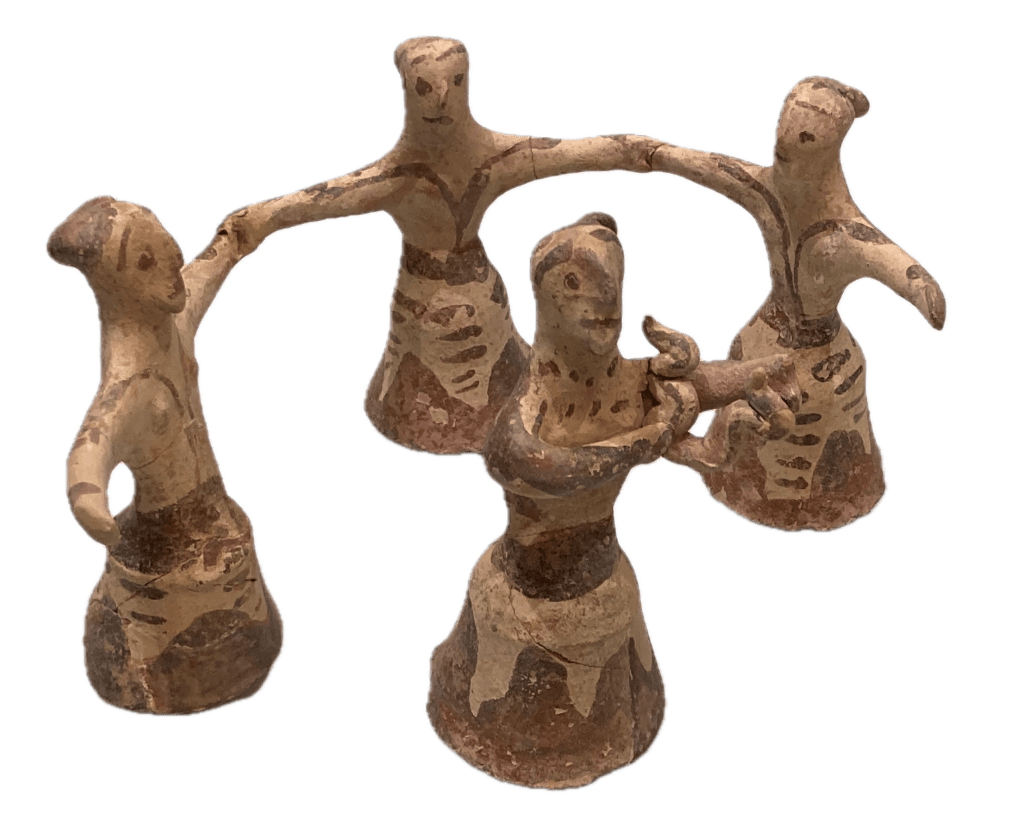
Women’s circle dance. Terracotta, Palaikastro, Crete,
1350–1300 BCE. Heraklion Archaeological Museum, Crete.
Photo: Laura Shannon.
The dance circle has been since ancient times the very embodiment of the loving Mother Earth and Mother Goddess. Ritual dance traditions with roots in the Neolithic era survive today in many places in southeastern Europe and the Near East – the same areas where egalitarian matriarchal civilisations flourished for thousands of years.
This is the region which archaeologist and archaeomythologist Marija Gimbutas called Old Europe, and these peaceful societies are those she describes in her groundbreaking books The Civilisation of the Goddess and The Language of the Goddess.
Heide Göttner-Abendroth and other pioneers in the field of Modern Matriarchal Studies have shed revealing light on egalitarian matriarchies and their worldview based on respect for mothers and the mothering principle. This ethic is embodied in the oldest ritual dances, whose teachings and symbolic language have survived from pre-patriarchal times.
Because of their ancient roots and continuity through time, women’s ritual dances encode skills and spells to help heal the trauma which accompanied the massive, and massively traumatic, civilisational shift from cultures of partnership and peace to social systems based on hierarchy, competition, domination, and denigration.
In our time, circle dance traditions may be disappearing in rural Europe, but they are also being revived or reinvented in spiritual and recreational circles all over the world. The healing the dances offer, especially for women, can go very deep, as they create a safe and sacred space for those who dance them. In a lifetime devoted to researching and teaching traditional women’s ritual circle dances, I have witnessed their therapeutic potential in countless ways.
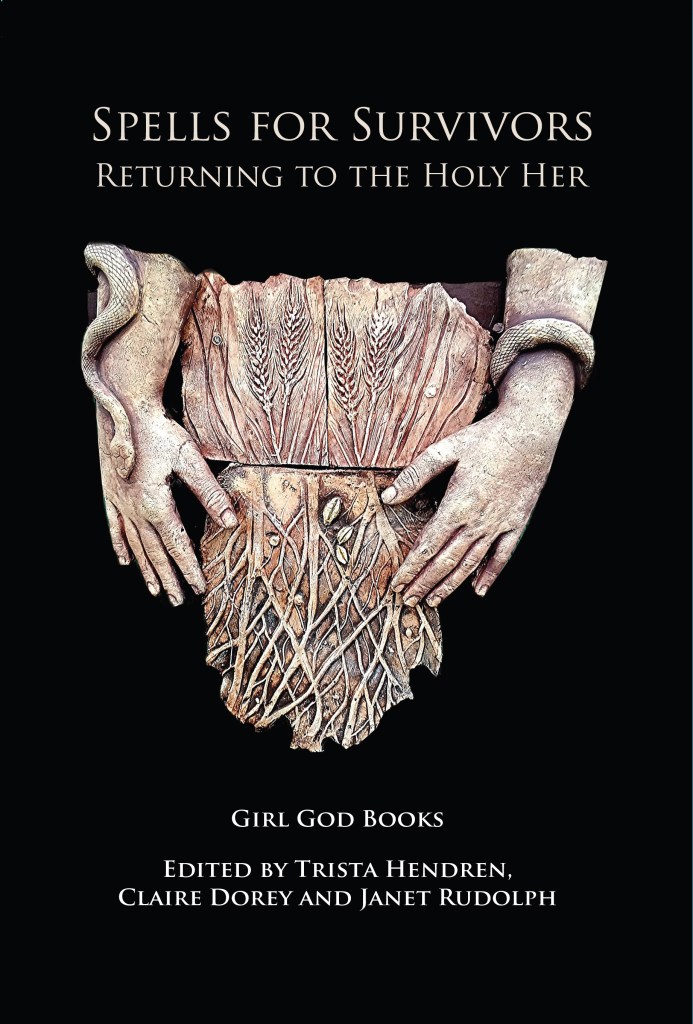
This summer I was asked by editor Trista Hendren to contribute an essay to the new anthology from Girl God Press, Spells for Survivors: Returning to the Holy Her. In the new essay, ‘Women’s Ritual Dances to Heal Somatic Trauma’, I share examples of dances and songs which offer tools for healing, both in their original contexts and for those dancing them today with conscious intent. Here is an excerpt from the essay.
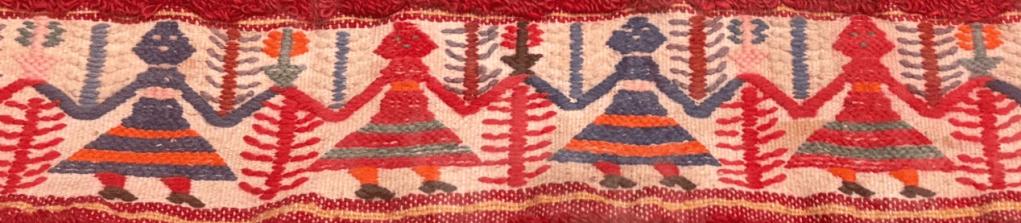
Women’s circle dance. Woven textile from Crete, 19th C.
National Historical Museum of Crete, Heraklion.
Photo: Laura Shannon.
Women’s Ritual Dances to Heal Somatic Trauma
Women’s ritual circle dances from Eastern Europe and the Near East have come to us in an unbroken lineage from Neolithic times, and still survive in many places today.
Dances, songs, tales, and textiles form an unwritten language, transmitting a continuity of meaningful symbol from early archaeological finds to folk art of the present day. Women’s ritual arts encode hidden messages transmitted from the ancient grandmothers, which women today can learn to decipher. Thus we open a portal to a collective memory of indigenous European wisdom, from the time before patriarchy and war.
Women’s ritual dances celebrate seasons of the year and the stages of our lives; the sacred cycle of life, death, and regeneration; and the sanctity of mothers, the Mother Earth, and the mothering principle. These are universal themes, of particular concern to women and girls. A lifetime dedicated to learning, decoding, and passing on these dances in women’s circles all over the world has allowed me to experience firsthand how all communal dancing is inherently therapeutic, and the women’s dances even more so.
Elsewhere I have written about the healing process in circle dance generally and trauma healing particularly, while many other authors have explored the vast topic of healing through communal dance.
Moving in synchrony with others in a circle gives us a sense of belonging, and creates what the HeartMath Institute calls ‘heart-rhythm coherence’, bringing benefits of increased composure, greater energy, clearer thinking, enhanced immune function and hormonal balance. Regular dance maintains heart health, muscle tone, pelvic floor integrity, and general fitness, and helps release emotional and physical tensions, to improve our moods and integrate our feelings. Circle dance is also an effective modality to facilitate trauma healing.
Women’s dances in particular play a significant role in healing somatic and sexual trauma. I suggest their precise combinations of steps, songs, rhythms, and symbols can be seen as healing recipes or magic spells, transmitting tools of survival from pre-patriarchal times. In this essay I share examples of dances, dance songs, costumes, and contexts, to illuminate some ways in which women’s ritual dances help hold and heal trauma.
The regular practice of circle dancing both requires, and builds, a strong and supportive community. Dancing together strengthens dancers’ self-esteem, helps develop leadership skills, and teaches girls from a very young age that they are valuable and worthy of protection. Costume elements emphasise dancers’ sense of self-worth and essential inviolable nature, while Goddess embroideries depict divine female figures in the same stances of stability and strength the women embody in their dancing.
Within the dancing community, women support each other to name and witness trauma with compassion, so it can be held safely in the healing container of the dance. Historical dance songs remember and honour those who suffered rape or assault, and celebrate those who dared to resist and rebel. The dance circle supports women’s recovery from sexual trauma by emphasising prevention and protection, and by manifesting the unconditional love which is seen as the gift of the mother Goddess.
Circle dance began to spread out from the Near East along with the development of agriculture, starting around 9,000 years ago, as Yosef Garfinkel has shown. Circle dance traditions survive best today in southern and eastern Europe – the same area where egalitarian matriarchal civilisations flourished for thousands of years. This region, named Old Europe by archaeologist and archaeomythologist Marija Gimbutas, was the cradle of sophisticated societies which honoured the Goddess, celebrated nature, made beautiful art, shared resources, and lived in partnership. These peaceful egalitarian matriarchies formed the foundation of human culture from approximately 7000-4000 BCE, and longer in some places, for instance until 1450 BCE in Crete.
Because the women’s dances predate patriarchy, they come from the long peaceful era before sexual trauma became the default female experience, and they reconnect us with the sanctity and safety of that earlier time. Women’s ritual dances offer a model and an embodied experience of recreating healthy self-esteem, mutual support, and right relationship, to help us move forward into a safe and peaceful future.
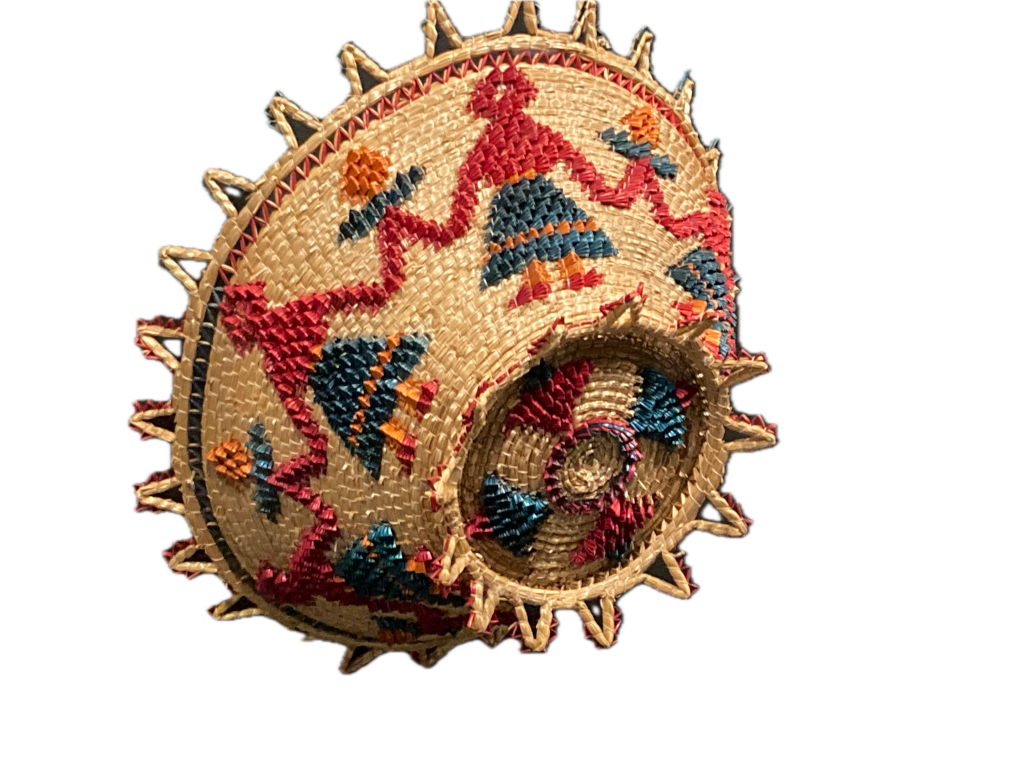
Panéri (ceremonial basket) with dancing circle of mother and daughter figures.
Folk Museum of Voroi, Crete.
Photo: Laura Shannon.
You can read Laura’s full essay (with complete footnotes and references) in Spells for Survivors: Returning to the Holy Her. “A potent collection of spells, rituals, poems, writings and artwork weaving a healing balm for survivors of sexual violence and those who love them.” Trista Hendren, Claire Dorey and Janet Rudolph, eds.. Girl God Books (2026). www.thegirlgod.com.
Selected References
Christ, Carol P. (2018). ‘What Is “Egalitarian Matriarchy” and Why Is It So Often Misunderstood?’, feminismandreligion.com, 16 April. Accessed 16 April 2018.
Ehrenreich, Barbara (2007). Dancing in the Streets: A History of Collective Joy. New York: Metropolitan Books.
Garfinkel, Yosef (2003). Dancing at the Dawn of Agriculture. Austin: University of Texas Press.
Gimbutas, Marija (1991). The Civilization of the Goddess. San Francisco: HarperCollins.
Göttner-Abendroth, H. (ed.), (2009), Societies of Peace: Matriarchies Past, Present and Future. Toronto: Inanna Publications & Education.
HeartMath Institute (2021). Improving Your Heart Connections and Communications. Boulder Creek, CA: HeartMath Institute.
Kelly, Mary B. (1989). Goddess Embroideries of Eastern Europe. McLean, NY: Studiobooks, 1989.
Shannon, Laura (2019). ‘Language of the Goddess in Balkan Women’s Circle Dance’, in Feminist Theology, Vol. 28, No. 1, pp. 66–84.
Shannon, Laura (2017). ‘Symbols of the Goddess in Balkan Women’s Dance’, in Dance, Movement and Spiritualities, 4:1, pp. 57–78. doi: 10.1386/dmas.4.1.57_1
Shannon, Laura (2016). ‘Women’s Ritual Dances: Secret Language of the Goddess’, in Hye-Sook Hwang, H. and Beavis, M.A. (eds.) She Rises! vol. 2: How Goddess Feminism, Activism, and Spirituality? Lytle Creek, CA: Mago Books, pp. 311-322.
Shannon, Laura (2014). ‘Sacred Space and Postures of Power: Conscious Circle Dance for a Better Future’ in Neue Kreise Ziehen Fachzeitschrift für meditativen & sakralen Tanz, Heft 2, pp. 6–9
Shannon, Laura (2011). ‘Women’s Ritual Dances: An Ancient Source of Healing in our Time’, in Leseho, J. and McMaster, S. (eds.) Dancing On The Earth: Women’s Stories Of Healing Through Dance. Forres: Findhorn Press, pp. 138-157.
Discover more from Feminism and Religion
Subscribe to get the latest posts sent to your email.


