

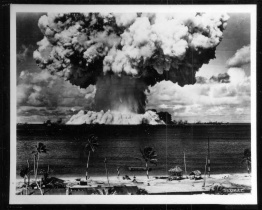
 I wish that in our pursuit of finding cures for illnesses we would do more as a collective species to prevent the causes, sometimes environmental ones. Why do we vote for people to make decisions that represent us but that we would never in a million years agree to? Bombs and the consequences of them raise questions of health and power. In the Yoga Sutras, 2.30, we read that “Yama consists of non-violence, non-lying, non-stealing, appropriate use of vital energy, and non-possessiveness.” The yamas are our social restraints. They are a negation of behaviors we might usually partake in.
Ahimsā, or non-violence, is listed first. It is the first element of the first limb of yoga; it is the basis for every other ethical aspect of our lives. Bombs are an example of a common and frequent behavior of violence that make the land, water, and sky increasingly uninhabitable. According to Micah Zenko of the Council on Foreign Relations, in 2016 alone, the U.S. is estimated to have dropped 26,172 bombs. Zenko says that this estimate is “undoubtedly low.” (1) This is one year and the bombs from one nation. (2) What is the environmental impact of all of the bombs dropped from every nation since the beginning of bombing history?
When a bomb is detonated, there is not only harm to the immediate life in that vicinity but life in the future and far away. According to the International Campaign to Abolish Weapons (ICAN) website, “the International Physicians for the Prevention of Nuclear War has estimated that roughly 2.4 million people will eventually die as a result of the atmospheric nuclear tests conducted between 1945 and 1980, which were equal in force to 29,000 Hiroshima bombs.” (5)
According to a statistic updated March 2016 on the Ploughshares Fund website, nine countries in the world have a total of 14,900 nuclear weapons, the U.S. and Russia holding 93% of them. (3) They have been used twice, both times by the United States, in war, but additionally they have been used in tests over 2,000 times in more than 60 locations over the globe, according to ICAN. (4) There are already unavoidable consequences to the earth and humans because of this irresponsible behavior that is ongoing. These tests occur in the atmosphere, under the earth, and under water. (6) Continue reading “The Trees and We Breathe Bombs Long Gone by Elisabeth Schilling”
 Even though I encountered wisdom literature when specializing in Hinduism during my Religious Studies doctoral program, through reading the works of Christian female mystics and the liberation theologies of feminist spiritual guides, it took a book I never encountered in my academic studies to give me a spiritual foundation that feels complete after my departure from Christianity: Eckhart Tolle’s
 As the winter months approach, at least one “Christmas” gathering will be on my schedule. As this holiday has been co-opted by consumerism as evidenced by my memory of the throngs of sales and shoppers in large shopping centers to get “the perfect gift,” I wonder how to give the perfect gift to Mother Earth simultaneously. At the December meeting of my local chapter of the Sierra Club, one of the members passed out a list of gift ideas for a “low-impact” season. Some of the items on the list include or have inspired the following:
 There are days I find myself so overwhelmed with sadness concerning the state of our world that I break down crying. Last week, I saw an episode of Mars, a scripted documentary shown on the National Geographic channel about human colonization of the red planet in 2033. One of the astronauts “interviewed” prior to leaving was asked why she was taking such a risk to inhabit Mars. She said something like, “We will give everything for this.” Why not give everything for Earth?
 Feminism and Religion