

 As a Catholic feminist theologian, activist, teacher, and writer Mary Hunt has made a massive impact in the field of feminism and religion. Following the completion of her graduate education (MA, Harvard Divinity School, M.Div., Jesuit School of Theology, Ph.D., Graduate Theological Union), Mary recognized a strong need for theological, liturgical, and ethical development by and for women and responded by co-founding WATER (The Women’s Alliance for Theology, Ethics, and Water) in 1983. Over the last 3+ decades, she has been instrumental in addressing social injustice and creating change in religion and community. Continue reading “Monthly Highlight: Mary E. Hunt”
Tag: LGBTQ
The Black Church, the Blues, and Black Bodies by Kelly Brown Douglas
 “Ooh, Ohh there’s something going all wrong”, Ma Rainey sang. There is indeed something going all wrong in the black church. This church, which is born out of the commitment to safeguard the life and freedom of all black people, has gained a reputation for repudiating if not demonizing certain black bodies, namely LGBT bodies. While there are certainly significant black church leaders who have vigorously defended LGBTQ person’s struggle for justice and equal treatment under the law, including support of marriage equality, those black church voices against LGBTQ rights have been vociferous and unrelenting. Continue reading “The Black Church, the Blues, and Black Bodies by Kelly Brown Douglas”
Breaking Up with Chick-fil-A by Gina Messina-Dysert
 I haven’t eaten fast food in many years; however as a new mom Chick-fil-A offered something quite different than other fast food chains: healthy options, freshly made food, clean space, and a great spot for play dates; not to mention the organization’s commitment to the environment. My daughter and I have made many trips to our local franchise in the last year. It became a usual spot for play dates, the go to place for dinner when I was on a time crunch (grilled chicken nuggets, fresh fruit, and chocolate milk has saved the day many times over!), and let’s not forget the perfect option for Baby S to get some play time in while Mommy connected to the free Wifi to get some work done. Yes, Chick-fil-A felt like a mommy’s dream come true.
I am embarrassed to say that I had heard rumors that Chick-fil-A was anti-same sex marriage; but I ignored all the warning signs trying to hold on to the many positives I thought the chicken chain brought to my life. With the recent blow up of Dan Cathy’s response “guilty as charged,” when asked about Chick-fil-A’s support for families led by heterosexual couples, I can no longer turn a blind eye. Continue reading “Breaking Up with Chick-fil-A by Gina Messina-Dysert”
Why I Failed Feminism 101: Gender, Sexuality, and the Power of Relationships
I forgot, that relationships, like feminism, are not easy, and that it is a conscious and continual effort of renewal to remind yourself everyday why you love the person you love and more importantly, in the case of feminism, why you fight, “the good fight.”
 I was once told by my ardent feminist advisor in undergrad to “not put all my proverbial eggs in one man basket” after discussing my relationship with my boyfriend over a cup of coffee. Thinking my relationship was different and that we were special, I heeded the warning but thought of it no further. Now, looking back on it three in a half years later, I wish I would have.
Relationships are a powerful tool. They help to make you feel special. They help to bring you joy. They help you discover the reason why a divine presence may have endowed us with the ability to love and most importantly they help you realize and discover things about yourself you may have never taken the time to notice.
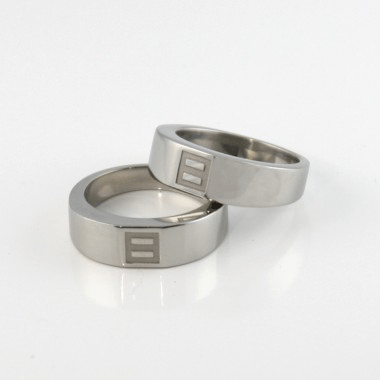 Feminism 101 is more than just the pop culture stereotype of a bunch of women advising the younger generation of girls to be weary of men and the pain they can bring. Feminism, specifically as what I now call Feminism 101, is the transformative ability to listen to your elders, trust yourself, and ultimately, if you happen to trust in the relationship you have built, knowing deep down that it is built on equality, love, and trust. Continue reading “Why I Failed Feminism 101: Gender, Sexuality, and the Power of Relationships”
“If You Allow Gay Marriage…” by John Erickson
“We need to start examining the underlying questions of counter-cultural relationships that view one man marrying many women to be hip because we begin to see that although a polygamist idea of marriage may be sexy from a popular culture standpoint, the thought of legally recognized gay marriage always then gets likened to bestiality.”
… you have to allow polygamy, bestiality, and everything else!” The title for my post this week is a quote from an individual I used to associate with. This individual, haling from a conservative evangelical background, tried to explain to several others and myself the reasons why gay marriage would eventually lead to the repeal of anti-polygamy and bestiality laws across the United States.
The problems that I have with this particular argument are conflating gay marriage with religious freedom. Activists and scholars can draw comparisons to anti-polygamy cases such as the 1878 U.S. Supreme Court case Reynolds v United States and the 1882 Edmunds Act and 1887 Edmunds-Tucker Act that disfranchised and led to the imprisonment of Mormon polygamists. But in the end, gay marriage is not about religious freedom but rather human rights.
I often feel that there is this need both within and outside religious communities to promulgate the idea that LGBTQ individuals want to get married within the sanctified walls of “the church” just as much as heterosexual couples do. Although I do not want to disqualify those who desire to see LGBTQ equality within their faith based communities, buying into a heternormative ideal of what traditional marriage should look like needs to result in LGBTQ individuals asking why marriage should be performed in sacred spaces in the first place The normative traditions that have often defined marriage have also served as shackles keeping LGBTQ couples in the mindset that to achieve fully marriage equality with their heterosexual counterparts is to fully immerse themselves within the same traditions and practices. Continue reading ““If You Allow Gay Marriage…” by John Erickson”
Bareed Mista3jil: Negotiating Gender, Sexuality, and Religion in Lebanon by Amy Levin
 It’s not often (enough) that I (have the time to) come across non-academic books that articulate and reflect some of the most complex intersections between religion, gender, and sexuality. Those that do are commonly produced in the Western hemisphere, often representing the voices of Euro-American cultures and religious traditions. That is why I want to give voice to Bareed Mista3jil, a book, or collection of “41 true (and personal) stories from lesbians, bisexuals, queer and questioning women, and transgender persons from all over Lebanon.” Bareed Mista3jil was published in 2009 by the organization Meem, a community of lesbian, bisexual, queer women and transgender persons (including male-to-female and female-to-male) in addition to women questioning their sexual orientation or gender identity in Lebanon. The purpose of the book is to give voice to those in Lebanon with non-conforming sexualities and identities in order to give hope to this under-represented, often silenced population. Here is a description from Meem on the origin of the book: Continue reading “Bareed Mista3jil: Negotiating Gender, Sexuality, and Religion in Lebanon by Amy Levin”
New and Old Queer Frontiers – Redefining Sacred Space by John Erickson
Queer. Sacred. Profane. Bar Culture.
One might not easily associate all four of those words in the same category, but Dr. Marie Cartier, a Professor at California State University Northridge, has crossed numerous boundaries in her search for the sacred in the pre-Stonewall Butch-Femme/Gay Women’s bar culture in twentieth century America.
A radical queer pioneer in the fields of both Women’s and Queer Studies in Religion, Marie has become a hero of mine during my time at Claremont Graduate University and in my personal journey as a male queer scholar in these fields.
As an activist, Marie has concentrated a majority of her work on activism and its involvement in shaping one’s identity as well as the world in which we occupy. Although the majority of Marie’s work concentrated on her personal interactions with butch, femme, and gay women, her interactions are transcending from being strictly personal to digital. Continue reading “New and Old Queer Frontiers – Redefining Sacred Space by John Erickson”
On Being a Gay Male Theologian During the War on Women by Dirk von der Horst
 For some time, a prominent strand of gay and feminist theory and theology has taken it almost as axiomatic that gay men, lesbians, and straight women have a common stake in dismantling patriarchy. While I have always understood my own work as a gay theologian in terms of that common struggle, recent developments point to a significant challenge to keeping that bond intact in the larger sphere of political activism.
At the end of last year, National Public Radio deemed 2011 an extraordinary year for gay rights. Buzzfeed listed 40 reasons why it was the best year for gays ever, beginning with a Gallup poll showing that for the first time a majority of Americans supported same-sex marriage. The list also included the repeal of Don’t Ask Don’t Tell and several firsts for openly gay elected officials. Even the world of professional sports is becoming more accepting: in a recent tweet, Ravens’ linebacker Brendon Ayanbadejo equated support for same-sex marriage with playing in a Super Bowl when asked about his life’s greatest accomplishments.
Simultaneously, we saw a steady legislative assault on women’s reproductive freedom. Continue reading “On Being a Gay Male Theologian During the War on Women by Dirk von der Horst”
 Feminism and Religion