“The wisdom of our ancestors is clear about this: If we do not take the journey inward to discover who we are, the creative potential within us will implode and we will destroy ourselves and the world”. Betty Kovacs
Jesus said something similar in one of the Gnostic Gospels: If you bring forth what is within you it will save you – if you do not bring forth what is within you, it will destroy you.
In what I believe was an attempt by my daughter to ease my “mother guilt” for the ways I felt I had let my kids down, she once told me that “the world’s problems can’t be attributed to crappy mothering.” While I appreciated her apparent effort to soothe my inner turmoiI, I can make a solid case that to a significant degree, they can be. In fact, the most critical issues we face in the modern world have everything to do with the fact that our social, economic, and cultural structures are materially thwarting, rather than effectively supporting and nurturing, the human animal – our entire species – and particularly children, in our efforts to survive and thrive.
It is true that mothers are not to blame for all of the ills of the world (though popular psychology can certainly make us feel as if everything is our fault). Nonetheless, in real and profoundly palpable ways, there are aspects of the human condition that are not receiving the attention, tenderness, and nourishment that we know very well – both by instinct and science – are crucial for physical, emotional, and spiritual resilience. Predictably, the Earth Herself is suffering in much the same way.
I carry the exact replica of MDNA handed down from mother to daughter since the depths of the last Ice Age 17,000 years ago. My father carries the YDNA of the Indo-Europeans handed down from father to son since the time when his male ancestors invaded Europe about 5000 years ago.
My female ancestors moved with the seasons as they gathered fruits and nuts, roots and greens to feed their families. Some of them may have blown red ochre around their hands to leave their marks in ritual cave-wombs.
Mitochondrial DNA is passed down exclusively from mothers to their children. My MDNA “T2b” was given the name “the clan of Tara” by Bryan Sykes in The Seven Daughters of Eve. According to Sykes the earliest female ancestor with this gene lived about 17,000 years ago, perhaps in Tuscany.
Most Europeans–male and female–are related to only eight or ten female ancestors. Going further back, all Europeans, Asians, and Aboriginal Australians are related to the women among the San “bushmen” who left Africa 100,000 years ago. The San are one of 13 lineages in Africa that can be traced back to a single African foremother. We really are one big family.
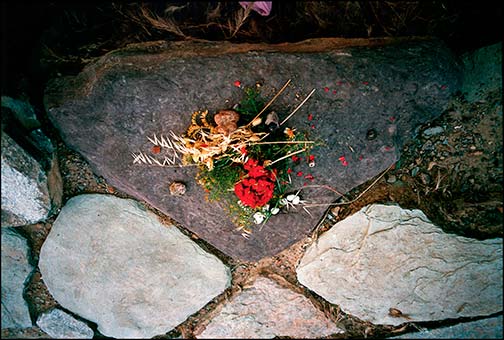
May we remember Brigid on her day in the fullness of her connection to bountiful and life-giving earth by setting a bowl of milk on an altar or special place in the garden on her holy day. Who knows, a snake just might come to drink from it.
The Christian Feast Day of St. Brigid of Kildare, one of the two patron saints of Ireland, is held on February 1, the pre-Christian holiday known as Imbolc. It is well known that St. Brigid has the same name as a pre-Christian Goddess of Ireland, variously known as Brighid (pronounced “Breed”), Brigid, Brigit, Bride, or Bridie. The name Brigid is from the Celtic “Brig” meaning “High One” or “Exalted One.” Brigid like other Irish Goddesses was originally associated with a Mountain Mother, protectress of the people who lived within sight of her and of the flocks nurtured on her slopes.
Imbolc marked the day that cows and ewes give birth and begin to produce milk. It was also said to be the day when hibernating snakes (like groundhogs) first come out of their holes. In northern countries, Imbloc signals the beginning of the ending of winter. The days have begun to lengthen perceptibly after the winter solstice when the sun stands still and it seems that winter will never end. At Imbloc spring is not yet in full blossom. But if hibernating snakes come out of their holes, it is a sure sign that the processes of transformation will continue and warmer days will not be far off. As Marija Gimbutas says, “The awakening of the snakes meant the awakening of all of nature, the beginning of the life of the new year.”
Review: In my first four posts sharing my recent Goddess Pilgrimage to Crete, I combined Joseph Campbell’s mono-myth with Maureen Murdock’s feminist version.
In this post and the final one to come, we complete the journey home. In Murdock’s feminist adaptation, I am now poised to Integrate the Feminine and Masculine within. My hybrid combines Campbell’s Reward (Seizing of the Sword), the Road Back, Death and Resurrection, and my Return with the Elixir.
Briefly: Having tested positive for COVID on the first day of the pilgrimage, I was required to quarantine at Hotel Idi near the village of Zaros near the Psiloritisfoothills in the bosom of Mother Mountain Ida. Four other sisters eventually joined me and we formed the Avocado Sisterhood, meeting daily for support and encouragement. However, I spent much of my time alone, moved inward, became very still, and underwent a personal spiritual transformation during this liminal time. My sisters left before I did as I still had not tested negative.
Stage Ten – The Road Back – Integration of the Feminine and Masculine
“[T]he Old European sacred images and symbols were never totally uprooted; these persistent features in human history were too deeply implanted in the psyche. They could have disappeared only with the total extermination of the female population.” Marija Gimbutas, The Language of the Goddess, 318.
August 15 is known to Greek Christians as the date of the Koimisi, “Falling Asleep” or Dormition of the Panagia, She Who Is All Holy. December 25 is a minor holiday in the Orthodox tradition, while Easter and August 15 are major festivals. The mysteries of Easter and August 15 concern the relation of life and death. In Orthodox theology, both Easter and August 15 teach that death is overcome: Jesus dies and is resurrected; Mary falls asleep and is assumed into heaven. These mysteries contain the promise that death is not the final end of human life. Yet this may not be the meaning of the rituals for many of those who participate in them.
If I had been asked to write the words that introduce visitors to the Heraklion Archaeological Museum of Crete to its earliest inhabitants, I would have said something like this:
While there is evidence that human beings visited Crete as early as 150,000 years ago, the first permanent settlers arrived from Anatolia in the New Stone Age or Neolithic era, about 9000 years ago, bringing with them the secrets of agriculture and soon afterward learning the techniques of pottery and weaving. As the gatherers of fruits, nuts, and vegetables and as preparers of food in earlier Old Stone Age or Paleolithic cultures, women would have noticed that seeds dropped at a campsite might sprout into plants. Women most likely discovered the secrets of agriculture that enabled people to settle down in the first farming communities of the New Stone Age. As pottery is associated with women’s work of food storage and preparation, and as weaving is women’s work in most traditional cultures, women probably invented these new technologies as well. Each of these inventions was understood to be a mystery of transformation: seed to plant to harvested crop; clay to snake coil to fired pot; wool or flax to thread to spun cloth. The mysteries were passed on from mother to daughter through songs, stories, and rituals.
When I learned about the Navajo Beauty Way, I understood it to be a path in which human beings respect all beings in the web of life and live in harmony with them. But I didn’t understand why this path was called the “Beauty Way.” As a young woman, I knew that my worth was defined by many in terms of my ability to conform to ideals of female beauty promulgated in movies, tv, and advertising. I didn’t believe the Navajos were talking about beauty in that sense, but because of my conditioning, I was not yet able to fully grasp what they might mean by beauty. I would have called the way they were describing a “Way of Harmony” or a “Way of Respect for Life.”
My recent discovery of Marija Gimbutas on Youtube rekindled my admiration for her work. In her slide-lecture “The World of the Goddess” Marija Gimbutas allows us to follow the line of reasoning she used to decipher the “language of the Goddess” in Old Europe.
Careful attention to her lecture shows that Gimbutas did not close her eyes, dream, and then attach her own ideas and intuitions to the artifacts she later discussed. Rather, she catalogued groups of images with similar symbolism and used her knowledge of nature (what does a water bird or an owl look like?) and folklore (she collected thousands of songs connected to the agricultural and life cycles in her native Lithuania in the 1930s) to unlock the meaning of ancient symbols.
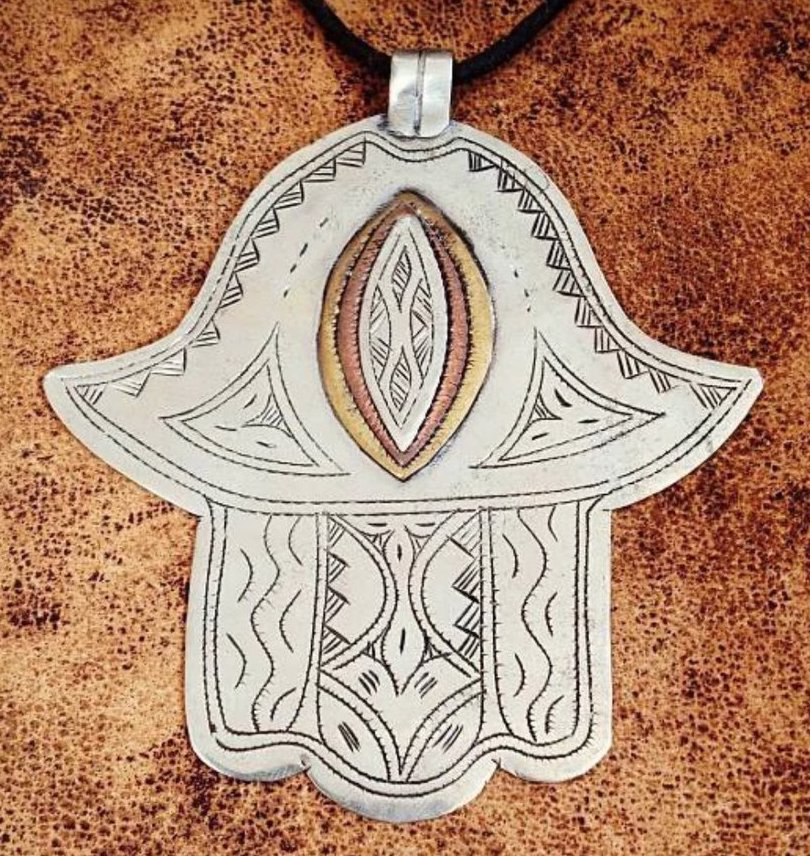
In my recent post ‘Forty Days After Childbirth, Mary Returns to the World,’ I wrote that ‘the woman’s power to bless and protect, as well as to create, is shown in the symbol of her hand.’ We see expressions of this power in the Orthodox Christian icon of the Three-Handed Madonna, whose third hand is over her womb, and the Hamsa, the hand-shaped talisman common to Jewish, Christian, and Islamic traditions. Also known as the Hand of Fatima, Miriam, or Mary, the Hamsa often incorporates eye or vulva motifs, which also offer protection.
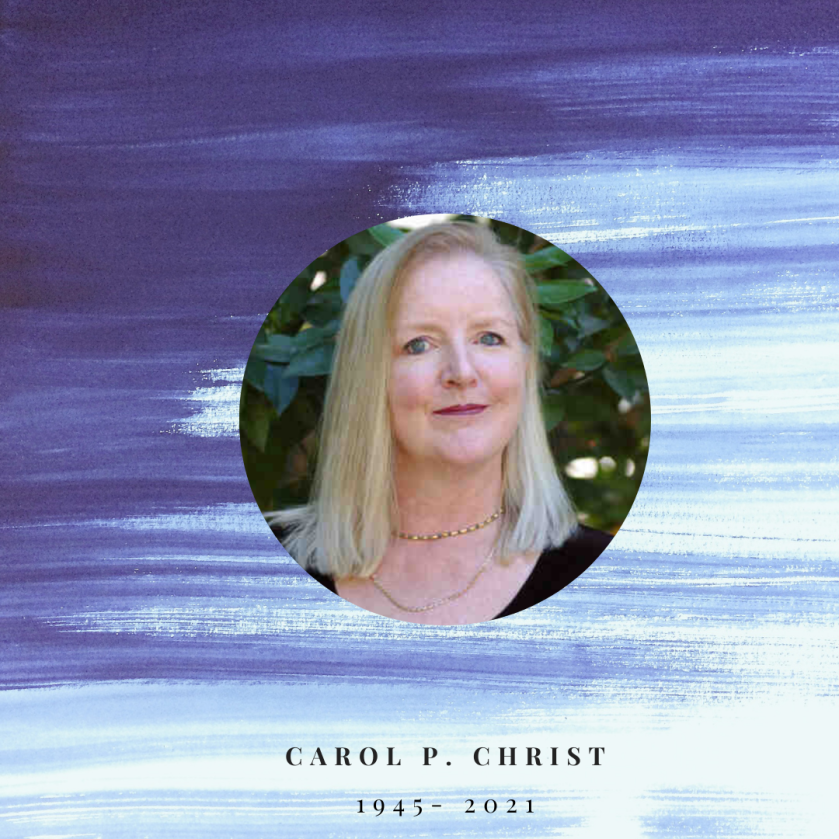
Hand, womb, and eye all signify female creative power, personified in the image of Goddess and revered in Neolithic Old Europe. This life-giving principle is expressed in many ways apart from childbearing: as Carol Christ affirms, early technologies of spinning, weaving, pottery, and agriculture, along with Neolithic religion, were most likely invented by women.






 Feminism and Religion