What Part of “No!” Don’t You Understand??: Morality at Center of Mid-Term Election by Elizabeth Fresee

As my late and dearly missed Professor, Dr. Otto Maduro, put it, “One mile from the courthouse, it’s complicated. One hundred feet from the courthouse, it’s not.” In that spirit, with just a couple of weeks until Nov 6, I submit that the mid-term election of 2018 is a referendum on morality – not a particular moral issue, but the entire principle of moral limits as a crucial element in a functional society. We are answering the question “Is morality itself still a thing?” Vote Republican, you are answering “No;” vote Democrat, you are answering “Yes.”

I must first clarify what I mean by “morality.” For some, it is about a traditional, hierarchical social order. The Almighty Father lays down the law and “No!” here means “No, you may not do anything I forbid, according to my will, regardless of your needs, including walking away from my authority and demands.” For most others, myself included, morality is about egalitarian, mutual concern for the well-being of all and a social contract obligating members of society to: a) not be mean jerks to one another and b) ensure those in need are basically cared for. “No!” here means “No, you may not trespass upon the integrity of others, nor may you walk away from your responsibility to them.” While many world religions have elements of the former version of morality, even the patriarchs generally have some obligation to social responsibility. The real heart of religiosity, though, is the mutual social contract, aka “The Golden Rule.” Continue reading “What Part of “No!” Don’t You Understand??: Morality at Center of Mid-Term Election by Elizabeth Fresee”

The Burden of Shame by Oxana Poberejnaia

I know a man who says to his daughter: “You should be ashamed of yourself” when he wants to imbue some good habits in her. One example would be not putting her dirty socks in the laundry basket. It might seem trivial, but I don’t think it is. I feel that shame is a toxic element of our personalities. I believe shame results in negative consequences, such as sabotaging oneself and health problems.
Many spiritual traditions, including Buddhism, perceive guilt as a trigger for moral development. The rational is, when we feel bad about something we had done, we will change our behaviour for better. The question is: how bad exactly are we supposed to feel, both in terms of quality and quantity of that feeling? Continue reading “The Burden of Shame by Oxana Poberejnaia”

Genetic Testing: The Ethical Implications of Expanded Newborn Testing – Who Benefits? (Part One) by Michele Stopera Freyhauf

Freyhauf, Feminism, Religion, Durham, Old Testament, Blogger, Bible, Gender, Violence, Ursuline, John CarrollWith Angelina Jolie’s electing to have a double mastectomy because she carried the BRCa Gene, and her mother and aunt died at a very early age of the disease, the issue of genetic testing is in the forefront again.  This is a three-part essay explores genetic testing when it comes to newborn testing (part one and part two) and concludes with exploring personal choices, availability, and psychological ramifications of genetic testing.

BabySeq
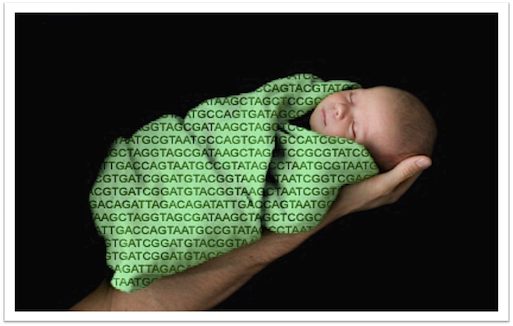
Picture originally found at http://www.ngsleaders.org/blogs.aspx

After nine months of worrying and diligent pre-natal care, the day to meet your unborn child is here.  Labor is long and for hours you lie in the birthing suite riding out contraction after contraction.  The moment finally arrives and you discover you have a son; ten fingers, ten toes and seemingly healthylungs by the cry that you hear.  He is then quickly taken over to the nurse’s station and a drop of blood from his heel is placed into a machine that in seconds will decode his entire genome. Soon your son’s future will be written in stone; he has a life expectancy of 30.2 years and has a 99% chance of dying from heart failure.  In that instance, your son has been labeled as an in-valid and he is now doomed to exist within a lower class of society, one that will prohibit him from pursuing his dreams. Society has discriminated against your new baby boy based solely upon his DNA.  A new form of eugenics is born.

This was the opening scene of the 1997 science-fiction movie called “Gattaca.” Besides pushing the bounds of human imagination, science fiction can serve as a warning about a future caused by the abuses of humankind.  The opening birth scene in this movie is quickly becoming a potential reality.  Now, a person’s entire genome can be decoded and in an instant, a person knows whether he or she will be susceptible to Parkinson’s disease, Alzheimer’s disease, Cancer, or other life threatening conditions.  Proponents of genetic sequencing believe that this is the holy grail of medical care and tout phrases like “personalized medical care” and “significantly reduced costs of healthcare.”  There is a rapid movement towards this goal through the proposed expansion of newborn screening for eighty-four conditions, most of which are not understood or have no known treatment. Continue reading “Genetic Testing: The Ethical Implications of Expanded Newborn Testing – Who Benefits? (Part One) by Michele Stopera Freyhauf”

The Danger of the Patriarchal Domination Mindset: Can We Do Anything About It? by Thea Iberall

The Danger of the Patriarchal Domination Mindset: Can We Do Anything About It? By Thea Iberall The Swallow and the Nightingale

At the confluence of misogyny, prejudice, homophobia, religious intolerance, environmental destruction, and violence is the patriarchy. We all know this and talk about it here from our own perspectives. I come as a scientist and writer. I have a love of history and science as well as a skill at simplifying complicated things. I abhor what some people are doing to our planet and the arrogance with which they do it. Unfortunately, because we want the stuff they are manufacturing, because there are too many of us, and because we are letting them do it, they do it with our blessings. I want to help change this situation with a novel I’ve been working on for almost 15 years.

In the year 2000, I sat in a dinghy in the caldera of the active underwater volcano at Santorini helping my geologist sister count the bubbles coming from below us. The experiment was part of my father’s research into the origins of life. I had had the seed for a novel thirteen years earlier when I heard Mimi Fariña sing The Swallow Song, talking with her about her deceased husband Richard Fariña and how lost his music has become. I began developing ideas, learning about the nightingale connection and discovering a 12th century Sufi master’s epic allegory about god. Sitting in that dinghy, everything coalesced: the story of how western civilization went off course. My book of contextual poems, The Sanctuary of Artemis, explores the roots of Western patriarchal culture and tells some of it. The novel would have a backdrop of a world collapsing as ornithologist Dr. Deborah Wright is unwittingly guided by the Sufi to figure out why the Capistrano swallows are dying. It would include an underlying history of an egalitarian world lost when this volcano erupted in 1628 BC. Richard Farina’s song would be playing throughout the pages.  Continue reading “The Danger of the Patriarchal Domination Mindset: Can We Do Anything About It? by Thea Iberall”

One Thing I Like About Christianity by Erin Lane

Erin LaneI never have good dreams. They always fall into the weird, creepy, or just plain terrifying category. Last night was no exception. I’ll save you the diary entry but after sharing the short saga with my husband this morning (who I’m sure dreams of lollipops, if he could only remember), he looked at me and said, “Geez, Erin. You really care that people like you.”

It was a neighborhood prank gone wrong. In the dream, I had been running through people’s lawns and hiding in bushes with my husband and two other guy friends. We were armed with squirt guns, except that they weren’t squirt guns; they were household cleaners. I don’t know what we thought we were doing exactly – take that organic tomatoes! and that you meddling cat! –  but we soon got caught and I proceeded to be excluded, shamed, and taunted. First by a group of wives who snickered at me from a safe distance in their convertible and whispered, “She’s always trying to be one of the guys.” Then by a work colleague standing nearby who asked me, “How would Jesus feel about your actions?” and then let his wife hose me down with a sprinkler, which in retrospect was very un-Jesus like. And lastly by one of my guy friends in crime who called me “snotty” for hamming it up for a photo opp when the press arrived. Continue reading “One Thing I Like About Christianity by Erin Lane”

Abuse of Power in the Catholic Church Part II – WE are the Church! By Michele Stopera Freyhauf

Spiritual Power is arguably the most dangerous power of all.  In the wrong hands, it gives the power to make judgments even about the eternal fate of another person.  It needs a sign on it at all times saying, ‘Handle with extreme care.’  The greater the power a person exercises, the more need there is for checks and balances before it is used and accountability after it is used.” – – Bishop Geoffrey Robinson

 May 6th, I addressed the issue of abuse of power in the Catholic Church and how we seem to be unraveling any kind of progress made since Vatican II.  Since writing that article, the Leadership of the LCWR met with Vatican Officials and expressed their concerns openly.  A dialogue occurred and left no resolution, just information that the leadership will discuss with the community at their August meeting.  That meeting will reveal their next step in this controversy – concede and follow the conditions and rules sets forth by the CDF or disband and form a new religious community or maybe there will be another option revealed.

I have to ask though – Was this a meaningful meeting or was it meant to pacify the Sisters and their supporters? Will the Vatican change its stance? Certainly, the U. S. Catholic Sisters have not been

reposted from http://www.nunsonthebuss.com/bus

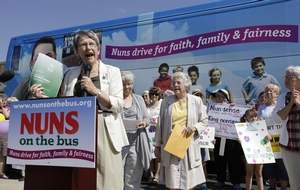
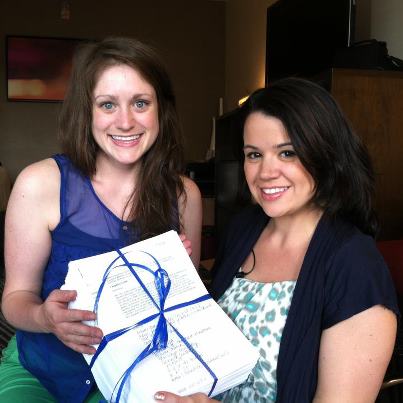
pacified, nor have their supporters.  For example, there is a “Nuns on the Bus” tour traveling around the United States,  prayer services for the Sisters, #nunjustice and #whatthesistersmeantome campaigns on Twitter.  Even the Women’s Ordination Conference delivered a petition containing over 57,000 signatures to the Vatican in support of the Sisters.  Certainly, the support for the sisters and their mission is not dwindling, but growing stronger every day.

As for the Vatican, a change in their position is doubtful, but we can continue to pray.  I am, however, very discouraged by a statement attributed to Pope Benedict that indicates a desire to have a smaller more faithful Church of Catholics then a large Church of people who do not adhere to Church Teaching – seeking out a small, strong, holy community.

Obviously, it is my hope that this statement was taken out of context, but I have to be honest and say

Women’s Ordination Conference delivering Petition
Picture reprinted from WOC’s page on Facebook

that my hope is filled with doubt.  This is not the first time I have heard clergy make this statement. Priests have made this statement in my presence – wanting a more faithful flock and dismissing those that do not adhere to their interpretation of Church teaching. This stance does not bear fruit, but is rather a power play – a play that can be called many things – misogynist, arrogant, non-pastoral, cold-hearted, and frankly un-Christian.  It also plays with a person’s spiritual fate and in many cases their soul.   The psychological impact of something like this is dangerous for some. Some ordained will go so far as to withhold sacraments or even compromise the person’s  status in the Church, including their role in ministry, for the sole purpose of  inducing compliance – a tactic that dates to the medieval period.

Continue reading “Abuse of Power in the Catholic Church Part II – WE are the Church! By Michele Stopera Freyhauf”

Sexual Education: The Limits of Conscience Formation by Mark Levand

Think back to the sexual education you received—or did not receive.  Think of all of the topics you covered in school or at home and how positively and confidently you talk about it today.  Many people will say that this sentiment does not resonate with them.  Much of the population receives subpar sexual education in the current public school curriculum and often times even worse sexual education in faith-based programs.  The sexual “taboo” that people feel when it comes to sex education—the fact that parents will leave it up to schools and the schools rely on parents to cover the “important stuff”—is a bigger injustice than many people care to realize.

The structure of sexual education in our society today is extremely inadequate.  Let us focus on sexual education in parochial schools for instance.  Many graduates of the elementary parochial curriculum that I have met have had a very miniscule sexual education.  When I ask them if they felt adequately prepared on the topic of sex the answer is often “no” commonly followed by an even more unsettling “what sexual education?” Continue reading “Sexual Education: The Limits of Conscience Formation by Mark Levand”