“We Knocked” :: A Review of Mormon Feminism by Caryn D. Riswold

caryn2Mormon feminists experience what most feminists of faith have heard at some point. Utter dismissal of the possibility of their existence.

We know several variations:

You can’t be Christian and feminist.

There’s no such thing as a Catholic feminist.

You can’t seriously be Jewish and feminist.

You can’t possibly be Muslim and feminist.

To be Mormon and feminist? Preposterous.

In response, scholars, activists, and writers within each tradition have had to document their history, make their theological case, and engage their scriptures as robustly as any conservative traditionalist would. In order to achieve meaningful institutional change, unimpeachable work and confident testimony is required. Continue reading ““We Knocked” :: A Review of Mormon Feminism by Caryn D. Riswold”

Why I Don’t Believe in Female Pastors by Andreea Nica

Andreea Nica, pentecostalismIt may come as a surprise to those who identify as both feminists and religious practitioners that I don’t believe women should be pastors of any dominant religious congregation. This includes most religions which, I assert, are rooted in and structured by the tenets of patriarchy. Does that mean I think women should be congregants of a patriarchal-originated religious system? You guessed it – no. While this may seem like a radical notion to some, it took me quite some time to come to terms with my own conflict in being both feminist and a believer.

My transition from the Pentecostal sect was a long, intricate process that involved life-altering decisions. The notion of leaving the church was driven by my immersion in women’s studies during my undergraduate degree. There were many difficult questions I simply didn’t have an answer for, as the church didn’t provide me with them.

One of them being: Can women instruct an entire congregation of believers?

For those who are female pastors, I’m sure you’ve heard this one a million times, but somehow it never fades from religious and secular discourse. Whether it’s the Islamic, Jewish, Christian, or Mormon faith, women have had to constantly fight for their right to preach religious doctrine. In the beginning of my transition, I was on the side of: Preach it ladies! Continue reading “Why I Don’t Believe in Female Pastors by Andreea Nica”

Making Inequality Visible: Mormons Seeking Women’s Ordination are Turned Away from Priesthood Conference by Aimee Hickman

DSC_0023 - Copy (2)Earlier this month, nearly 150 women were turned away from listening to the leaders of their church. The first weekend of October in the Mormon (LDS) Church is set apart for church members world-wide to hear messages from their leaders. The conference takes place in 5 two hour segments of speakers and music. The Saturday evening segment is called the Priesthood Session–a meeting all priesthood holding men and boys aged 12 and up are expected to attend. This year a new demographic asked to attend the Priesthood Session. Ordain Women, an activist feminist group which is petitioning LDS Church leadership to prayerfully consider the ordination of Mormon women to the priesthood, arrived at the conference doors and respectfully asked for admittance. These women were turned away one by one until the doors were closed and blocked.

On October 5th, I eagerly watched Twitter and Facebook feeds in anticipation of the news of the day: would the many dear friends I had who were petitioning LDS Church leaders for admittance into the Priesthood Session of General Conference be allowed to participate? The first word I got was from Ordain Women organizer Suzette Smith’s simple status update: “They said no.” Continue reading “Making Inequality Visible: Mormons Seeking Women’s Ordination are Turned Away from Priesthood Conference by Aimee Hickman”

Rebekah of the Hebrew Bible: A Mormon Feminist Model by Caroline Kline

Kline, CarolineThis semester I took a class on women in the book of Genesis. I was particularly interested in learning more about the language used to describe Eve, since she is such an important model of inspired action and proactivity for Mormon women. However, I also discovered another woman in the book of Genesis whom I saw as a potentially powerful model for Mormon feminists, a woman caught in a patriarchal context, but one who decisively and creatively figures out how to insert herself, her ideas, her inspiration into the events at hand: Rebekah.

Let me recap the most crucial incident: When Isaac is old, blind, and believes he is approaching death, he determines to give a special blessing to his firstborn son Esau. When Rebekah hears of his plans, she springs into action, ordering her younger son Jacob to impersonate Esau in order to obtain this blessing. Rebekah feels so strongly that Jacob should get this blessing – and no wonder, given her revelation from God forty years before that Jacob should inherit the promise – that when he objects, fearing a curse from his father if he is found out, she says to him, “Let your curse be on me, my son. Only obey my word, and go…..” (Genesis 27:13). Continue reading “Rebekah of the Hebrew Bible: A Mormon Feminist Model by Caroline Kline”

Pantspocalypse: It’s Time for Conversation about Mormon Gender Norms by Caroline Kline

Kline, CarolineA little over a week ago, hundreds if not thousands of Mormon women across the world participated in Wear Pants to Church Day, a movement orchestrated by some feminist Mormon women in an effort to bring attention to issues of gender inequity in the Mormon faith. Pants were the chosen symbol because there are strong cultural norms against women wearing pants to church. This event was conceived as an opportunity to make visible the fact that Mormons are questioning traditional sex-segregated customs in the LDS Church and want to dialogue about these issues. Supportive men were asked to wear purple shirts or ties to signify their solidarity.

What surprised everyone in the Mormon feminist community was the vicious response by some other Mormons to this proposed action. On the event’s Facebook page, other Mormons attacked idea, hurling insults at the women. One man even made what sounded like a death threat, saying that people who participate in activists movements like this “should be shot … in the face … point blank.” The negative reactions centered around two issues: 1) that it’s inappropriate to engage in any form of protest – no matter how subtle — in church and 2) that it’s inappropriate for women to wear pants to church. Continue reading “Pantspocalypse: It’s Time for Conversation about Mormon Gender Norms by Caroline Kline”

Why I am a Mormon Feminist by Emily U.

We can do it! RosyI’m not a historian or sociologist, but I’ve noticed something about civilizations.  They always seem to think they are more special than other civilizations.  It’s not important to my purpose here to name names, but so many groups have had a superiority complex of one kind or another that I wonder if a need to feel more special is written into human DNA.

There may be biological explanations for why people draw distinctions and make rankings for each other, but I’m going to speculate about a psychological or spiritual one.  I wonder if this hunger for superiority stems from a lack of security about one’s value as a human being.  The first temptation of Christ started with the words “If thou be the son of God…” and if we are to believe Christ’s temptations were real it means that even Jesus must have, at least momentarily, been able to question his identity.  He was tempted to believe the lie that he was not who he knew himself to be.  We mere mortals experience that temptation not infrequently, and unlike Jesus, we sometimes succumb to it.

One strategy people have for dealing with insecurities about their identity is to artificially elevate themselves above others.  As in, if I’m not special at least I’m more special than (fill in the blank).  This has caused so much pain and injustice.  And regardless of culture, time, or place, women seem to always be on the losing side of this equation. Continue reading “Why I am a Mormon Feminist by Emily U.”

A Sea Change Towards Women’s Ordination by Mary Ellen Robertson

If I see a flaw in contemporary Mormon feminism, it’s that we haven’t ventured outside our own religious community to partner with other religious feminist activists. Working separately or in ignorance of the work already done by other religious feminists, we’re more likely to spend time reinventing the wheel than building upon the lessons learned.

Fortunately, there’s an exciting shift afoot.

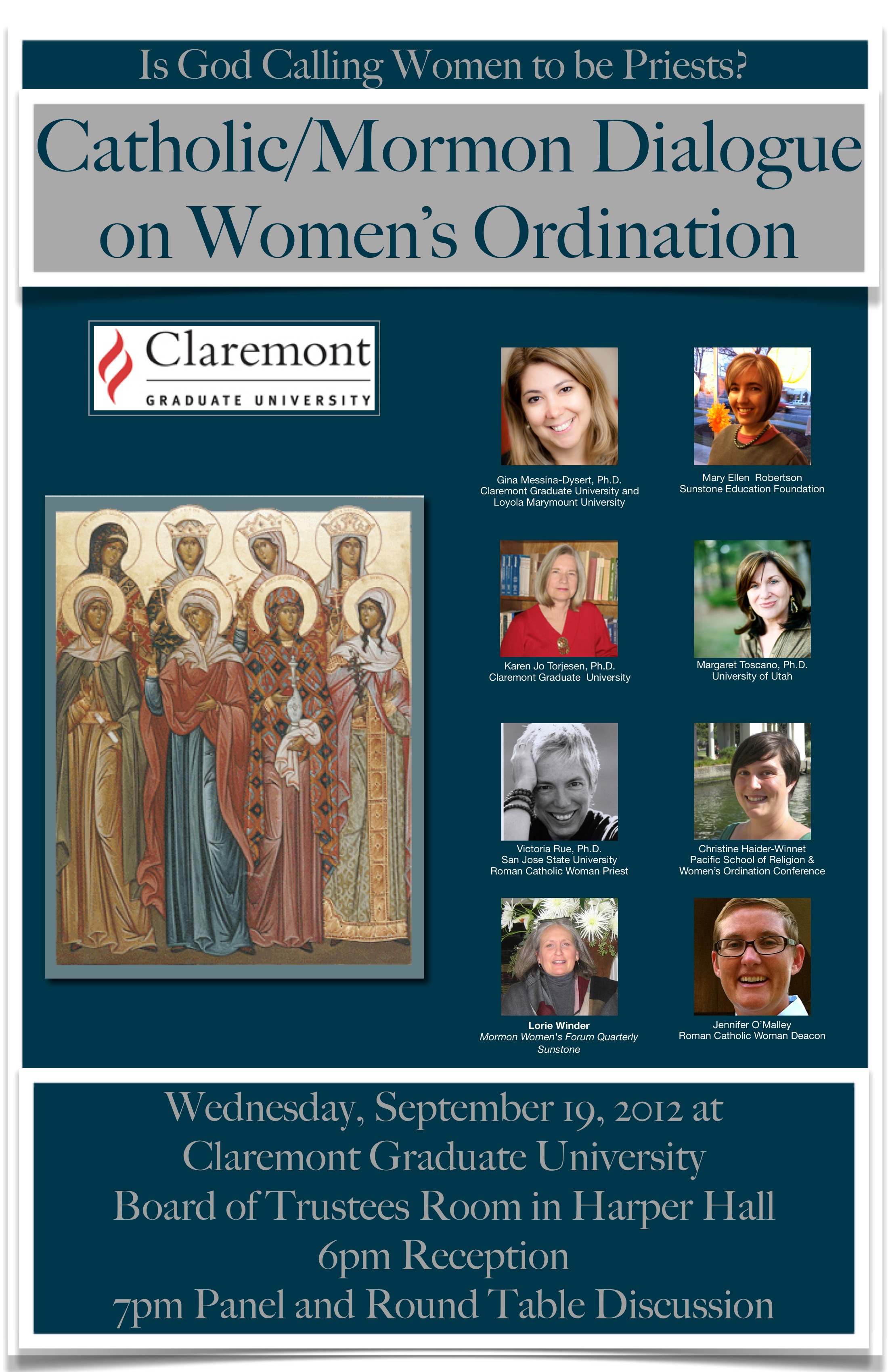
Last week, Catholic and Mormon women came together for a dialogue on women’s ordination.
Hosted by Claremont Graduate University, this discussion brought together six women from  patriarchal religions to explore what happens when we call an all-male priesthood into question and examine the theological and cultural assumptions upon which an all-male priesthood rests. Continue reading “A Sea Change Towards Women’s Ordination by Mary Ellen Robertson”

Catholic/Mormon Dialogue on Women’s Ordination

The Catholic/Mormon Dialogue on Women’s Ordination at Claremont Graduate University will take place Wednesday, September 19, 2012.  It is an incredibly relevant topic today and particularly interesting with a Mormon/Catholic presidential ticket before us.

It makes sense to bring Catholics and Mormons together to dialogue about this issue.  Women’s ordination in both Churches is considered a taboo topic and one that if discussed in public can lead to excommunication.  Certainly the women who will stand publicly to address this issue and share their passion and conviction for the need to ordain women are courageous and committed to the recognition of the full humanity of every woman and every man.  Continue reading “Catholic/Mormon Dialogue on Women’s Ordination”

Tonight I Mourn for the Woman I Might Have Been by Caroline Kline

A few days ago, as I attended a conference on women in the LDS Church, I realized something about my Mormon feminist community: many of these Mormon women in the audience have felt called to ministry. Many came to this conference because they feel their scope of service and spiritual authority is constricted in the contemporary institutional LDS Church, and they have so much more they want to give to it. Many came to the conference hoping to find strategies to expand the visibility and sphere of action in this church which has enriched their lives in so many ways. Continue reading “Tonight I Mourn for the Woman I Might Have Been by Caroline Kline”

Why Some Mormon Feminists Stay by Caroline Kline

In my almost two decades as a Mormon feminist, I’ve seen my fellow Mormon feminists come and go. Mostly go. Remaining a practicing Mormon while also embracing feminist principles is for many of us a harrowing and angst-inducing endeavor. While some have ultimately found a measure of peace in our decisions to stay practicing or partially practicing, others find they simply cannot live with the dissonance. As I’ve watched myself and other women around me navigate the huge decision about whether to remain in the Church, I’ve come up with a few theories as to why some of us stay.

First, and most obviously, a Mormon feminist is more likely to stay if she fully embraces Mormonism’s basic truth claims about Joseph Smith as prophet and Mormonism’s exclusive restored priesthood. However, many Mormon feminists have nuanced takes on those questions. They might think of Joseph Smith as an inspired man who tapped into some compelling theological ideas about eternal progression and humankind’s divine potential, but might pull back on exclusivity claims. Continue reading “Why Some Mormon Feminists Stay by Caroline Kline”