As a Hen Gathers by Elanur Williams

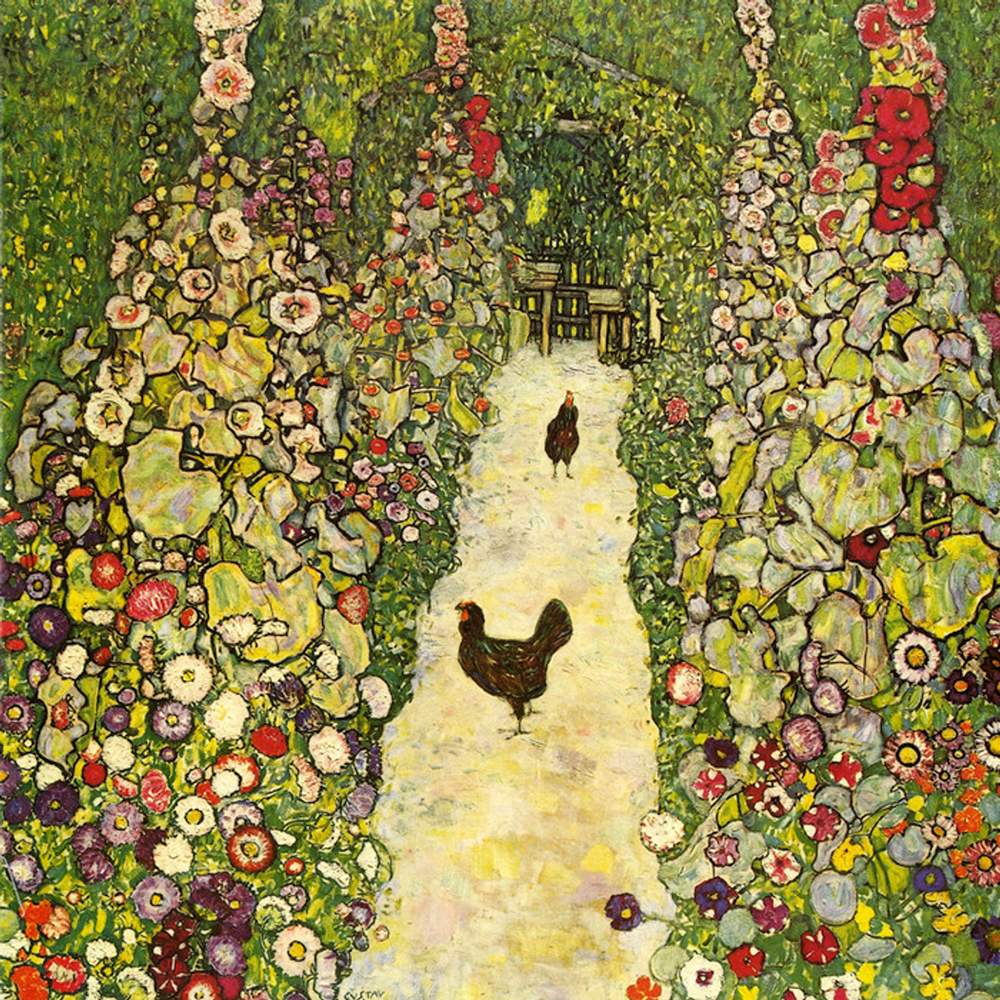
Gustav Klimt, Garden Path with Chickens, 1916

In the early years of my childhood, my family lived for a short time on a poultry farm in Bandırma. Hens wandered freely, unconfined. The contours of that land have long since changed, replaced by refrigerated depots and industrial freezers that hum along the highways, the relentless march of capital. In the Gospels of Luke and Matthew, Jesus laments: “How often have I desired to gather your children together as a hen gathers her brood under her wings, and you were not willing.” These days, I find myself returning to the image of the mother hen—a figure who embodies a special wisdom that is seldom named, yet deeply and instinctively known.

Although I did not have a religious upbringing, I grew up embracing aspects of many faiths. My spiritual background is Alevi, and after inviting the Presbyterian faith into my life following my marriage, I find these layered identities influence each other in ways that are both intricate and transformative. In her sermon Who Is Jesus? Mother Hen, Reverend Agnes Norfleet lingers on the vulnerability of the mother hen metaphor, questioning what strength a hen can possibly offer in the face of the fox—Herod—and, more broadly, in the face of violence at large. Reverend Norfleet asks why Jesus does not invoke a more forceful or fiercer maternal figure—a lion, perhaps, or a bear? What does this choice imply for our activism and understandings of leadership? What unique wisdom does the mother hen offer?

Continue reading “As a Hen Gathers by Elanur Williams”
Legacy of Carol P. Christ: EASTER OF THE GODDESS: A VIEW FROM GREECE

This was originally posted on April 16, 2012

On Good Friday, Easter Saturday, Easter Sunday, and Easter Monday the blogs on feminismandreligion.com celebrated mothers and God the Mother.*

 This is my body, given for you.
This is my blood, given for you.

While these words are the center of a Christian liturgy celebrating the sacrifice of Jesus as the Christ, they are more appropriately spoken of our own mothers. Your mother and my mother and all mothers, human and other than human, mammalian, avian, and reptilian, give their bodies and blood so their offspring might have life. True, mothers do not always make conscious choices to get pregnant, but almost all mothers affirm life in their willingness to nurture the young who emerge from their bodies and from their nests. Had mothers—human and other than human–not been giving their bodies and their blood from time immemorial, you and I would not be here.

Continue reading “Legacy of Carol P. Christ: EASTER OF THE GODDESS: A VIEW FROM GREECE”

The Mixed Bag that is Toldot by Ivy Helman.

The parshah for November 26th is Toldot, Genesis 25:19-28:9.  In it, we have the struggles of Isaac and Rebecca to conceive, the relations between Abimelech and Isaac’s family, the birth of Esau and Jacob, and the loss of Esau’s birthright and his father’s blessing.  As we will see, this is a tricky portion from a feminist perspective because of Rebecca, yet, from an ecofeminist perspective, I find the way in which the portion discusses the interconnection between the water, the land, and divinity helpful.

Let me begin with the water and then we will look at Rebecca.  Toldot takes place in and around the city of Gerar in Philistine territory, while Abimelech ruled.  Isaac and his family travel through the land quite a bit between verses 26:16 and 26:32.  Most of this section pertains to them moving and then digging new wells, the covering of wells, and the finding of water.  What I find particularly interesting here is the way in which water and peace seem to go together.  For example, in 26:20-21, Isaac and his family have constructed a well but it is causing them to have troubles with the locals.  Isaac seeks peace and thus leaves.  In verse 26:26, Isaac is visited by Abimelech and eventually a formal peace is declared.  This is followed in 26:32 by Isaac’s servants finding water in a freshly dug well.  In other words, Isaac is willing to uproot his family time and again to cultivate peace; he is not willing to go to war over what in the desert really is a quite limited resource.  

Continue reading “The Mixed Bag that is Toldot by Ivy Helman.”

“Calculated Emotional Violence” and Abuse: Memories of ‘Mother Days’ by Sara Wright

I took the above phrase from a post on FAR (published 5/6/22) after it triggered memories of mother abuse. Like Sedna I was a daughter who was thrown into the sea, her fingers cut off one by one (but not by my father). Abandoned and left to die, Daughter sank to the bottom of the sea. The classic Handmaid’s Tale. In the Inuit story the abused daughter survives, transforming into Mistress and Mother of the Animals. As a woman I have followed in Sedna’s footsteps in that I became a dedicated naturalist with a fierce love for all non-human creatures (and plants), but I have yet to transform my unfortunate family history.

With Mother’s Day approaching, I am forced against my will to think about my calculating, deceitful mother who had little use for women in general, and spent her life criticizing and eventually deleting her only daughter permanently from her life. Trashed.

My first crib memory is one of raw terror – a bewildered baby crying out for a mother that never came. Comfort, compassion, love were withheld. Now at 77 I ask myself: what was wrong with this woman?

Continue reading ““Calculated Emotional Violence” and Abuse: Memories of ‘Mother Days’ by Sara Wright”

From the Archives: Child of the Earth by Elizabeth Cunningham

Moderator’s note: This marvelous FAR site has been running for 10 years and has had more than 3,600 posts in that time. There are so many treasures that have been posted in this decade that they tend to get lost in the archives. We have created this column so that we can all revisit some of these gems. Today’s blogpost was originally posted October 18, 2020. You can visit the original post here to see the comments.

I have a vivid childhood memory of being sick with the stomach flu and standing in the doorway of my parents’ bedroom looking for my mother. Her care for sick children was tender and thorough. She would bring us ginger ale and toast with jelly. When she had time, she read us stories. I can remember her steering me, heavy with fever, back to a bed that she had magically smoothed and cooled. But that day my mother lay in her own bed in an old nightgown, not stirring. She had the flu, too, and could not get up to care for the rest of us. It was a shocking and sobering moment.

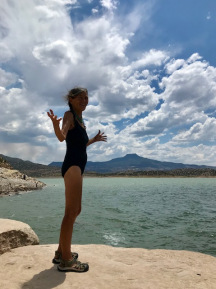
As I grew older, I transferred my need for comfort, reliability, and continuity from my mother to the earth, the sure turning of the seasons, beloved trees, waters, and rocks.  As a young mother, I looked forward to sharing my own childhood joys with my children, among them jumping into autumn leaf piles. The first time my children leaped into a leaf pile, they came up covered with the ticks that have now made my region the epicenter of Lyme and other tick-borne diseases. Nor was I able to share with my children the joy of drinking water straight from a stream.

Continue reading “From the Archives: Child of the Earth by Elizabeth Cunningham”

Child of the Earth by Elizabeth Cunningham

I have a vivid childhood memory of being sick with the stomach flu and standing in the doorway of my parents’ bedroom looking for my mother. Her care for sick children was tender and thorough. She would bring us ginger ale and toast with jelly. When she had time, she read us stories. I can remember her steering me, heavy with fever, back to a bed that she had magically smoothed and cooled. But that day my mother lay in her own bed in an old nightgown, not stirring. She had the flu, too, and could not get up to care for the rest of us. It was a shocking and sobering moment.

As I grew older, I transferred my need for comfort, reliability, and continuity from my mother to the earth, the sure turning of the seasons, beloved trees, waters, and rocks.  As a young mother, I looked forward to sharing my own childhood joys with my children, among them jumping into autumn leaf piles. The first time my children leaped into a leaf pile, they came up covered with the ticks that have now made my region the epicenter of Lyme and other tick-borne diseases. Nor was I able to share with my children the joy of drinking water straight from a stream. Continue reading “Child of the Earth by Elizabeth Cunningham”

Mother – Daughter Betrayal by Sara Wright

(1)

Today is my mother’s birthday and although she has been dead for more than a decade I still think of her almost every day. At the time of her death I had not seen her for twelve years. Not by choice. After my father’s sudden demise my mother chose my children, her two adult grandsons to be her protectors, and dismissed me from her life, permanently.

When she died, my mother divided her assets evenly between my children and me, forcing her only daughter to live beneath the poverty level for the remainder of her life.

The final betrayal.

At the time of her death I was teaching Women’s Studies at the University.

Continue reading “Mother – Daughter Betrayal by Sara Wright”

Don’t Think About That – a poem of motherhood in this wounded world by Trelawney Grenfell-Muir

Get the kids out the door to swim
Sunscreen, lots of sunscreen
Summer’s worse every damned year
Deadly heat waves are killing people as our civilization begins to crumble

Don’t think about that, gotta remember to fill water bottles
Pack a snack
Settle the dogs in their crates
Cages like those refugee children who keep dying in concentration camps

Don’t think about that, gotta get everyone herded into the car

Continue reading “Don’t Think About That – a poem of motherhood in this wounded world by Trelawney Grenfell-Muir”

The Sound of Silence: a mother’s day reflection 2019 by Sara Wright

Here in the high desert it has been raining off and on for the last few days. A giant puddle sits in the driveway and all the trees range in color from subtle shades of sage to emerald. Fringed Chamisa, spun gold and salmon wildflowers are bent low but stems are luminescent. Seedlings are sprouting in unlikely places.

I can’t think of a better mother’s day present for the desert than these ongoing cloud-bursts that are nourishing the earth with water and minerals from the sky. I am profoundly grateful for this year’s spring greening.

The earth is experiencing a sense of renewal. I wish I could say the same for me with respect to mothering and mother’s day. I cross this cyclic threshold with the same feelings of dread and grief that overpower me each year. Neither of my children acknowledge me as the mother who once loved them so fiercely, but oh so imperfectly in her own confusion and despair.

I was such a young wife, barely twenty when I became pregnant with my first child. Two years later I was a mother of two sons. Within five years I was divorced and on my own.

Although I tried to repair the damage as soon as I was able, neither child was willing to join me. I desperately suggested counseling – many times. As adolescents and young adults both Chris and later David, responded with chilling silence and apparent indifference to every frantic attempt I made to bridge the gap.

Continue reading “The Sound of Silence: a mother’s day reflection 2019 by Sara Wright”

The Race-ing of Innocence: Calling All Feminists to Converse by Marcia Mount Shoop

mms headshot 2015Well over 100,000 people and counting have read a blog post called “Nothing But the Truth: A Word to White America After the Recent Unpleasantness in Washington DC” that I wrote. Going on 400 commenters have weighed in on my website.  I have not been able to keep up with replying to all the comments, but I have read them all. And a few cluster around the topic of childhood innocence and the role of adults in nurturing/protecting/informing children around the realities of things like racism, sexism, and the ugly layers of American history.

This exploration of the nature of childhood and our culture’s role in nurturing what we value about childhood calls out for feminist reflection.  So, I put this out to the FAR community of conversation for discussion.

Some of the comments that interest me the most are those who gave the young men from Covington Catholic a pass because they are “just kids.” And they felt media and others were being too hard on them to expect them to understand what was going on in front of the Lincoln Memorial when competing narratives about our country converged.

Continue reading “The Race-ing of Innocence: Calling All Feminists to Converse by Marcia Mount Shoop”