Legacy of Carol P. Christ: The Mountain Mother: Reading the Language of the Goddess in the Symbols of Ancient Crete

The blog was originally posted on May 22, 2017

Before he told the story of how his people received the sacred pipe, Black Elk said:

So I know that it is a good thing I am going to do; and because no good thing can be done by any man alone, I will first make an offering and send a voice to the Spirit of the World, that it may help me to be true. See, I fill this sacred pipe with the bark of the red willow; but before we smoke it, you must see how it is made and what it means. These four ribbons hanging here on the stem are the four quarters of the universe. The black one is for the west where the thunder beings live to send us rain; the white one for the north, whence comes the great white cleansing wind; the red one for the east, whence springs the light and where the morning star lives to give men wisdom; the yellow for the south, whence come the summer and the power to grow.

But these four spirits are only one Spirit after all, and this eagle feather here is for that One, which is like a father, and also it is for the thoughts of men that should rise high as eagles do. Is not the sky a father and the earth a mother, and are not all living things with feet or wings or roots their children? And this hide upon the mouthpiece here, which should be bison hide, is for the earth, from whence we came and at whose breast we suck as babies all our lives, along with all the animals and birds and trees and grasses. And because it means all this, and more than any man can understand, the pipe is holy. [italics added]

In this passage Black Elk illustrates the multivalency of symbols: the sacred pipe does not have a single meaning, but many meanings, in fact, more meanings than anyone can understand.

Continue reading “Legacy of Carol P. Christ: The Mountain Mother: Reading the Language of the Goddess in the Symbols of Ancient Crete”
Legacy of Carol P. Christ: Mountain Mother, I Hear You Calling

This was originally posted on July 7, 2014

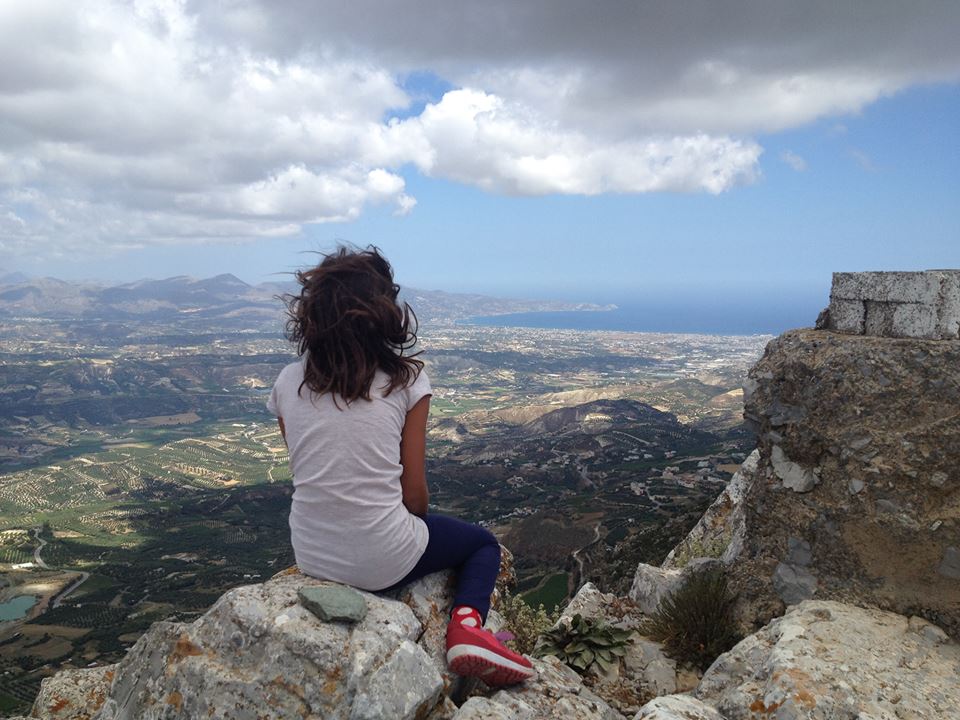
The mountaintop shrines of Mount Juctas in Archanes, Crete are situated on twin peaks, which may have symbolized breasts. Ancient shrines on the northern peak date from 2200 BCE until at least the end of the Ariadnian (Minoan) period in 1450 BCE. A crevice in the rock was filled with offerings of pottery, clay images of women and men in ritual dress, diseased bodies and body parts, sheep and cattle, and other objects. Excavations to a depth of 13 meters did not reach the bottom layers. Many offerings had been burned, suggesting that the objects were first thrown into fire and then dropped into the crevice. People who climbed the mountain for the festivals would have spilled over both peaks and there may have been shrines as well as fires on both of them.

Continue reading “Legacy of Carol P. Christ: Mountain Mother, I Hear You Calling”

The Mountain Mother: Reading the Language of the Goddess in the Symbols of Ancient Crete by Carol P. Christ

Before he told the story of how his people received the sacred pipe, Black Elk said:

So I know that it is a good thing I am going to do; and because no good thing can be done by any man alone, I will first make an offering and send a voice to the Spirit of the World, that it may help me to be true. See, I fill this sacred pipe with the bark of the red willow; but before we smoke it, you must see how it is made and what it means. These four ribbons hanging here on the stem are the four quarters of the universe. The black one is for the west where the thunder beings live to send us rain; the white one for the north, whence comes the great white cleansing wind; the red one for the east, whence springs the light and where the morning star lives to give men wisdom; the yellow for the south, whence come the summer and the power to grow.

But these four spirits are only one Spirit after all, and this eagle feather here is for that One, which is like a father, and also it is for the thoughts of men that should rise high as eagles do. Is not the sky a father and the earth a mother, and are not all living things with feet or wings or roots their children? And this hide upon the mouthpiece here, which should be bison hide, is for the earth, from whence we came and at whose breast we suck as babies all our lives, along with all the animals and birds and trees and grasses. And because it means all this, and more than any man can understand, the pipe is holy. [italics added]

In this passage Black Elk illustrates the multivalency of symbols: the sacred pipe does not have a single meaning, but many meanings, in fact, more meanings than anyone can understand. Continue reading “The Mountain Mother: Reading the Language of the Goddess in the Symbols of Ancient Crete by Carol P. Christ”

Mountain Mother, I Hear You Calling by Carol P. Christ

carol christThe mountaintop shrines of Mount Juctas in Archanes, Crete are situated on twin peaks, which may have symbolized breasts. Ancient shrines on the northern peak date from 2200 BCE until at least the end of the Ariadnian (Minoan) period in 1450 BCE. A crevice in the rock was filled with offerings of pottery, clay images of women and men in ritual dress, diseased bodies and body parts, sheep and cattle, and other objects. Excavations to a depth of 13 meters did not reach the bottom layers. Many offerings had been burned, suggesting that the objects were first thrown into fire and then dropped into the crevice. People who climbed the mountain for the festivals would have spilled over both peaks and there may have been shrines as well as fires on both of them.

Goddess Pilgrim on Mount Juctas

With lack of imagination, archaeologists often write that worship in mountaintop shrines in Crete began when the king ascended the mountain to survey his realm. This ignores the fact that people are like goats and will climb anything if they can. Bones provide evidence of domesticated sheep, goats, and cattle in Crete long before there were kings. Surely shepherds climbed Mount Juctas before any kings did.

The idea that mountains are for kings also ignores the fact that there are no kings in Crete today, no realms to be surveyed, and yet the people of Archanes still ascend the mountain for the summer festival known as the Transfiguration of Christ on August 5th and 6th. A church called Afendis Christos or Christ the Lord on the southern peak of Juctas is the destination of current pilgrims. Today the uneven dirt road recently cut into the mountain is clogged with cars (only) during the festival. Continue reading “Mountain Mother, I Hear You Calling by Carol P. Christ”

WANGARI MUTA MAATHAI AND SACRED MOUNT KENYA by Carol P. Christ

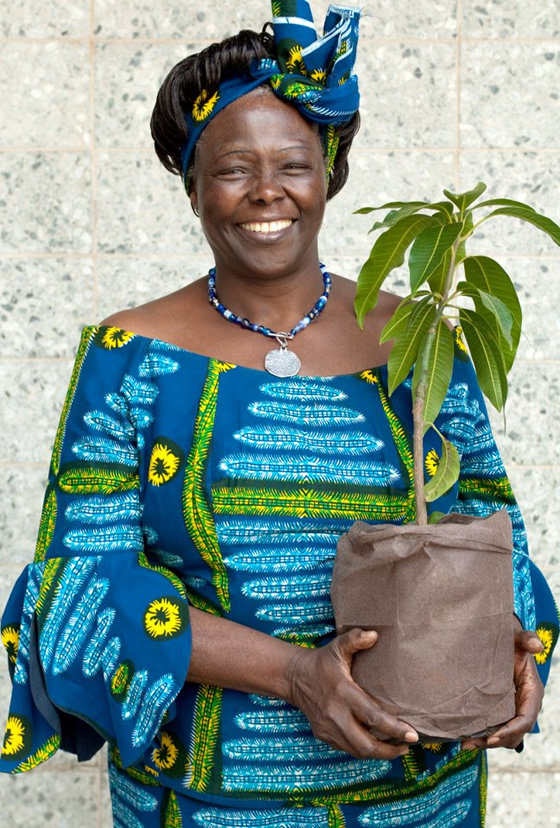
carol-christWangari-Maathai-1September 25, 2013 is the second anniversary of the death of environmental, peace, justice, and democracy advocate and Nobel Peace Prize recipient Wangari Muta Maathai.

Wangari Muta was born in 1940 in a round hut in rural tribal Kenya.  Wangari’s tribe considered the fig tree to be holy, and she was taught that one is never to cut a fig tree down or to use its branches for firewood.  Wangari spent many happy childhood hours in the shade of a fig tree that grew by a nearby stream.  Fig trees play an important role in the ecological system of the Rift Valley of Kenya.  Their roots penetrate the hard rock surface of the mountains to find underground water, thus opening channels where the water flows upward to fill streams and rivers.

As an adult Maathai learned that the fig tree she played under had been cut down by a settler with the result that the river had dried up.  This was happening all over Kenya on a massive scale to make room for cash crop plantations.  Rivers were silting up and widespread erosion threatened to turn the fertile Rift Valley into a desert. Crops were failing, animals were starving, there was no wood for cooking fires, and rural people were suffering.

Maathai  says that as she was thinking about this problem “It just came to me: ‘Why not plant trees?’ … This is how the Green Belt Movement began.”  Continue reading “WANGARI MUTA MAATHAI AND SACRED MOUNT KENYA by Carol P. Christ”

A New Glossary for Crete: The Power of Naming and the Study of History by Carol P. Christ

carol-christThe words we use affect our thinking. In the case of ancient Crete the repetition of the terms “Palace,” “Palace of Knossos,” “King Minos,” “Minoan,” “Priest-King,” and “Prince of the Lilies” shape the way we understand history–even when we ourselves know these terms are incorrect. We must engage in “new naming.”

Ariadne. May have been a name of the Goddess of pre-patriarchal Crete. The ending “ne” signifies that Ariadne is not of Greek or Indo-European origin and thus predates the later Greek myths.

Ariadnian. The name I have given to the Old European pre-patriarchal culture of Crete, from arrival of the Neolithic settlers from Anatolia c.7000 BCE to the Mycenaean invasion c.1450 BCE. Arthur Evans named the Bronze Age (c.3000-1450 BCE) culture of Crete “Minoan” after King Minos of Greek mythology, son of Zeus and Europa, husband of Pasiphae, father of Ariadne, whose gift of the secret of the labyrinth to Theseus led to the downfall of her culture. Evans assumed that Minoan Crete was ruled by a King.

This image I call “Ariadne Dancing” could become the new “icon” of Ariadnian Crete.

minoan woman dancing

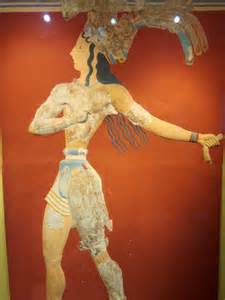
It could and should replace the “icon” of  the “Priest-King” Arthur Evans’ “imaginatively” reconstructed and named the “Prince of the Lilies.”

 prince of the lilies

Once we remove the crown which probably belonged to a Sphinx, the figure’s white color and athletic body suggests it was intended to portray a young female bull-leaper leading a bull. Continue reading “A New Glossary for Crete: The Power of Naming and the Study of History by Carol P. Christ”

Inspiration by Jassy Watson

Jassy_Agora1-150x150This “Mountain Mother” painting is an ode to women’s earth wisdom and is my prayer for reclaiming of that wisdom to heal the earth and all her beings.
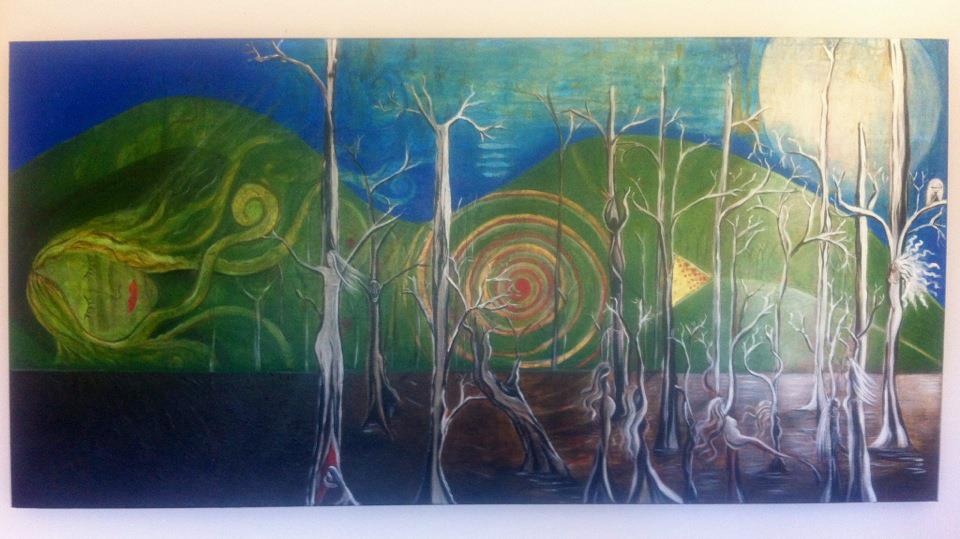
When I am inspired to paint I can think of nothing else, the desire to put brush to canvas takes over every ounce of my being, and it is difficult to be present in everyday life. There are other times where I’ve wanted to create but inspiration was lacking: I would start a painting and have no desire to finish it. I would often get quite frustrated at myself.  It’s only recently that I’ve had the realisation that down time is just as significant as the up time. Rather than get anxious about not creating a masterpiece, I have learnt to go with the flow, take pleasure in the time of rest, because I know it’s all part of the cycle.  My inspiration always returns with abundance. Presently I am bursting at the seams with creativity, and I can’t find enough hours in the day to let all this inspired energy out. I am overcome with a sense of urgency I can’t explain. I am committed to paint and write with the intention that my personal message becomes part of the global message for change as our sacred feminine wisdom is being called forth. I am determined and full of courage to be part of the movement that brings about a shift in all aspects of life.

My present state of inspiration can be attributed to my recent Goddess pilgrimage to Crete with Carol Christ. I am sure that anybody who has attended such pilgrimages will attest that these experiences are life-changing. Travel alone is profound, but to share the experience in a circle of twenty amazing women is even more so. We sang, danced, trekked through the Cretan countryside, delved deep into caves; the womb of our great mother, climbed mountains and cleansed in the sea. We prayed and communed with the goddess daily, participating in rituals that were meaningful, un-contrived and safe. While I have always known that the goddess is everywhere, within and without–encountering her ancient past in a present day context is a feeling I’m not sure I can adequately describe with words, hence my desire to express some of these feelings through my art.

 “Mountain Mother” Jassy Watson
“Mountain Mother” Jassy Watson

Continue reading “Inspiration by Jassy Watson”

Reading Plato’s Allegory of the Cave as Matricide and Theacide by Carol P. Christ

When I read Plato’s allegory of the cave as an undergraduate, I was told it had something to do with the idea that the “form” of a table is more “real” than the table itself. I must confess that I had no idea what this could possibly mean.

As a graduate student, I struggled with philosophical and theological ideas rooted in Platonism.  Rosemary Radford Ruether named the flawed worldview created by a “classical dualism” that separates mind from body, spirit from the world, rationality from emotion, and male from female.  Her ground-breaking essay “Mother Earth and the Megamachine” clarified the difficulties I was having.

Western philosophy, described by Alfred North Whitehead as a series of footnotes to Plato, had gotten off on the wrong foot. At its very beginnings, western philosophy had attempted to sever mind from the body and nature, alleging that “man’s true home” was not life in the body on planet earth. Continue reading “Reading Plato’s Allegory of the Cave as Matricide and Theacide by Carol P. Christ”