

Viśākhā: Surrogate Mother of Buddhism by Oxana Poberejnaia

oxanaViśākhā is often called the greatest female lay follower of the Buddha. She prompted the Buddha to give numerous teachings. She also donated generously to the Sangha (monastic order). Her crowning contribution was building a monastery called Migāramātupāsāda.
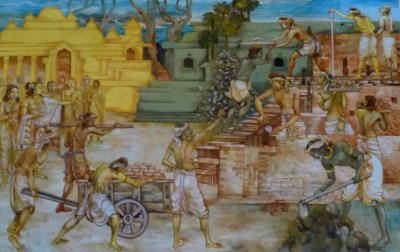
Visakha Directing the Construction of the Eastern Monastery in Savatthi, at the Nava Jetavana, Shravasti

She is said to either die as a “stream-enterer” (a person who will definitely become enlightened, no matter how many life times it will take). Another account about her afterlife says that she would live for eons in happiness in one of the divine realms before achieving the final Liberation there and then.

Viśākhā appears in numerous Suttas of Theravadin Canon. From the modern feminist point of view, the content of these discourses reinforces patriarchal gender stereotypes. In particular, Viśākhā is portrayed as a caring Mother for her relatives, Bhikkhus (Buddhist monks and nuns), and other people.

Continue reading “Viśākhā: Surrogate Mother of Buddhism by Oxana Poberejnaia”
The Elusive Patriarchy by Oxana Poberejnaia

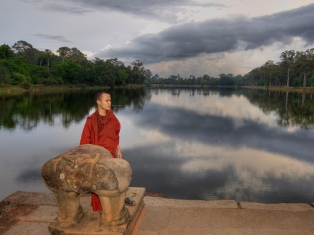
oxanaThe sense of separate personal identity is elusive. It is difficult to observe, find and bring to the surface of consciousness where, according to Buddhist beliefs, it dissipates naturally, like a bubble of foam popping. In the same way patriarchy is entrenched in so many different ways and on so many different levels in society that it is as difficult to reach out to it and weed it.

tharavadamonkThere is a Sutta in Theravadin Canon called “Khemaka Sutta” (About Khemaka). The main character in the Sutta, Buddhist monk Khemaka explains his understanding of the “lingering residual ‘I am’ conceit, an ‘I am’ desire, an ‘I am’ obsession.” Khemaka says that it is as difficult to capture and wash away as the remaining scents in clothes that have been washed over and over again.

In Western psychology, there is a notion of catharsis: allowing one self to experience previously repressed emotions. For instance, ancient Greek tragedies like Oedipus are seen as these psychological journeys for the audience. The spectators initially refuse to admit they have certain forbidden impulses. However, through empathising with the protagonist they unwittingly allow themselves to experience those. Healing happens as a result.

Continue reading “The Elusive Patriarchy by Oxana Poberejnaia”

Like Birds in the Sky by Oxana Poberejnaia

oxanaI once heard an educated non-feminist say that it would not matter if women came into positions of power. He gave examples of Margaret Thatcher, Indira Gandhi and other women and pointed out that once in power they started wars and engaged in other aggressive tactics, just like men politicians.


Firstly, the obvious logical mistake is that not every woman is a feminist, in the same way as not every man is an agent of patriarchy. Secondly, when talking about systems and key positions within these systems, one can see that these posts will play the role that is predetermined by the system.


systemIt would not matter if a head of a patriarchal organisation is a feminist or not. She or he will play a role of a head of a patriarchal system. That is, unless she changes the system altogether and it ceases to be patriarchal.
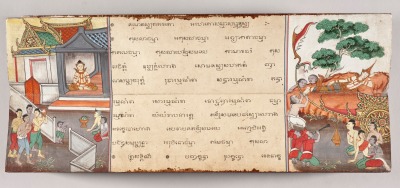
 

This reminded me of verses from The Dhammapada, a collection of ancient Buddhist verses, which speak about having no home and leaving no trace. By behaving thus, we remain independent of the dominant systems and give our opponents no opportunity to control us.

Continue reading “Like Birds in the Sky by Oxana Poberejnaia”

Touch the Earth by Oxana Poberejnaia

oxanaI suddenly felt sad. Not depressed, but low and sorrowful. I realised that it must have been because I had just exploded and answered my husband in an angry, tense voice. He had said something and I reacted in this overblown manner. What he said could have been construed as an encroachment on my rights as a woman and a human. Whether this was the case or not, I was saddened by my own violent reaction.

How did that happen? Earlier that very day I was walking outside, quietly surveying autumn scenery of the North West England. The leaves were starting to turn in earnest. The birch trees sent their yellow carved leaves to the other side of the road, which did not have birch trees. I was in a state where my “I”, my “Ego” was relaxed and not constricted to just the confines of my body. I became conscious of this fact and a thought arose: “Here we go, finally I am getting close to Liberation.”

Continue reading “Touch the Earth by Oxana Poberejnaia”

Whose life is this: yours or your identity’s? By Oxana Poberejnaia

oxanaWhat is, would you think, one of the foremost problems that my Russian friends and relatives mention to me? Economy? Politics? Personal and family issues? Nope. It is immigrants in Europe. I hear genuine concern and aversion when my friends mention the number of Muslims in the UK or the fact that there are predominantly black arrondissements (city districts) in Paris.

This mystified me. I sensed that although they were talking about countries foreign to them, they perceived the situation as a personal threat. Why should this be so?

I postulate that it is my old frenemy, identity (or “ego”, or “self” – whichever you prefer) that is at work here. I also realised that the same mechanism works wherever people protest against feminism, contrary to all and any rational arguments. Very often, even women protest, to their detriment.

Continue reading “Whose life is this: yours or your identity’s? By Oxana Poberejnaia”

The Fringe is Our Stronghold by Oxana Poberejnaia

oxanaRecently I have come across several stories of women’s fringe spiritual movements or practices. This made me think about the role of outsiders’ or minority views in religions and society.

Patriarchy pushes women and their issues to the margins of society and religion. It seems that there women sometimes invent their own spiritual practices. These allow women to stand their own ground in religious matters, to preserve self-respect and to keep the hope of the highest spiritual attainment.

Quite often these beliefs and practices seem shocking in their bizarreness and their stubbornness not to accept orthodox norms.

Continue reading “The Fringe is Our Stronghold by Oxana Poberejnaia”

O Tempora o mores by Oxana Poberejnaia

oxanaI have entitled this post O Tempora o mores after a sentence by Cicero, meaning “Oh what times! Oh what customs!” I would like to discuss how some of the messages we get from religious writings are defined by the age in which they were written.

As a result, I argue that it is wiser to pay more attention to the overall message of a given spiritual tradition, rather than to subject our view on a single quote.

Phra_Malai_Manuscript_LACMA_M.76.93.2_(11_of_21)One of the most popular texts in Thai Buddhism (which is of Theravada tradition) is called Phra Malai Klon Suat, “Chanted Version of Phra Malai.” It was reproduced copiously in the 19th century, with the earliest version dating from the 18th century. However, its origins are believed to be more ancient, coming from the original Indian Buddhism.

Continue reading “O Tempora o mores by Oxana Poberejnaia”

The good vs the better by Oxana Poberejnaia

oxanaToday let’s talk about the relationship between the Ultimate and the relative. I do not have the answers to these tricky questions, I would just like to outline the problems. Why, on the Buddhist path, do I often tell myself and others not to rush to get Enlightened immediately? Why do I often keep silent about my friends’ attitudes that I find not so feminist?

There is an old platitude that the theme of the Soviet films about social problems was the “struggle of the good against the better.” This was the case because in the USSR there supposedly was no class struggle and no problems proceeding from the rule of the Communist Party. So in the scripts the conflict was set up between good Soviet people and even better Soviet people, the latter even more dedicated to the Communist ideals.

The fact that I am a feminist and follow a Buddhist path must mean that in principle I am all for “the better” and even, “the best” – that is, a social world where women and men enjoy equal rights and everyone is enlightened.

Continue reading “The good vs the better by Oxana Poberejnaia”

“Suchness” of inequality vs. the “story” of patriarchy by Oxana Poberejnaia

oxanaIn the TV film about American suffragists “Iron Jawed AngelsAlice Paul (played by Hilary Swank) says to a psychiatrist who came to prison to assess her mental state during her hunger strike:

You asked me to explain myself. I just wonder what needs to be explained. Let me be very clear. Look into your own heart. I swear to you, mine’s no different. You want a place in the trades and professions where you can earn your bread? So do I. You want some means of self expression? Some way of satisfying your own personal ambitions? So do I. You want a voice in the government in which you live? So do I. What is there to explain? Continue reading ““Suchness” of inequality vs. the “story” of patriarchy by Oxana Poberejnaia”

Feminism and Buddhism: constructive wave interference by Oxana Poberejnaia

oxanaAlthough it can be said that the Buddhist teaching can benefit all, including feminists, it can also be argued that Feminism has a lot to teach Buddhist practitioners. Rita M. Gross made this point brilliantly in her “Buddhism After Patriarchy: A Feminist History, Analysis, and Reconstruction of Buddhism.”

While Buddhism generally encourages investigation, it is still easy for a Buddhist practitioner to become complacent. This complacency can be caused by the feeling of safety that your particular school of Buddhism provides. How your mind works, how the world works are all explained, all is well, just keep practising in the assigned paradigm, there is no need for thinking outside the box.

However, Buddhists often forget that it is exactly outside the box where the Buddha has been pointing with his every teaching, ever since he got liberated. When a Buddhist practitioner is stuck, the vigour of Feminism can provide inspiration. Feminists simply never stopped, do not intend to stop now.

Continue reading “Feminism and Buddhism: constructive wave interference by Oxana Poberejnaia”