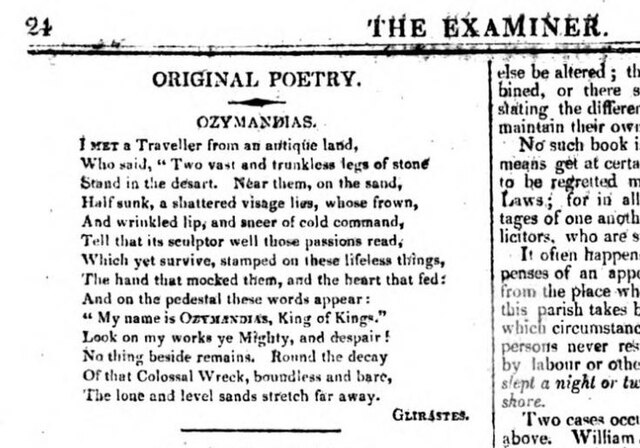
I met a traveller from an antique land Who said: “Two vast and trunkless legs of stone Stand in the desert . . . Near them, on the sand, Half sunk, a shattered visage lies, whose frown, And wrinkled lip, and sneer of cold command, Tell that its sculptor well those passions read Which yet survive, stamped on these lifeless things, The hand that mocked them, and the heart that fed: And on the pedestal these words appear: ‘My name is Ozymandias, King of Kings: Look on my works, ye Mighty, and despair!’ Nothing beside remains. Round the decay Of that colossal wreck, boundless and bare The lone and level sands stretch far away.”
Percy Bysshe Shelley 1792 – 1822
There has been discussion of what to name Trump’s ever-expanding ballroom. Some have suggested naming it after Epstein. I would suggest naming it after Ozymandias from Shelley’s poem.
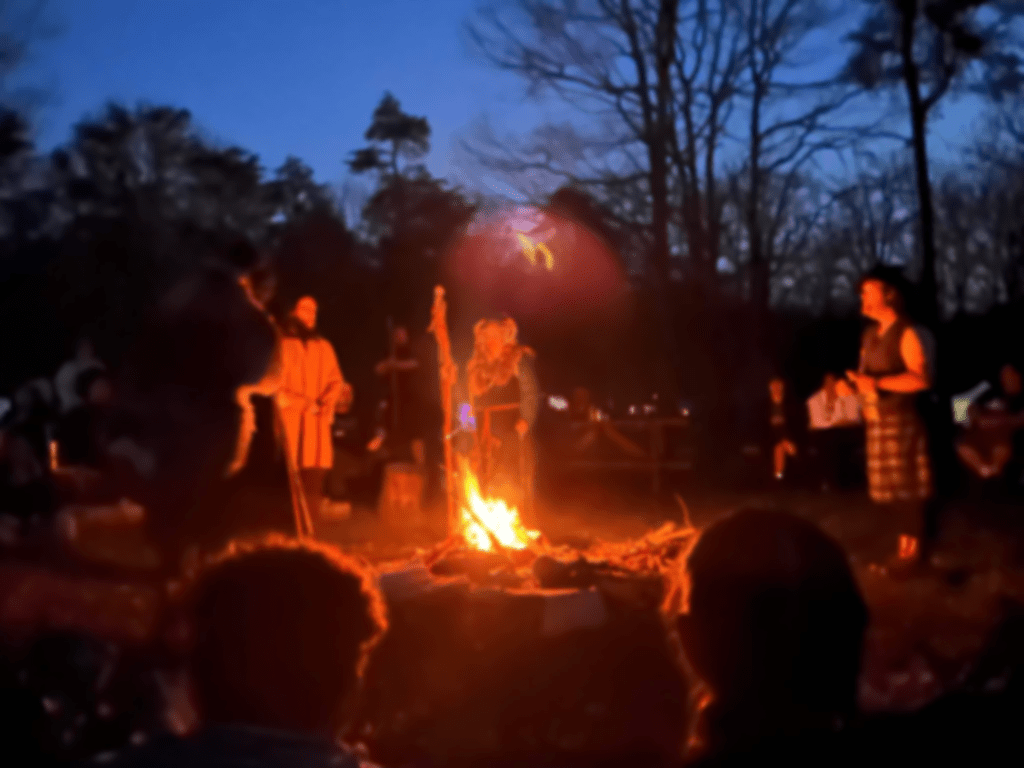
There is something about building projects that feed to the patriarchal ego. The Patriarchal ego stands on permanence, largess and if that involves crushing those “below” them, that is just how it is. Pre-patriarchal pagan systems focus on the cycles of life and are based on an understanding that impermanence is what life is all about. Life works on cyclic movement. The seasons, the moon, the sun, the stars, all is in motion and all presages different aspects of the wheel of life.
Actually it comes twice, once in midsummer, the longest day of the year, and once in midwinter, the longest night. Winter Solstice is also known as the first day of winter.
For those of us attuned to the cycles of Mother Earth, Winter Solstice is a time to celebrate the dark and the transformations that come in the dark. Many of the customs associated with Christmas and Hannukah, including candles, Yule logs, and trees decorated with lights were originally associated with Winter Solstice. The extra pounds put on during winter feasting were insulation against the cold winter nights.
Those who fear that many of the customs of the Christmas season might be pagan are right. As we learn again to honor our place within the cycles of birth, death, and regeneration, we can return these customs to their roots in the circle of life.
No matter which or how many gods we believe in, thinking about what we’ve done wrong and how we can set it straight is useful. The Day of Atonement, the Talmud says, “absolves from sins against God, but not from sins against a fellow man unless the pardon of the offended person is secured.”
Back in the Stone Age, otherwise known as the early 1980s, I had jobs as a technical writer and editor in five different industries, including aerospace and computer development. Hey, I was trained as a Shakespearean scholar, but in those days—pretty much like today—there were almost no jobs in the academy for newly-hatched Ph.D’s. So I tried technical writing. At one of the aerospace jobs, I sat in the “bullpen”—me and nineteen middle-aged white guys—whereas all the other women slaved—on typewriters in that pre-computer age—in the typing pool. There was a major class distinction in that aerospace firm, and I was glad to be with the guys. (Yes, shame on me.) Those were the days of 9 to 5. As far as I’m concerned, that movie is nonfiction.
One of my tech-writing buddies at the aerospace company was a former Jehovah’s Witness who had been disfellowshipped because his beard was the wrong shape and he’d refused to correct it. Another was an older man who had studied with Earnest Holmes himself and had also known Manly P. Hall in earlier days. A third friend, the project librarian, was a Conservative Jew. All three of these guys soon noticed the books I was bringing to read at lunch. These included the works of Dion Fortune and Gerald B. Gardner, and numerous metaphysical authors, plus every book I could find on alchemy, the tarot, New Thought, reincarnation, trance channeling…well, you get the idea. I was exploring occult worlds and ideas. When we weren’t talking about how to help the engineers write gooder English and I wasn’t trying to figure out how a FLIR (Forward-Looking InfraRed) helmet works, my three buds and I had some majorly interesting conversations on comparative religion and the occult (the word means “secret, hidden”) aspects of religions in general.
One day the Jewish librarian brought me a book to add to my library. This was the 1973 edition of The Jewish Catalog. What a wonderful book! I still have it. It’s sitting next to my keyboard as I type this.
Back in those innocent days, I still believed the pagan myth of the nine million witches burned by the inquisition during the Middle Ages. Yes, it’s a myth—there were never that many witches on the face of the earth at the same time; such a holocaust would have nearly depopulated medieval Europe. I have since learned that it is shameful to compare a mythological holocaust with the real Holocaust of World War II. I read The Jewish Catalog from cover to cover and learned a great deal.
Now flash forward to 2002 when the owner of RedWheel/Weiser phoned to ask me to write a book for them. I immediately said yes. The book, which they titled Pagan Every Day, is not, however, a pagan tome. It’s a daybook, a year and a day of short essays on topics that include goddesses, gods, and old pagan festivals and philosophy, and also saints and holy days from Christianity, Judaism, Islam, Hinduism, and Buddhism, plus less well known religions, plus interesting historical events…and then I also named Miss Piggy as The Goddess Of Everything. I get fan emails from people saying they reread the book, a day at a time, every year and still enjoy every page.
For September 24, I wrote about Judy Chicago’s Dinner Party, which was the most amazing exhibition I’d ever seen. The next day that year was Yom Kippur. I turned to my copy of The Jewish Catalog, where I learned about an obscure custom called kapparot. Here is what I wrote. Yes, I believe that we can borrow—but not pirate!—other people’s customs, acknowledge and express our gratitude to those other people and their religions, and then adapt what we borrow to a pagan perspective. After all, we’re all kin.
September 25: Yom Kippur
The Jewish Catalog describes custom called kapparot, which “entails swinging a chicken around one’s head as a…symbol of expiating sins. The chicken is then slaughtered and given to the poor….” Most people these days tie money in a handkerchief and swing that around their head, saying, This is my change, this is my compensation, this is my redemption.
Yom Kippur, the last of the ten days of Yamim Noraim, occurs at nightfall on the ninth day of Tishri. The rites for Yom Kippur are set forth in Leviticus 16.
No matter which or how many gods we believe in, thinking about what we’ve done wrong and how we can set it straight is useful. The Day of Atonement, the Talmud says, “absolves from sins against God, but not from sins against a fellow man unless the pardon of the offended person is secured.” People seeking recovery in Twelve-Step programs likewise turn their lives over to the care of “God as they understand him” (Step 3), make a list of people they have harmed and become “willing to make amends” (Step 8), and then actually make amends (Step 9).
Pagans can make amends before Samhain. We want to have a clean emotional field in which to rest over the winter and plant fresh seeds in when spring comes. Let’s revive that old Jewish custom. But not swinging the chicken! That’s cruelty to swinger and swingee. Tie crystals or red corn or other symbolic items in a clean white handkerchief and swing it around your head, reciting the blessing quoted above. Then go around and see the people you need to see. Speak heart to heart with them. Give them something blessed from your handkerchief. Get on with your lives, as friends or no longer as friends, but not as enemies.
BIO: Barbara Ardinger, Ph.D. (www.barbaraardinger.com), is a published author and freelance editor. Her newest book is Secret Lives, a novel about grandmothers who do magic. Her earlier nonfiction books include the daybook Pagan Every Day, Finding New Goddesses (a pun-filled parody of goddess encyclopedias), and Goddess Meditations. When she can get away from the computer, she goes to the theater as often as possible—she loves musical theater and movies in which people sing and dance. She is also an active CERT (Community Emergency Rescue Team) volunteer and a member (and occasional secretary pro-tem) of a neighborhood organization that focuses on code enforcement and safety for citizens. She has been an AIDS emotional support volunteer and a literacy volunteer. She is an active member of the Neopagan community and is well known for the rituals she creates and leads.
I just returned from a Pagan festival in Tennessee. This is the first overnight event that I have gone to post Covid pandemic and also the first Pagan festival that I have ever been to. Pre-pandemic all the events that I have gone to have been Women’s events and gatherings such as Gather The Women Annual Gathering, ALisa Starkweather’s Daughters of the Earth, Midwest Women’s Herbal Conference and others along those lines.
They pretty much all had a Pagan dusting to them because anything where you find the Divine in the Feminine and in the Earth, rocks, crystals, herbs, the stars, and populated by people who live closer to the Earth, avoid crowds, are empathetic, well, you’ve got Pagan leanings.
But I shied away from the word ‘Pagan’ for a long time, because I grew up Catholic and even though growing up in a very waspy suburb of Dallas, I did not give it much thought at all, I have since realized that the undercurrent of my belief system was that Pagans were evil, animal sacrificing, overly sexual, devil-worshiping and otherwise just something to be avoided.
Two recent posts, Community Immunity by Natalie Weaver on May 6, and Carol Christ’s May 11 essay, Women Invented Agriculture, Potter, and Weaving…, have spurred me to focus and finally share something that I’ve meant to for a long time. For 30 years I helped my husband realize his dream of a small farm, while I continued working as an artist. We both came from urban backgrounds and both (separately) charged out into the wild world at age 17, inventing as we went along. That fearless approach continued with the farming many years later.
We started with sheep and cows but soon turned to focussing on goats. We wanted to farm organically from the start (1988) and that, combined with a lack of childhood indoctrination into Big Ag Culture had us devouring all the information we could while carefully observing the animals and applying our shared humanistic approach to daily life to the care of goats. I say this last part so no one imagines a slavelike situation as is often seen in images of dairy farms. Continue reading “Caprine Community by Laurie Goodhart”
Last fall, my family took a vacation to Myrtle Beach, South Carolina, where I grew up. As a child, one of my favorite places to visit was Brookgreen Gardens, a wildlife preserve that was once the winter home of Archer and Anna Hyatt Huntington. Anna was a prominent sculptor of the early twentieth century, and decided that part of the property should be sculpture gardens open to the public.
When they purchased the property, many of the trails were lined with live oak trees; Spanish moss still drips like thick honey off twisted and gnarled branches that drape over bricked pathways. As a child in the Low Country, live oaks always symbolized timelessness. They felt eternal and otherworldly, and my memories of visiting the Angel Oak near Charleston on school field trips – of throwing my legs over her lower branches, bark scratching up my scrawny legs – these are memories I still carry with me when I look to what was beautiful about my childhood. Continue reading “Knowing the Live Oaks: Finding the Balance Between Historicity and Inspiration in Neopaganism and Goddess Spirituality by Chris Ash”
When it comes to my family, I’ve always felt different. One of my earliest memories from when I was really young was being told that I felt things too passionately—that I felt too much. What was never said but was implied was that I felt dissent too much, too often, too vocally. It made people uncomfortable. It made my family uncomfortable. When it came to understanding my faith/religious path, my family and I started diverging early on, never really meeting again—at least not for now.
When I was about five, I remember asking why women could not be priests. My mother brushed it aside and said we could be nuns. She was blind to the inherent misogyny behind the same Church that so many of her female family members had built (we come from a long line of nuns and Jesuits). I thought maybe someday I could be a woman priest. I would change it all. I would be Pope Joan.
When I was thirteen, I started noticing the wealth involved in the Roman Catholic Church, the opulence of the lived Catholic life. When I asked my parents why the Church did not lead in example and live in poverty using its wealth to actively live the gospel, I was told, “ This wealth is a gift to humanity. It is there for all of us, a patrimony to those who open their hearts.” I wasn’t talking about art, I was talking about the RCC’s gold assets—valued in the billions —but it didn’t matter. I’ve seen my family donate to Church building funds my entire life—buildings that were then sold off to pay for the Church’s offenses later on. Still, I thought if I became more involved, with the “right kind of Catholics”, I would be able to change the Church from within. Continue reading “You Are What You Read by Martha Cecilia Ovadia”
It has occurred to me that it’s possible that some of the bloggers and readers of this site may not know very much about pagans, so here’s a little New Year’s lesson. The first thing to know is that pagans are almost by definition rebels. That means any generalization anyone may make will almost certainly have a thousand exceptions. You may have heard what Will Rogers wrote in 1932: “I am not a member of any organized political party. I am a Democrat.” Well, the same goes for pagans: many of us joke that we don’t belong to an organized religion. “Pagan,” by the way, is the generic term. Witches, Wiccans, and eclectics (among others, see below) are specific terms. Many of us belong to what are called traditions, which are somewhat analogous to the Protestant denominations. Some traditions are said to go back to the Middle Ages (or further back), but this is generally nonsense. Paganism as it is practiced today is a modern religion looking for (and—voilà! finding!) roots in the ancient and classical pantheons or in Old Europe, where archaeology shows us that the Goddess was worshipped thousands of years before Abraham met his god, ca. 2000 BCE (see Marija Gimbutas’ text for more information on this). Continue reading “Who Are the Pagans? by Barbara Ardinger”
Barbara Ardinger (one blogger here – watch for her “twist” on this in January!) and I were discussing that an explanation of the pagan year and our Sabbats might be in order. Sometimes when we are immersed in our own spiritual practice, we forget that those who read what we have written may not have a clear understanding of what forms the basis of the holy days we speak of in our articles. These holidays are called Sabbats. The word sabbat is of obscure etymology but was understood in the Middle Ages to mean a gathering of witches and heretics. The word comes from the Hebrew Shabbath meaning a day of rest. Christians use the word Sabbath for Sunday, their traditional day of worship. It is interesting to note this was not a term originally coined by pagans, themselves. It has been borrowed or adopted for use today.
Pagans see the journey traveled in a year or a lifetime as kind of wheel. It is based on the earth’s journey around the sun. One rotation equals one year. We call it the Wheel of the Year. Since the origins of most of the traditions practiced by pagans in this country come from the Northern Hemisphere, the turning of the wheel is based on the Earth’s travel around the sun and the impact that is felt in the Northern Hemisphere. It would be exactly the opposite for those in the Southern Hemisphere. Continue reading “The Pagan Wheel of the Year by Deanne Quarrie”
To me, it isn’t the belief that is meaningful, it is the feeling I get in those magical moments when I am connected to spirit.
When I was young, my mother owned a girls’ camp on the shores of a string of small lakes in Northern Wisconsin. From the age of 2 until I was 16, I spent every summer surrounded by silver birch trees and strong women. We lived in Army surplus tents and learned to ride horses and paddle canoes, build campfires and treasure the female spirit. Sunday evenings we would walk two by two singing through the forest down to the lake, where we would sit on pine logs on a little point of land between two shores and listen to the waves lap against sand as my mother read to us from Gilbran and her favorite poets. Those were our “Sunday vespers services.”
So I was raised on a Goddess path, although neither my mother nor I knew it then.
I had no interest in religion, which to me was Big Daddy in the Sky. It never occurred to me that what I felt in the forest had anything to do with religion, and I thought being spiritual meant that one prayed a lot and didn’t have any fun. When I left home at 18 and moved to Greenwich Village, I left the feelings I had those summers, what I know now was the spiritual part of me, behind. The world seemed full of wonderful adventures, and I wanted to have my share. Continue reading “Serving Spirit by Wendy Griffin”




 Two recent posts,
  Last fall, my family took a vacation to Myrtle Beach, South Carolina, where I grew up. As a child, one of my favorite places to visit was Brookgreen Gardens, a wildlife preserve that was once the winter home of Archer and Anna Hyatt Huntington. Anna was a prominent sculptor of the early twentieth century, and decided that part of the property should be sculpture gardens open to the public.


 Feminism and Religion