Legacy of Carol P. Christ: Coming Together to Honor the Mother

This was originally posted August 13, 2019

From the evening of the 14th through the day and night of the 15th of August, thousands of pilgrims ascended the Holy Rock of Petra to honor the Panagia—She Who Is All Holy. 

There is “something really beautiful”* in being among them.
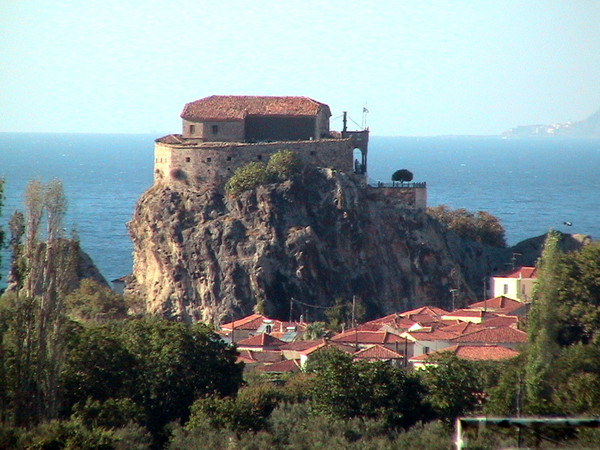
Six of us set out from Molivos at 7:30 on the 14th to meet in the square of Petra to ascend to the church.  Petra was already full of so many pilgrims that police had forbidden traffic in the main square and were directing cars into a nearly full parking lot in a field.  When we got out of the car, the two others who came with me and I had a perfect view of the steady stream of pilgrims climbing the rock, which was already lit up in the twilight.

Continue reading “Legacy of Carol P. Christ: Coming Together to Honor the Mother”
Ariadne and Me – Stumbling Toward the Divine by Arianne MacBean

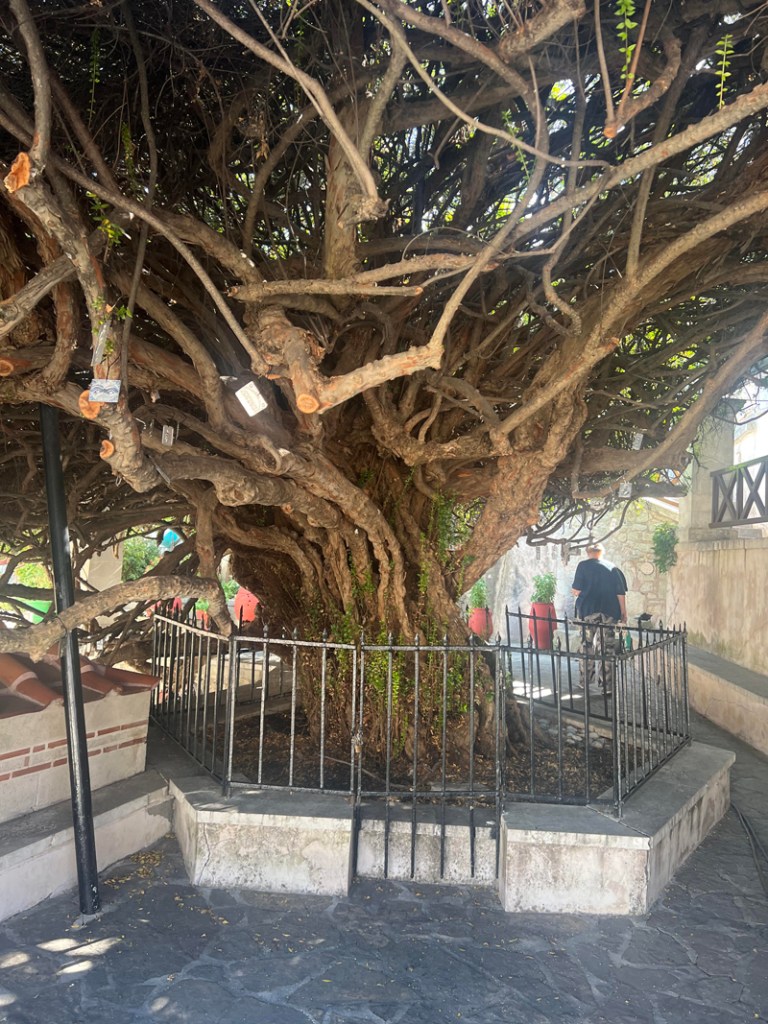
The Sacred Myrtle Tree with its protective fence at Paliani Monastery

I went to Crete because I longed for some kind of communion with Ariadne. Each time I gathered in ritual with the women on my trip, I hoped She would speak to me, or that I would feel something and know that She was in me, or I within Her. At Paliani, I had these same wishes as I walked toward the over-1000-year-old sacred myrtle tree. Set back in the corner of the quiet convent, I was struck by the contrast between the tree’s black bark and surrounding black fence set against the hopeful flickering of silver ex-votos that filled each branch. I walked around the back of the tree on a slight upper landing and searched for a branch within reach. Finding a spot where I could rest my forearm, albeit awkwardly, I leaned in and waited for Her.

Continue reading “Ariadne and Me – Stumbling Toward the Divine by Arianne MacBean”

Legacy of Carol P. Christ: Why a Goddess Pilgrimage?

This was originally posted on October 1, 2012

What is a Goddess Pilgrimage and why are so many US, Canadian, and Australian women making pilgrimages to ancient holy places in Europe and Asia?  The simple answer is that women are seeking to connect themselves to sources of female spiritual power that they do not find at home.

Traditionally pilgrims leave home in order to journey to a place associated with spiritual power.  “Leaving home” means leaving familiar physical spaces, interrupting the routines of work and daily life, and leaving friends and family behind.  For the pilgrim, “home” is a place that has provided both comfort and a degree of discomfort that provokes the desire to embark on a journey.  The space of pilgrimage is a “liminal” or threshold space in which the supports systems of ordinary life are suspended, as Victor Turner said.  A pilgrim chooses to leave the familiar behind in order to open herself to the unfamiliar—in hopes that she will return with new insight into the meaning of her life. 

Continue reading “Legacy of Carol P. Christ: Why a Goddess Pilgrimage?”

Initiation and Descent part 1 by Terry Folks

Review: In my first two posts about my recent Goddess Pilgrimage to Crete, I invited you to consider your stage in your current Heroine’s Journey as you followed me.

In my hybrid of Joseph Campbell’s mono-myth with feminist scholar Maureen Murdock’s version, the first six stages of the Heroine’s journey are: Ordinary World, the Call to Adventure, Refusal of the Call, Arrival of Mentors, Crossing the First Threshold, and Encounters with Tests, Allies, and Enemies. These archetypal stages were overlaid with Murdock’s Separation from the Feminine, Identification with the Masculine, Gathering of Allies, Road of Trials, Meeting Ogres and Dragons, Finding the Boon of Success, and Awakening to Feelings of Spiritual Aridity and Death.

Briefly: At home on Vancouver Island, Canada, I was overworked, other-focused, burnt out and overwhelmed with horrific family crises. I was terrified of doing the Goddess Pilgrimage on my own. I finally accepted divine assistance and flew to Crete. I tested positive for COVID on the first day of the pilgrimage.

Continue reading “Initiation and Descent part 1 by Terry Folks”

My Pilgrimage to Crete – September 2023, Part 2 by Terry Folks

Part 1 was posted yesterday.

Stage Four – Mentor Appears

Joseph Campbell spoke of ‘mentors’ appearing to help the sojourner, and what Maureen Murdock called the gathering of allies. In my hybrid of these two archetypal journeys, there may be several mentors – human, power animals, divine guides or a combination. She could be a wise elder who helps the heroine prepare for the journey or gives her a gift for later use. In my case the wise elder was my 93 year old mom who became one of my mentors. When I expressed my excitement and fears, she said what she always says when I – one of her seven children – am facing a challenge: “Go get’em Tiger!” She also offered financial support so I could take time away from my psychotherapy practice.

Two other mentors showed up in what Carl Jung called my ‘active imagination’: Carol Christ and Marija Gimbutas. Both have transitioned so my active imagination conjured their support as divine intervention. I reread Carol’s reflections and teachings on the pilgrimage, and watched the videos she made as inspiration. I felt her invitation. I was ready to change.

Continue reading “My Pilgrimage to Crete – September 2023, Part 2 by Terry Folks”

My Pilgrimage to Crete – September 2023, Part 1 by Terry Folks

Carol Christ’s Legacy honored by Laura Shannon, and the Ariadne Institute

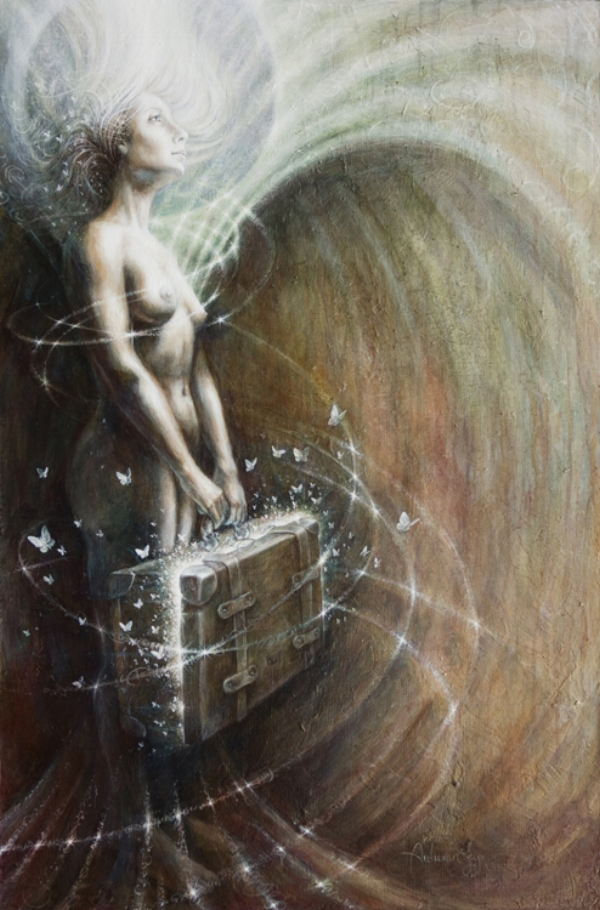
Adventure by Autumn Skye with permission of artist

When I teach the Heroine’s Journey in my Sophia Women’s Wisdom Group, I draw on Joseph Campbell’s idea of the mono-myth, an archetypal story that resonates with every human across time: The Hero’s Journey. I combine Campbell’s ideas with pieces of feminist Maureen Murdock’s heroine’s journey to recognize the unique pathway of the feminine. I call this my hybrid heroic journey. If you are not familiar with Maureen Murdock’s work, I invite you to see how she brought her feminist eye to Campbell’s iconic Hero’s Journey in her book The Heroine’s Journey: Woman’s Quest for Wholeness. After her conversation with Joseph Campbell six years prior to his transition, Murdock felt he missed “that the focus of female spiritual development was to heal the internal split between woman and her feminine nature” (p. 2). In my hybrid heroic journey, that split in the early stages is internalized negative masculinity. The rejection of our feminine nature may appear differently in each woman’s life but it is often characterized by treating ourselves how we imagine men perceive us.

My recent Pilgrimage to Crete was astonishing; my epiphany, gradual. As I share my adventure, imagine stages of your own heroine’s journey wherever you are in that cycle. I hope that by sharing this series, you will experience a real life example of Dion Fortune’s definition of magic: ‘The art of changing consciousness at will’. Starhawk, Truth or Dare, 1988.

Continue reading “My Pilgrimage to Crete – September 2023, Part 1 by Terry Folks”

Crete as the cradle of a culture of peace – Part Two by Laura Shannon

Part One of this article spoke of our collective yearning for peace, and the difficulty of imagining a peaceful world when we are taught to believe that “patriarchy and with it war and domination are universal and inevitable.” (Carol Christ, 2015)

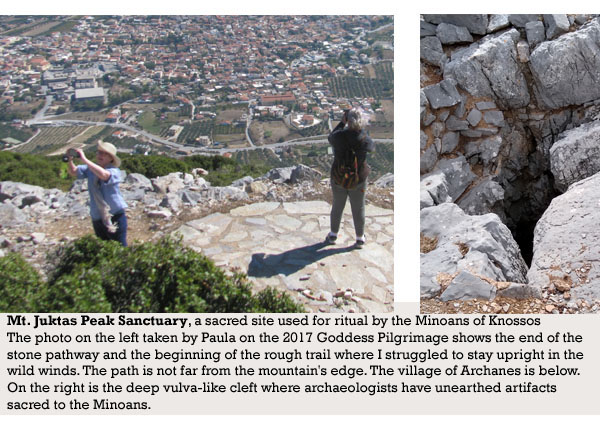
But this is a myth. The peaceful civilisation of Bronze Age Crete lasted two thousand years with no sign of violence, slavery, or war. Most likely matriarchal, matrifocal, and matrilineal, ancient Crete embodied the final flowering of Old Europe. Art and archaeology reveal a life-loving people who honoured the earth, the Goddess, and nature, particularly mountains, caves, and trees. Key values and symbols of this culture of peace survive today in Cretan women’s dances and folk arts including pottery, textiles, baskets, and bread.

Continue reading “Crete as the cradle of a culture of peace – Part Two by Laura Shannon”

Crete is the Cradle of a Culture of Peace – Part One by Laura Shannon

These are difficult days. We awaken daily to the ongoing horror of senseless killing. My heart is filled with a yearning for peace. Now is the time to dream of peace, to choose peace, to practice peace – within our selves, with those we love, in our communities and in our world.

But what might a peaceful world look like? It can be hard to even imagine – not only because we live in a world filled with war, but because we have been taught to believe, as Carol Christ explains, that “patriarchy and with it war and domination are universal and inevitable.” However, she goes on, “this is a myth perpetrated by those who do not want to give up the power and privilege the patriarchal system has accorded to them.” War is not inevitable. Peace is possible.

Continue reading “Crete is the Cradle of a Culture of Peace – Part One by Laura Shannon”

From the Archives: Sacred Water by Molly Remer

This was originally posted on August 9, 2017

“Drinking the water, I thought how earth and sky are generous with their gifts and how good it is to receive them. Most of us are taught, somehow, about giving and accepting human gifts, but not about opening ourselves and our bodies to welcome the sun, the land, the visions of sky and dreaming, not about standing in the rain ecstatic with what is offered.”

–Linda Hogan in Sisters of the Earth

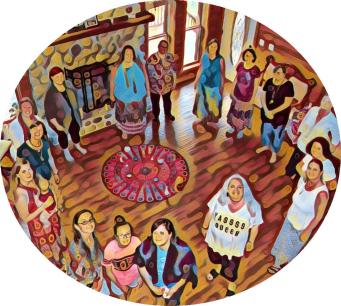
The women have gathered in a large open living room, under high ceilings and banisters draped with goddess tapestries, their faces are turned towards me, waiting expectantly. We are here for our first overnight Red Tent Retreat, our women’s circle’s second only overnight ceremony in ten years. We are preparing to go on a pilgrimage. I tell them a synopsis version of Inanna’s descent into the underworld, her passage through seven gates and the requirement that at each gate she lie down something of herself, to give up or sacrifice something she holds dear, until she arrives naked and shaking in the depths of the underworld, with nothing left to offer, but her life.

Continue reading “From the Archives: Sacred Water by Molly Remer”

Return to Mountain Mother[1] by Jeanne F. Neath

Mountain Mother, I hear you calling me.
Mountain Mother, we hear your cry.
Mountain Mother, we have come back to you.
Mountain Mother, we hear your sigh.

Lyrics by Carol P. Christ [2]. Sung to the tune of “Ancient Mother.” (origin unknown)

What do a bunch of feminist women do while riding a tour bus around the Mediterranean island of Crete? If they are on the Goddess Pilgrimage started by Carol Christ and continued by Laura Shannon, they sing songs honoring the Goddess. The song that drew me most from the first time I heard it on the fall 2022 Goddess Pilgrimage was “Mountain Mother.” Not surprising since the rocky, sparsely vegetated, yet hauntingly beautiful mountains of Crete surrounded us much of the time as our trusty bus wound its way up and down and around the island.

Continue reading “Return to Mountain Mother[1] by Jeanne F. Neath”