It is Hanukah. I have discussed the reasons I have found observing it difficult in a past blog. Namely, as an ecofeminist, I will not celebrate the violence of war or the slaughter of animals at the temple. This year presents a new challenge: how to celebrate the miracle of the oil in the midst of a global pandemic. For inspiration, I have looked at this week’s Torah portion: Mikeitz. Its Joseph tale has helped me find a meaningful practice for my Hanukah observance this year: the power of a human community’s action to preserve life.
The parshah begins with pharaoh having bad dreams. He has called on every interpreter he can think of and no one could interpret them for him. That is until he hears tale of Joseph and summons him. After hearing his dreams, Joseph satisfactorily explains the dreams’ meaning. Joseph says that there will be seven years of abundant crops followed by seven years of famine. The pharaoh believes Joseph and begins to make preparations. He appoints Joseph to oversee them.
Sometimes, being overwhelmed with guilt makes one unable to act. Other times, guilt manipulates and attempts to control. It might offer a sense of responsibility and concern. More often than not, guilt comes bundled in small doses of should-haves and could-haves.
For example, when you feel guilty for skipping exercise and instead lay in front of the television binge-watching your new favorite show. It’s not the end of the world, but you really should have gone and exercised. Or, when you feel bad for getting into a fight with a friend and saying something mean when you could have done otherwise. In general, I think there is such a thing as a healthy amount of guilt which spurs right actions, sincere apologies, forgiveness and knowledge of the good.
Jewish tradition generally agrees with me that a measured amount of guilt is often quite helpful. Guilt instructs us in right and wrong and guides us to be more responsible, more mature individuals. Indeed, it even clues us into a better understanding of G-d. Continue reading “On Guilt and G-d, the Parent by Ivy Helman.”
When studying the Shoah, it is extremely important for teachers to introduce students to the 1800s concept of race “science,” which is what I have been doing in my classes over the past few weeks. An American and European development, this “science” was deeply connected to the development of racism. Through a “scientific” method, humans were classified based on certain characteristics (i.e. head size, posture, gait, etc.) and traits (i.e. aggression, passivity, even temperament, etc.). Physicality was linked to personalities that were “typical” as well as desirable or undesirable.
Race “science” supported the slave trade, colonialism and the exhibition and exotification of non-European peoples. In the case of the Shoah, race “science” was heavily relied upon by the Nazi Regime in their propaganda, law and ideology. For the Nazis and all nations under their purview, “Jewish” was a racial identity, “scientifically-proven” through measurements and observations and set out by the Nuremberg Laws of 1935, previous and subsequent anti-Semitic decrees and the systematically-planned extermination of 6 million of us.
We women of this blog, of this movement to bring Feminism to Religion and vice versa, are planting seeds of a better future. One part of this future is educating young people. I do not want my daughter to repeat some of the mistakes I have done in my youth. One thing I would most certainly urge her to do would be:
Conserve Your Energy
One of the Foremothers of the Goddess movement said that it is very easy to observe Goddess in everyday life: just look at teenage girls. They are uninhibited, creative, playfully sexual (I do not promote underage sex here, I am just emphasising that people can be sexual in their life cycle before and after they practice sexual acts with other people). Most of all, teenage girls are bursting with energy.
The question is: where would this energy go? What would it be spent on?
I’m moving to Prague in the Czech Republic at the end of August. (In case anyone is concerned, I will still be a regular contributor to this blog.) In part, moving to Europe feels like diving headfirst into the unknown. At the same time, it also feels right.
A full-time teaching job still did not materialize again this year despite my best efforts. I’m beginning to see the blessing in that since a full-time job would have made the decision to go that much harder. Yet, the decision to move wasn’t easy either.
My plan in Prague is to teach English to local business people as well as feminism and ecology at Charles University. Neither of these plans is solid. I don’t have any job offers yet. I could go there and everything could fall through or I could go there and decide to do something totally different. In many ways, it’s up to me. I’m not sure if I have ever placed myself into a situation in which I have so much freedom. At the same time, I’m also quite nervous about the entire situation. At least I’m not moving to Prague alone. Continue reading “Choosing Well by Ivy Helman”
For many feminists, experience is crucial. Experience has long been associated with feminist epistemological theories which suggest that reflection on and analysis of one’s experiences offer crucial insight into society. In the history of the women’s movement, this insight and analysis has many times translated into direct action to change the way our society functions.
Experience too has been problematized by various postmodern and postcolonial feminist theorists. They rightly point to the situated-ness of all experiences along class, race, gender, ethnic, religious and other lines. (For more on these ideas, one could read Postcolonialism, Feminism & Religious Discourse edited by Laura E. Donaldson and Kwok Pui-lan.) The context of each and every experience is different. It would be unwise therefore to assume that experiences produce adequate knowledge about societies and how they function. For example, the experience of white middle-class British women living in India during the British occupation is very different from her indigenous contemporary and completely different from lower caste men and women of the same time period. It is important to remember here that patriarchal privilege rears its head and favors some people’s experiences over others, often codifying an experience as “the experience.” When we talk about experience then we should acknowledge that there is no such thing as a generic experience. In fact, some post-modernist feminist thinkers think that situated-ness can color experience so much that our experiences may not even be reliable descriptions of the way society functions. Continue reading “My Experience of Community by Ivy Helman”
Prompted by a dear friend of mine during the new moon, last month I set an intention to “clean my house.” This intention does, to a degree, involve the actual “house,” aka, apartment in which I live. Great—fantastic even, and no problem at all! I actually love to clean, particularly cleaning out closets, garages, cupboard or really, any space where junk can be hidden away, brought into the open, sorted and organized. I’m really not joking. I tell people this, and they laugh and say, “oh, I should have you come clean at my house.” Seriously—do. I am still waiting for several invitations.
But meditatively speaking and in dreams, one’s “house,” is often one’s self and one’s physical body in particular. This work has been a bit more challenging to me. As I shared in my January post, I have been working this year to “create a healthier relationship to food in at least one way,” which also involves creating a healthier relationship with my body altogether, physical, spiritual, mental and emotional.
One reason I began to practice yoga and meditation was so that I could learn to better care for my body. Feminism teaches me to reclaim embodiment and value physical bodies more, and yoga teaches me to incorporate what I learn in a highly physical way. In yoga, I also found a safer place to access what I consider sacred and divine by approaching it primarily in my body while my mind and emotions unlearned an abusive relationship to God. I have even searched my “house” once before through active meditation and visualization. It was extremely powerful. I fixed broken locks. I gave people back items I didn’t even know I had been storing for them. I also realized that I was not ready to open some doors. The process was fun and very rewarding, involving almost two hours of seated meditation.
Yet, I have also struggled to maintain this practice. I felt very disconnected from myself before the new moon last month and hadn’t wanted to meditate. I wanted a vacation from embodiment and myself. Embodiment, after all, often demands that we actually hear what our bodies are trying to tell us. Honestly, I don’t always want to listen. When I have too much work to do, I don’t want to know that I am tired. When I am anxious, I would rather feel in control. I knew, however, cognitively, that “cleaning my house,” would be good for me so I made myself set the intention. I pushed myself to carve out moments in passing during the day to focus my mind and tell me what I wanted to do. I then proceeded to have four powerful dreams in the week following this intention-setting, all related to my “house.” In the final dream, I spoke to me, literally. I faced myself and said very assertively, “You need to work with what you have.” Continue reading “Cleaning My “House” by Sara Frykenberg”


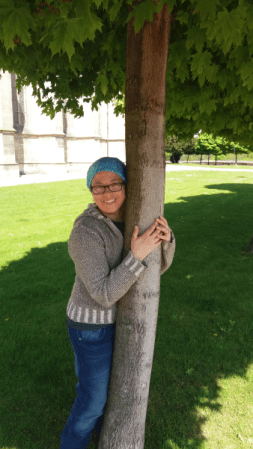
 Sometimes, being overwhelmed with guilt makes one unable to act. Other times, guilt manipulates and attempts to control. It might offer a sense of responsibility and concern. More often than not, guilt comes bundled in small doses of should-haves and could-haves.






 Feminism and Religion