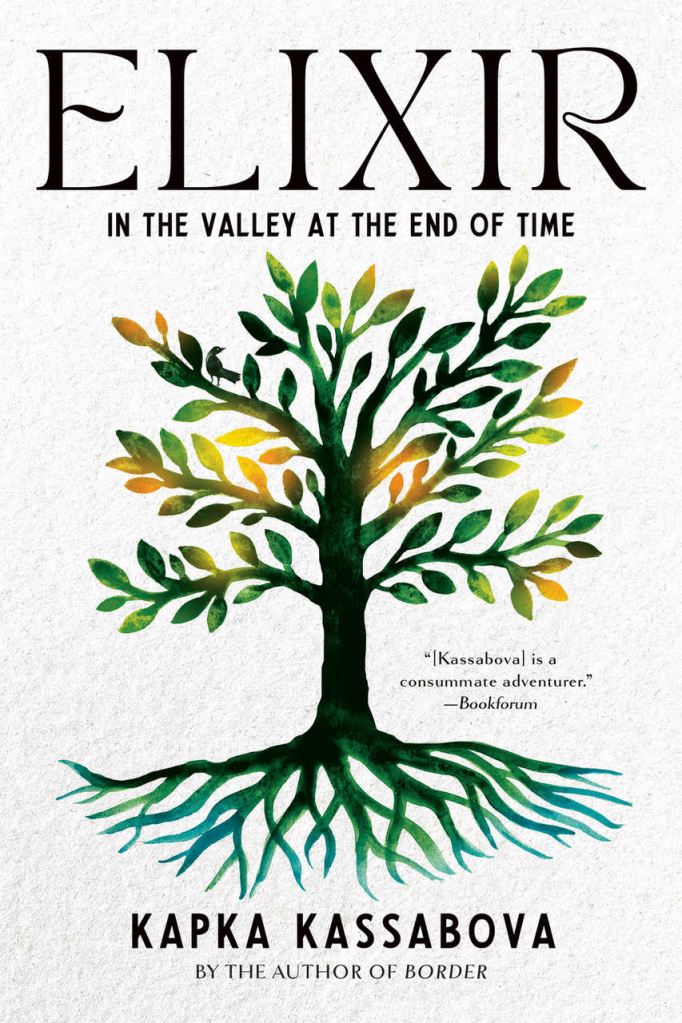
Elixir: In the Valley at the End of Time by Kapka Kassabova, Book review by Laura Shannon

Kapka Kassabova is an award-winning author of poetry, fiction and nonfiction, born in Bulgaria and now living in the Scottish Highlands. Her newest work of narrative nonfiction, Elixir, soars with the luminous prose and unflinching honesty we have come to expect from this brilliantly gifted writer.

Elixir is an extraordinary, profoundly moving book. The moment I finished reading it, I began again from the beginning, pausing only to order multiple copies for friends. Like Robin Wall Kimmerer in Braiding Sweetgrass, Kassabova effortlessly integrates science and the sacred, addressing historical, ecological, and personal trauma with clarity, compassion, and hope. Elixir combines memoir, travel, history, ethnography, botany, philosophy, spirituality, eco-psychology, traditional Chinese medicine, and even alchemy, in a subtle, sophisticated exploration which defies categorisation.

Continue reading “Elixir: In the Valley at the End of Time by Kapka Kassabova, Book review by Laura Shannon”

Durga Rising: Feminism as Fierce Compassion By Beth Bartlett

In her FAR post earlier this year,[i] “Why Feminism Needs the Fierce Goddesses,” Susan Foster argues that a “flagging” feminist movement needs the revitalizing energy of the “fierce goddesses” of ancient times to challenge the patriarchal forces that seem to be on the rise as increasingly we find women’s lives and freedoms constrained. She writes, “the dark goddesses of ancient times have been submerged in our psyches, but they serve as a repository of fierce energy, of female rage against injustice.”  She continues, “It’s important and healthy for us as women to reclaim our anger, using it to protect ourselves and fight for our rights in systems that are oppressive.”

Reading this, I immediately thought of Beverly Wildung Harrison’s, “The Power of Anger in the Work of Love,” and China Galland’s, The Bond Between Women: A Journey to Fierce Compassion. Anger as the work of love; fierce compassion.  In this time of mass shootings, insurrection, the ongoing assault on women, LGBTQ, and BIPOC peoples, when rage seems so easily fueled by hate, envy, and greed, it is the rage based in love and compassion that is most needed.  This is the rage of the fierce dark goddesses who are moved to act against injustice, the rage of the feminism I love. With its source in love and compassion, it is a rage that rebels in the best sense of the word – that at once refuses injustice and affirms dignity and respect, that speaks truth to power, that is grounded in solidarity and friendship, and values the immanence of the earth, the water, the body, and the divine spark in all beings.[ii] 

Continue reading “Durga Rising: Feminism as Fierce Compassion By Beth Bartlett”

Breath, part 2 by Beth Bartlett

You can read part 1 here.

Much has been written about the last breath, but not much about the first. Recently, I happened to listen to a re-broadcast of an episode of NPR’s Radiolab on “Breath.”  It began with an explanation of the ingenious, miraculous first breath in which we transition from water-dwelling beings in the watery womb to air-dwelling beings outside in the world.  In the water-dwelling fetus, the lungs have no function. Instead, the fetus gets its oxygen from its mother through the placenta and umbilical cord, the oxygenated blood flowing directly from the right to the left chambers of the heart through a hole — the patent foramen ovale — bypassing the lungs that in fetuses are filled with water.  But in the split second of that first breath, the umbilical cord shuts down the flow of oxygenated blood and the patent foramen ovale closes, requiring that the once water-filled lungs now be filled with air.  The right and left sides now forever closed off from each other, from now on, the oxygen-deprived blood that flows into the right side of the heart must be pumped out of the heart into the lungs where it is enriched with oxygen, and then returns to the left chambers of the heart where it is then pumped to every tissue in our bodies.  That first breath enables the continual flow of in-breath and out-breath, for most of us, about 500 million times in our lifetimes. I will never forget that first breath of my own child as he came in to the air-breathing world. That first cry remains, and always will, the sweetest sound I have ever heard. Aware now of all that happens with that first breath, I am filled with an even deeper awe.

Continue reading “Breath, part 2 by Beth Bartlett”

A Womanist’s Perspective by Sara Wright

Last night I was listening to plant scientist Monica Gagliano who is pushing the boundaries of what we know about plants. She proved that plants respond to the sound of water by moving toward it and cannot be tricked. Bio-acoustics is the study of sound and Monica is researching other ways that plants communicate. We know they use chemical messengers to warn each other above ground and below through the mycelial network thanks to the work of Suzanne Simard who I shall discuss in a moment. We have learned that plants emit electrical impulses. But Monica is studying another way that plants communicate. She says they listen to all the plants around them and learn from each other so that they do not have to re-invent the wheel with each generation. In one amazing memory experiment mimosa plants taught her that plants remember what happened to them previously and don’t repeat their mistakes. The Mind of Plants was her first book. She also studied with Indigenous healers in the Amazon and discusses this mysterious and compelling journey in her latest book Thus Spoke the Plants.

Continue reading “A Womanist’s Perspective by Sara Wright”

The Legacy of Carol P. Christ: Meeting the Windigo

Towards the end of Braiding Sweetgrass, mother, biologist, and member of the Citizen Potawami Nation Robin Wall Kimmerer sets out at the end of winter to visit a forest area near her home that she considers hers not in name but in virtue of her love and care for it. On arriving, she discovers that the forest is no more, having been clear-cut by the owner. The wildflowers and the plants she has harvested over the years have sprouted up, but Kimmerer knows that without the forest cover they will be burned by the sun and their places taken by brambles.

Kimmerer is overcome by anger and despair, her feelings for the land she loves merging with her knowledge that not only her forest, but the earth itself is being treated as nothing more than a product by so many—without second thought for all that is lost.

Continue reading “The Legacy of Carol P. Christ: Meeting the Windigo”

Grief Overshadows Joy by Sara Wright

Fall is the season of ‘the cutting away’, a poignant time to celebrate the deepening darkness as we turn inward. I think the powers of the goddess are strongest at this time of year… I wrote this wistful poem in celebration of Autumn as I am experiencing it this year… perhaps the personal reflection that follows is the kind of thinking that is capable of opening a door to a new way of perceiving?  

Autumn Gold

Autumn gold

stains the maples

beech hay ferns too

each day

 a deeper glow

bittersweet bleeds

into lemon

liming veins

scarlet sears a leaf

or two

salmon rose blurs…

 fir balsam hemlock

spires reach

skyward

forest green

needles

soak in drops

of rain.

Continue reading “Grief Overshadows Joy by Sara Wright”

The Miracle of Becoming by Sara Wright

We use the word “transformation” very casually in our culture. Humans including feminists have ‘adopted’ the word to describe an inner shift in mental awareness, and of course this can happen, although not usually after a weekend spiritual retreat. The dictionary defines transformation as a dramatic change in form or appearance. In animals, transformation becomes a metamorphosis – a true change in form during that creature’s life cycle. In physics the word denotes an induced or spontaneous change of one element to another by a nuclear process. As a naturalist and ethologist it seems to me that humans may not really know what the word transformation really means. Doesn’t transformation include both mind and body? Perhaps we need to turn to nature to find out! One point becomes abundantly clear. Transformation is fraught with danger and only some creatures (and humans?) are able to survive the shift. What follows is a story of transformation that moved me to tears.

When the extraordinary creature emerged from a split translucent capsule I could hardly believe my eyes. Although I have witnessed butterfly transformation many times over the course of my life none have moved me like this butterfly birth did.

Continue reading “The Miracle of Becoming by Sara Wright”

Sky Woman comes to Earth by Sara Wright

Every twig

is singing

a song of thanksgiving

to Sky Woman

who gifts

steady rain

 nourishing

earth’s parched body.

Cracked ground

softens

 soaks in minerals

and scent

 sensing wonder.

Continue reading “Sky Woman comes to Earth by Sara Wright”

Meeting the Windigo by Carol P. Christ

Towards the end of Braiding Sweetgrass, mother, biologist, and member of the Citizen Potawami Nation Robin Wall Kimmerer sets out at the end of winter to visit a forest area near her home that she considers hers not in name but in virtue of her love and care for it. On arriving, she discovers that the forest is no more, having been clear-cut by the owner. The wildflowers and the plants she has harvested over the years have sprouted up, but Kimmerer knows that without the forest cover they will be burned by the sun and their places taken by brambles. Continue reading “Meeting the Windigo by Carol P. Christ”

Receiving, Giving, Reciprocating vs. Nonintervention: Two Different Models for Environmental Ethics by Carol P. Christ

“Gifts from the earth or from each other establish a particular relationship, an obligation of sorts to give, to receive, to reciprocate.” –Robin Wall Kimmerer

The notion of a gift economy is at the heart of Robin Wall Kimmerer’s Braiding Sweetgrass. Kimmerer shares a different way of being in the world: one that recognizes the gifts that have been given to us and the necessity to reciprocate. In the modern world we have been taught that nature’s resources are ours for the taking. We have not been taught that nature’s resources are not infinite, that they exist in a web of interdependent relationships in which minerals, plants, animals, and human beings all participate. Everything we do has consequences for other living things.

For many environmentalists, the goal is to leave “wild” nature alone. In this model, the destruction human beings have done to nature is recognized. But what is not understood is that human beings are part of nature too. For hundreds of thousands of years, we and our ancestors have interacted with nature. The model of setting aside spaces for wild nature does not recognize that human beings can interact in positive ways with nature and that we have done so for millennia. Continue reading “Receiving, Giving, Reciprocating vs. Nonintervention: Two Different Models for Environmental Ethics by Carol P. Christ”