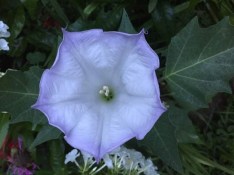
The Cottontail
watched me
climb
a steep hill
to meet her
at the Cross –
road.
She split the stone.
Datura delusions emerge
from this bloodline.
I stumble
down down down…
Her feet beat
a mourning drum
I’m in free fall.

Exploring the F-word in religion at the intersection of scholarship, activism, and community.

The Cottontail
watched me
climb
a steep hill
to meet her
at the Cross –
road.
She split the stone.
Datura delusions emerge
from this bloodline.
I stumble
down down down…
Her feet beat
a mourning drum
I’m in free fall.
On the path
through the pines
I see clumps of
moss scattered,
an old tree trunk
is raked as if
with claws;
clumps of downed bark
food for the earth.
My heart soars.
Wild hope pours
through me like honey.
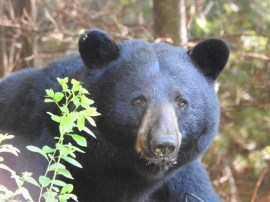
 I am a naturalist and ethologist who has studied many animals and birds in their natural habitat; my 15 year study of Maine’s black bears is perhaps the best example of the work I do. I am a dedicated animal advocate and telepathic communication is part of many if not all of my interactions with both tame and wild animals.
I am also an eco-feminist who believes that women have always had a more intimate connection to the natural world, that if developed, will lead to telepathic communication.
A couple of months ago I wrote a story about the telepathic relationship between my dove, Lily B and me. I put it on my blog and every day there after I noted that a number of people read it. At first I didn’t pay much attention but after awhile I couldn’t dismiss the odd sensation that this story was traveling from country to country in a very peculiar way. One day I counted 11 countries whose bloggers just read one article, the story about Lily B. Bloggers continue to read about my dove on a daily basis. This morning, for example, someone from Egypt read it. Continue reading “Telepathy, Women, and Birds by Sara Wright”

I am gazing out the window; an almost bare leafed apple tree’s sap has begun its descent for the winter months. Trees participate in a great round; breathing slows as the tree becomes drowsy. Soon the merciful cold will put her and others of her kind to sleep, not to awaken until life each tree’s life – blood thickens to rise and soar into the highest branches with a warming sun. Only tree roots stay awake throughout the winter searching for nutrients, exchanging carbon and carbohydrates, water, meeting new friends and avoiding foes, their root tips branching, fusing, glowing – solving problems far more complex than those of humans…
Last night a full white ‘falling leaf moon’ slid unobstructed through apple branches casting shadowy silver arms around our bed. My dogs were restless. I could see the rounded luminous pearl embedded in an ebony sky shining through all the deciduous trees that were dressed in scarlet splendor just a week ago. Last night those trees were bare. Continue reading “Passionflower Autumn by Sara Wright”

When we meet
our deep
brown eyes
mirror a
mutual need
for light
to penetrate
human darkness.
Your eyes are
wary and fearful;
Mine hunger
for your touch.
I cry out softly
“Don’t be afraid…
I love you”.
We share
a haunted skin –
hunted down
by Difference.
You are slaughtered
by men with guns.
I am knifed by wounding
man words,
– boy threats,
a ‘gift’ of a still warm
grouse – her neck twisted
and broken – dropped
at my door.
There are so many ways
to kill an animal.
You have shiny black fur
and my skin is light
but our senses scream
as one
in torment –
our bodies feel
the earth moving
under our feet.
We have no place
left to go –
no hope of peace.
What’s left?
Courage
to endure.
Working notes:
Some nights I walk down to the field, the one I call “field of dreams” to gaze up at the constellation of the Great Bear who circumnavigates the sky. In the Northern Hemisphere the Great Bear was probably the first image and manifestation of the Goddess. As a bear She denned in the fall, gave birth in dead winter, was reborn in the spring, feasted during the summer, and re –entered the cave of night in the fall, participating in an endless round of becoming. This year I feel the loss of Her Presence keenly. It has been a year of endurance; one in which hope has been absent. A year permeated by fear, drought, heat, stagnancy, unbearable waiting for house repairs to begin. It is almost October; un – dealt with house repairs loom as parched leaves drift to the ground and rains never come… I am losing perspective and I know it.
Wild bears have been for the most part absent from my life. For the first time ever. The absence of day bears mirrors the apparent loss of the Great Mother in me. I am drowning in doubt, depression, and uncertainty.
Of course, hunting pressure has reduced the number of bears to almost zero and those that still haunt what’s left of these broken forests have little food or protection. Even though I offer sanctuary, treats and friendship bears have been too wary, visiting only under the cover of night. I almost never see them.
The exception was Coal, a timid 300lb adult female that barely allowed me to get a few glimpses of her during the month of June…Although Coal knows me she is no longer interested in friendship. That she has survived long enough to reach adulthood and is of breeding age (she bred last year but lost her cubs to god knows what horror) guarantees that she has had too many threatening encounters with men to trust any human, including me – a woman who loves her.
Because we are in the midst of the three month black bear slaughter I think about Coal every day hoping that somehow she has managed to escape the hunters raging gun, wild dogs that ‘hound’ her, the ugly steel traps illegal in every state but this one…I look at her picture wondering if there is some way to reach her, to protect her – to help her survive. But I suspect that I am as powerless to help her, as I am to help myself.
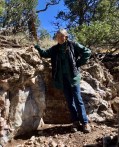
Sara is a naturalist, ethologist ( a person who studies animals in their natural habitats) (former) Jungian Pattern Analyst, and a writer. She publishes her work regularly in a number of different venues and is presently living in Maine.

I breathe in
the scent of
moist wooded bogs,
crystal lake waters,
baskets of dew
heavy and sweet
soaking heat
through every pore…
note withered leaves
shriveled mosses
and still
the rains do
not come.
The Earth is on Fire.
Stagnant pools
shrunken trunks,
the lack of fruiting bodies
falling leaves
a crisped ground
beneath my feet
remind me
that grief must be
felt with as much
awareness as possible
to create the
necessary bridge…
My weeping pine
keeps me mindful –
The Earth is on Fire.
Two thousand year old Redwoods
succumb to flaming
heartwood…
Yet some will live on.
Trees know that
There is nothing they
can do to stop
this holocaust
besides witnessing,
accepting their dying,
leaning into
the Grief of the Earth,
as she yields
to the power of
‘What Is.’

Working notes: From the personal to the collective
A few days ago I had to take down a pine tree that I loved. Although I did not do the actual cutting I did make the decision to end the tree’s life, so I am the one responsible. My young friend made the cut, felling the tree in just the right direction; his father who was assisting felt a fierce wind hit his face as the tree slammed into the ground just beside him. Indoors, I shuddered involuntarily even as relief flowed through me like a river. It was over.
This tree cutting was witnessed by “tree people” – three humans who truly love trees. Afterwards, Marcus came to me. “Are you all right?” I choked back an avalanche of tears. Not (at that moment) for the tree, but for me because, like the tree, I too had just been witnessed by this boy’s sensitivity – For the first time in my 75 years I was not alone with my tree grief. No other words passed between us but the depth of our feelings united us with each other and that tree. Not a shred of separation. Amazing, and yet so comprehensible.
I felt sorrow over the loss of the tree; but also, strangely, accepting. The next morning I wrote the following:
Treefall
Last night I poured water at the base of the tree as a blessing, gathered herbs to place against her trunk. I lay my hands on rough bark as I spoke … reminiscing about the bear fur I first found scattered around her pine-rooted floor. I told the tree how much I loved the sound of her needles rustling, the intoxicating scent of those that fell to the ground, the “candles” s/he bore in late spring, the masses of pine cones that appeared shortly thereafter. How kindly s/he blocked the heat of the summer sun from the house; how much I loved her. I told her too that I hoped that she would not feel too much pain. I listened then for a response and sensed a stillness; this tree knew what was coming and accepted her dying. There was no answer forthcoming regarding pain… (I called this marked tree a female but all white pines are monoecious meaning that each tree produces male and female cones).
That was as far as I got.
An email came in from Marcus a few minutes later that addressed my question: did he feel that trees experienced pain?
What follows is his response.
“In my experience, I have found that trees certainly do feel pain. The difficulty is in understanding it because the pain the trees feel is only knowable at a visceral level in our bodies. The pain in my body is the tree‘s pain. The tough part is that because that pain is in my body, it gets mixed up with my own feelings of loss, which makes it immensely challenging to sort through. However, a few weeks ago when I had to cut down an apple tree that was being destroyed by tent caterpillars the separation of this pain was discernible. Once the tree was gone there was an immense release of pain in my body. But even so I still carried the sadness of the tree’s loss…I spent so much time getting to know that apple tree that I could feel it drowning in its own sap because it could no longer photosynthesize. Yesterday was different. I could feel the tree and the split but couldn’t communicate with it as well…I was so nervous and stuck in my own place (we all were nervous because the tree was 167 feet tall). But what I know for certain is that trees accept death much easier than we do… the dying hurts physically but the trees are never scared of death or regretful at what is being left behind. They are much more in touch with the fluidity of their spirituality and with the cyclic nature of life. They understand that death is not an endpoint… Dead trees that have stumps continue to live as they transfer what I think of as their essence, meaning soul, spirit, consciousness to whatever comes next. It is only when the underground network for transference is ripped away that a tree really dies.”
I should add that Marcus is a nature mystic, though he doesn’t yet know it. A scholarship to Dartmouth left him feeling as if he didn’t belong and after a year he dropped out. Now he cares for his family’s forest, cuts trees when needed, creates magnificent art from dead trees and trains for the Olympics. He is 21 years old.
It stuns me that someone who is 50 years younger than I am could be such a powerful teacher, friend, and the first person I have ever known that feels the way I do about trees and can communicate these ideas/feelings on such an embodied level. I adore him.
The following day I learned firsthand about the terrible fires that are ravaging Colorado after talking with a woman who cannot even leave her own house (I have deliberately been avoiding the news).
That night I had a catastrophic dream rife with cultural holocaust elements.
When I awakened that morning I was so sluggish I could barely move. I dragged myself outside and stood quietly by the tree soaking in her dying scent. Pinenes. Tears were seeping into the heartwood from the still living cambium. I thought of the billions of burning, slaughtered trees. I felt helpless and quite stupid. Profoundly depressed, I knew enough to stay with the grief as I moved through the day; the trees had taught me well. My body felt like lead. I fell asleep in the early afternoon.
The next morning I awakened refreshed; the collective grief had receded because I felt it and didn’t try to hurry it or twist my experience into some bizarre form blurring its painful edges with new age ‘gratitude,’ for example. I paved my own way to peace and illumination on a personal level by being with others who truly loved trees and allowed themselves to feel their grief as I did – with them and also alone.
It also interests me that as a ‘tree woman’ that I was still called to feel catastrophic tree grief on a collective level just after my personal loss. By avoiding the news (because of Trump) I was also lacking in awareness and knowledge. Our Earth is on Fire, trees are dying by the billions, and these beings need to be witnessed, especially by those who are capable of standing it (so many are not and I think this is part of the problem). Blind acceptance of the death of billions of trees seems out of place in this context. Resignation is not an endpoint. The trees will guide me into whatever comes next. Of this, I am certain.
Sara is a naturalist, ethologist ( a person who studies animals in their natural habitats) (former) Jungian Pattern Analyst, and a writer. She publishes her work regularly in a number of different venues and is presently living in Maine.
 Read Part I of Re-Visioning Medusa here.
Recently, I was given a wonderful gift, a small shiny black pot with Avanyu’s image carved into its micacious clay surface. I have become enamored by the images and the mythology around this powerful serpent. Every day I look at my pot and wonder what specific message Avanyu might be trying to convey to me.
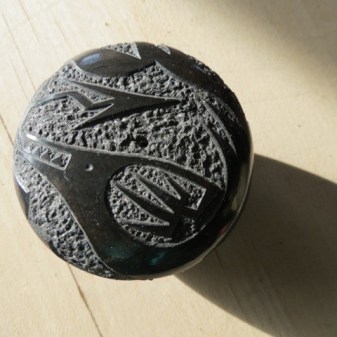
As I began this essay I also wondered how Avanyu’s serpentine aspect might relate to my writing about Medusa? Was he guiding me? I certainly believe he is highlighting the importance of needing to live through the truth of my body. Continue reading “Re-Visioning Medusa: Part II by Sara Wright”

All through my childhood a self-portrait, painted by my mother hung above my parents’ bed. I was fascinated by this image of the stern face of my very beautiful mother with her long wavy chestnut hair. In the painting my mother’s body was buried in the sand up to her neck. Behind her, churning waves cascaded onto the shore. A blue sky was visible. A few seashells were scattered around and a large shiny green beetle was crawling over the sand. On the surface this image of my mother with her long curly hair seemed quite serene but as a child the painting disturbed me. It was as if this painting held a key – but to what? My father loved the painting and often commented on it…
I can remember playing at the seashore. My father would dig holes and bury both his children up to their necks in the warm sand that also held us fast…

I had one reoccurring childhood nightmare of waking up and not being able to breathe. Continue reading “Re-Visioning Medusa: Part I by Sara Wright”

For Carol.
Women’s relationship with plants stretches back to the beginning of humankind. Most of us know that women invented agriculture and became the first healers.
I come from a family of women who all had gardens, but no one grew herbs. It interests me in retrospect how I turned to these healing plants. I first used them for culinary purposes as a young mother; but as I approached midlife (mid –thirties) I began to gather herbs for medicinal purposes. I realize now that I made this shift just as I began to embrace the goddess and the Earth body as my mother and turned inward to healing myself. The two were definitely connected. It is the Body of the Earth that is capable of healing our broken souls and bodies; and some wise unconscious part of me knew that. Continue reading “Herb Talk: Bee Balm by Sara Wright”
 I have just returned from the brook where I offered up my Toad Moon prayers to the song of the Hermit thrush and to the rippling waters – first honoring my body with a poem written just for her, and then by repeating my hope/belief/intention that the search has ended and my house will get the structural help she needs without invasive machines scarring my beloved trees and land… I release my doubt – a plague that has incarcerated me for months.
I felt my body rooting into forested soil… I belong here; I am loved here.
Peace filtered through the green – trees, seedlings, lichens, mosses, grasses and the clear mountain waters. Silence, except for thrush’s morning benediction. Continue reading “Morning Meditation by Sara Wright”
 Feminism and Religion