Will Donald Trump Go to Heaven? by Gina Messina

Having seen the image of a toddler crying while law enforcement questioned her mother, my daughter was filled with fear, anxiety, and confusion. After tearfully asking if she would be taken away from me, my nine year old followed up with the question, “Will Donald Trump go to heaven?”

It is true that the young girl was not a child who was being separated from her mother. Nonetheless, she has become the face of this time in history where American values no longer include “family values,” protecting children, or respecting human dignity. 

The business mogul who claims a Christian identity with a room full of bibles to prove it, has made oppression, injustice, and the general devaluing of life the core of his administration. While Jesus calls us to embrace the stranger, walk with the least of these, to be a loving neighbor, and work for the liberation of every person, Trump’s actions and policies violate every teaching. And so, my daughter’s question was not out of line. Continue reading “Will Donald Trump Go to Heaven? by Gina Messina”

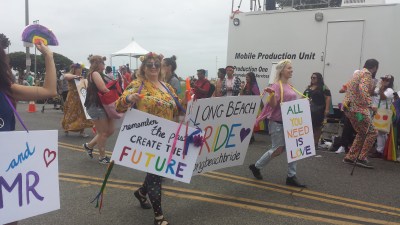
Long Beach, California – 2018 Pride! by Marie Cartier

Photos by the author unless otherwise indicated

Last year I published a photo essay with pictures of Long Beach, CA’s Pride week-end. You can see last year’s photo essay here. I also published a photo essay of the Los Angeles Resist March from last year here.

It feels more important than ever to re-member/ re-attach ourselves to the normality of resistance, freedom, solidarity, courage and joy. I hope the pictures here help you FAR family to re-member your activist selves and re-invigorate them if they are in need of it. I know mine was before the past week-end. Here are photos from the Long Beach Dyke March on Friday night, and the Long Beach Gay Pride parade on Sunday morning.

Continue reading “Long Beach, California – 2018 Pride! by Marie Cartier”

Just How Rotten Are Things in Denmark? by Marcia Mount Shoop

The Shakespearean quote, “something is rotten in the state of Denmark,” comes from a palace guard. After watching Prince Hamlet walk away with the ghost of Hamlet’s murdered father, the former King, the guard has a sinking feeling about how screwed up things are in his country.

And if you remember the play at all, things were pretty rotten. By the end of the story just about everybody dies. Revenge, misunderstandings, accidents, and lust for power are just a few of the causes of death. The guard was right. Something was rotting away at his country—something that was vacating people’s integrity and trust, something that was not afraid to use violence and lies to get its way, something that was blind with a hunger for more and more power no matter the cost.

Continue reading “Just How Rotten Are Things in Denmark? by Marcia Mount Shoop”

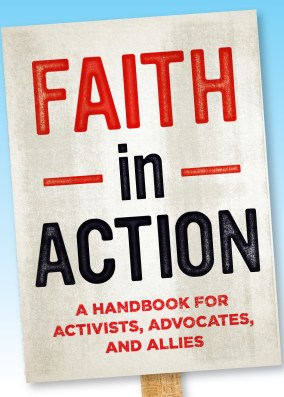
Faith in Action by Lisa Kloskin

Nearly a month ago, American voters showed up at the polls and delivered some big wins: the first openly transgender person was elected to a statehouse—Danica Roem in Virginia. Roem defeated an incumbent candidate who authored an anti-trans bathroom bill. Also in Virginia: the boyfriend of a reporter shot and killed on live TV, Chris Hurst, won a seat to the statehouse on a gun-control platform, defeating the three-term NRA-backed incumbent. And Hoboken, New Jersey, got its first Sikh mayor: Ravi Bhalla. These and others are encouraging signs that love and tolerance are gaining ground in the public sphere. But there’s still so much work to do. White Supremacists and Nazis still walk boldly in the streets, LGBTQIA teens still face bullying and higher rates of self-harm, women are still paid less for equal work and harassed in every arena, sea levels are rising at faster rates than we previously thought, people of color are still being killed by police, mass shootings are still a regular part of our news cycle, refugees are still waiting in camps around the world for a chance at a better, safer life.

Activists and advocates have been working for justice in these and other areas for decades. In the last year, spurred on by events like the Women’s March, a growing group of would-be activists has emerged. These allies are a welcome addition to the justice movement, but many worry they won’t do or say the right things, and want to have their perspectives deepened on important issues. They need guides and resources to give them the knowledge, tools, and confidence to make a real impact.

Continue reading “Faith in Action by Lisa Kloskin”

Small Business Saturday: Feminist Gift Guide for the Holidays by Angela Yarber

Wondering what to give the revolutionaries in your life for the holidays? Want to support feminist small businesses as you shop? Need some creative ideas with powerful feminist history and theory embedded in each purchase? Would it help if the gifts fused together feminism and religion? The Holy Women Icons ProjectLagusta Luscious,  and Bloodroot Feminist Vegetarian Restaurant has plenty of ways for you to celebrate the holidays with empowering gifts to please feminist in your life.

The feminist non-profit Holy Women Icons Project seeks to empower marginalized women by telling the stories of revolutionary holy women through art, writing, and special events. For over five years, a different holy woman has been featured each month on Feminism and Religion; we became an official non-profit earlier this year; and we have some beautiful, creative, and empowering offerings suitable for the holidays.

Continue reading “Small Business Saturday: Feminist Gift Guide for the Holidays by Angela Yarber”

Gratitude – A Salve to Heal Our Wounds by Judith Shaw

judith shaw photoTomorrow being Thanksgiving in the United States offers an opportunity to reflect on gratitude. With so much anger bubbling up on all fronts is it possible that gratitude could be the salve to heal our wounds?

Continue reading “Gratitude – A Salve to Heal Our Wounds by Judith Shaw”

Opting In, Opting Out: Navigating Political Divisions “for the Sake of the World” by Katey Zeh

photo-1470115636492-6d2b56f9146d

Over a year ago I made the decision not to watch–not to consume the vitriol of this political disaster we in the U.S. have created for ourselves. It was a conscious choice in favor of my own self-preservation which I stand by. I had no idea at the time how important that decision would be for my own mental and spiritual health in the coming months.

Since then I’ve done a lot of opting out: not watching the Presidential debates (not in full anyway), not reading much political analysis (the article titles alone cause me rage), not discussing the election before bed. Late one night my husband mentioned some egregious thing that Donald Trump had said earlier that week, and I got so riled up over it that afterward I couldn’t sleep for hours. After that we had to establish a rule that no one could bring up politics after sitting down for dinner.

My way of coping this election cycle has been similar to how another person might react to a violent image on TV: I’ve kept my eyes shut, peeking every few moments to see if the worst has passed. This avoidance behavior has begun to feel uncomfortable, even unethical. As a person of faith, is it not my responsibility to call out abuses of power for what they are? If I do not offer my voice to the cacophony of political discourse, am I complicit in the hatred being spewed? I’ve thought often of Audre Lorde’s famous line, “Your silence will not protect you.” Continue reading “Opting In, Opting Out: Navigating Political Divisions “for the Sake of the World” by Katey Zeh”

Get Compassion: Reflections on Childbirth and Privilege by Katey Zeh

hospital-840135_1920

Jessi Klein wrote an Op-Ed in last Sunday’s New York Times entitled “Get the Epidural” in which she takes on the arguments for “natural” childbirth and makes an astute point about its premise: “It’s interesting that no one cares very much about women doing anything ‘naturally’ until it involves their being in excruciating pain.”

Thinking back to the months leading up to my daughter’s birth, I remember occasions similar to the one Klein describes in this article in which I was asked about my pre-natal care and plans for the birth, though admittedly they did not often come from strangers in the grocery store line. While Klein’s response was different from mine (I birthed without pain medication, and as you might have guessed from the title, she planned for an epidural), we each experienced feeling judged by others when they heard about our intended plans for birthing.

Klein alludes to this childbirth debate as symptomatic of our increasingly competitive culture around motherhood. I agree with her. But I worry about what happens when we talk about birth as primarily a parenting event rather than a physical one. When we divorce our intentions for our babies from what we desire for our bodies.

As with any piece having to do with childbirth, this article made the rounds on my Facebook feed and incited the usual divisiveness that all social media posts seem to do, splitting my friends and acquaintances into those who felt affirmed by Klein’s words and those who felt silenced by them. My reaction was to applaud that we have the ability to make different decisions about our health care, and that no matter how we plan our births—or how they turn out in the end—that is something to celebrate.

In my attempt to be diplomatic, I also quickly overlooked the assumptions of privilege at play in Klein’s piece and in my own response. Let’s start with the concept of a birth plan. A plan assumes that different options are available and acquirable. I’ve often written about how my pregnancy was one of the times when I felt my white, educated, middle-class privilege most acutely. I was able to have an intervention-free birth in large part because my family could afford to pay a doula on top of covering the costly medical fees related to the pregnancy and birth.

I wonder among my circles of privileged parents, why do we occupy so much of our time and expend so much of our energy arguing over which school of medically-sound thought regarding childbirth is best when there are so many people who bring life into world with inadequate or no health care at all?

Years before I got pregnant I began working with faith communities as an advocate for the full range of reproductive health care needs that people have throughout their lives, including safe and respectful childbirth. I’ve spent a lot of time reading and retelling the biblical stories of women giving birth and comparing them to the stories of global women today who face enormous challenges in their labor and deliveries. Tragically each year hundreds of thousands of women lose their lives as they bring new life into the world.

Pieces like Klein’s remind me of how easily people like me get caught up in our own spheres of experience and become blinded by the privilege that affords us the ability to fixate on details of our own lives rather than turning our gaze toward the world’s immense suffering.

As a faith-based advocate for gender justice, I’m currently working on a book with the FAR Press called Women Rising in which I look at the lives of ten biblical women through the lens of our current struggles for women and girl’s freedom and well being around the globe. One of my chapters focuses on the story from the book of Genesis in which Rachel dies in childbirth, and another looks at Mary’s delivery of Jesus as the miracle of maternal survival. My hope is that those of us who identify with the sacred stories of the Jewish and Christian scriptures will re-encounter them in a way that leads us back to a place of compassion for one another rather than judgment.

Katey Zeh, M.Div is a strategist, writer, and educator who inspires intentionalKatey Headshot communities to create a more just, compassionate world through building connection, sacred truth telling, and striving for the common good.  She has written for outlets including Huffington Post, Sojourners, Religion Dispatches, Response magazine, the Good Mother Project, the Journal for Feminist Studies in Religion, and the United Methodist News Service.  Find her on Twitter at @kateyzeh or on her website www.kateyzeh


A Choir for Reproductive Freedom by Katey Zeh

choir-305352_1280

I was home watching the live stream of those gathered in front of the Supreme Court building to show their opposition to this law that has prevented so many women from accessing the abortion services they need. The speakers, many of them leaders in reproductive justice organizations, powerfully called out the many ways that this unjust law has targeted women of color, immigrant women, and poor women.

During one of the speeches, those gathered in support of this law began singing “Spirit of the Living God.” It was audible over even the most powerful voices speaking out against it. I began to get irritated. But as the song continued, I got angry–and then I got inspired. Continue reading “A Choir for Reproductive Freedom by Katey Zeh”

Pope Francis, Complementarity, and US Politics by Gina Messina-Dysert

Gina Messina-Dysert profileA theology of complementarity, referred to by Pope Francis as an “anthropological fact,” has had  a strong influence on American politics.  According to the Vatican teaching, women and men have distinct but complementary roles, meaning that women’s value is found in the home as wife and mother and men are responsible for providing for the family.  Such a teaching is highly problematic in that it demeans women’s value and places women on the underside of dualism.

As a woman with an ongoing struggle with infertility, I find it troubling that my church sees my value as less because my womb is barren. Likewise, do women have less value if they choose a career over motherhood?  What if they choose not to marry?  There are also clear implications for single parents, LGBTQ parents, and so on.  In addition, societal norms make clear that women’s work in the home is not valued as the work of men in society.  Likewise, it is damaging to men in that it refuses to acknowledge the critical role men play in the household, in the lives of their children, and their responsibilities to be partners and co-parents.

The idea of complementarity upheld by Pope Francis greatly contributes to economic injustice for women.  The Vatican’s refusal to value women’s roles outside the home influences US social policy on women’s issues. The continued struggle to close the pay gap, implement paid parental leave, and create viable options for childcare and early childhood education are directly connected to complementarity. If women are supposed to remain in the home and be wives and mothers, then there is no need to address any of these issues. How can we possibly have women in leadership roles if they are supposed to be at home cooking dinner and caring for children? And so, when women do pursue careers the social attitude is that women do not belong. Such an idea is even more problematic for women of color who suffer a lower pay rate – $.64 on the dollar for African American women and $.54 for Latina women. Furthermore, many have have been forced to work outside of the home as a result of economic and racial injustice.  In this secular nation, Christian values dominate our political debates and perpetuate the idea that women are subordinate to men. And to be frank, these are community issues that impact men as well as women; yet they have been deemed women’s issues as a result of the manifestation of theological teachings.

As republicans focus on defunding Planned Parenthood, ending marriage equality, protecting religious freedom, and claiming issues like parental leave are not federal issues, women continue to be relegated to second class status. In a time of turmoil and multiple threats to the progression of our nation, there is greater concern for regulating women’s bodies than guns.

https://www.youtube.com/watch?v=17RJfgsTQUc

Pope Francis has been praised for his commitment to the poor; yet he has been unable to make the connection between poverty and the women’s issues that exist as a result of complementarity.   Likewise, the Church’s stance on reproductive justice continues to perpetuate the very issues that the pope seeks to address.  As Sr. Joan Chittister points out:

I do not believe that just because you’re opposed to abortion, that that makes you pro-life. In fact, I think in many cases, your morality is deeply lacking if all you want is a child born but not a child fed, not a child educated, not a child housed. And why would I think that you don’t? Because you don’t want any tax money to go there. That’s not pro-life. That’s pro-birth. We need a much broader conversation on what the morality of pro-life is.

No doubt, his lack of relationships with women is a major contributing factor to his ignorance when it comes to such issues – by the way, which could be easily fixed by embracing women’s ordination. And so, as Pope Francis has become an international figure deemed a savior to the people, these disconnects fuel ongoing US political debates that keep women in a marginalized position and continue a cycle of poverty and oppression.

Pope Francis has called for a “Year of Mercy” in which he has stated that if a woman confesses having an abortion, she will be forgiven.  Many have praised the pope for taking such a step towards healing; yet, I can’t help but think, “how judgmental and irresponsible.”  Without knowing a woman’s circumstance, her decision making process, her doctor’s concerns, etc., why should one be told to repent? To deny women the right to reproductive justice is to deny women the ability to make decisions about their physical, emotional, and financial health – and we see this play out in the US as a result of the influence of complementarity in our political system. So, in this “Year of Mercy,” I wonder will the Vatican confess its sins against women, LGBTQ persons, and others it has marginalized?

comingspring 2016Portions of this article are excerpts from If Jesus Ran for President coming from the Far Press in Spring, 2016.

Gina Messina-Dysert, Ph.D. is Assistant Professor of Religion and Gender Studies at Ursuline College and Co-founder of Feminism and Religion. She writes for The Huffington Post, has authored multiple publications and is the co-editor of the highly acclaimed Faithfully Feminist: Jewish, Christian, and Muslim Feminists on Why We Stay. Messina-Dysert is a widely sought after speaker and has presented across the US at universities, organizations, conferences and on national platforms including appearances on MSNBC, Tavis Smiley, NPR and the TEDx stage. She has also spoken at the Commission on the Status of Women at the United Nations to discuss matters impacting the lives women around the world. Messina-Dysert is active in movements to end violence against women and explores opportunities for spiritual healing. Connect with her on Twitter @FemTheologian, Facebook, and her website ginamessinadysert.com.