

Aphrodite in Bagram Afghanistan & The ‘Friend of the World’ of the Flower Ornament Scripture by Stuart Dean

Stuart WordPress photo

 In the 1930s two ancient storerooms in Afghanistan near what is now the Bagram US Air Base were discovered by French archaeologists and unsealed for the first time in about two thousand years.  They contained artifacts from all over the ancient world, evidencing just how active trade then was along the complex network of routes known collectively as the Silk Road.  Among the artifacts in one of the storerooms was a plaster statuette of Aphrodite (‘Bagram Aphrodite’).
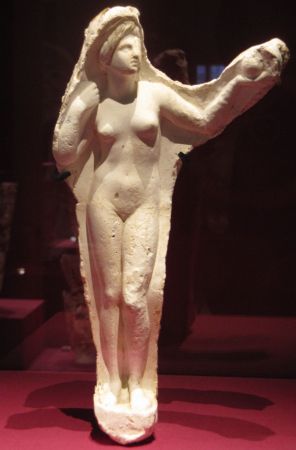
BagramAphroditeThough it is not known what the motivation originally was for acquiring the Bagram Aphrodite, its presence in Afghanistan arguably evinces an interest in female spirituality–if not in the owner of the storerooms then among some of the people in the market for which she may have been destined.  Evidence of such interest among Buddhists is to be found in the Flower Ornament Scripture (FOS), a compendium of sutras dated to approximately the same time (and possibly the same region) as the storeroom containing the Bagram Aphrodite.  Female spiritual figures, both mortal and immortal, some portrayed as having official positions, others without any, are prominent in the final chapter of the FOS, so prominent that one scholar suggests Buddhist women of the time in some way influenced its composition (see Douglas Osto, Power, Women and Wealth in Indian Mahayana Buddhism).

Continue reading “Aphrodite in Bagram Afghanistan & The ‘Friend of the World’ of the Flower Ornament Scripture by Stuart Dean”

Sappho’s Prescription For A Healthy Heart & the Taoist/Buddhist Concept of Forget (忘)

Stuart WordPress photoA two line fragment of Sappho’s poetry (S.120) reads:

But I am not one to keep venting my anger:
Rather I let some things in my heart go unspoken

Sappho’s word choices here make this as difficult as any of her fragments to appreciate in translation.  Yet, not only do those choices make attribution of this fragment to Sappho secure, they also manifest her importance in an area for which she rarely receives attention: early Greek medical thinking.  One reason her importance in that regard is largely unnoticed is that Western medicine in general has abandoned its own tradition, retaining only the nomenclature and some of the symbolism of early Greek medicine. Continue reading “Sappho’s Prescription For A Healthy Heart & the Taoist/Buddhist Concept of Forget (忘)”

Poppaea & Paul: Was This About A Female Challenge To Male Privilege? by Stuart Dean

Poppaea Sabina as portrayed on a Roman coin minted 62-65 CE.


As suggested in my first post on Poppaea it is likely she knew one or more of the women Paul refers to in Romans. Of particular interest is the woman Paul refers to as his ‘mother’ (Romans 16:13).  If Poppaea knew her she surely knew about Paul.  If that was the case, then it seems all but certain Poppaea was among those members of the imperial household to whom Paul refers at Philippians 4:22.  Corroboration of that may have been in the source(s) of an anecdote Saint John Chrysostom tells, attributing Paul’s incarceration and execution to Nero’s anger at his interaction with a woman with whom Nero was erotically involved.

Though it is difficult to place much reliance on Chrysostom’s anecdote without more knowledge about his source(s), in the aggregate the evidence for Poppaea knowing about or even meeting with Paul is relatively strong, especially when compared to the sort of evidentiary problems with which ancient historians regularly grapple.  Furthermore, it is easy to spot the issue Poppaea would have focused on (that precisely because it relates to sexuality could have led in antiquity to the sort of distortion or misunderstanding of her motivation in meeting with Paul) that may underlie Chrysostom’s anecdote: circumcision.  The problem with understanding that issue today, however, ironically relates to modern perceptions of no relevance whatsoever to the ancient evidence. Continue reading “Poppaea & Paul: Was This About A Female Challenge To Male Privilege? by Stuart Dean”

Astrology and Its Relevance to the Jewish (and Christian) Belief of Poppaea by Stuart Dean


Poppaea Sabina as portrayed on a Roman coin minted 62-65 CE.

As a follow up to my last post on Poppaea Sabina, I want to focus on Poppaea’s interest in astrology, one of the few facts about her that can be confirmed independently of the hostile (and hence questionable) depiction of her by the Roman historian Tacitus, who, apart from Josephus, is the primary source of information about her.  Indeed, she may have practiced astrology, for as Empress she was given a celestial sphere on her birthday by the poet Leonidas, who said it was a gift “worthy . . . of her learning.”  Another possible indication of Poppaea’s special interest in astrology is the fact that a large banquet hall in the Roman imperial mansion built during Nero’s reign (recently discovered), probably conceived of and designed before Poppaea’s death (perhaps with her input), had some rotational feature, effectively making it a planetarium.

Though Tacitus thus would appear to be accurate on Poppaea’s interest in astrology, there is good reason to be wary of sharing his negative opinion about it.  He never expressly explains himself on the issue, but it is not hard to spot what bothered Tacitus about astrology and hence Poppaea.  Famous for his appreciation of freedom of speech, Tacitus wistfully looked back on a time when that was a freedom enjoyed only by men.  By contrast, ancient astrology was but one part of a comprehensive philosophy of nature that viewed the entire cosmos as governed equally by male–and female–powers. Continue reading “Astrology and Its Relevance to the Jewish (and Christian) Belief of Poppaea by Stuart Dean”

Poppaea Sabina: A Victim of Domestic Violence– But Why Does That Matter Now? by Stuart Dean

Poppaea Sabina as portrayed on a Roman coin minted 62-65 CE.
Poppaea Sabina as portrayed on a Roman coin.

It has been nearly 2000 years since the Roman emperor Nero kicked his pregnant and sick wife, Poppaea Sabina (hereafter Poppaea), killing her and what was probably the near full term fetus she was carrying.  That Poppaea was murdered deliberately should not be doubted, for not long after her death Nero had her son by an earlier marriage, who was then still a minor, killed by being drowned (a fishing ‘accident’).

Given that domestic violence has a history that repeats itself with sickening regularity it is necessary to explain why this particular case should matter now.  It is because at the time of her murder Poppaea was, with the sole exception of her murderer, the wealthiest and most powerful person in the world, whose attention was curiously focused not on Italy or Rome but on Judaea and Jerusalem.  There is evidence to suggest that had Poppaea not been murdered the history of Judaism and Christianity would have been substantially different than it has been, especially with respect to the role of women. Continue reading “Poppaea Sabina: A Victim of Domestic Violence– But Why Does That Matter Now? by Stuart Dean”

The Sphere: A Symbol of Ancient Greek Female Spirituality by Stuart Dean

Stuart WordPress photoOriginally, in ancient Greek, ‘sphere’ simply meant ‘ball.’  Though its grammatical gender varied, it was primarily a feminine noun.  It is in that sense and with that gender that it bounces into Western literature in the episode of the Odyssey where Nausicaa and her companions are playing catch on a beach (Odyssey 6.100 ff).

Nausicaa is said to be conducting her companions in ‘molpe,’ a curious term that seems to refer to dancing, music and poetry as a single form of performance art.  Authorship (including possibly female authorship) and dates of individual episodes of the Odyssey remain debatable, but both from this episode as well evidence from other sources there is no doubt that in general what Nausicaa and her companions are doing here relates to an actual custom among Greek women that dates back to well before writing was adopted. Furthermore, molpe was spiritually significant.  As the conductor of its performance Nausicaa is compared to Artemis.

The reference to Artemis as one of those who ‘holds heaven’ (Odyssey 6.150), suggests that the sphere with which Nausicaa and her companions are playing may have been intended (at least by the author of this episode) to be a symbol of the celestial sphere.  That suggestion is bolstered by an appeal to what is to be found in the fragments that survive of the poetry of Sappho, who it is readily apparent considered herself as much a musician and choreographer as a poet.  That is to say, whereas Nausicaa may be a fictional persona, with Sappho we have the only direct evidence of any substance directly from an actual woman of what constituted molpe.  From how she refers to a female performer of molpe as goddess-like (S. 96), followed immediately by a comparison of yet another woman’s beauty to that of the moon, as well as other fragments of poems where either the appearance or movement of women in connection with a molpe performance is related to celestial events such as the appearance of a full moon or the movement of the Pleiades, it is clear that for Sappho choreography was in effect applied cosmology (see S. 154 and S. 34 and how it is surely echoed in a much later Latin poem here). Continue reading “The Sphere: A Symbol of Ancient Greek Female Spirituality by Stuart Dean”

The Declaration of Independence: A Misogynistic Mash-up of Greek Philosophy and Roman Law

Stuart WordPress photoRegardless of political identity in America there seems to be an almost religious reverence for the Declaration of Independence (DI).  By far the most quoted sentence from it is the one that begins “We hold these truths to be self-evident, that all men are created equal.”  Though it is hardly ‘self-evident,’ the history behind the words in these two clauses betrays the fact that they constitute a misogynistic mash-up of Greek philosophy and Roman law.

First, the Greek philosophy in the first clause.  Precisely because of how often this portion of the DI is quoted (perhaps most memorably by Martin Luther King), the idea that there are ‘truths’ that are ‘self-evident’ may seem–self-evident.  From the perspective of the history of Greek philosophy, however, such an idea is as problematic as it is peculiar and for that very reason can reliably be traced back to one source: Plato.  The most likely direct source is the introductory section of an ancient Platonic commentary on Greek mathematical methodology.

Though relatively obscure today, it was a much admired work in the Renaissance and for a few centuries thereafter, influencing a wide range of disciplines, including law.  As a consequence of that influence law was conceptualized more geometrico (in a geometric manner), with legal documents drafted (as they often still are today) with a list of ‘defined’ terms first followed by the propositions to which they relate.  Similarly, judicial decisions still slavishly follow a quasi-mathematical methodology, ‘applying’ law to the ‘facts’ of the case, as if plugging numbers into an equation, with everything set out in a sequence of paragraphs identified by a combination of Roman numerals and arabic letters (‘as applied’ in Hobby Lobby (see the majority’s penultimate paragraph)). Continue reading “The Declaration of Independence: A Misogynistic Mash-up of Greek Philosophy and Roman Law”

Contraception, Christianity & Law by Stuart Dean

Stuart WordPress photoNotwithstanding the widespread belief that contraception is not consistent with the principles of Christianity, there is no basis for it.  On the contrary, contraception was closely associated with early Christianity.

Matthew 19:12 is the only passage quoting Christ that is on point.  Christ has been speaking about family law (adultery), acknowledging here that the issue is not relevant to eunuchs, including those who castrate themselves “for the kingdom of heaven.”  At a minimum it seems problematic how this verse is to be understood today.  Yet, the evidence for Christians castrating themselves in the first few centuries after Christ comes from a variety of sources, many of which are considered to be otherwise reliable.  It is very difficult to see why Matthew 19:12 itself should not be taken both as evidence of the practice and Christ’s implicit endorsement of it.

Continue reading “Contraception, Christianity & Law by Stuart Dean”

Before Misogyny Contaminated Theology by Stuart Dean

Stuart WordPress photo

Compared to many issues related to ancient history, it is relatively easy to identify not just where and when misogyny began to contaminate theology, but  the person primarily responsible for it: Plato, who lived in Athens in the late fifth and early fourth centuries BCE. Although today Plato is not thought of as a theologian, in antiquity theology was not just one discipline among many, but rather was synonymous with philosophy as an overarching system of thought to which all else was subordinated. Conceived of in this way theology was comprised of a variety of interrelated theories that today ostensibly appear to be discrete disciplines, including biology and psychology.

There is thus little question but that the exclusion of women not just from theology but from literate culture generally up until the 20th century can to a great degree be attributed to Plato. In one dialogue he categorizes women as a subaltern species of humanity that has yet to evolve to the level of being attained by men. Consistent, in an odious way, with that biological theory, is Plato’s view of female psychology as being such that it should be against the law for women to establish private religious shrines and related rituals since they derive the inspiration for doing so from dreams, apparently incapable of the ‘serious thought’ he deemed necessary for such matters. Given that context it is hardly surprising that in all his ‘dialogues’ there is not one female participant.

Continue reading “Before Misogyny Contaminated Theology by Stuart Dean”

The Physician Luke, the Virgin Mary and the Poet Sappho by Stuart Dean

Stuart WordPress photoSince my last contribution to Feminism and Religion my interest in Sappho and her influence has led me to a detailed analysis of Luke 1:27-45 (hereafter, the “Conception Story”).  I want to share two observations from that analysis that I think will be of interest to readers of this blog.  Both relate to the generally agreed upon fact that Luke was a physician and in particular to knowledge he can be assumed to have had of female anatomy based on evidence from approximately contemporaneous sources.

My first observation relates to the fact that Luke lived during a time when the existence of ovaries in women had only recently been discovered and their function correctly understood.  While this had obvious implications for Greek medical theory, it would appear to have affected how Luke himself interpreted the source material he had for the Conception Story and hence how he told that story.  My second observation, based on what is known of Greek gynecology, is that Luke would have correctly understood that although as a medical term ‘virginity’ does refer to the physical fact that sexual intercourse has not occurred, it does not necessarily or even often have an anatomical meaning.  That observation leads directly to investigating whether ‘virgin’ as used by Luke may have a primarily metaphysical rather than physical meaning.

Though in general the ‘glory days’ of Classical Greece belonged to the centuries well before Luke’s time, that is not true of Greek medicine.  Notwithstanding promising origins in a sexual egalitarianism that was in principle consistent with modern medicine, Greek medicine regressed substantially with Aristotle, who introduced the notion that the male’s contribution to reproduction was the active one and the female’s merely the passive provision of the material for its success.  Not only did Aristotle not know of ovaries, even after their discovery it is far from clear when exactly their function was fully understood (the best evidence is about a half century after Luke).  Once that happened, however, Greek medicine moved back towards the sexual egalitarianism of its origins (the ‘two seed theory’ of reproduction), repudiating Aristotle’s theory (the ‘single seed theory’ of reproduction). Continue reading “The Physician Luke, the Virgin Mary and the Poet Sappho by Stuart Dean”