

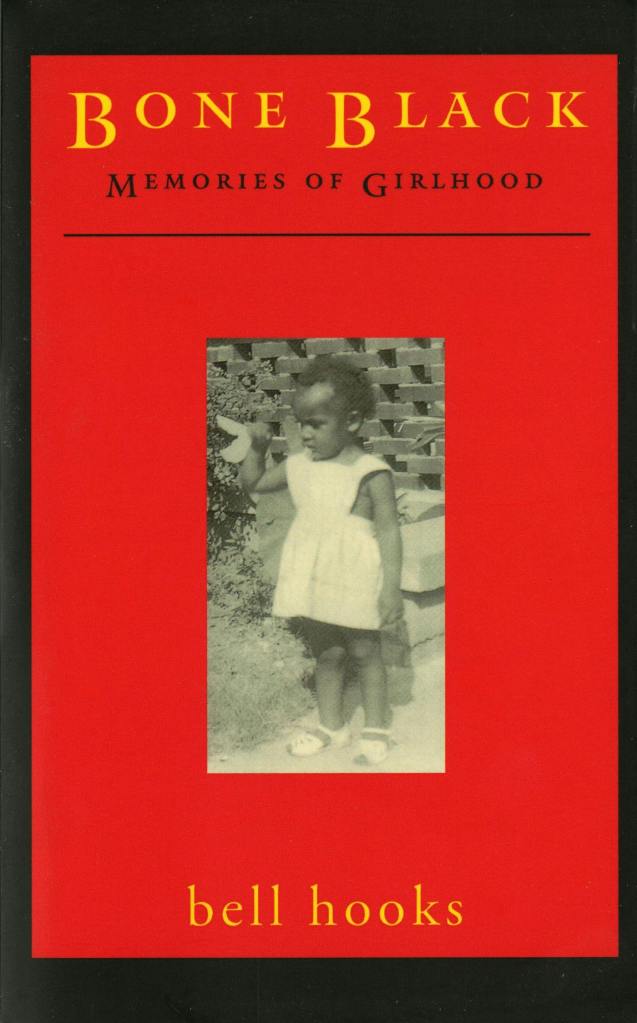
Bell Hooks explores in the memoir Bone Black: Memories of Girlhood the extreme effects of race, gender, and class on her identity and self esteem as a Black woman. Each chapter of Bone Black showcases stories of Bell Hooks’ childhood experiences growing up in a racially segregated environment. Through these experiences, she shares how the mainstream beauty standard, the racism towards Black people, and the limitations imposed by class and gender have shaped her perceptions of herself and her worth. Hooks also discusses how white supremacy, the patriarchy, and societal neglect intertwine.
What particularly stood out to me is how her story and the themes mentioned connect to spirituality and are offering further ideas on resistance and empowerment. It also touches on connections with identity formation and our sense of self. For example, the memoir shared insight of how the beauty standards at the time were typically associated with being white. As a Black woman, Hooks shared how she had felt undesirable due to not being included in these standards that were set in place. She does not just reflect on the pain of being marginalized but she also delves into the complexity of being a Black woman in a masculine dominated world. Hooks had to navigate both the oppression of racist behavior by others around her and the misogyny of a patriarchal system that was determined to define her worth based on her appearance.
Hook’s struggle involves more than just challenging the effects of racism, and that it also requires resisting the stereotypes or ideas depicting Black womanhood as inferior or invisible. This memoir invites its audience to take a closer look at their own experiences with their identity and self worth, specifically those who are from marginalized communities or who are made to feel like an “other” by society’s dominant ideas. Unfortunately, some of these experiences shared by Hooks in the memoir can still be very relevant and relatable for many women in present time. Whether it is through experiences with racism, sexism, homophobia, transphobia, or classism, many people do still continue to face internal questions about their worth, identity, and their place in the world. Bone Black is a helpful guide that, despite these external forces, shows there is power in self affirmation and in the reimagining of one’s worth outside of the constraints placed by society.
While my struggles are vastly different from Hooks’s, they do share a common idea: both of us were affected by society’s exclusionary beauty standards. Though I am not a person of color, I also grew up feeling alienated by an idealized image of beauty that didn’t include people like me. As I grew older, I noticed over time how the media’s portrayal of beauty, through magazines, television shows, and advertising, have intensified my previous insecurities of growing up “bigger” than my peers. I aspired to be the image of the “ideal” woman who was admired for her looks and valued for her similarities to the mainstream standards of beauty. I wanted to be that woman that boys would drool and fantasize over for ages. My goal was to be seen as beautiful in the way that was celebrated by society. However, I began to realize that I could never be that woman. I could only be myself, and in accepting that, I learned how to reclaim my own sense of beauty and reject all of the external validation.
But, there are some certain thoughts that come up when looking at and discussing the exploration of race, class, and gender in Bone Black. How can someone reconnect with their sense of self in a world that continues to impose limiting and harmful definitions of who they are? How do people reclaim their worth in a system that is aiming to dehumanize them? In her writing, Hooks is presenting a vision of spiritual empowerment by tying together the struggle for self worth and identity with spirituality. Again, this is an idea that many people can relate to. Spirituality or divinity does not only have to occur in religious institutions or organizations, but it can be found in the way Black women, and all people of color for that matter, resist oppression.
In turn, this sense of community coming together and uniting can also help in reaffirming beauty and worth. Even though some common themes in Bone Black are mainstream beauty standards, racism towards Black people, white supremacy, the patriarchy, limitations imposed by class and gender, and various others, it also represents how valuable companionship and spirituality are in order to help reclaim self worth and identity. Having a source of solidarity and creating safe spaces where everyone can be able to feel affirmed is a beautiful concept. An important theme in Bone Black: Memories of Girlhood is connection, such as understanding and being mindful of someone’s struggles, especially when it comes to race. And, this is only one example of a piece of literature showing how intersectionality and spiritually go hand in hand.
Discover more from Feminism and Religion
Subscribe to get the latest posts sent to your email.

 Feminism and Religion