The Importance of Rituals (Part 2) by Elise M. Edwards

elise-edwards

In my previous post, I wrote about the importance of rituals. The rituals of the Easter season helped me process some difficult emotions. The way that rituals mark time and demonstrate consistency has been a comfort for me when facing new challenges and settings. But I am quite aware that rituals can become empty.   In one of the comments to that post, a woman named Barbara responded, “There came a time for me when familiar and meaningful ritual no longer made sense. I had changed in understanding of what the ritual symbolized and celebrated. And haven’t found new rituals that make sense for me now…or at least I’m not aware of any.” Barbara’s remarks capture not only the loss from no longer being able to relate to existing rituals after life changes, but also the difficulty in finding or creating new rituals to take their place. I thanked Barbara for her honesty and decided that this post would continue the discussion, focusing more on discovery and creation of new rituals.

As I was preparing that post, I watched an episode of Call the Midwife that prompted me to reflect on the need to create rituals when existing ones just don’t work. Call the Midwife is a BBC-PBS show about nurses and midwives living in a convent in London’s East End at the end of the 1950s and early 1960s. The show is based on the memoirs of Jennifer Worth, and it does a better job than most primetime dramas of showing female characters’ experiences the joys and challenges of their professional lives and personal lives. As it is set in a convent with several characters who are both nuns and midwives, the show also explores the theme of vocation. What does it mean to be called to the religious life? Called to nursing? What does motherhood demand? Continue reading “The Importance of Rituals (Part 2) by Elise M. Edwards”

The Importance of Rituals by Elise M. Edwards

elise-edwardsMy sister once said about me, “One thing you have to understand about Elise—she takes the ritual of whole thing very seriously.” My sister was right and her words helped me see this quality about myself. What ritual was she talking about me taking so seriously? Happy hour on Fridays.

It was a different season of my life when she said this. I don’t have Friday happy hours regularly anymore, although I did gather with my friends nearly every week for food and drinks for many years throughout my 20s and 30s. It was often on Fridays, but at one point it was Wednesdays and then, for about a year, it was Thursday nights after a late shift at work.

More recently, I would meet a friend for crepes at the farmers’ market on Saturday mornings. Although the day and the time and specifics of these gatherings would vary, the act of setting aside a weekly time to connect with people dear to me and relax as we indulged in good food or drink was a ritual to me.

Continue reading “The Importance of Rituals by Elise M. Edwards”

Role Play: In Search of the Authenticity of My Being by Elise Edwards

Elise Edwards“I stood in the authenticity of my being: Black, preacher, Baptist, woman. For the same God who made me a preacher made me a woman, and I am convinced that God was not confused on either account.”
– Reverend Dr. Prathia Hall

These words came across my Facebook feed on Sunday in celebration of International Women’s Day. Reconciling Ministries Network put the statement on its Facebook page, along with a picture of Prathia Hall preaching from the pulpit, in remembrance and honor of women leaders who contributed to the US Civil Rights Movement. This past Sunday, March 8, when the quote was displayed, marked the 50th anniversary of Selma’s Bloody Sunday. Prathia Hall was a leader in the Student Non-Violent Coordinating Committee (SNCC) and one of the activists on the Edmund Pettus Bridge who were attacked as they began to march from Selma to Montgomery, Alabama. Later in her life, she became an ordained minister, professor, and womanist theologian.

For me, this past weekend was about remembrance through many forms. While there were many events commemorating Selma and the important events that unfolded there 50 years ago, my family and I were focused on a more intimate form of remembrance. On Saturday, we held a dinner and informal memorial service for my godfather who passed away last month. I got the news of his death on a day when I’d been doing some deep soul-searching and reflecting about the image I present to the world and its correspondence with who I am and desire to be. Just a few days prior, I’d spoken to my godfather about his health and subsequently, I had been questioning how I might be more connected to him. We lived several states apart, and I wondered how I could be a good goddaughter to him despite the distance. Those questions are left unanswered in the wake of his death. Continue reading “Role Play: In Search of the Authenticity of My Being by Elise Edwards”

Awake! Awake! A Reflection on the Awakening of Conscience and Advent by Elise M. Edwards

Elise Edwards‘Tis the season to be…?

For me, this has not been a season to be jolly. I teach at a university, and again, I’m in the midst of the most hectic time of year of grading and exams and wrapping up projects due at the end of the calendar year. There have been moments of joy and rest. But I’ve been more reflective and sorrowful. This year, my heart and mind and soul have been opened up in new ways and I feel more urgency and need for social change. I’ve been experiencing “conscientization” during the time of year many Christians refer to as Advent.

I was introduced to the concept of conscientization in the work of Christian feminist and womanist ethicists like Beverly Wildung Harrison and Stacey Floyd-Thomas. Other feminist and liberationist thinkers had already convinced me of the vital role that critical thinking, consciousness-raising, and action occupy in ethical reflection and social change. In a chapter on “Feminist Liberative Ethics” in a textbook on liberative approaches to ethics, Michelle Tooley explains the meaning of conscientization:

“Activists speak of conscientization as waking up to the injustice in the world—or seeing it for the first time. It is not that the injustice is beginning; it is that you encounter oppression, injustice, violence yourself or you see it in a person or situation. You may have seen the same situation many times before, but for some reason you begin to connect the event with a deeper recognition that the injustice is wrong.”

(p. 185, Ethics: A Liberative Approach, Miguel A. De La Torre, Editor)

I was conscientized the night I heard that a grand jury did not indict Darren Wilson for killing Mike Brown, an unarmed black man. I was horrified to learn that this police officer doesn’t even have to stand trial for his violent and deadly act. Now it wasn’t like before grand jury’s decision I thought that black lives were given equal value in the US justice system. After all, for months I have been researching and preparing a paper called “When the Law does not Secure Justice or Peace” about artistic and religious responses to the dishonoring of black male personhood. I have been mourning the loss of Trayvon Martin and others as I write. But this decision left me sobbing in a hotel room as I watch the events unfold in Ferguson, Missouri. I gained a deeper social awareness about the depths to which the demonization and disregard of the lives of black women, men and children are entrenched in American life and the institutions within it.

I gained deeper self-awareness too. One reason the tragedy of the grand jury’s decision became so palpable to me is that just hours prior, I witnessed former president Jimmy Carter address the American Academy of Religion. He spoke passionately about the proliferation of violence, mistreatment of women, climate change, and other social concerns. To put it plainly, I was floored to see a white man in his 90s who was raised in Georgia and was a Southern Baptist until his 70s state without any qualms that people in power intentionally misinterpret religious texts to support the domination of women and nonwhites because those they do not want to lose their privilege. Yet he also called himself, like Archbishop Desmond Tutu, a “prisoner of hope.” He believes that things will change, and draws from his Christian convictions to sustain hope and motivate his work to fight injustice.

I was electrified by his words. I, too, had hope. In the days prior, I had gotten a break from my daily life, connected with friends, and conversed with like minds. I had been thinking about art and love. I had learned strategies for de-centering dominant narratives in the classroom and I was hopeful that I could use them to make a difference in my students’ lives. But mere hours later, while watching the news, the self-awareness I came to is that my hope is more fragile than I wish it to be. Futility consumed my hope.

A few weeks later, I can assert that my faith in God is not shaken, but my hope in humanity’s goodness has as much stability as a house of cards. In my present state of mind, I’m grateful that we are at a point in the church year that provides me with an opportunity to mourn the brokenness of our world. Christmas is approaching, but that doesn’t mean I have to sing merry carols. Advent is a season when Christians reflect on why the world needs God’s miraculous action and what it means to wait for light to emerge in the darkness. In the church calendar, it is a time when Christians re-enact and re-experience the anticipation of Jesus’ coming. Advent songs have a different character than Christmas carols. Many of them have a haunting tone or an eerie, sad, or mysterious sound. The lyrics of these songs place exhortations to “Rejoice!” next to pleas of “O come, o come, Emmanuel!” Emmanuel, also spelled Immanuel, means “God with us.” Christians draw this name from the Hebrew prophecies in Isaiah that are cited in the Gospel of Matthew’s account of Jesus’ birth. Matthew describes Jesus’ birth as the fulfillment of prophecy.

My conscientization allows me to hear these prophecies anew. They are familiar to me, as they are repeated often this time of year in Christian settings, but I hear them in new ways. I hear Isaiah 9:6 quite differently: For to us a child is born, to us a son is given, and the government will be on his shoulders. And he will be called Wonderful Counselor, Mighty God, Everlasting Father, Prince of Peace.

“The government will be upon his shoulders” likely means that this child will have authority. But as I hear those words this year, I imagine the Prince of Peace in the choke-hold of a law enforcement officer. I think of a little baby who are welcomed into the world with joy but who grows up only to be killed at a young age by threatened authorities and crowds of supporters. This is the story Christians tell about the God who is with us, the God who is also fully human. And this is the story we tell about Michael Brown, Eric Garner, Tamir Rice, Alesia Thomas, Aiyana Stanley-Jones and far too many others.

This Advent, I’m making a real effort to hold hope and despair together. I don’t want to become hopeless. I don’t want to think that my work in the classroom, in my church, in my community, on this site and in the printed page have no meaning. Hope is what sustains us to work for justice. I want to believe in that transformation of hearts and minds and souls is possible and immanent even when it emerges through sorrow and struggle. Suffering, sorrow, and killing without consequences must not be acceptable. With my new eyes, I see just how terrible they are.

Elise M. Edwards, PhD is a Lecturer in Christian Ethics at Baylor University and a graduate of Claremont Graduate University. She is also a registered architect in the State of Florida. Her interdisciplinary work examines issues of civic engagement and how beliefs and commitments are expressed publicly. As a black feminist, she primarily focuses on cultural expressions by, for, and about women and marginalized communities. Follow her on twitter, google+ or academia.edu.

Responding to Human Suffering by Elise M. Edwards

Elise EdwardsIn the past few weeks, there have been renewed debates throughout the US about death with dignity laws and the role of government is providing or securing access to health care. The tragic story of Brittany Maynard and the incessant election-year politicking about the Affordable Care Act (Obamacare) have made issues about human suffering more visible and volatile than usual. These are topics I deal with in two courses I am teaching this semester–one about Christian ethics and the other about bioethics.

I truly admire those who work in the presence of suffering daily by caring for others.   It’s difficult to even talk about suffering in the classroom day after day. My intention behind doing so is for my students to resist simplistic responses by either valorizing human pain and suffering or retreating to escapism. I caution them about using religion to legitimize suffering when it accompanies from evil, yet encourage them to see the meaning in suffering as well. We try to maintain the fine line of affirming the experiences of those who claim to gain strength or some other good from their pain without crossing into discourse that names the pain itself as something good. We debate whether there can be any way of discussing suffering as redemptive. We discuss disparities in medical treatment and health care along economic, racial, gendered, cultural, and international divides and what the responses of clergy, medical providers, and everyday people to remedy them.

Through these heavy debates, I’ve gained more clarity about the ways that suffering is often a result of human injustice and I’m deeply saddened by it. Continue reading “Responding to Human Suffering by Elise M. Edwards”

Fannie Lou Hamer’s Commitment to Life by Elise M. Edwards

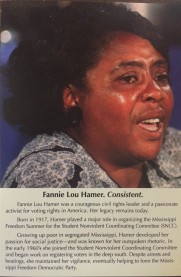
Elise EdwardsA few weeks ago, I came across a postcard that I was given at a conference last year. I got the postcard (advertisement?) because it has a picture of Fannie Lou Hamer on it, and in my home and office, I like to display images and quotes from inspirational women, especially black women. Hamer was a sharecropper from rural Mississippi who became a leader within the civil rights movement in the United States. I was happy to have something with her likeness on it. It was only later that I looked at the text on the front and back of the card, which read in part, ”Often called the ‘spirit of the Civil Rights Movement,” Hamer worked tirelessly on behalf of the rights of others—including the unborn. [She said,] ‘The methods used to take human lives such as abortion, the pill, the ring, etc. amounts to genocide. I believe that abortion is legal murder.’” I realized then that the card was distributed by an organization called Consistent Life, who, in support of a “consistent ethic of life,” is “committed to the protection of life threatened by war, abortion, poverty, racism, capital punishment and euthanasia.”

I was conflicted about the ushamere of Hamer’s image for this organization’s purposes. It is true, Hamer did have those views about abortion and birth control. But I did not know if her image and story was being manipulated for a particular political and religious agenda—one I do not align myself with. I put the card in a box of other images and quotes. I didn’t display it, but I didn’t throw it away, either, which is why I came across it again a couple weeks ago as I was cleaning and decorating my home office. I had the same misgivings about the image as before, and I set it aside again. Continue reading “Fannie Lou Hamer’s Commitment to Life by Elise M. Edwards”

More than Individual Concerns by Elise M. Edwards

Elise EdwardsWell, the fall semester of the school year has begun. I’m teaching undergraduate classes in Christian Ethics and Bioethics this fall. I’ve designed my classes so that they are much more discussion-based than they have been in previous semesters and as a result, I’m noticing the things that challenge and confuse my students fairly early. I have readings from feminist, womanist, and mujerista thinkers in these courses, and unsurprisingly, some of my students don’t know what to do with the arguments feminists make about how we arrive at moral decisions and live them out. I hope that as we work through the essays together, my students and I learn from each other.

I assigned an essay called “Theology’s Role in Public Bioethics” by Lisa Sowle Cahill that was included in the Handbook of Bioethics and Religion edited by David E. Guinn (2006). Cahill, a feminist thinker, asserts that theology can be a conversation partner in public debate about bioethics and also an advocate for just, compassionate, and inclusive health care practices. Citing the work of another feminist, Maura Ryan, Cahill argues that ethical questions about reproductive technologies should be examined not only as individual dilemmas but as issues that exist within a social justice context. In the conclusion of the essay, she states, ”Specifically, one of [theology’s] most important and distinctive contributions to public discourse is a critique of the ways in which modern biomedicine and biotechnology have become luxury items marketed to economically privileged classes, while the world’s poor majority lacks basic health needs.” (55).

I suppose because I’ve been reading feminist thought, theology, and social ethics for years, some of the claims that my students see as radical and new are commonplace and go unquestioned by me. I expected some of my students to disagree with Cahill and Ryan’s particular positions about assisted reproduction. But I was surprised by students’ rejection of the idea that debates about reproductive technologies include MORE than individual considerations.

I’ve blogged on this site about reproductive rights before, and let me be clear that I do not think that the church, state, or any institution should have more governance over a person’s body than that person herself. But while respecting individuals’ rights to make health decisions for themselves, I also acknowledge that these “individual” decisions have broader social implications and meanings. This is one reason second-wave feminists have insisted that “the personal is political.”

Feminists routinely relate individual, “personal” acts and beliefs to larger constructs and the too-often asymmetrical power dynamics at work within them. This is why we are disturbed by video of a man who knocks his fiancée out and drags her unconscious body from an elevator and pop stars who gain commercial success by graphic displays and descriptions of sexuality that is objectifying or exploitative. And, in response to one of my students who wondered if feminist interpreters of religious texts go too far, that is why they point to patriarchy in a story that seems to be about devotion (referring to the Book of Ruth).

I’m grateful to my students for prompting me to explain some of these convictions that feminists hold. Certainly feminism is not monolithic. We feminists disagree on many issues including the scope of individual rights, the role of religion in public debate, and the extent of harm (or lack thereof) in media portrayals of female sexuality. But I believe we tend to agree that our personal decisions as well as our societal issues should be addressed with a consciousness that as humans we are beings-in-relation. Our conviction that we are connected and affected by each other lies behind our motivation to make the world a better place for women and girls and others who suffer from patterns of dominance.

What do you think?

Elise M. Edwards, PhD is a Lecturer in Christian Ethics at Baylor University and a graduate of Claremont Graduate University. She is also a registered architect in the State of Florida. Her interdisciplinary work examines issues of civic engagement and how beliefs and commitments are expressed publicly. As a black feminist, she primarily focuses on cultural expressions by, for, and about women and marginalized communities. Follow her on twitter, google+ or academia.edu.

Sleeping: Thinking about Bodily Practices, Pt. 2 by Elise M. Edwards

Elise EdwardsAs I mentioned in my previous post, I’ve been reflecting on bodily practices–especially those that are not typically associated with feminism and religion. Our lives as embodied persons are so multi-dimensional! There is so much we perceive and experience through our senses, through our movements, and through the places we locate ourselves. So I have decided to use this blog to think through some ideas and learn from you in this community of readers, contributors, and commenters. Over the next few months, I will continue to discuss the ways I am becoming more intentional about connecting habits surrounding the body to feminist and religious concerns. Once again, I’ve glossed on only a few of the many connections we could make about women, religion, and bodily practices. Today I write about sleep. I would love to hear your thoughts in the comments below.

Do feminism and religion have anything to do with sleep?

Sleeping is as vital to human survival as food and water. But lamentably, getting the proper amounts of sleep is not one of those healthy goals that is fiercely defended. It is much more common to hear someone brag about how productive she can be on a few hours of sleep than to boast about her productivity after a full night’s rest. I have to admit, I am always a little suspicious of those people who proudly proclaim they only need 4 or 5 hours of sleep, and I’m a little antagonistic to those who want to recruit the rest of us into their sleepless world: “There is so much else you could be doing with your time than sleeping!” They say, “I’ll sleep when I’m dead!” I have even heard “Sleep kills dreams!” Um, actually, dreams come when you sleep. Sleep breeds dreams, you could say. More on that below.

As you might be able to tell, I am the type of woman who loves sleep. I love climbing into my bed at night. I enjoy the feeling of waking up with a rested body and a renewed spirit and a groggy-but-fresh mind. I especially love naps for that reason. The most enjoyable and perhaps “productive” seasons of my life have been those when I could take a nap after class, after work, or after the gym.

Sleep is vital because it allows the body to rest. In the Christian tradition, we claim that rest is part of the creation of the world. That God marveled at the wonderful world God created, and when the work was done, God rested. This rest inspires the Sabbath. Sabbath is a day set aside for rest, worship, and contemplation of the holy. It is regrettably observed less and less in contemporary American Christianity. Since we have let go of the need for the Sabbath, it certainly no surprise we have also lost sight of the importance of daily rest, too.

Although my thoughts are little uncharitable towards those who preach the gospel of little sleep, I am very sympathetic to those who feel they do not have enough time to sleep. To those who feel like sleep is a luxury they cannot afford. Certainly many women tasked with numerous responsibilities often feel this frustration. They make do with less sleep because they have to complete more tasks in their waking hours. Yet it has been my experience that even those who are overworked and overscheduled appreciate the uncommon times when they can sleep a little longer than usual.

For me, times of sleep are very much connected to gratitude. In the past year or so, I have retrieved the practice of nightly prayer, which sadly got left behind in my childhood years. In all honesty, it was not a renewal of spiritual piety that led me to resume these bedtime prayers. It was insomnia. As much as I love sleep, I am often kept from it by anxieties and thoughts of the coming day. I started using bedtime prayers as a way of turning my cares over to God. These silent prayers become conversations about what is important to me and what concerns me. I talk to God about what I am grateful for. I talk to God about my family and my friends, about their lives and concerns that weigh on me. And then I let it go–at least for the night–and trust my soul to the divine power who cares for me while I sleep.

These nightly prayers have not only promoted peaceful sleep (for most nights, at least) but also the experience of vivid dreams. Dreams, like other visions, are honored in many religions as a place where the divine communicates with humanity. But this too, seems absent from contemporary American Christianity. Perhaps it is because dreams are associated with the intuitive senses, and therefore the feminine, that they are overlooked. Dreams are less clear and presumably more open to speculative interpretations than the texts we read during the day. I cannot say whether I meet God or whether I meet my deeper self in dreams, but I do know I am connected to powerful ways of being in my sleep, and that this is important for my spiritual life.

My final reflection about sleep is an acknowledgment that we often do not sleep alone. While sleep itself takes us to a solitary place, we often share our beds with lovers, children, and other family members and friends. Like those bedtime prayers, the words we speak under the covers in those moments before sleep connect us to our bed-mates. Whether they are ghost stories or secrets or incoherent ramblings about the day to come, these nighttime words prepare our minds for the sleep that will soon overtake us. Unless, of course, we are next to someone who snores or kicks.

Elise M. Edwards, PhD is a Lecturer in Christian Ethics at Baylor University and a graduate of Claremont Graduate University. She is also a registered architect in the State of Florida. Her interdisciplinary work examines issues of civic engagement and how beliefs and commitments are expressed publicly. As a black feminist, she primarily focuses on cultural expressions by, for, and about women and marginalized communities. Follow her on twitter, google+ or academia.edu.
Eating: Thinking about Bodily Practices, Pt. 1 by Elise M. Edwards

Elise EdwardsI am currently preparing to teach a course on bioethics in the fall. I plan on combining some common, secular materials on biomedical ethics with some theological material and some feminist readings. After all, in a course that centers around practices related to the body, birth, and death, there seems ample opportunity to introduce feminist themes. Some feminist perspective, of course, is typical, like when we will discuss abortion and contraception. (Or at least it is common in my courses where try to present multiple sides of an issue.) Anything related to conception, pregnancy, and birth is easily understood as a “women’s issue” and therefore something that feminists address. I’ve discussed abortion and contraception in previous posts on this forum.

However, I realized in going through readings for this course that I have not focused much on other practices related to the body in my scholarship or personal reflection. Specifically, I have not connected them to theological principles or feminist convictions. Perhaps not everything concerning the body is directly relevant to feminism. But I am sure if I thought about it, I would be able to make the connections. We are physical creatures and the feminist movement generally affirms recognizing our embodiment.

Continue reading “Eating: Thinking about Bodily Practices, Pt. 1 by Elise M. Edwards”

Songs for the Soul by Elise M. Edwards

Elise EdwardsDuring the Christian season of Lent, many Christians focus on spiritual practices or disciplines that bring them closer to God. This year, I did not really engage in this type of reflection until the end of Lent. I have been wrapping up my first year teaching college students full-time, I’ve been focused on several writing projects, and I’ve been traveling. I did not intentionally think about spiritual practices until I participated in a silent retreat before Holy Week and traveled first to spend the holiday with my family and then again to mourn and remember the life of my aunt.  I reflected on them when I most needed them.

Continue reading “Songs for the Soul by Elise M. Edwards”