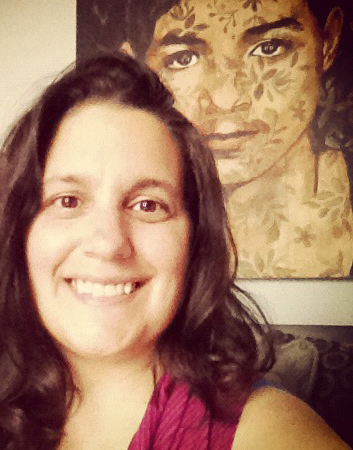
Like Rain on Dry Land by Marcia Bedard

When first I moved to a rural mountain community near Yosemite, I was spiritually parched, and my soul felt  dry as a bone. Desperate for the rich conversations of my sisters, after taking an early retirement from the CSU Fresno Women’s Studies Program, I had an intuitive sense that I might find some like-minded women friends in a small group that met weekly at our local church, led by Diana, our courageously and outrageously feminist pastor, who has since moved on to what I hope are friendlier communities for feminist pastors.

If PFLAG, and similar marginalized groups, had found an oasis there, in what was called (in order to please the church fathers) a Women’s Bible Study Group, so could I. A year before, this would have been my last choice of groups to join, but in a town where fundamentalist churches thrived, and Starbucks was the only place you could find a copy of literature as subversive as The New York Times, it was my only choice. It was in the church basement, amidst a thinly disguised knitting/bible study group, that we gathered weekly to receive what turned out to be a truly holy (meaning wholly) communion of spirit, enriched by various reading that Diana generously shared with us. Continue reading “Like Rain on Dry Land by Marcia Bedard”

A Sea Change Towards Women’s Ordination by Mary Ellen Robertson

If I see a flaw in contemporary Mormon feminism, it’s that we haven’t ventured outside our own religious community to partner with other religious feminist activists. Working separately or in ignorance of the work already done by other religious feminists, we’re more likely to spend time reinventing the wheel than building upon the lessons learned.

Fortunately, there’s an exciting shift afoot.

Last week, Catholic and Mormon women came together for a dialogue on women’s ordination.
Hosted by Claremont Graduate University, this discussion brought together six women from  patriarchal religions to explore what happens when we call an all-male priesthood into question and examine the theological and cultural assumptions upon which an all-male priesthood rests. Continue reading “A Sea Change Towards Women’s Ordination by Mary Ellen Robertson”

Working and Working Out: “Health,” Obesity, and Labor by Stefanie Goyette

What I think we must consider in analyzing any form of “health” that is encouraged, and even enforced, is that such encouragement comes back in the end to the ability to work, to be “productive,” and, in turn, to spend the money that one earns. 

What is “health”? What does it mean to be “healthy”? Physical well-being and energy? Mental and emotional balance? A sense of general control over one’s body and self? I had originally meant to speak of the frequent reduction in our culture of “health” to appearance: sexual attractiveness, muscle tone, body size, etc., but Lesley Kinzel has already given an analysis of this paradigm, twice, in fact. Go read her articles, then come back here and we’ll talk about some other stuff.

Attractiveness as a measure of “health,” which we will consider as being already established as a cultural fact, effectively defines health neither as a personal sense of well-being nor as a set of conditions agreed upon in consultation with a physician. Rather, aesthetic criteria render health a metric that lets other people judge – and judge others on – a level of “health.” This judgment affects women disproportionately and, being external, reduces the value of female subjective experience and the power of subjectivity in the individual. Yet this externalization by no means ends with quotidian social interaction, but also extends to the medical establishment and the regulation of bodies in terms of the normal and the pathological – no great revelation here (Foucault already said it) – and these measures are already part of the intrinsic layout and values of the culture to which a given medical establishment belongs. Continue reading “Working and Working Out: “Health,” Obesity, and Labor by Stefanie Goyette”

THE INTERPRETER; or An Introduction to Hermeneutics by Daniel Cohen

 He showed us that every text contains two messages, one formed by the ink and the other by the spaces left between the inked letters, the material included and that which was excluded, and that the message was never complete if only the first text was read.

(Hermeneutics: The art or science of interpretation, especially of scripture. Oxford English Dictionary)

It was all the interpreter’s fault.

He came to our city looking for employment. It was soon clear that he had a wide knowledge of many languages, and most of our merchants began to employ him in their dealings with foreign traders. We saw him speeding from one to another, in those sandals of his with the odd widening at the heels, often pausing to tell one merchant of a recent purchase of interest by another. It seemed that trade prospered with his coming. Our merchants became wealthier and busier than they had ever been. Continue reading “THE INTERPRETER; or An Introduction to Hermeneutics by Daniel Cohen”

It’s Junk Science by Brian Froelich

Let’s be honest. It’s not about the junk science. There were some crazy things said recently but they were crazy with a purpose.

Republican Rep. Todd Aikin (who is a policy blood brother to Republican Reps. Paul Ryan and Chris Smith) effectively said a woman’s subconscious can determine if she gets pregnant. He said as a result of a rape a women’s body can shut down its reproductive mechanisms. Of course this is junk science. And Republicans quickly reacted to the predictable public uproar by castigating Rep. Aikin and seeking his resignation from the race. (Two interesting exceptions to that list were former Presidential candidate Mike Huckabee and current Congressional candidate Rep. Chris Smith. Huckabee by his stout defense and Smith by his silence.)

But this had nothing to do with Republicans’ regard for science. In fact science is held in very low regard in the Republican party. This is best exemplified by the fact that the Republicans appointed Rep. Aikin to the Congressional Science Committee. Continue reading “It’s Junk Science by Brian Froelich”

Hijacking the Nuns? by Kate Conmy

When stuck between a vow of obedience and a hard place known as the Vatican, sisterhood may be our only prayer. Since April 18, 2012, the U.S. nuns have been cast into the headlines as the Vatican’s Congregation for the Doctrine of the Faith (CDF) released a harsh assessment of the Leadership Conference of Women Religious (LCWR), an umbrella organization, representing 80% of U.S. sisters.  Accused of “radical feminist themes,” “corporate dissent,” and among other things, not taking an official stance on some hot Catholic issues, nuns have become frontrunners of a revolution.

The groundswell of support and solidarity pouring forth from faithful Catholics and the media has been unprecedented by all standards; when the secular feminist website Jezebel is calling for Sr. Simone Campbell , executive director for the Catholic lobby group, NETWORK, for president, the issue has clearly gone beyond the choir. The movement has taken on the adage “we are all nuns,” expressing a shared sense of oppression by the Catholic Church. If the second largest religious domination in the U.S. (10%) is “former Catholic,” then this shared sense of betrayal by the Vatican may not be new, but it has found new energy in the conflict between Rome and the American nuns. Continue reading “Hijacking the Nuns? by Kate Conmy”

How Joan of Arc Crashed Through My Pagan Heart by Marcia Quinn Noren

Born into a Lutheran family of academicians, from earliest childhood I questioned their divisive, anti-Catholic rhetoric and systemic methods of indoctrination. The punitive consequences of my rebellion against their worldview were swift, harsh and unrelenting. Separated emotionally from my mother, subjected to abuse by a narcissistic father who considered himself a warlock, I subconsciously adopted the warrior archetype as a means of survival. Steely armor encased my heart, hidden beneath a feminine veil. When the feminist voices of the 1970’s grew into a force that would not be silenced, for the first time, I felt less alone.

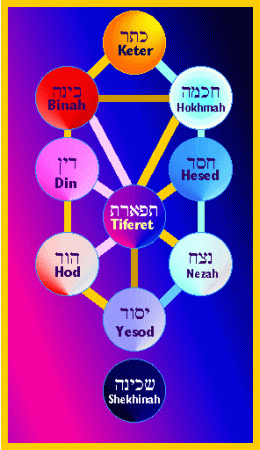
Actively seeking alternative spiritual resources throughout the years that followed, I found a road with many tributaries rising up to meet me, as though that ancient Irish blessing had touched my life with grace. Soothed by nature’s elements, I have always felt the presence of divinity in the earth and sky, in the company of animals and invisible beings. Through studying Hindu and Buddhist traditions, I learned the value of going into the silence. A glimpse of the divine feminine appeared when Quan Yin poured compassion into my soul from the vessel she carries. An immersion into the Western Mystery Schools brought the Hebrew Tree of Life into focus, and there I found a balance of yin and yang, male and female in the Kabbalah’s Sephiroth. Continue reading “How Joan of Arc Crashed Through My Pagan Heart by Marcia Quinn Noren”

Sacred Outcry: A Poetic Trilogy by Mary Saracino

1.  NO COUNTRY FOR OLD WOMEN

Howling from the mountaintops
wailing from the riverbanks
scooping the moon into their waning wombs
the old women know that lies kill,
distortions maim, hope isn’t enough to feed starving
babies, school the ignorant, put an end to war.

Like Furies, the old ones rise,
clench their furious fists against the blazing sun;
like Harpies they roar, casting dire warnings
upon the winds of change; soothsaying Sibyls
decipher omens, portend the future, speak in baffling koans.
With dakini wisdom they cut through
illusion, vote in primaries, attend caucuses,
raise their voices against power, shatter
the corrupted ceilings that chafe the crowns
of their wizened heads.

The wandering Maenads cry: “This is no country
for old women.”

Medea calls down her midnight powers,
prays for revolution, strengthens the tired tongues
of memory. Eloquence isn’t enough to heal
a wounded country; sequined celebrities
can’t mend a nation’s odiferous past. Kali avenges
her sisters, the long-patient Queens & Crones,
Maidens & Mothers. The forgotten ones
wait and watch and warn: “Beware the hubris
of ages. Beware the greedy hand that grabs the golden fleece.” Continue reading “Sacred Outcry: A Poetic Trilogy by Mary Saracino”

Her Name by Janine Canan

She is dancing her Dance
and everything changes.
This is what is meant by Impermanence,
buddhist for God.

She is dancing her Dance
and nothing remains.
This is what is meant by Nothingness,
atheist for God.

She is dancing her Dance
and everything is beautiful.
This is what is meant by Changing Woman,
navajo for God. Continue reading “Her Name by Janine Canan”

The Solace of Another Woman’s Story by Yvonne Augustine

This week, I read an excellent, gripping, poignant blog post by Feminist Philosopher Leanne Dedrick entitled “Things That Make Me Cry: The Practice of Unbelief.” The purpose of the piece was Leanne’s desire to address a misperception by some non-atheists that atheists are devoid of emotion, violently hostile to anything associated with faith, and unable to deal honestly with the Divine. She also corrects the erroneous assumption that atheists seek to “hide from, or purposefully turn […] away from, the ‘saving grace’ of religion.” In the post, she wrote specifically about her own journey from ultra-conservative Christianity to atheism. Continue reading “The Solace of Another Woman’s Story by Yvonne Augustine”