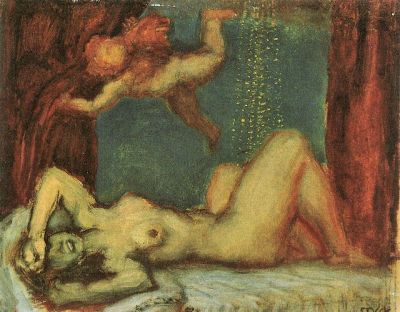
Warning: contains images of rape portrayed through the lens of the objectifying pornographic male gaze
When I reflected on the discovery of a rape fresco from ancient Pompeii that depicted Leda and the swan, I did not mention that the image of the rape of Leda by Zeus along with related images of Zeus raping Europa as a bull and raping Danae as a shower of gold are favorite themes in the history of western art up to the present day. Myths of rape not only give artists permission to paint or sculpt naked women but also to normalize rape as an aspect of culture. In the imagination of western artists, noble or immortal women are portrayed as passively accepting and even enjoying being raped. The fact that these women are understood to be icons of female beauty delivers the message that female beauty invites rape.
I am beginning to understand my university education as brain-washing. I was 17 years old and in my first semester of college when I was shown images of Zeus raping women on a large screen in a darkened auditorium while being told that I should pay attention to perspective, brush-work, and detail. I understood that in learning to appreciate great works of art I would be considered intelligent and sensitive by other intelligent and sensitive people whose ranks I hoped to join. I learned what I was being taught. I was not told was that my “education” was grooming me to accept rape as part of high culture and as beautiful. Continue reading “This Is What Rape Culture Looks Like in “Great” Art by Carol P. Christ”
I was not paying full attention when I heard a news report on CNN saying that archaeologists had uncovered an “ancient erotic fresco” in Pompeii. Hmm, I thought to myself, this story deserves further investigation.

I had heard whispers about frescoes that only men were allowed to see when I visited Pompeii as a student years ago. I now know that these were idealized pornographic wall paintings in brothels of handsome young men engaging with beautiful prostitutes in variety of sexual positions. In real life prostitutes in Pompeii were slaves who worked in appalling conditions in dark, dank, windowless cells. No doubt many of their customers were unwashed toothless dirty old men.
This has been another hard month. I don’t feel it to be hard. I just know objectively that it is. The typical challenge of balancing my work with the children’s needs and the management of a household has been intensified by the onset of a serious medical condition in my family. I now enter that phase of elder care, which I understand is more or less bound to bankrupt the average household. I have become the much-begrudged adult child, compelled to make decisions for other people’s lives and regarded in the fog of suspicion. My intentions are now under scrutiny; my time is usurped; my efforts are thankless. I’m not complaining really. I am just describing.
In the midst of things, I have managed to take my older son to the seeming ends of the earth to visit potential high schools. I am managing a Destination Imagination team for my fourth grade son’s class. I am teaching six courses, and my home is relatively clean. I am running a weekly lecture series, I volunteered at the Church this month, and no one has missed any meals. I even managed to sew a blanket for a friend’s new baby. There are many more serious family, medical, and economic issues that underlie my day-to-day, but along with everyone else, and perhaps a little more so than some others, I just accept that I am amazingly over-extended.
This semester I’m teaching a course titled “The Abrahamic Traditions: Women and Society.” Because I believe story is one of the best ways to understand a point of view, I use a novel or memoir to accompany each tradition. The novel I use in the Judaism unit is Anita Diamant’s, The Red Tent.
The Red Tent focuses on Dinah, Leah and Jacob’s daughter. Early in the novel, the narrator says, “My name [Dinah] means nothing to you. My memory is dust….The chain connecting mother to daughter was broken and the word passed to the keeping of men who had no way of knowing.”
The biblical account (Genesis 34) tells us that Shechem, King Hamor’s son, “seized her [Dinah] and lay with her by force.” It also says that Shechem’s “soul was drawn to Dinah” and “he loved the girl,” and insisted that his father arrange things so Dinah could be his wife. Nowhere in the biblical account do we hear Dinah’s voice. She’s portrayed as a victim and used as a bartering tool by Jacob and his sons in their attempt to gain power in the region. Jacob and his sons required that Hamor and all the men within his kingdom be circumcised as a condition for the marriage between Dinah and Shechem. King Hamor agreed, but on the third day after the men were circumcised and in pain, Simeon and Levi, two of Jacob’s sons, entered the city “and killed all the males,” for “defiling” their sister. “Should our sister be treated like a whore?” Dinah then disappears from the narrative.
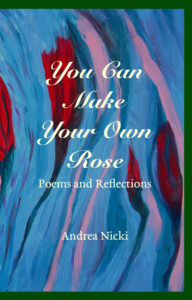
You Can Make Your Own Rose by Andrea Nicki is a collection of poems infused with the spirit of feminist sensibility, social justice and activism. The poems offer more than mere therapeutic comfort while depicting shamanic-inspired healing rituals and magical encounters. They are trauma-free in the sense that Nicki doesn’t ask for our sympathy nor does Nicki simply wish to share traumatic memories. On the contrary, she utilizes somewhat analytical and educational language, interlaced with subtle picturesque and lyrical details alongside a severe social critique, to depict the emotional, intellectual, and social landscape of her reflections on incest and other gender-related forms of abuse.
For about a year and a half, I have been working on a collection of poetry that I feel is worth something. I have been writing poetry since I scribed pages hidden between my math textbook when I was 9, gone through poetry workshops in graduate school where I produced a creative thesis, and continued to write off-and-on after that. I have an extensive cornucopia of poetry, but it was around last October of 2016, perhaps, that I decided to write my experience.
As a pre-teen, I wrote about what I thought my life could be, fantasizing about being an older woman with mottled relationships, missing opportunities to discuss my fragile relationship with my parents as the only-child-golden-child, my passion and doubts as a religious, my shame at not being more experienced. Even when I was in graduate school for poetry in Ohio, I didn’t think my life was worth excavating. I wrote dreamy, dense poetry that was surreal and symbolic but largely incoherent. I could again have written about my evolving religious beliefs, my curiosities and risks I took living outside of my home state of Oklahoma as a young woman for the first time, my declining relationship with my mother, or my insecurities again, but this time as a lesser-prepared graduate student in comparison with my literary and theory-laden colleagues.
On one hand, some might say the culture I come from is narcissistic and navel-gazing. I would agree, but just like I feel women can sometimes be selfish in a quite necessary and liberating way (as opposed to those around her accusingly saying she is “so selfish” for abandoning them/following her own path/needing a room of her own), I feel the confessional and self-reflective can be the healing and helpful side of the coin. For me, at least in my experience, my “finished” collection feels exactly this way.
It is not easy navigating the world with fragile boundaries, self-worth, and a potential history of manipulations. I often seek wisdom in spiritualities and unfamiliar religions because I need a substitute for the childhood traditions I have abandoned as a raft mid-stream. I am attracted to fashioning another raft, this one not pre-fabricated but gathered over some time by reaching for branches and tendrils. I am never confident about my assessments concerning relationships, and I mostly avoid going very deep with people anyhow or keep my head down so as to go unnoticed or divert the interest of others because I don’t yet know how to have healthy relationships that entail elements of balance or stay more-or-less in the middle way. It is awkward and fumbling to do life on one’s own, and I am hardly a victim. I completely admit that healing is within my purview and I simply have not tried hard enough, or that I just need to accept that no relationship is perfect and one cannot exactly have pleasure without pain, and so allow my body to sink into the underwater worlds and be taken by the sensory suctions of sea urchins and stings of jelly fish. Perhaps a relationship can also be one of peace and calm passions where those involved keep their attachments in check. I guess that is possible.
At my school, a religious institution, we start every faculty meeting with a reflection, meant to inspire us, make us think, help us to connect, etc. I am admittedly, sometimes very uncomfortable with these reflections. I don’t always like corporate ‘prayer’ because of my past experiences in an abusive faith. They make me uncomfortable, defensive; even though I understand the value of collective ritual. Challenging me to face these feelings, my department chair asked me to give a reflection for our faculty assembly. So I did so by sharing the way I know how to share (in a collective way) best: in a blog. And here I present these reflections, my blog, with all of you as well. My thoughts about taking the year apart, and putting ourselves back together again at the end of the year:
(Reflection has been edited slightly in terms of length and clarification for presentation to this online audience.)
What do you get when you have two ladies, one a Baptist Minister living in KY and one an agnostic living in LA, making jokes and talking about the Bible? Don’t know? You get the new and exciting podcast Bible Bitches!
What do you get when you have two ladies, one a Baptist Minister living in KY and one an agnostic living in LA, making jokes and talking about the Bible? Don’t know? You get the new and exciting podcast Bible Bitches! We hope that you’ll take a moment to check out this new and exciting podcast that explores the F-word in Religion (among many other topics) and read the Q&A below with the creators Rev. Laura Barclay and Sara Hof! Click here to listen to the podcast (now on episode 5)!
In their purest form, “egalitarian matriarchies” place the mother principle at the center of culture and society. Their highest values are the love, care, and generosity they associate with motherhood. These values are not limited to women and girls. Boys and men are also encouraged to honor mothers above all, to practice the traits of love, care, and generosity, and to value them in others.
“Egalitarian matriarchal” societies are matrilineal which means that family membership and descent are passed through the female line. They are also usually matrilocal, which means that women live in their maternal home all of their lives. Family groups are usually extended rather than nuclear. Often there is a “big house” in which groups of sisters, brothers, and cousins live together with mothers, aunts, grandmothers, and great-aunts. In what I imagine to have been the original form of the system (still practiced by the Mosuo of the Himalayas), men also live in their maternal house, visiting their lovers at night, and returning home in the morning.
Mosuo women at festival
These societies practice small-scale agriculture. The women are owners and guardians of the land, which is held in common by maternal clans. They are also the guardians of the secrets of agriculture, food storage, and food preparation, which are passed down from mothers to daughters through songs, dances, rituals, and stories that celebrate the Earth as a great and giving Mother. The powers of women as birth-givers and as the guardians of the mysteries of the agricultural cycles are symbolically related to the powers of birth, death, and regeneration in nature and in all creative processes.
Women seated under trees in place of honor at Minoan festival
These social and cultural systems must have first developed at the beginning of the Neolithic era, when “woman the gatherer” first discovered the secrets of agriculture that allowed people to settle down and farm the land. If women discovered agriculture, then it makes sense that they would have been leaders in the first settled communities and guardians or owners of the land they farmed. They would have been the ones to build the first homes on or near the farmland. Sons as well as daughters would have been born in these early settlements.
The males of the families or clans continued to hunt. Over time they became responsible for building and heavy farm labor and for grazing flocks and seeking raw materials away from the settlement. It makes sense that they would be the ones to venture away from the community to gather information and to trade. In a recent documentary, Mosuo men stated that they don’t work as hard as women. This may not have been the case in the past. Today products and raw materials are brought in through the capitalist economy: traditional roles of traders are obsolete. Information gathering was an important part of trade expeditions: this is how new technologies spread rapidly in the Neolithic era; religious and cultural symbols were also shared by traders. Today there are books, newspapers, television, and the internet. Nor are Mosuo men involved in inter-clan negotiations in the People’s Republic of China.
From the division of labor in these societies, an egalitarian system of governance developed in which the elder women or grandmothers supervised the “internal” life of the house or clan. The “internal” domain included family and farm and all of the rituals surrounding birth, puberty, and death, as well as planting and harvesting. Women played central roles in creating and enacting all of these rituals. Through their expeditions and trade activities, elder men, the brothers of the grandmothers and uncles of the next generations, became responsible for the “external” relations of the clan, meeting people from other cultures when they were away from home, and welcoming visitors who arrived on their home territory.
Because of this division of labor, the elder men would have been the ones to meet and greet colonists and invaders and also to speak with storytellers, historians, and anthropologists, most often also men, who were interested in learning about their culture. If foreign men came from patriarchal cultures, they would have assumed that the men who met them were the leaders of their groups. The party line in the field of anthropology, which is followed by academics in other disciplines, is that “men wield the power” in matrilineal societies. I was disappointed to read this when I first started learning about matrilineal societies as a graduate student and to find it repeated in a recent article arguing that Minoan culture might have been matrilineal and matrilocal.
Those of us who have been socialized in patriarchal societies in which “men wield the power” cannot easily imagine alternative systems. When we begin to think about female power, we immediately conjure up pictures where “women wield the power” by going to war, keeping men as slaves, sexually abusing and raping them, and forcing them into subordinate positions. Such images are so abhorrent that we may conclude that patriarchy is not so bad after all. And this stops us from looking for or wanting to envision alternatives.
In 1981 anthropologist Peggy Reeves Sanday challenged these conventional views in her ground-breaking Female Power and Male Dominance. Examining all of the pre-urban societies documented in anthropological records, she discovered that societies that celebrated and valued female power were not female dominant but egalitarian. She also found that societies that celebrated and valued male power were almost always male dominant. They tended to develop in times of external threat (when men became warriors) or environmental crisis (when the female power of the earth was viewed as having failed the community). Though Sanday’s arguments are convincing, they failed to change that anthropological consensus that “men wield the power” in all human societies, including those that celebrate female power and are matrilineal and matrilocal.
What the consensus that “men wield the power” in matrilineal, matrilocal, and matrifocal societies does not recognize is the power women hold in the internal relations of the group. For example, in the Iroquois culture, the councils of female elders that managed the day to day life of the clan were just as important as the councils of male elders that through their “chief” met with European settlers and invaders. In fact, the councils of female elders were slightly more powerful than those of the male elders. Iroquois women could remove male leaders they did not approve of and reject decisions of the male council to go to war. This power of the female council did not mean that Iroquois women dominated Iroquois men. Rather it was an important check-and-balance ensuring that men’s councils could not unilaterally take actions that would negatively affect the internal relations of the clan.
What should we call societies such as these? Obviously we should continue using the terms “matrilineal” and “matrilocal” where they apply. But what term should we use to describe these cultures as a whole? Archaeologist Marija Gimbutas called the egalitarian societies of Old Europe “matrifocal” because she recognized that the term “matriarchal” is usually (mis)understood to mean female dominant; this decision did not protect her work from being criticized for its challenges to the patriarchal consensus.
I dared to use the “m” word after reading Peggy Reeves Sanday and Heide Goettner-Abendroth. I define egalitarian matriarchy as a society and culture organized around the mother principle of love, care, and generosity, in which mothers are honored and women play central roles, and in which men also have important roles and every voice is heard. My new suggestion is that the “m”word always be preceded by the “e” word, in other words that we not use “matriarchy” unmodified, but always write and speak of “egalitarian matriarchies” in order to make it clear that we are not talking about female-dominated societies. This will be my practice in the future.