 Feminist theories and theo/alogies are often concerned with voice, naming and re-membering. Many feminists do this work, again and again, because of persistent silence and silencing, invisibility, erasure of stories, desires, religions and ways of being, because of missing histories, and a dominating culture’s inability and unwillingness to hear those they marginalize. We “hear each other into speech,” to counteract and recreate, to find power in ourselves and with those whom we share common cause.
We hear each other into ….speech.
Speech is treated as a sacred thing; and certainly, I hold the stories and voices of those with whom I’ve shared parts of my own feminist journey very sacred. I find the ability ‘to voice’ sacred. But I am also aware that as a citizen of the United States, “speech” or more specifically, “freedom of speech,” is sacralized as a part of my national mythology.
It is an implicit myth: all one needs to do is utter the word “speech” in the United States to conjure images of protest, civil rights, the free press, revolution, etc. There are many heroes in this mythology, most of whom “spoke truth to power,” rebuffing domination for the “common good.” The ‘free speaker,’ is often cast as the subjugated “everyman” (sic) whose autonomy and purpose drive society towards greater freedom. “He” and “his” subjugation, real or “alternative fact,” are then made to serve the larger myth of the American Dream. There is a major problem here: “the American Dream” is about freedom and independence for the white, Western male. So is it any wonder, then, that the myths surrounding “freedom of speech,” are so easily turned around to villianize those who might challenge this hegemonic power? Continue reading “Freedom and Speech by Sara Frykenberg”





 We treat the physical assault and the silencing after as two separate things, but they are the same, both bent on annihilation.
 Two weeks ago, I spoke at a conference entitled “The Role of Academia and Religious Leaders in Relation to Refugees and the ‘Refugee Crisis,’” in Bratislava, Slovakia. One of the main questions of the conference was: what role do academics play in the refugee crisis? Are academics activists? Many conference presenters and attendees directly linked the two ideas. However, there were some who voiced their concern as to how in-touch academics actually are with reality and surmised that because of this academics probably weren’t activists. Wait! What? How can we not be activists?
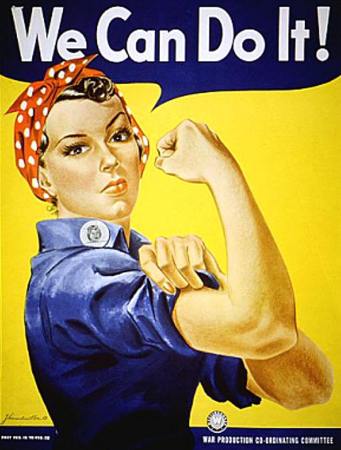 Betty Friedan interviewed the unhappy housewives, their human potential unfulfilled by a lack of vocation outside the home. I wonder if her claim was just a premise of the lawn being more manicured on the other side. The book received criticism by reviewers asking who was really oppressed and what perspectives were ignored. I’ve been on a few lawns, and I am here to confirm there is no true green grass anywhere. Mostly it’s either covered with the blood of women who die in the Global South because of the poor working conditions that pay them too little to support their families or laced with pesticides for profit or sheets of concrete to the dismay of our feet. I suppose there might green grass somewhere, but it costs more than some of us can afford, meaning a woman would have to earn more than what is only enough to rent a room in someone else’s house, an apartment of her own being too expensive much less any sort of fund for a cabin in the woods.
 I was asked by my sculpture teacher to make a monument. “A monument to what,” I asked? “Anything,” he answered. The only parameter seemed to be that the work was produced in wood. Having seen some interesting stone and marbleizing paints, I had the immediate idea to transform the wood into a marble-like appearance. Marble, for some reason, probably because it is the cemetery standard, seemed like the right medium for a monument to me.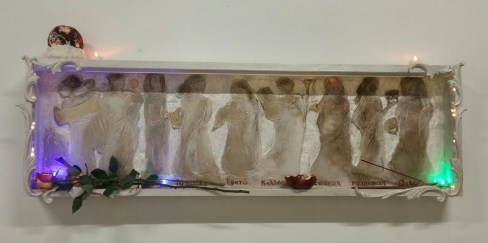
 Feminism and Religion