My woman’s body is entering the dark time of the moon, even with blinding white snow lashing the windows, even with a full moon tracing its way far above thick clouds. My mood is black and soon I’ll be flowing red, and the snow will just drive on white, white, white.
In The White Goddess, Robert Graves tells us: “…the New Moon is the white goddess of birth and growth; the Full Moon, the red goddess of love and battle; the Old Moon, the black goddess of death and divination.”
The Celt in me feels cradled by this imagery, even if, as Judith Shaw and Carol P. Christ have pointed out elsewhere on this site, the idea of maid, mother, and crone is a modern invention, not gift from the past. I agree with Christ: “My suggestion is that we give up the idea that the details of contemporary Goddess Spirituality are rooted in and authorized by tradition. We can instead acknowledge that though we are inspired by the past, we are the ones who are creating contemporary Goddess Spirituality.”
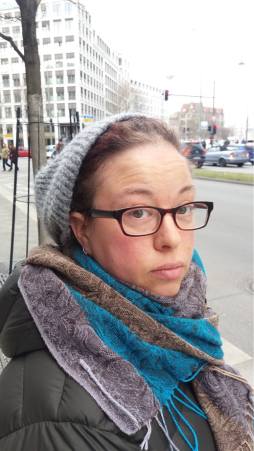
My birthday was last Wednesday. Perhaps more than any other time of the year (yes, even more than Rosh Hashanah and Yom Kippur), the days and weeks leading up to my birthday are filled with personal reflection. Not that religious and secular new years don’t give me pause to reflect, but I think the lack of buzz around this personal event seems to offer me more space and time to think.
This year more than past years, I’ve been thinking about beliefs: what I believe in; how ideas and concepts that were important to me last year are less so this year and vice versa; how beliefs motivate me to act or not; what role belief plays in my life; why some beliefs demand solid resolve and others not so much; and so on. I wanted to share with you some of my personal reflection. Continue reading “On Belief and Action by Ivy Helman”
I remember so vividly entering graduate school in my early forties and being told I was an “eco – feminist” by my professors. What does that phrase mean I asked having no relationship that I knew of to feminism. Feminists, I thought vaguely, naively, even stupidly, burned bras and hated men…
I was asked to read “Woman and Nature; The Roaring Inside Her” by Susan Griffin to help me see who I was, and after finishing this one book I submerged myself in feminist writings like a starved woman – child. My teachers were right. I was a feminist – an eco –feminist because I had already made the connection between what was happening to the Earth and what had happened to me. Every tree that was chopped down was a part of me, every stream that was polluted was a part of me, every animal that was slaughtered was a part of me because I was a part of Nature. I owed my life to Nature, the only mother I had ever had. I loved Her, honored her, became her fierce advocate and in the process She eventually taught me to love myself.
(Written the day after the Parkland high school, Florida shooting.)
Last night, my husband and I went outside to our driveway to sit in the car and have a beer. Those of you with lots of children will understand that sometimes you just do not have the time, energy or funds for babysitting, but at least we have some uninterrupted time to talk to each other. Our youngest is six years old, so the older ones can easily watch her for twenty minutes. We are not leaving toddlers to fend for themselves. And it is cold out. That is why we are in the car.
Only last night, there was no ‘unwinding’ going on. Somehow, we started speaking about the Parkland, Florida high school gun shooting, and his voice became raised.
He calls it ‘Meditarranean’ and ‘passionate’; I call it an ineffective way of communicating. I would like to say that I replied calmly. But I did not. He had me, and my voice became raised in response.
What do you get when you have two ladies, one a Baptist Minister living in KY and one an agnostic living in LA, making jokes and talking about the Bible? Don’t know? You get the new and exciting podcast Bible Bitches!
What do you get when you have two ladies, one a Baptist Minister living in KY and one an agnostic living in LA, making jokes and talking about the Bible? Don’t know? You get the new and exciting podcast Bible Bitches! We hope that you’ll take a moment to check out this new and exciting podcast that explores the F-word in Religion (among many other topics) and read the Q&A below with the creators Rev. Laura Barclay and Sara Hof! Click here to listen to the podcast (now on episode 5)!
Yesterday marked the 50th anniversary of the assassination of Martin Luther King, Jr. Thousands gathered at his memorial and many more rallied across the U.S. to honor King’s commitment to civil rights and non-violent action. His message continues to resonate in a nation that has never ceased to struggle with complex issues related to race, gender, sexuality, religion, and so on.
While the Land of the Free is invested in honoring King’s death, we could instead be focused on how he lived. As Rev. Jesse Jackson explains,
He mobilized mass action to win a public accommodations bill and the right to vote. He led the Montgomery bus boycott and navigated police terror in Birmingham. He got us over the bloodstained bridge in Selma and survived the rocks and bottles and hatred in Chicago. He globalized our struggle to end the war in Vietnam.How he lived is why he died.Continue reading “Remembering MLK’s Life, not Death by Gina Messina”
A month ago, the Hollywood Chapter of the National Organization for Women (NOW) and the City of West Hollywood presented the Vagina Monologues. The event was a complete success and we raised over $5,000 for Planned Parenthood Los Angeles! While the cast and crew worked together and formed a community in West Hollywood, communities were being ripped apart by senseless gun violence that took the lives of 17 beautiful souls at the Marjory Stoneman Douglas High School in Parkland, Florida
The cast and crew began to have discussions over a specific monologue and whether or not the audience, or cast members, would be triggered by its use of gun specific language in relation to the power of the vagina.
Feminazi is an image and narrative created by patriarchy to control the liberation and recognition of women as autonomous political subjects, and to serve as a warning to thwart these processes.
It is a label used for male supremacy to name the fearless woman. Fear is a control mechanism used to keep us living in terror of: expressing opinions, gaining weight, walking on the street, being raped, ridiculed, or lonely, not being married, being rejected, or dismissed, having too much cellulite, going to hell, traveling alone, being beaten, believing in ourselves, etc.
Feminazi is a modern myth designed to make us believe that there are good and bad feminists, and that it is possible to exclude and ignore all feminists through labels and stereotypes. A woman’s transition toward liberation can be seen as threatening to others when it is assumed that “someone else” outside the woman herself, has the privilege to define which feminisms are acceptable, or which processes of liberation and searching for autonomy are legitimate, or not.
On February 20, 2018, the Greek government issued a Presidential Decree mandating the formation of government bodies to monitor and protect the more than four hundred bird and wildlife habitats in Greece designated as part of the European law Natura 2000. This decision came after decades of government inaction regarding the enforcement of the Natura law it accepted as part of its entrance into the European Union.
Whether the Presidential Decree will result in protection on the ground remains to be seen, but it is an important step in the right direction. The Presidential Decree was issued after years of negotiations initiated by the European Commission to compel the Greek government to comply with the law. A Complaint to the European Commission regarding failure to protect the Natura wetlands of Lesbos on which I was the first author formed part of the basis of these negotiations.
a ditch drains a wetland to produce agricultural land
Almost as soon as I became a birdwatcher in 1999, I began to notice the degradation of bird habitats by dumping, drainage, and building, especially in wetland areas. Wetlands are seasonal bodies of water created by winter rains that dry out in the summer heat. Generally, they are shallow, which means that they are a perfect stopping over place for migrating birds. The most common visitors to wetlands are wading birds that stand in shallow pools and puddles without immersing their bodies in the water. Lesbos, the island where I began to watch birds, has some of the most important wetlands in Europe, visited by birds migrating from Africa to Europe in the spring for rest and feeding. Because of this, Lesbos is also a destination for birdwatchers.
Wetlands are not only important for birds. In rainy periods they act as a sponge between rivers and the sea and dry land, absorbing water that otherwise could cause flooding. The devastating flood damage to New Orleans in recent years is the result of building on wetlands. Similar damage occurs regularly wherever wetlands are drained, including on the island of Lesbos.
In 2001, I wrote a petition that was signed by over 600 birdwatchers and others urging the Greek government to protect the wetlands of Lesbos. I presented it at an open meeting in May 2001 organized by the Mayor of Kalloni, Lesbos, Aris Eleftheriou, to explain the plan to protect the wetlands of Kalloni which had been funded by the European Union. Instead of being congratulated for his work and vision, the mayor was met by an angry mob. Many of the Natura wetlands are privately owned fields traditionally used for grazing sheep and goats. As local economies were transitioning to tourism, landowners did not want any restrictions placed on their ability to drain and build on their land.
flamingos are now permanent residents of Lesbos
It was in this context that John Bowers, a longtime birdwatcher in Lesbos, an environmental economist, and the first to sign my petition, formed Friends of Green Lesbos, an international internet-based group dedicated to protecting the wetlands of Lesbos that soon counted over 800 members. I became its Vice President. In 2003, Friends of Green Lesbos, in co-operation with Idatinos, a local environmental group, drafted an internet letter and petition, that was automatically sent to the Greek government every time it was signed, asking the Greek government to fulfill its legal responsibility to protect the wetlands of Lesbos. The government responded that it was required to enforce the Natura law even though no specific Greek law had been passed specifying how this was to be done. A committee in the department of building and land development in Lesbos was created and charged with the responsibility of protecting the local wetlands.
We did not understand that this committee would not be monitoring the wetlands on a regular basis, but would only respond to complaints. This was clarified at a meeting organized by World Wildlife Fund in Athens in 2005. I was then put in touch with a new local environmental group, Nautilos en drasi that was also formed to save wetlands. Together with WWF, we began to draft complaints about the degradation of individual wetlands. These complaints, numbering well over fifty, were all decided in our favor. Fines were issued, but there was no mechanism to ensure compliance. Numerous meetings with the Governor of the island resulted in promises that were not kept. We finally realized that he was more interested in currying favor with landowners and developers than in enforcing the law.
In 2008 while lecturing at a conference in Ireland, I met a Green Party member of the European Parliament who encouraged me to write a complaint to the European Commission. After six months of intense effort, I completed a formal complaint of over 100 single-spaced pages, supported by two large files of documents, detailing the government’s failure to protect the wetlands under the Natura law. It was immediately approved by Friends of Green Lesbos and Nautilos en drasi, but it took over two years for World Wildlife Fund and Hellenic Ornithological Society to revise and sign it.
The complaint was submitted to the European Commission in September 2011. After several requests for additional documentation, the Commission found Greece in violation of the Natura law in Lesbos in October 2014. In August 2016 the Commission informed us that it had made our case part of horizontal negotiations with Greece regarding its failure to protect all of its Natura sites. The February 2018 Presidential Decree is the fruit of these negotiations. It is certain that the European Commission will continue to watch the situation in Greece to ensure that the government follows through with the monitoring and protection mandated by the new law.
This has been a long and tiring and often discouraging struggle of nearly two decades and it is still ongoing, but if the end result is the protection of all of the Natura sites in Greece, it will have been well worth it.
Others involved in Natura struggles in Lesbos besides John Bowers and myself include Eleni Galinou, Michael Bakas, Costas Zorbas, and Stellios Kraonakis, and in Athens, Foteini Vrettou, George Chassiotis, and Elias Tzirtzis of World Wildlife Fund Greece, and Malamo Korbeti of Hellenic Ornithological Society.
In celebration of Women’s History Month, the Holy Women Icons Project is excited to launch Revolutionary Girls, a new program seeking to empower marginalized adolescent girls by telling the stories of revolutionary women through art, writing, and discussion. Partnering with local schools and other non-profit organizations in the Puna District of Hawai’i County, we are creating a curriculum that features often overlooked historical and mythological women whose lives, legends, and legacies embody empowerment, resilience, and emotional intelligence that can embolden adolescent girls to become socially aware revolutionary leaders.
Research shows that girls’ self-esteem plummets in early adolescence, due in part to unrealistic body images in media and casual (or even overt) sexism from parents, teachers, and peers. Our Revolutionary Girls project aims to counter these negative influences by offering girls aged 11-15 a space of empowerment. Prior to adolescence, many girls believe they are as smart, strong, and capable of leadership as boys. At the onset of puberty, girls are often taught that their only value is in their appearance, and that they are not as capable or valuable as men and boys. Simultaneously, girls are exposed primarily to the histories and myths of men in power while in the classroom, the revolutionary lives, legends, and legacies of countless revolutionary women altogether absent from their textbooks and lessons. Continue reading “Women’s History Month: Painting and Empowering Adolescent Girls by Angela Yarber”



 My birthday was last Wednesday. Perhaps more than any other time of the year (yes, even more than Rosh Hashanah and Yom Kippur), the days and weeks leading up to my birthday are filled with personal reflection. Not that religious and secular new years don’t give me pause to reflect, but I think the lack of buzz around this personal event seems to offer me more space and time to think.


 Yesterday marked the 50th anniversary of the assassination of Martin Luther King, Jr. Thousands gathered at his memorial and many more rallied across the U.S. to honor King’s commitment to civil rights and non-violent action. His message continues to resonate in a nation that has never ceased to struggle with complex issues related to race, gender, sexuality, religion, and so on.


 In celebration of
