Research and the Dissertation: Getting Back to Basics by Michele Stopera Freyhauf

Freyhauf, Durham, Hahn Loeser, John CarrollHistory is written by the victors – this is something that we all know, or at least should know. I apologize in advance for being elementary in my discussion, but I think one thing that scholars tend to do too often is assume our readers or audience has a firm grasp on what we are talking about. With this topic, I am not assuming.

When studying artifacts from past civilizations, an interesting phenomenon of using spolia as a demonstration of conquest is commonplace. If a conquered country’s deity is placed on the bottom of a column, or even turned a different direction, the significance usually means that deity is demoted or inferior – this is found in the Hagia Sophia (especially under the structure). If spolia is found whereby a country adds their deity (even if that deity is their ruler) to another country’s monument, then there is a coexistence or combining of empires with the conquesting ruler in prominent view, even substituting past rulers. This is best demonstrated on the Arch of Constantinople whereby Christian symbols and the likeness of Constantine was incorporated into an arch that once displayed the victories of Marcus Aurelius and Domitian. If you are interested in this topic, please see my article “Hagia Sophia: Political Symbolism in Stones and Spolia” in Popular Archaeology magazine.

Continue reading “Research and the Dissertation: Getting Back to Basics by Michele Stopera Freyhauf”

When Baby Girls and Old Crones Ruled by Jeri Studebaker

Jeri Studebaker

The data came as somewhat of a shock to me.  I stumbled across it one day in The Civilization of the Goddess, a mammoth book by the late Lithuanian-American archaeologist Marija Gimbutas about what Gimbutas dubbed “Old Europe” – a culture area in southeastern Neolithic Europe that she maintains was centered around female deity.

Until she had the temerity to suggest that people at some point in the past might have worshipped goddesses rather than gods, Gimbutas had a sterling reputation among academics, even being hired to teach at two of the most prestigious of all  American archaeology departments, Harvard’s and UCLA’s.  After presenting her goddess theory of Old Europe, however, Gimbutas came under attack by a few powerful male archaeologists, after which her reputation among academics began to plummet (see Spretnak 2011 for a good accounting of Gimbutas’ fall from grace).

Marija Gimbutas
Marija Gimbutas

Before I get to the data that so startled me, I need to tell you a bit about archaeologists.  Like the members of many academic disciplines, they disagree with each other – sometimes vehemently (and perhaps even somewhat more vehemently than scholars in other disciplines).  One thing however they all agree on is this: the higher the quality and quantity of grave goods buried with an individual, the higher that individual’s status in her or his society. Continue reading “When Baby Girls and Old Crones Ruled by Jeri Studebaker”

Dance of the Bees: Reading the Language of the Goddess by Carol P. Christ

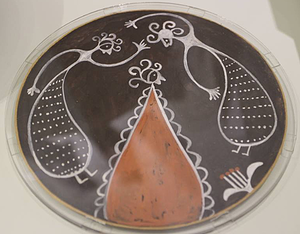
bee women dancing croppedThe image from an ancient Cretan bowl (c.1700 BCE) from the Sacred Center of Phaistos pictured here has often been interpreted as an early depiction of Persephone’s descent or rising. But are clues from later Greek mythology pointing in the right direction in this case?

Recently, my colleague Mika Scott posted the Phaistos bowl image on our Goddess Pilgrimage Facebook site in conjunction with the bee pendant from Mallia. This juxtaposition led me to think again about the importance of bees and pollination in agricultural societies and to offer an alternative reading of the symbolism on the bowl. Continue reading “Dance of the Bees: Reading the Language of the Goddess by Carol P. Christ”

Has the Phaistos Disk Been Cracked? by Carol P. Christ

Carol Christ in LesbosRecent headlines in the international press announced that the enigmatic language of the ancient Cretan “Phaistos Disk” has been translated—in part—by the Welch-Cretan scholar Gareth Owens. Owens states that the Phaistos Disk records an ancient hymn to a Mother Goddess. More specifically he claims that one side is dedicated to a Pregnant Goddess and the other to a Birth-Giving Goddess.

All of this is very exciting, but is he right? Continue reading “Has the Phaistos Disk Been Cracked? by Carol P. Christ”

The Ancestors Live in Us by Carol P. Christ

Carol Christ in LesbosOn the recent Goddess Pilgrimage to Crete women had the option of riding up a winding road on a mountainside in the back of a farm truck singing “She’ll Be Comin’ ‘Round the Mountain” or could choose to go with the guard in his closed automobile.

That evening one of the older women who had chosen to ride in the car said, “I saw how much fun you were all having, but I have done that before. This time I was happy to let the rest of you do it.”

“That’s exactly how I feel about death,” I responded. “Some people want to live on after death, but I don’t. I am happy to let others do it. The only thing that would upset me would be if life did not go on after me.” Continue reading “The Ancestors Live in Us by Carol P. Christ”

COMPLICATIONS AND CONFUSIONS IN DISCUSSIONS OF THE GODDESS by Carol P. Christ

carol christAlthough writing in patriarchal Greece from a patriarchal perspective, Hesiod said in his Theogony or Birth of the Gods that Gaia or Earth alone was the mother of the Mountains, Sky, and Sea. With the male Sky she gave birth to the next generation of deities known as the “Titans,” who were overthrown by Zeus. Hesiod’s was a “tale with a point of view” in which “it was necessary” for the “forces of civilization”–for him represented by warrior God and rapist Zeus–to violently overthrow and replace earlier conceptions of the origin life on earth and presumably also to overthrow and replace the people and societies that created them.

With the triumph of Christianity in the age of Constantine in the 4th century AD, Christus Victor replaced Zeus in the cities, while the religion of Mother Earth continued to be practiced in the countryside. Over time, many of the attributes of Mother Earth were assimilated into the image of Mary, and priests began to perform rituals earlier dedicated to Mother Earth, such as blessing the fields and the seeds before planting. In the Middle Ages “the Goddess” re-emerged within Western Christianity in devotion to the Virgin Mary, the female saints, and figures such as Lady Wisdom, at the same time that the history of the Goddess was being erased.

In the middle of the 19th century, in Das Mutterrecht (The Mother Right), J. J. Bachofen stunned the scholarly world with his theory that matrilineal kinship, matrilineal inheritance, and reverence for the Great Mother were to be found at the origins of civilization. Bachofen challenged the view that patriarchy and the worship of male Gods had existed “from the beginning .” Continue reading “COMPLICATIONS AND CONFUSIONS IN DISCUSSIONS OF THE GODDESS by Carol P. Christ”

Curiosity About Everything and the Language of the Goddess by Carol P. Christ

carol christMy recent discovery of Marija Gimbutas on Youtube rekindled my admiration for her work. In her slide-lecture “The World of the Goddess” Marija Gimbutas allows us to follow the line of reasoning she used to decipher the “language of the Goddess” in Old Europe.

Careful attention to her lecture shows that Gimbutas did not close her eyes, dream, and then attach her own ideas and intuitions to the artifacts she later discussed. Rather, she catalogued groups of images with similar symbolism and used her knowledge of nature (what does a water bird or an owl look like?) and folklore (she collected thousands of songs connected to the agricultural and life cycles in her native Lithuania in the 1930s) to unlock the meaning of ancient symbols.

I suspect that most of the critics of Gimbutas lack the knowledge she gained through her wide curiosity about life. Do other archeologists as a group know what specific species of water birds or owls really look like? Do they have the same kind of knowledge of folklore and folk traditions that Gimbutas had?   Continue reading “Curiosity About Everything and the Language of the Goddess by Carol P. Christ”

Women’s Ritual Dances: The Dancing Priestess of the Living Goddess by Laura Shannon

Laura ShannonKyria Loulouda calls to her sister to help her wind the yards of woven girdle around and around my waist. Kyria Stella’s aged fingers, still strong, tuck the sash ends in tightly, smoothing down the fabric she and Loulouda wove themselves. The snug embrace of the sash supports my back and encourages me to stand proudly upright.  As they help me with the intricate tucks and pleats of the festival dress, and the careful tying of the flowered headscarf, I see their tired, careworn faces come alight with joy and expectation. When they are satisfied, they turn me towards the mirror, smiling.

We gaze at ourselves, a row of three women, dressed alike. Like the butterflies embroidered in bright silks on the dark cloth of the bodice, we too are transformed. The food is prepared, the housework is done, the animals taken care of for the night; the other women await us in the square where, by tradition, they will open the dance with their own singing as they have done countless times throughout their lives. We are in the village of Pentalofos in Greek Thrace in the early twenty-first century, living a timeless scene which has been repeated through the generations for hundreds, perhaps thousands of years. Continue reading “Women’s Ritual Dances: The Dancing Priestess of the Living Goddess by Laura Shannon”

“Immanent Inclusive Monotheism” with a Multiplicity of Symbols Affirming All the Diversity and Difference in the World by Carol P. Christ

carol-christIn recent years monotheism has been attacked as a “totalizing discourse” that justifies the domination of others in the name of a universal truth. In addition, from the Bible to the present day some have used their own definitions of “exclusive monotheism” to disparage the religions of others. Moreover, feminists have come to recognize that monotheism as we know it has been a “male monotheism” that for the most part excludes female symbols and metaphors for God.  With all of this going against monotheism, who would want to affirm it?

In response to some or all of the above critiques, many modern pagans define themselves as polytheists, affirming at minimum, the Goddess and the God, and at maximum a vast pantheon of individual deities, both female and male, from a single culture or from many, including divinities with animal characteristics.  Other pagans define themselves as animists, affirming a plurality of spirits in the natural world. A group of Christian feminists have argued that the Christian Trinity, the notion of God Three-in-One, provides a multiple and relational understanding of divinity.

While also rejecting exclusive monotheism and male monotheism, Jewish poet, ritualist, and theologian Marcia Falk provided a definition of inclusive monotheism that I find compelling.

Monotheism means that, with all our differences, I am more like you than unlike you. It means that we all share the same source, and that one principle of justice must govern us equally.  . . Continue reading ““Immanent Inclusive Monotheism” with a Multiplicity of Symbols Affirming All the Diversity and Difference in the World by Carol P. Christ”

Was Ariadne the Most Graceful Bull-leaper of All? Deconstructing and Re-visioning Greek Mythology by Carol P. Christ

carol-christSometimes we think of Greek myth as a pre-patriarchal or less patriarchal alternative to the stories of the Bible. After all, Goddesses appear in Greek myths while they are nearly absent from the Bible. Right?

So far so good, but when we look more closely we can see that Greek myth enshrines patriarchal ideology just as surely as the Bible does.  We are so dazzled by the stories told by the Greeks that we designate them “the origin” of culture. We also have been taught that Greek myths contain “eternal archetypes” of the psyche. I hope the brief “deconstruction” of the myth of Ariadne which follows will begin to “deconstruct” these views as well.

bull leaping ring before 2000 bc phourniAriadne is a pre-Greek word. The “ne” ending is not found in Greek. As the name is attributed to a princess in Greek myth, we might speculate that Ariadne could have been one of the names of the Goddess in ancient Crete. But in Greek myth Ariadne is cast in a drama in which she is a decidedly unattractive heroine.

In the story told by the Greeks, Ariadne falls in love with Theseus, a handsome young man who was sent with 11 other Greek young people to be fed to a monster (who is half man, half bull) known as the Minotuar. The Minotuar is Ariadne’s half brother (see below). Because of her “love” for Theseus, Ariadne helps him to murder her brother.  She then flees with Theseus on his boat.

However, this “love story” does not have a “happy ending” as Theseus abandons Ariadne on a nearby island–long before he arrives home in Athens. Theseus is ever after celebrated as a hero who killed a monster, while Ariadne is just another cast-off female.  Whose story is this? Continue reading “Was Ariadne the Most Graceful Bull-leaper of All? Deconstructing and Re-visioning Greek Mythology by Carol P. Christ”