A Rescue Remedy, Part 2 by Barbara Ardinger

The handsome but uncharming prince having been magicked, the witch and her coconspirators know it’s time to focus on finding Ella. The witch looks around the table.

“Mrs. Janedoe and Mrs. Worthington,” she says, “you are two of our most highly experienced sauceresses…I mean sorceresses. Mrs. Bezukhov, you are also a woman of great, if temporarily diminished, power. Let us work together and see what we can do. Surely when people of good will work together they can raise energy that leads to positive results. Yes?” She looks around. “Please come up to my study.” The ravens of course know they are members of this ad hoc coven, and Mrs. Bezukhov goes out to her little room (actually a stall) in the barn to fetch her old scrying stone.

“Now,” says the witch, “we need to find out where Ella is and—”

“Before that,” says Kahlil, the prophetic raven, “we gotta fly that…er…sausage to the city ’n’ drop it on that lousy prince and hit ’im where it’ll do the most good. Make sure he got the message, doncha know. I got a new buddy who’ll fly with us.” He waves a wing at the window and another raven flies in. “This’s Icarus.” The new raven bows. “Despite his name, he’s a good flyer ’n’ he knows the safest routes to the capital and the bestest ways to get around the city.” Kahlil shows the bagged sausage to Icarus, who studies it and shakes his head like he’s just been attacked by a million fleas. “Okay,” says Kahlil, “youse girls just keep an eye on us in that there scrying stone.” He starts to rise from the table, but Mrs. Worthington stops him.

Continue reading “A Rescue Remedy, Part 2 by Barbara Ardinger”

A Rescue Remedy, Part I by Barbara Ardinger

A year, now. It has been a full year since the phony election that put El Presidente in the Golden Office. A year since people began leaving the capital and the nation’s other large cities. While some of the refugees emigrated to quasi-democratic nations, most of them settled in the small towns and on the farms across the countryside, where they began building new, rural lives. A year ago, it was a flood of refugees. Now fewer people are able to escape.

A year, now, and even though she has studied and practiced, the wicked witch is no wickeder than she ever was. Nowadays she even forgets to put on the wicked-witch mask that she used to think scared people. But it’s easy for everyone to see that, masked or not, she’s just an ordinary woman practicing an old-time religion. She’s never fooled anyone, not the sixty or so refugees who now live on her farm, especially not the various ravens who drop by regularly for snacks in exchange for gossip.

Continue reading “A Rescue Remedy, Part I by Barbara Ardinger”

Dandelion Warriors, Incest Survival and An Artist Statement on That Christmas Morning Feeling by Marie Cartier

MarieCartierforKCETa-thumb-300x448-72405I have blogged excerpts from my novel That Christmas Morning Feeling in progress previously—the first excerpt here and additional ones here and here. This blog serves as an “artist statement” regarding the novel in progress.
I want to discuss in this blog thoughts on my own creative process—how a project can percolate for years (this one for well over ten years) and be in pieces in several places (handwritten, hard drives, on a laptop, here in FAR) and then some magical “tipping point” comes that creates the necessary conditions to put other things aside and work on that project, birthing it forward.

Certainly the death of both my parents in one year, and the resulting fallout in the last two years, complicated relationship struggles both to be sure, prompted me to want to write this novel and put it out into the world in a finished form, which is what I’m trying to accomplish now.

This book is not an autobiography…it’s not “my story.” But, to be sure, I am a survivor of childhood sexual abuse and the feelings and experiences from that time have been published in autobiographical form in my poetry book, I Am Your Daughter, Not Your Lover,  a play (of the same title, while much of this dramatic work is out of print, my work is catalogued at UCLA; here is the finding aid) based on the book produced in Los Angeles, and a one woman show I did entitled Blessed Virgin. I also created the activism project, Dandelion Warrior, which awarded medals to survivors who came to my numerous readings in the nineties who were willing to give up the option of suicide. To date I awarded well over a thousand buttons/medals to survivors in the States and internationally. When the buttons ran out I simply shook hands with the survivors who were willing to stand shoulder to shoulder with me and make the commitment to stay on the planet.  

dan_but

I was the first artist the state of California awarded an Artist in Residence grant to, to work specifically with incest survivors, and I worked also with women from forced marriages, and also prostitutes, creating dialogues with them and with survivors of childhood sexual abuse and created projects that showcased their voices coming together in the struggle for survival. I performed slam poetry about incest survival when it was just called reading poetry in bars; I did one woman shows and got flack in my reviews, as well as praise. For instance, one reviewer simply said “Speak Repressed Memory,” as he went on to say he didn’t believe survivors’ stories coming forward and did not at all review my play or performance except to say I was an “accomplished actress.” The rest of his review was about how he hated incest survival stories, and therefore the reader was to assume also my play.

I continued with my work. Continue reading “Dandelion Warriors, Incest Survival and An Artist Statement on That Christmas Morning Feeling by Marie Cartier”

Is There a Such Thing as a Code of Ethics in Academia?  by Michele Stopera Freyhauf


One of things that has dismayed me since I began graduate school and started focusing my study on the Bible, is how much sensationalism exists. We are told in the academy not to use Wikipedia or watch the History Channel. The first, as we know, is unreliable due to the fact that anyone can enter information and make changes. The other caters to the general public. What compounds this problem is the fact that scholars, many times – even reputable ones – appear on these shows. Sometimes creative licenses are exercised by the producer distorting or otherwise shifting the message of what the scholar was trying to explain. Other times, scholars will just give the producers and the public exactly what they want to hear and thus perpetuating myths rooted in literalism.

Alpocalypse_Cave
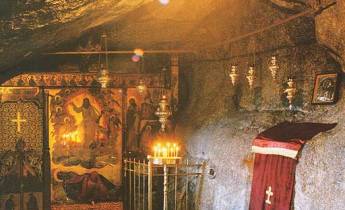
Cave in the Church of the Apocalypse in Patmos, Greece

This is not the only time this issues manifests.  The other time I encountered this is when I travel to sacred or holy sites in the Middle East.  The people in charge of sites may want raise money and increase tourism – so they give the people what they want.  What do I mean by this?  Walking into a place that has a story whether true or not provides pilgrims a sense of awe and wonder.

Certainly I am not saying that this experience should be diminished or should be taken away. What I am saying is that we should be a bit more truthful in our descriptions and remove the shroud of literalism that seems to fuel tourism and not faith. What was difficult for me when visiting Patmos is the rhetoric surrounding the island. It may or may not have been where John had his visions, but certainly the mystique surrounding the Church of the Apocalypse seems to perpetuate the literalism that surrounds the Book of Revelation as being prophetic in dealing with the end times.  Moreover, the vendors around the Church certainly focus their merchandise to support this myth.  However, while I study the Book of Revelation and teach that it is something other than prophetic, a person visits the island and the church, are told that it is prophetic – who is a person to believe?   Me or the religious order running the Church or the vendors living on the island?

This also happens at dig sites.  If a tourist is led by a guide or lead at a holy site being excavated and they tell them what they want to hear so they come back and tell their friends, who has more creditability – me or the person who guides on the site?  When scholars like myself, write about a topic that seems to gel with what the commonly held view of the academy, and goes against literalism or fundamentalist beliefs, we become heretics in relation to the information being fed by the sensationalism on the History Channel and the tourist industry.  So the popular view does not change and the academic view is left on the margins and Biblical literalism wins.

Continue reading “Is There a Such Thing as a Code of Ethics in Academia?  by Michele Stopera Freyhauf”

My Fanime Exploration of Fan Fiction—Questions of Consent and Erotic Expression

Sara FrykenbergEvery year, my husband, sister and I attend the Japanese animation convention Fanimecon in San Jose, CA. We cosplay, watch anime and peruse the various panels designed for fan entertainment and education. This year I was even lucky enough to be interviewed for the student film Unconventional, about cosplay culture, which you can check out following the link above!

Since I can’t (and don’t want to) leave my feminist lens at home, I often seek out the panels that address issues of representation, gender, diversity and sexuality when attending this conference; and usually, the con does not disappoint. Here are some examples of the panels hosted at Fanimecon in the past three years: Continue reading “My Fanime Exploration of Fan Fiction—Questions of Consent and Erotic Expression”