The Door by John Erickson

Faith is something we get from each other, and sometimes in the most magical of circumstances, faith becomes embodied by the person you love the most.

I have a Ph.D. in American Religious History but I’ve never been much of a religious person.  It’s been one of the conundrums of my life but nevertheless, I found religion and its role in influencing, for good and bad, the lived experiences of the LGBTQ community something worth exploring.

I’ve been struggling with writing this post ever since I graduated and officially became “Dr. John.” In preparing for my defense, the Chair of my Dissertation Committee requested that at the start of the defense, he wanted me to introduce my project, its overall scope, and most importantly why I wrote it.

Why did I write it?  How does one answer why they chose to devote 8 years of their life to a single subject in search of an original idea?  While some would sit and grapple with this question, I knew what the answer was all along because it always was (and always will be) about my maternal grandmother, Gladys Hritsko.

I wanted to know what made me different.  Throughout my dissertation, I interviewed people who, much like myself, grew up in similar small towns, attended the same conservative church services, and heard the same damning things that I did about my sexuality being preached from the pulpit. Many of my subjects were deeply hurt by religion and it set some of them up for years of searching and painful memories and experiences that both forced them to leave their religious and faith-based communities they grew up in or, in the worst case, being kicked out by their family as a result of their religion.
Continue reading “The Door by John Erickson”

The Feast of Santo Tomas by Sara Wright

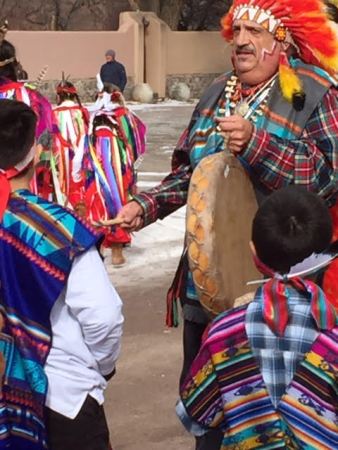
This morning I went up to the village plaza in Abiquiu to watch the dancers parade around the church with their saint who is also honored at this village festival held every year at the end of November.

This is one of the two Native American festivals that is honored each year by the genizaros who are mixed Spanish and American Indian people who embrace and practice the Catholicism that was once forced upon them.

This eclectic community is made up of descendants of Native American slaves. Those captured in warfare were brought here, converted to Catholicism, taught Spanish and held in servitude by New Mexican families. The young women and female children endured the usual atrocities perpetuated on captive females including rape at the hands of their captors. Some New Mexican male genizaros gained their freedom by serving as soldiers to defend frontier villages like Abiquiu from Indian raids. By the late 1700s, genizaros comprised one-third of the population of New Mexico. Ultimately these non – tribal peoples were assimilated into New Mexican culture.

The dances are beautiful to witness with the smallest female children dressed in predominantly white regalia some wearing a rainbow of ribbons, the young girls were dressed in red and white and had red circles of war paint inscribed on their cheeks, some of the older women also wore red, many carried turkey or eagle feathers in their hands. Most wore face paint.

Continue reading “The Feast of Santo Tomas by Sara Wright”

In the Beginning…by Lori Stewart

In the beginning
the very beginning, not the
patriarchal, colonial beginning

In the beginning
was the Word
which may have been
a grunt, a vibration, a thought, a feeling
a woman or man or a non-binary being

In the beginning was the Word
And the Word was with God
beside, above, below, inside
and God was perhaps a woman, a man or non-binary
a thought, a vibration, a feeling
or…pure unadulterated love Continue reading “In the Beginning…by Lori Stewart”

What I Learn from Women in Southern Morocco by Laura Shannon

I feel deeply fortunate to be able to travel regularly to southern Morocco. In Taroudant in the Souss Valley, and further south in the Anti-Atlas Mountains, my groups of students have the chance to discover women’s cultural traditions including music and dance, weaving and embroidery, household and healing rituals. In the seven years I have been leading these tours, women have joined me from a dozen different countries and as many different faiths, and most of them end up feeling at home here just the way I do.
What makes southern Morocco so special? Many threads come together to create the extraordinary ambience which permeates this part of the country. First of all, there is the Berber influence: a large percentage of Moroccans in the South are Berbers, and many elements of ancient North African Berber culture, with roots in Neolithic times, remain percepible beneath the relatively recent overlays of Arabic culture and Islam.

Continue reading “What I Learn from Women in Southern Morocco by Laura Shannon”

Mother of All Fears by Trelawney Grenfell-Muir

This time of year, the general public tends to pay more attention than usual to witches. Much of it is lighthearted – halloween costumes and memes about where to park your broom. Some of it is spiritual – adherents of the modern religions of Wicca and neopaganism discussing symbolic and supernatural beliefs. And some of it is historical – analyzing the witch trials of past centuries and wondering how they apply, ethically, to modern day intolerance and violence.

Within all these discussions, usually unnamed and unexamined, is the framing metaquestion: what should we fear? And what should we do about that which we fear?

Historic witch trials (from a time when witches were believed to be evil agents of Satan) reveals how we humans always try to externalize badness and goodness, so we can exterminate badness and excuse ourselves for our lack of goodness. So we have heroes and villains, neither of them very human, but rather idols and symbols of our fears. I honestly think the patriarchy’s fear of females is as strong as it ever was. When the most popular videos on the most popular internet porn sites are of ****TRIGGER WARNING RAPE, INCEST**** raping a stepsister, or doctors raping a teenage girl in the hospital for cancer, or of border agents raping a pregnant young refugee, and these sites are visited by 98% of the men in our society, what does that say about us as a species? Or a culture? As Tallessyn Grenfell-Lee says, “Scary, scary vaginas!

Continue reading “Mother of All Fears by Trelawney Grenfell-Muir”

Wealth In Imagination by Laurie Goodhart

Artwork and sustainable agriculture are the two threads of my professional life. They mingle fruitfully beneath the surface as I sift through remaining evidence of ancient worlds, trying to sense how people of lost cultures met basic survival needs and also how they responded to the very human hunger for beauty, meaning, and story.

In revisiting the remnants with empathy and wonder, scavenging for resonant clues and forks in the road that we didn’t take, some subtle but significant things continually resurface. For one, various ancient Greek writers  (males, e.g., Plato, Strabo, Euripides) noted that it is “the women” who keep things sacred and maintain spiritually oriented rituals; that without the impetus of women, men would not bother to honor the sacred in everyday life, carrying on without much concern beyond themselves. Continue reading “Wealth In Imagination by Laurie Goodhart”

A Place Below the Cattails by Sara Wright

As a woman with Passamaquoddy roots when I first came to Abiquiu I was invited to participate in the six pueblo celebrations along the Rio Grande which made me feel blessed, grateful, included, and at “home.”

My own people’s lives and traditions were  destroyed by colonial peoples centuries ago.

Yesterday I was invited to attend a river blessing on what I call Red Willow River a tributary of the Rio Grande by folks of Spanish and Indigenous descent who live here in Abiquiu on the mesa. These people, although local, are of mixed descent and do not follow the seasons and cycles of the year as the surrounding pueblos do. There is a heavy overlay of Spanish colonialism along with a restrictive (to me) Catholicism that sets this village apart from the pueblos.

Still, I was looking forward to this celebration

That was supposed to be led by Tewa Women United from the neighboring pueblos. It was a beautiful day, and of course we were all on “Indian Time” which means practically that ceremonies start when the time was right.

However, this blessing of the river didn’t come together at all. People milled around aimlessly. Some left. The children some of whom were dressed in regalia played for a while and eventually got hungry. Some complained they had to get back to school for a game.

Continue reading “A Place Below the Cattails by Sara Wright”

On Believing Things That Are Not True by Carol P. Christ

Anyone who is following American politics these days knows that the American President and his acolytes have little respect for what the rest of us consider to be the truth—or at least the best approximation of the truth that we can discern. Last week, while discussing the “lie” of white supremacy that approximately 40% of the American public has bought hook, line, and sinker, I had occasion to reflect again on the relation between traditional religious beliefs and rejection of reason and common sense. As is also well-known the President and his supporters have no respect for factual truth.
In response to a question about how to reach the women who believe whatever the President says, I responded:

I would also say that fundamentalist religion is a big problem because it teaches people to accept things that science and common sense show are not true on the authority of God (who is portrayed as a white male). This teaches people to distrust their own common sense and reasonably reliable facts. I remember growing up with liberal Protestantism and Vatican II Catholicism. In both contexts I was encouraged to think for myself and not to accept everything on the authority of scripture or tradition. Of course when the churches and synagogues encouraged us to think for ourselves, they also opened the door that enabled us to leave. Because we did, liberal and progressive denominations are in decline relative to their more fundamental and authoritarian counterparts.

With these thoughts swirling around in my head, I keep returning to a Ted Talk I came upon a few weeks ago titled “Letting Go of God” by comedian and philosopher Julia Sweeney. Continue reading “On Believing Things That Are Not True by Carol P. Christ”

“If All Knowledge Must be Reinterpreted, Why Not Religion?” Says Islamic Feminist

xcelina-feminismo.jpg.pagespeed.ic._RyiiQg3TR.jpg

Vanessa Rivera de La Fuente is Muslim, feminist, and a human rights activist
Photo: Personal archive

Background: Journal O ‘Globo, one of the most important newspapers in Brazil, belonging to the transnational media group of the same name, published this interview with Vanessa Rivera de la Fuente on Islamic Feminism. Given its relevance to the discussion on the subject, it was translated by prominent Islamic feminist and scholar Keci Ali to share it with English-speaking readers.

The Muslim women’s movement has different agendas in accordance with the reality of each country. In Latin America, the Muslim Vanessa Rivera fights against prejudice about Islam.

by Isabela Aleixo*

Vanessa Rivera de La Fuente is Chilean and Muslim. Besides being an academic researcher, she’s also an Islamic feminist engaged with questions of gender, human rights, and social development. Vanessa has wide experience in social projects in Latin American countries.

In an interview with CELINA, she discusses the prejudices that Muslim women face in Latin America, explains the movement’s demands, destroys stereotypes, and declares: “I’m a woman and I demand to be treated as a person.”

Do you consider yourself an Islamic feminist? Why?

I consider myself a feminist woman, who lives feminism in all the distinct facets of her life: I’m Muslim; I’m a single mother; I’m a professional woman, an academic; and I’m a women’s rights activist. I’m feminist with all my life experiences. I think being a woman in male-dominated society is itself a political fact, so everything that I am as a woman can be resignified by feminism, including being Muslim. Islam is integrated into my life and my political struggle, which is intersectional. It’s based on the radical idea that all women are people and we deserve equal rights and a world free of violence.

Continue reading ““If All Knowledge Must be Reinterpreted, Why Not Religion?” Says Islamic Feminist”

PENTECOST a time to FILL THE WORLD WITH SPIRIT by Mary Jane Miller

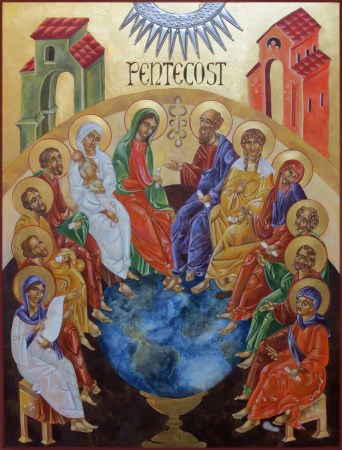
Pentecost is followed by Ordinary time, the longest season of the church year. It gives us plenty of time to think about what happened when the Holy Spirit descended on the Apostles. I have always loved the idea that this one moment changed us, it was and is the fulfillment of God’s promise to pour out the Holy Spirit on all flesh, empowering diverse people to exercise divine power. It is commonly understood that the first to receive the power from on high are the male disciples, “locked in a closed room for fear of persecution.” Apparently these Jewish disciples were not too worried about their wives and children.

After painting several Pentecost Feast Day icons as an artist, iconographer and child of God I cannot remain silent with what I think the icon has taught me. It feels obvious that the great gift of the Holy Spirit was for all of humanity. I want to commemorate an ongoing Pentecost, a time to fill the world with spirit, where women and children are invited into the closed room and given a rightful place at the table. Images have a great deal of influence in opening the heart and the mind. Imagine a new contemporary understanding of divine light touching all human beings as well as the planet.

The Spirit Descending

A half circle of twelve descending rays is commonly found at the top of any Pentecost icon. This representation is critically important for the beginning of our narrative. “Then there appeared to them divided tongues, as of fire, and one sat upon each of them.  And they were all filled with the Holy Spirit and began to speak with other tongues, as the Spirit gave them utterance. (Acts 2:2-4)

Imagine that these rays represent the uncreated energies filling the universe, the same rays any of us might feel when touched by grace. These divine rays envelope us as they come from beyond time and space.

Continue reading “PENTECOST a time to FILL THE WORLD WITH SPIRIT by Mary Jane Miller”