Making Inequality Visible: Mormons Seeking Women’s Ordination are Turned Away from Priesthood Conference by Aimee Hickman

DSC_0023 - Copy (2)Earlier this month, nearly 150 women were turned away from listening to the leaders of their church. The first weekend of October in the Mormon (LDS) Church is set apart for church members world-wide to hear messages from their leaders. The conference takes place in 5 two hour segments of speakers and music. The Saturday evening segment is called the Priesthood Session–a meeting all priesthood holding men and boys aged 12 and up are expected to attend. This year a new demographic asked to attend the Priesthood Session. Ordain Women, an activist feminist group which is petitioning LDS Church leadership to prayerfully consider the ordination of Mormon women to the priesthood, arrived at the conference doors and respectfully asked for admittance. These women were turned away one by one until the doors were closed and blocked.

On October 5th, I eagerly watched Twitter and Facebook feeds in anticipation of the news of the day: would the many dear friends I had who were petitioning LDS Church leaders for admittance into the Priesthood Session of General Conference be allowed to participate? The first word I got was from Ordain Women organizer Suzette Smith’s simple status update: “They said no.” Continue reading “Making Inequality Visible: Mormons Seeking Women’s Ordination are Turned Away from Priesthood Conference by Aimee Hickman”

Mormon Feminism and the Need for Ritual and Practice Creation by Caroline Kline

Kline, CarolineIn the past year, Mormon feminist activism has exploded. Wear Pants to Church Day, Let Women Pray, and Ordain Women are three recent projects which encouraged Mormon feminists to agitate collectively and put pressure on the institutional LDS Church to be more inclusive. I was proud to be involved in each of these, and I see this new activism as enormously important. Not only has it led to actual change (a woman did recently pray in General Conference), but this kind of public agitating also creates more space within the fold for Mormon feminists, so often silent about their questions, to discuss their feminist convictions and hopes with other Mormons.

Over the last few months, however, I have had the growing sense that pressuring the institution for change is only one part of our feminist struggle. We also need to begin developing our own community practices, our own rituals, and our own traditions. We need practices we can pass on to the next generations of Mormon women, so that our granddaughters and great nieces can turn to these traditions and find insight and inspiration in them. Continue reading “Mormon Feminism and the Need for Ritual and Practice Creation by Caroline Kline”

Women’s Erasure in Patriotic Songs by Caroline Kline

Kline, CarolineA couple of weeks ago, I attended my first grader’s school Patriotic Program. At home he had been singing snatches of “Fifty Nifty United States,” “Proud To Be an American,” and “America the Beautiful” for the last few weeks, so I was not surprised by the selection of songs. What did surprise me, when I actually sat down and listened to several verses of these songs, was the extent of the God language present in them (I thought public schools would avoid that a bit more) and the fact that many of these songs featured verses that were overtly androcentric.

Take “Proud to be an American.” The chorus is: “And I’m proud to be an American,/where at least I know I’m free./And I won’t forget the men who died,/who gave that right to me./And I gladly stand up,/next to you and defend her still today./‘ Cause there ain’t no doubt I love this land,/God bless the USA.”
Continue reading “Women’s Erasure in Patriotic Songs by Caroline Kline”

Review of “The Book of Mormon” by Ivy Helman

IMG_5998My friend and I won two tickets to “The Book of Mormon” showing as part of Broadway in Boston.  Having known nothing about the musical, we were curious and excited to be going.  Nearly two weeks later, we are still discussing how we feel about the production.  We agree that overall we like it and there are some very funny parts, but we are also troubled and disgusted by it on a number of levels.  Moreover, the fact that we like it makes us quite uncomfortable.

As a Broadway production, the cast was amazing!  The songs were creative.  Characters were dynamic and showed marked growth.  “Spooky Mormon Hell Dream” was outright brilliant with its use of humor, satire and fear to explain the Mormon preoccupation with hell as punishment for immorality and/or disbelief. Continue reading “Review of “The Book of Mormon” by Ivy Helman”

Women’s Ordination and the Mormon Church by Margaret Toscano

Me April 2011 3Caroline Kline’s March 26 post, “Mormons Who Advocate Women’s Ordination,” marks a new direction in the Mormon feminist movement. As she describes, the website Ordain Women was launched on March 17 by a few dozen Mormon women and men who state: “As a group we intend to put ourselves in the public eye and call attention to the need for the ordination of Mormon women to the priesthood.” By the end of March, 44 people (37 women and 7 men, including a Mormon bishop) have posted profiles with photos where they describe their relationship to Mormonism and why they think women should be ordained. I understand from the organizers of this site that a number of others have submitted profiles for posting and that the site has had close to 100,000 hits. On the corresponding Facebook page, however, only 363 people have given Ordain Women a “Like” sign.

While supporters may appear to be a small group in comparison to the 14 million Mormon (aka LDS) church members worldwide, it is a significant number for a grassroots movement like this. As a Mormon feminist who has publicly advocated for the ordination of women since 1984, this is the first time I have seen more than a handful of people willing to state publicly their belief that women should be ordained. In the past, women’s ordination has always been the dividing issue among Mormon feminists. All Mormon feminists want women to have more voice in the Church, more decision-making power, more visible authority and equality. Very few have wanted to be ordained into the male-priesthood structure of the Church, though more have claimed a private, spiritual priesthood.

And yet, as I have always argued, there is no way that Mormon women can be equal to Mormon men as long as they are denied access to priesthood ordination and offices because the priesthood structure controls all resources, discourses, and practices. In some ways this issue is even more crucial in the LDS Church than in other religious traditions because the Mormon organization is based on a lay priesthood where all active boys and men have priesthood. What this means is that grown women have less practical and religious authority than their 12-year old sons. Continue reading “Women’s Ordination and the Mormon Church by Margaret Toscano”

Mormons Who Advocate Women’s Ordination by Caroline Kline

Kline, CarolineA couple of months ago, I came across the “Ordain a Lady” video by the Catholic Women’s Ordination Conference. Even though it was lighthearted, clever, and fun, it made me cry. Why? Because as a Mormon feminist, I had never seen such confident assertions on video for the need for women’s ordination:

“Woman priest is my call
Women preaching for all
Don’t listen to St. Paul
‘Cuz I can lead the way”

I felt chills run up my spine as I watched these women asserting their strength, their vision, and their truth. Amen, I said to myself. Indeed, “Justice doesn’t look like only male priests.” As this video circulated among various Mormon feminist email lists, several other women mentioned that this video brought them to tears too. Continue reading “Mormons Who Advocate Women’s Ordination by Caroline Kline”

Rebekah of the Hebrew Bible: A Mormon Feminist Model by Caroline Kline

Kline, CarolineThis semester I took a class on women in the book of Genesis. I was particularly interested in learning more about the language used to describe Eve, since she is such an important model of inspired action and proactivity for Mormon women. However, I also discovered another woman in the book of Genesis whom I saw as a potentially powerful model for Mormon feminists, a woman caught in a patriarchal context, but one who decisively and creatively figures out how to insert herself, her ideas, her inspiration into the events at hand: Rebekah.

Let me recap the most crucial incident: When Isaac is old, blind, and believes he is approaching death, he determines to give a special blessing to his firstborn son Esau. When Rebekah hears of his plans, she springs into action, ordering her younger son Jacob to impersonate Esau in order to obtain this blessing. Rebekah feels so strongly that Jacob should get this blessing – and no wonder, given her revelation from God forty years before that Jacob should inherit the promise – that when he objects, fearing a curse from his father if he is found out, she says to him, “Let your curse be on me, my son. Only obey my word, and go…..” (Genesis 27:13). Continue reading “Rebekah of the Hebrew Bible: A Mormon Feminist Model by Caroline Kline”

Pantspocalypse: It’s Time for Conversation about Mormon Gender Norms by Caroline Kline

Kline, CarolineA little over a week ago, hundreds if not thousands of Mormon women across the world participated in Wear Pants to Church Day, a movement orchestrated by some feminist Mormon women in an effort to bring attention to issues of gender inequity in the Mormon faith. Pants were the chosen symbol because there are strong cultural norms against women wearing pants to church. This event was conceived as an opportunity to make visible the fact that Mormons are questioning traditional sex-segregated customs in the LDS Church and want to dialogue about these issues. Supportive men were asked to wear purple shirts or ties to signify their solidarity.

What surprised everyone in the Mormon feminist community was the vicious response by some other Mormons to this proposed action. On the event’s Facebook page, other Mormons attacked idea, hurling insults at the women. One man even made what sounded like a death threat, saying that people who participate in activists movements like this “should be shot … in the face … point blank.” The negative reactions centered around two issues: 1) that it’s inappropriate to engage in any form of protest – no matter how subtle — in church and 2) that it’s inappropriate for women to wear pants to church. Continue reading “Pantspocalypse: It’s Time for Conversation about Mormon Gender Norms by Caroline Kline”

Don’t Worry, I Won’t Marry Your Girlfriend: Sexuality, Identity, and the Easy Laugh

No longer having to deconstruct the larger cultural and sexual narratives, heterosexuals who do not support marriage equality or feel threatened by homosexuals return to their one source of power that reinforces the ideology that they are on the right path: the Bible. “Marriage is between a man a woman,” or “A man shall not lie with another man as he would a woman,” becomes the newly reinforced heterosexual rallying cry and the progressive progress that occurred in the past becomes nothing more than a joke.

johnI must say, I will be the first to admit that the recent outbreak of videos promulgating the idea that gay men will marry a straight guy’s girlfriend or lesbians will marry a straight girl’s boyfriend all for the sake of marriage equality left me stifling my laughter as I attempted to pay attention in class.

However, after the calamity died down I took a moment to reflect upon the intrinsically embedded aspects of misdirected norms of sexuality, gender, and misogyny latent within the laugh lines and the guffaws throughout each video. Continue reading “Don’t Worry, I Won’t Marry Your Girlfriend: Sexuality, Identity, and the Easy Laugh”

Why I am a Mormon Feminist by Emily U.

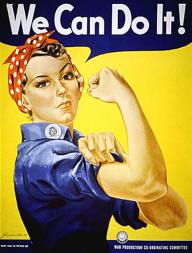
We can do it! RosyI’m not a historian or sociologist, but I’ve noticed something about civilizations.  They always seem to think they are more special than other civilizations.  It’s not important to my purpose here to name names, but so many groups have had a superiority complex of one kind or another that I wonder if a need to feel more special is written into human DNA.

There may be biological explanations for why people draw distinctions and make rankings for each other, but I’m going to speculate about a psychological or spiritual one.  I wonder if this hunger for superiority stems from a lack of security about one’s value as a human being.  The first temptation of Christ started with the words “If thou be the son of God…” and if we are to believe Christ’s temptations were real it means that even Jesus must have, at least momentarily, been able to question his identity.  He was tempted to believe the lie that he was not who he knew himself to be.  We mere mortals experience that temptation not infrequently, and unlike Jesus, we sometimes succumb to it.

One strategy people have for dealing with insecurities about their identity is to artificially elevate themselves above others.  As in, if I’m not special at least I’m more special than (fill in the blank).  This has caused so much pain and injustice.  And regardless of culture, time, or place, women seem to always be on the losing side of this equation. Continue reading “Why I am a Mormon Feminist by Emily U.”