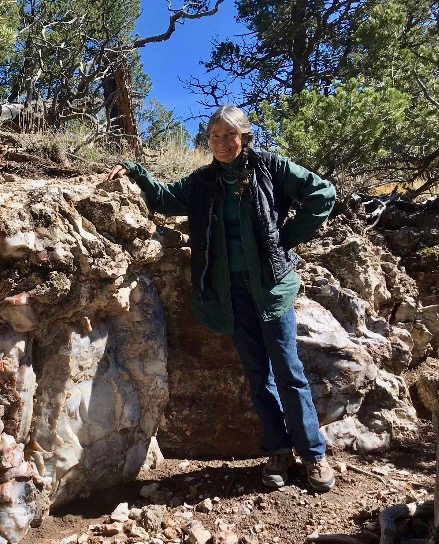
Yesterday I dreamed that I discovered a bird’s nest that was hidden in the center of an evergreen tree. This little dream moved me deeply because this is the time of year I celebrate my love and gratitude for all trees, but especially evergreens, and the dream felt like an important message. For me in winter, the “Tree of Life” is an evergreen.
Outdoors, I recently placed a glass star in the center of my newly adopted Juniper here in New Mexico, repeating a pattern that began in Maine years ago with my Guardian Juniper in whose center I also placed a star…Inside the house an open circle created out of a completely decayed tree trunk sits at the center of my Norfolk pine; around the room spruce, juniper and pinion boughs are twinkling with miniature lights. The tree has a festival of lights at her feet. The point of making these gestures is to keep me mindful that tree bodies are sacred in their wholeness and each tree explicates the immanence of divinity. Another way of saying this is to say that Natural Power lives in trees. This goddess is steadfast. Continue reading “For Love of Trees by Sara Wright”
I am dressed in a white cloak that obscures all but my face. The robe is splattered with paint and blood. I am awash in every color of the rainbow and dripping paint. I have been raped by strangers and no one is accountable.
This morning I could not get this frightful image out of mind but I had the strong sense that it had an impersonal aspect that had nothing to do with me.
This weekend at the Pueblo of Abiquiu the community celebrates the feast day of the first official saint of the Americas, Santa Rosa, and I planned to attend…
The people of Abiquiu call themselves Genizaros. Representing Apache, Navajo, Comanche, Kiowa, Pawnee, Ute and Wichita, detribalized Native peoples from the Plains that were captured and traded during the Indian wars of 18-19th centuries, and sold to New Mexicans as slaves and servants where they were stripped of their identity, instructed in Hispanic ways, and baptized as Christians. The People survived by incorporating Hispanic and Christian cultural practices into a distinct Genizaro consciousness, one that is distinct from the Indigenous Tewa speaking peoples (descendants of the Anasazi) who also live here in six pueblos along the Rio Grande. Continue reading “In the Shadow of Santa Rosa by Sara Wright”
It is October, the veil is thin the year is waning the leaves are turning I am trying to say goodbye to my grandmother she is dying. I do not know what to say.
The leaves are red the sky is blue I saw a crow in the tree behind the house.
The threads of this year are becoming thinner.
The threads of her life too are becoming thinner
What do I say to the one who breathed life into my father who wove his cells into being who cradled him as a baby who wept into his hair.
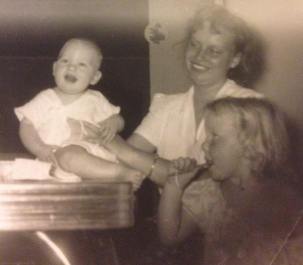
Twyla with my dad, Tom, in 1953.
Carrying the cells
of the generations The chain of life
continuing to spiral through time, and place,
and distance and falling leaves.
What do I say as life thins, as breath fades
What do I say when all that remains is the space between us
What do I say
when I catch a glimpse of the swift unraveling of time the wrinkles in eternity
What do I say
as time folds in on itself and now it is me in the bed and my son, gray-haired, blue-eyed is reading to me in a quiet voice
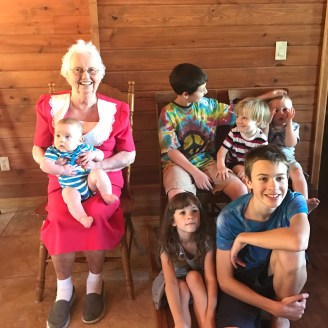
Grandma Johnson with her great-grandchildren in April, 2017.
as the chapter comes to a close.
Part 2: The Answer
That night, I dreamed of my grandmother she shrank to the size of a small child I picked her up and held her against my body We looked in the mirror cheek to cheek and smiled together I kissed her face and told her: “You are wonderful.” Then we danced around the room together her head against my shoulder I kissed her again on her white hair and no more words were needed.
Part 3: The Memorial
At this time last year, as the leaves fell and the wheel of the year dipped into darkness, my last grandparent died. I recognize that I am fortunate in having reached nearly forty while still having a living grandmother, but there is still such a sensation of finality and ending in saying goodbye to the final grandparent. Twyla was my paternal grandmother and I was not as close to her as I was to my maternal grandmother who died in 2013, but she is the woman who wove my father’s bones into being, and her death left a hole in our family and a sensation of an ended section in the tapestry of generations.
After the dream I write of above, I went back to see her a final time, five hours before she took her last breath. This time, I sat with her alone. I kissed her on her white hair and told her she was wonderful. I played her a song (Beyond the Gates by T. Thorn Coyle and Sharon Knight). I spoke to her of her good work in the world, that she had done it, that she’d finished her work, and that she had given so much and done so well. As a mother myself, the sensation of how powerful it is to have seen all your babies through to adulthood and into grandparenthood themselves filled the room. My dad, her second child and only son, has teenage grandchildren now himself. My grandmother’s youngest child of her five children is in her mid-fifties (and also a grandmother to teenagers). Sitting in the darkened room, listening to the song play, I was staggered by the magnitude of having seen each of your own children through their lives and into grandparenthood. While there are many ways to leave a legacy and it is not a “failure” by any means to not see all of your children into grandparenthood or to not have children yourself, what a gift it must be to bear witness to these generations if it does, in fact, unfold in that way, and to see your own tiniest baby have grandchildren of her own. This is something I hope to see for myself.
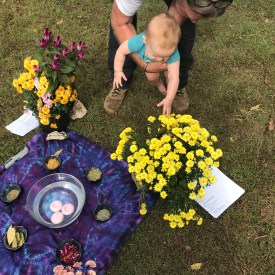
My dad holding his youngest grandchild at the memorial.
I then had the blessing, the honor, the privilege of being asked to prepare a memorial service for my grandmother. Five years ago, I was also asked to facilitate the memorial ceremony for my other grandmother. The unique, uncommon blessing of fulfilling this role for both of my grandmothers is not lost on me, as I know no one else who has had the experience of serving both sides of their family of origin in this way. I felt so honored to be trusted to help guide my family through both of these experiences of loss and grief. I spoke to my husband of how humbled, grateful, and fortunate I feel that I have a family who would let me do this, not just for one grandma, but for both of them, and he said, “you know, honey, maybe we should all be grateful to you that you’re willing to do this for us.” So, I received that recognition into my heart with appreciation as well.
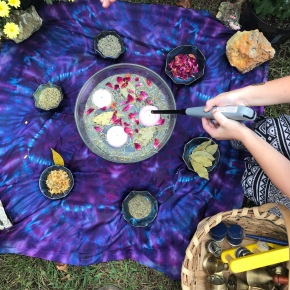
My daughter, then six, keeping the candles lit and tended on the altar space during the memorial.
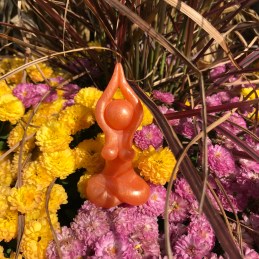
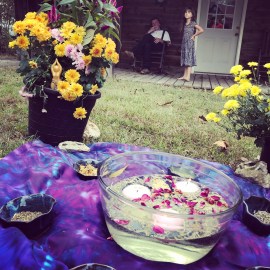
It is powerful to create ceremonies that acknowledge transitions within the life of your family. During this ceremony for my grandmother we each had time to speak of her, I had poems I had written, and readings to share. We had a centerpiece with flowers, floating candles, and photos of her, and we each held handfuls of herbs that we offered into the bowl of water as we shared our stories and memories. Each person took time to do so and spoke with care, tenderness, love, and laughter. Sharing this time and space together and creating a container for people to be heard in their grief and love rather than participating in the type of “canned” or impersonal memorial service that may be more commonly offered by religious groups, was what we needed to say goodbye to this woman who wove a part of our souls. My aunt said: this is the kind of send-off that everyone needs, and that felt very true and real.
My extended family is not pagan or liberal or alternatively religiously minded and as I planned the memorial I was conscious of not wanting it to be “too much” for them. As I typed my outline, I’d first included a song and other practices common to other rituals and retreats I lead and when I heard that my aunts and cousins were coming, I’d removed the song and some ritual elements, fearing making them uncomfortable. They then said they weren’t coming, so I added the singing back in. On the day of the memorial, they did in fact come, and I decided we would sing anyway, whether comfortable and familiar or not. We sang the same song to begin and to end the memorial (“We Are a Circle”) and when I looked around the circle the second time we sang and saw that everyone there holding hands, their faces wet with tears, were all singing too, I knew that it had worked.
If you have the opportunity to create ceremonies and rituals of personal meaning for your own family, please do it. It holds so much value, such life and power and love, in a way that is difficult to create by someone outside of the family. A small group of people who really care and who are willing to connect with each other in a meaningful, connected, vulnerable way, births so much real magic together. This container can be created by you, for you, and for the ones you love the most.
“Everyone can do the life-changing, world-renewing work of magic…the Dalai Lama said, ‘It’s not enough to pray and meditate; you must act if you want to see results.’ We are called to offer real service to others, to the Goddess. That service may take many forms: mopping the floor after the party, priestessing rituals, healing, planning, teaching, carrying the heavy cauldron from the car, sitting with a dying friend, writing up the minutes for a neighborhood meeting, organizing a protest to protect a sacred place from development, writing letters to Congress, training others in nonviolent civil disobedience, growing food, or changing the baby’s diapers. All of these can be life-changing, world-renewing acts of magic…”
—Starhawk and Valentine, The Twelve Wild Swans
There is a companion audio recording available about this memorial service preparation, the death of my grandmother, and about how to weave a strong “ritual basket” to carry a ceremony. The first part is an audio ritual for my online circle with thoughts about claiming your magic, fear of the label of witch, etc., so if you want to skip past that only to the memorial information and ritual theory, skip to 16:20 in the audio:
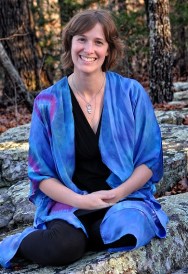
Molly has been “gathering the women” to circle, sing, celebrate, and share since 2008. She plans and facilitates women’s circles, seasonal retreats and rituals, mother-daughter circles, family ceremonies, and red tent circles in rural Missouri and teaches online courses in Red Tent facilitation and Practical Priestessing. She is a priestess who holds MSW, M.Div, and D.Min degrees and wrote her dissertation about contemporary priestessing in the U.S. Molly and her husband Mark co-create Story Goddesses, original goddess sculptures, ceremony kits, and jewelry at Brigid’s Grove. Molly is the author of Womanrunes, Earthprayer, and The Red Tent Resource Kit and she writes about thealogy, nature, practical priestessing, and the goddess at Patreon and at Brigid’s Grove.
During a meditation before bed, I saw an image of a candelabra similar to what Jewish people use for Hanukkah. It was yellow/gold in color, engraved/etched onto a surface. All at once I saw the imagery of a star, a silhouette of a woman, and a beam of light move from the base of the candelabra through the top and beyond.
In these moments, I did not understand the significance of or the relationship between these images. What did a feminine figure have to do with the Jewish candelabra? What is the name of their candelabra? I could not even recall the name of it. It was something I grew up knowing the name of, as it was an image that I frequently saw beside the kinara of Kwanzaa in my school-aged years.
Because I was sheltered from the Abrahamic religions, my mother opted for participating in Kwanzaa as a means to shield me from any potential bullying from my classmates, and to celebrate a part of my diverse heritage. It was already a problem for my peers and the adult staff at school that I chose to identify as a Jamaican-American or a mixed person, as opposed to African-American. To tell a group of African-American Christians or those with an Afro-centric view that I didn’t celebrate Christmas or Kwanzaa, or that my mother taught me to listen to my dreams and intuition, would only serve as a means to further isolate myself; and by extension, my little sister. So celebrate Kwanzaa we did, until I began high school.
I am a Vajrayana Buddhist. I follow the Buddha Dharma via the Vajra path. My journey to the Dharma was through lucid dreams. I have not once had a human teacher, in this lifetime, to teach or guide me to/on this path. My teachers have been the Dakinis, the Mothers, or a variety of emanations of the Divine Feminine embodying many forms of wisdom. They are the ones that have provided me with the practices to engage and the ways in which I need to BE, in order to DO, in this lifetime.
“How do you know these dreams are not from your mind?”
Do you know how many times I have heard this question, from sangha members of less melanin? Did you know that it has always been a Western Buddhist that has challenged my experiences, yet those that follow the Buddha Dharma in Asia would always inquire about them from a place of curiosity?
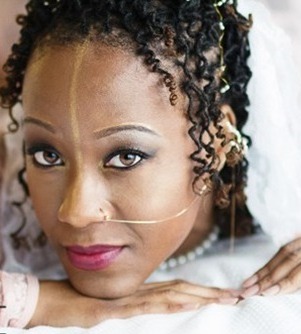
Dreaming has always been a huge part of my life. When I was a little girl, I would run to my mom in the morning, before I was even completely awake, and tell her what I had been dreaming, It would seem very important, I mean, desperately, terribly important, to share whatever journey I had been on.
I would have repeating dreams; dreams with choose-your-own-adventure options; dreams with strange symbols and images and words. I must have known that my dreams were valuable in a particular way to my waking mind, my manner of knowing, and even my concepts of reality because quite early on in my life I started to try to understand what dreaming actually was. I remember getting a book called Far Journeys (or something like that) about lucid dreaming. I remember learning about dream paralysis, which was a cause of great relief, since I occasionally experienced it and had to overcome the sense of terror it created. I developed an early and avid interest in dream symbolism and psychology. I was relieved when I finally learned the name Carl Jung. In short, dreaming was central to my total experience of mind. Continue reading “Following My Dreams by Natalie Weaver”
My mother spent a good deal of her life defending my father to me and my brother. “Your father didn’t mean it,” she would say. “Your father loves you—he just doesn’t know how to show it.” “Your father never cried when his mother died—that is why he is so angry now.”
Shortly after my mother died, my brother said to me: “I finally realized that the only way I could get along with Dad was if he decided on that particular day that he was going to get along with me.” My brother’s words hit me like a ton of bricks. At the age of forty-six, I was still trying to get along with my father. I had years of therapy to help me understand our relationship. My brother saw the truth without the benefit of therapy.
About six months after my mother’s death, I had the most amazing dream. Though I have alluded to it in my writing, I promised myself not to speak of it directly it while my father was still alive.
I had accompanied friends to the Greek Saturday night Easter service in their village. At the stroke of midnight we lit candles saying “Christ is risen, he truly is,” before embracing and kissing each other on the cheeks. I was sleeping in a guest room in my friends’ house. The dream occurred shortly before dawn. Though I rarely remember my dreams, I awoke with a clear memory of this one.
In it my mother spoke to me in Greek. She told me that now that she was no longer living, she had a clearer perspective on the way our father treated me and my brother. She explained that she had loved my father so much that she had not wanted to see that he had been cruel to us and to recognize the ways he had harmed us. She said she was very sorry that she had not protected us. Her final words before the dream ended were: “Don’t ever love anyone so much that you become blind.”
To this day I do not know why my mother spoke to me in Greek–perhaps it was a way of distancing herself from my father and indicating that she was on my side now. It seemed deeply appropriate that she appeared to me at the time when the Greeks were celebrating the resurrection of “life from the grave.” My mother’s words were a healing balm: healing the breach that her siding with my father a crucial junctures in our relationship had created in my relationship with her, and healing an even deeper would in my psyche.
About that time I was reading Alice Miller’s discussion of the poisonous pedagogy of control. Miller says that the most important words abused children need to hear are: What happened to you was wrong. This should not happen to you or to any child. In the dream my mother spoke the words she had been unable to speak while she was alive. She told me that she finally understood that there was no excuse for the way my father treated me and my brother.
I came to realize that the words my mother spoke when she was living, words intended to absolve my father and assuage my pain, had confused me about the nature of love. From my mother, I learned to imagine that people–especially men–who treated me badly loved me deep down but could not show it. No wonder I always ended up feeling hurt and abandoned.
My mother’s ability to acknowledge the truth about my father when she came to me in my dream was a revelation. The blinders that had clouded all my relationships fell away. I could now begin to see all of my relationships more clearly and to recognize which relationships were healing me and which were harming me. Before the dream I literally did not have a clue, because my mother had taught me love is a magical feeling that has no relationship to actual behavior. After the dream I learned that love manifests in both word and deed. My life has been different from that day to this.
Though I never doubted the healing power of this dream, I had some difficulty in squaring it with my belief that death is the end of individual life. If my mother was not living heaven or somewhere else, then how could she speak to me after she had died? In the ensuing years I have come to understand that the ancestors live in us. The words my mother spoke to me when she was alive became part of my cellular memory. The mother-daughter relationship is so profound that there are times when the mother-daughter boundary is blurred. As I recognize how deeply this is true, it no longer seems important to know if “my mother” appeared to me in my dream or if “my mother as she lives in my me” appeared in my dream. Her appearance transformed my relationship with her and my relationship with my self. And that is what matters.
In memory of Janet Claire Bergman Christ, August 11, 1919-December 7, 1991.
I had few expectations before my visit in the winter of 1999 to Cairo’s Rav Moshe Synagogue, also called the “Rambam.” I only knew it to be an obscure synagogue and yeshiva associated with the renowned twelfth-century theologian, sage, and physician, Moses Maimonides.
I left Egypt as an infant with my parents in 1951. Now I was finally back, hoping to experience the place that had shaped my family. Accompanied by a Muslim Egyptian friend, I walked the streets my parents had walked, attended services in the elegant downtown synagogue where they’d been married, tasted the familiar foods of my childhood, listened with delight to the melodious sounds of Egyptian Arabic. But seeking the Rambam was little more than a whim, sparked by a few lines in a Guide to Jewish Travel in Egypt. “Not on any tourist itinerary,” the brief blurb stated about the derelict synagogue in ‘Haret al Yahud, the city’s medieval Jewish quarter, far from where my parents had lived. Still, I had to go.
I once dreamed I was giving a lecture on a spiritual philosophy called magmatheism. The literal meaning, I thought when I awoke, would be something like “belief in the divinity of molten rock.” I had the sense this dream was trying to tell me something about what I had come to believe and know. When I asked my friends what they thought magmatheism was, they gave answers that delighted and intrigued me.
One said: “the belief that God/Goddess dwells below the ground and every once in a while erupts out gloriously.”
Another said: “By studying the ways in which rock is liquid, we can understand the oneness of all things… Our separation is an illusion. We are part of the whole.”
A third said: “Honoring the magnetic pull to earth.”
A fourth said: “The unmanifest that creates the foundation of all life.”
The dream told me something real about the power of dreaming. It let me know that a life physically and spiritually connected to the earth—the life I was trying to live and to encourage others to live—did not only occur when I was awake, but when I was asleep. The dream told me that the earth was speaking to me in my dreams. As dream tender Stephen Aizenstat writes, “Dream images are not representations of our personal nature only, but are also informed by the subjective inner natures of the things and creatures out there in the world. (Aizenstat, S. Dream Tending: Awakening to the Healing Power of Dreams. New Orleans, LA: Spring Journal, Inc. (2011), pp. 149-150).
In early December 2016 I visited central Williamsburg in Brooklyn, New York, where my 2x great-grandparents Thomas and Anna Maria Christ and their son George and his family, including my father’s father Irving John, lived for over fifty years. I had compiled a list of all the known addresses of the family in Williamsburg from census and death records. The family lived in a several block square area surrounding Most Holy Trinity Roman Catholic Church on Montrose Street for all that time.
Most of the buildings at the addresses where the family lived had been torn down and replaced with housing projects in the mid-twentieth century. Some of the remaining ones are being torn down today, as this area of Williamsburg is being gentrified. Still, enough of the old buildings remain to give a sense of what the neighborhood was like in the 1800s. Continue reading “Ancestor Connection in Williamsburg, Brooklyn by Carol P. Christ”


 Yesterday I dreamed that I discovered a bird’s nest that was hidden in the center of an evergreen tree. This little dream moved me deeply because this is the time of year I celebrate my love and gratitude for all trees, but especially evergreens, and the dream felt like an important message. For me in winter, the “Tree of Life” is an evergreen.
 Last night I had a nightmare.
 comfortable and familiar or not. We sang the same song to begin and to end the memorial (“We Are a Circle”) and when I looked around the circle the second time we sang and saw that everyone there holding hands, their faces wet with tears, were all singing too, I knew that it had worked.
 ‘It’s not enough to pray and meditate; you must act if you want to see results.’ We are called to offer real service to others, to the Goddess. That service may take many forms: mopping the floor after the party, priestessing rituals, healing, planning, teaching, carrying the heavy cauldron from the car, sitting with a dying friend, writing up the minutes for a neighborhood meeting, organizing a protest to protect a sacred place from development, writing letters to Congress, training others in nonviolent civil disobedience, growing food, or changing the baby’s diapers. All of these can be life-changing, world-renewing acts of magic…”
 She plans and facilitates women’s circles, seasonal retreats and rituals, mother-daughter circles, family ceremonies, and red tent circles in rural Missouri and teaches online courses in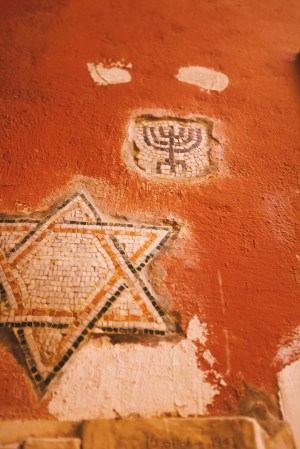
 Dreaming has always been a huge part of my life. When I was a little girl, I would run to my mom in the morning, before I was even completely awake, and tell her what I had been dreaming, It would seem very important, I mean, desperately, terribly important, to share whatever journey I had been on.
 My mother spent a good deal of her life defending
 I had few expectations before my visit in the winter of 1999 to Cairo’s
 In early December 2016 I visited central Williamsburg in Brooklyn, New York, where my 2x great-grandparents
  Feminism and Religion