The Mighty Oak or Acorn? by Sara Wright

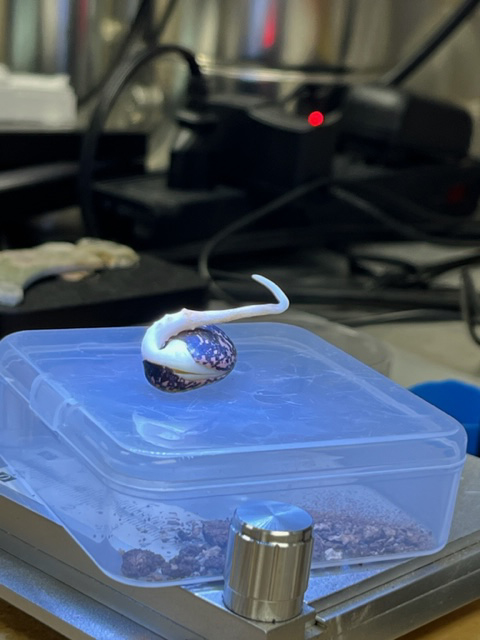
Most of us are familiar with the mythology around oak trees. They are considered oracular beings in many traditions. The Druids considered  them to be sacred, the Greeks associated oaks with Zeus –( patriarchy strikes as the ‘ king’ of trees). In Britain there was a goddess of oak trees….but in general oaks are considered to be male beings though they bear seeds and flowers on one tree.

 Mighty male trees ? Nothing could be further from the truth in terms of behavior because oaks are found all over the world and in this country they are what is considered to be a keystone species. What this means is that oaks support and nurture an incredible amount of animals, insects and birds. A ‘ Mother ‘Tree in every way. We have four species in this country, one of which clones itself and behaves like a bush. It is believed to be about 1300 years old ( found in the west).Throughout the world oaks are also considered to be keystone species.

Continue reading “The Mighty Oak or Acorn? by Sara Wright”

Aging and Kinship by Sara Wright

When I moved to the mountains my children were grown and gone…

Finally I had land of ‘my’ own with a brook and mountains that was surrounded by forests. I felt protected by something I could not name. I was living on the edge of wilderness and a hunger I had been carrying for all of my adult life was finally appeased.

Although I had a vegetable and flower garden I felt a deep reluctance to cut trees and eventually lost most of my field to pines. When I finally built my log cabin, I did plant fruit trees, but every action was predicated on my need to give back to nature what she had given to me.

Continue reading “Aging and Kinship by Sara Wright”

Return to Mountain Mother[1] by Jeanne F. Neath

Mountain Mother, I hear you calling me.
Mountain Mother, we hear your cry.
Mountain Mother, we have come back to you.
Mountain Mother, we hear your sigh.

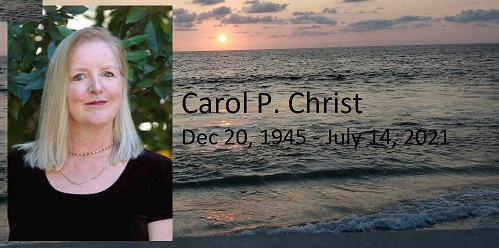
Lyrics by Carol P. Christ [2]. Sung to the tune of “Ancient Mother.” (origin unknown)

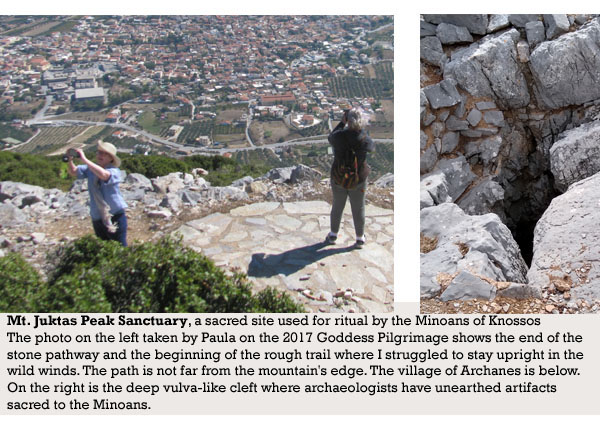
What do a bunch of feminist women do while riding a tour bus around the Mediterranean island of Crete? If they are on the Goddess Pilgrimage started by Carol Christ and continued by Laura Shannon, they sing songs honoring the Goddess. The song that drew me most from the first time I heard it on the fall 2022 Goddess Pilgrimage was “Mountain Mother.” Not surprising since the rocky, sparsely vegetated, yet hauntingly beautiful mountains of Crete surrounded us much of the time as our trusty bus wound its way up and down and around the island.

Continue reading “Return to Mountain Mother[1] by Jeanne F. Neath”

The Reindeer Goddess Seeks Help by Judith Shaw

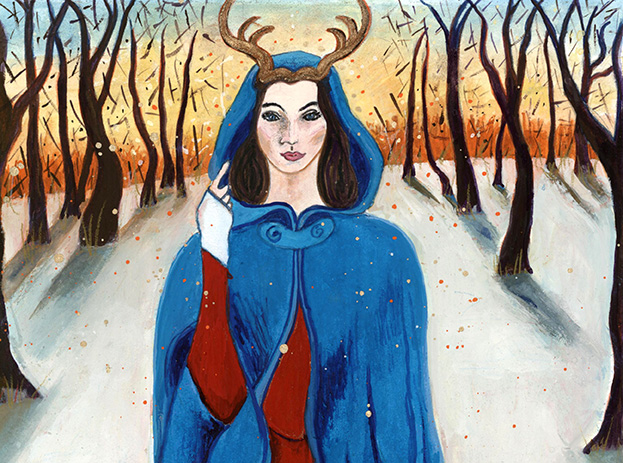
Imbolc has come and gone. It appears that Punxsutawney Phil, the American version of animal weather prophets on that cross-quarter day, was correct. Winter cold continues. I’ll admit that I am getting pretty tired of the cold but it does help me to keep focused on the paintings for my winter fairytale – Elena and the Reindeer Goddess.

Though my work on this project will certainly continue into the spring and summer, this will be the last excerpt I post here at FAR. I know you will all be more interested in postings related to the growing times of spring and summer once the days are longer and warmer. This third excerpt picks up where my post from last month stopped. If you missed excerpts one and two you can check them out here and here.

Continue reading “The Reindeer Goddess Seeks Help by Judith Shaw”

Seeding Up by Sara Wright

Every spring it’s the same… the hunger to begin starting seeds. As a woman and an eco -feminist I am convinced that this need to work with seeds and soil is an ancient pattern that stretches back to our egalitarian matriarchal beginnings.

Some of us like me come from a family of gardeners so there is something to say about the influence of our ancestors directing this process on a personal level. Both patterning and ancestral influences seem to work together. Another “both and”.

After I broke my foot last year I was forced to cease gardening altogether out of necessity because I could no longer use a shovel. If I am really honest I can say I was more than ready to let go. I have grown both vegetables and flowers since I was a child, then while raising a family. At mid – life when I moved to the mountains I made (what seems today) a radical decision. I decided to plant trees, plants and flowers primarily for non – humans in a small area around my house. Nature determined what grew and thrived on the rest of my land. Today people call this re-wilding but then my intention was simple. I wanted to give back to nature what S/he had given to me. I wanted nature to be the receiver.

Continue reading “Seeding Up by Sara Wright”

Legacy of Carol P. Christ: Woman and Nature: Our Bodies Are Ourselves

This was originally posted on June 26, 2017

This earth is my sister; I love her daily grace, her silent daring, and how loved I am how we admire the strength in each other, all that we have suffered, all that we have lost, all that we know. We are stunned by this beauty, and I do not forget: what she is to me, what I am to her.

These words are from Susan Griffin’s Woman and Nature which I often recommend as one of my favorite books. Over the years I have read this passage and others from Woman and Nature aloud with my students, and we have always been moved, most  of us to tears. More recently these words have become the center of the “Morning Blessing” on the Goddess Pilgrimage to Crete.

Continue reading “Legacy of Carol P. Christ: Woman and Nature: Our Bodies Are Ourselves”

Inspiration is Always Present by Sara Wright


I walk with care
clearing paths
iced over
lead feet
dragging
a broken foot
my companion
Listen to
first spring
bird song –
chickadees
and doves!

Continue reading “Inspiration is Always Present by Sara Wright”

Seeds of Hope: Part Two by Beth Bartlett

You can read part 1 here.

The patenting of seeds[i] has made the thousands-year-old practice of seed saving illegal, as is the sharing of seeds from farmer to farmer. The most notorious case is that of Canadian farmer Percy Schmeiser, whose canola crops were contaminated with Roundup Ready canola pollen blown into his fields from neighboring corporate farms. When Monsanto trespassed onto his fields, took samples, and found Roundup Ready canola plants mixed in with Schmeiser’s own canola plants, they sued him for violation of patents. Ultimately, the Canadian Supreme Court ruled in favor of Monsanto, but also ruled that Schmeiser owed Monsanto nothing.

In my own city, seed sharing became an issue when in 2013 our local library decided to start a seed library. The project was begun with great hopes that patrons could check out seeds for their home gardens, with the understanding that they would save a portion of their seeds and return these to the library for next year’s use. [ii] Project leaders hoped this would preserve locally adapted seed varieties. Unfortunately, after the seed library came to the public’s attention, the Minnesota Department of Agriculture informed the library that they were in violation of a Minnesota statute that prohibited the exchange of non-commercial seeds. [iii] Library Manager Carla Powers commented, “ . . . the law went so far as to make it illegal for gardeners to exchange a handful of seeds with one another.”[iv] But this did not end the library’s efforts.  Several ally organizations[v] stepped up to create an amendment to the statute that exempted the exchange of non-commercial seeds from testing, labeling and licensing laws. This inspired a state-wide effort to change the law, which was successfully accomplished in that year’s legislative session.[vi]

Continue reading “Seeds of Hope: Part Two by Beth Bartlett”

Seeds of Hope: Part One by Beth Bartlett

Author’s Note: This piece was inspired by Janet Maika’i Rudolph’s wonderful FAR post of December 15th, 2022, “Ode to Seeds.”

“. . . I know, yes, there is renewal, /because this is what the seeds ask of us/ with their own songs/ when we listen to their small bundle of creation,/ of a future rising from the ground . . .” – Linda Hogan

The first seed catalogs started arriving in the mail even before the turn of the new year.  In an annual ritual of hope, in the depths of winter we turn our thoughts and dreams to growing things – seeds of heirloom tomatoes, cucumbers, squash, carrots, and beans that will feed us and grace our tables in the summer and fall, and colorful marigolds, nasturtiums, and zinnias that will delight all summer long with their beauty. Is this the invincible summer of which Camus wrote?[i] 

Continue reading “Seeds of Hope: Part One by Beth Bartlett”

Feeding the Birds….Refuge, Part 1 by Sara Wright

It’s another gray snowy day with large white flakes falling from the sky… January lasts “forever” every single year. I feed chickadees on my window ledge until the squirrels show up; then I scatter seed on the ground. Chickadees begin their day just before 7 AM when it is still dark, coming to the ledge. Today the turkeys are absent, fluffed up monks still hidden under hemlock boughs. The blood male cardinal appears with his usual message. I peer into the forest as the turkeys make their way across the brook and start up the hill while gazing at sage green shield lichens and two pure white birches that stand out like sentries, peeling white skin. Some maples and many hemlocks border the brook that is running clear of ice. A multitude of twigs and evergreen spires sway, branches twist and bend filling every inch of space, a comforting sight, even though all the deciduous trees are bare. Global warming turns snow to rain and back again in every storm creating ice bound paths, easily traversed by my little dogs. Dangerous for me. Often now I am housebound.

This gray world of mine needs animation from within…

Continue reading “Feeding the Birds….Refuge, Part 1 by Sara Wright”