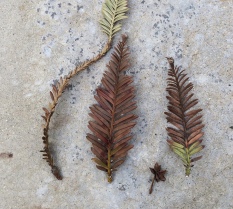
Much of our lives lack the rich culture of ritual that I think would help us repair the relationships we have with our own bodies and with the earth. The Rg Veda is one of the oldest collection of hymns from India. In them, I find a playful and introspective expression of desires and fears that, at first, did not seem to me to hold much wisdom for a modern contemplative. But lately, I have been noticing how the speakers communicate to or about the earth, and how their lives seem centered around trying to take a part in creation. Mostly, these hymns are stories and supplications for rain, cows, victory in battle, and a long life. But there is a deep understanding of the power and divinity in the universe that is the very earth-based wisdom that our humanity-in- crisis needs. If the Qur’an is God calling for humanity to be grateful, the Rg Veda is a model of a humanity that could be nothing else.
I love one incantation, for instance, found in the tenth mandala, that seems to be from a compounding physician, praying to the healing herbs that might make her client well again. I imagine her alone, in a greenhouse pharmacy, on a damp late afternoon, fingering stems and leaves before crushing them with her mortar and pestle to make a bespoke tincture that holds a cure. She knows the plants intimately, and works as if she is on holy ground: Continue reading “Honoring the Earth in our Rituals of Well-Being by Elisabeth Schilling”
“Let the beauty we love Be what we do
There are hundreds of ways to kneel and kiss the Earth.”
–Rumi
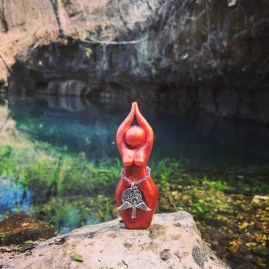
Introductory note: At the end of 2016, my parents purchased a piece of land about one mile from where I already live (they live one mile further away than that). In addition to woodland and meadow, this land has two springs, three creeks, a cave, and ¼ mile of river access. While I have been deeply connected to the land of my birth, the Missouri Ozarks, for a long time, and have written about that connection in multiple past posts for FAR, this new-to-us land has offered a new opportunity: the chance to get to know another section of land “from scratch,” deeply, wildly and well, and to become wise stewards of it for the time in which it is in our care. It is also the first time I have been able to so closely and intimately observe the origin source of a body of water. Previously not giving it much thought, I now have the daily privilege of observing the source of the flow as I watch water emerge directly from the ground. First, there is simply none and then, suddenly, a deep blue pool constantly bubbling as water rises to the surface and flows away on its long, long journey to the sea. This essay is a series of three vignettes as I spend this year immersing myself in relationship with this land.
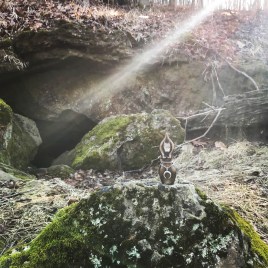
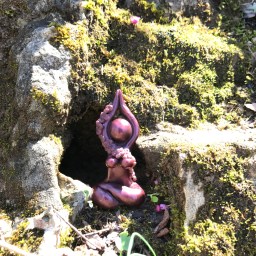
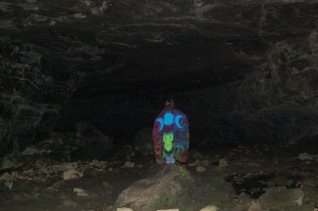
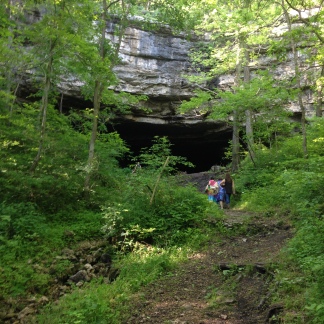
We walk along the nearly vertical hillside hanging onto small trees for support. Finally, though we almost miss it, we spy the opening to the cave nestled behind several mossy stones. The sun is still on the rise above the tree line and the rays filter through the trees so one ray is pointing directly at the cave entrance. We crawl inside, bumping our heads and scraping our backs as we wiggle into this womb in the earth. Once inside, the chamber enlarges so we can stand up. Unlike other caves we have experienced in this area, the only human signs we find are a single bottle cap, a glass bottle, and two sets of initials carved into a rock. In the dark silence we hear the sound of water dripping steadily. I make my way further into the cave, acutely aware that this is living cave and being careful not to step on the fresh, wet, cervix-shaped beginnings of new stalagmites on the floor. At the back of the cave, I find her. A Madonna-like stone column, glistening with water. In the silence of the cave, I quietly sing Ancient Mother to her, as tears well in my own eyes.
I am of this earth for this earth and by this earth.
We skirt carefully along the bank of the creek, making our way to the largest spring. Over three million gallons of water a day flow effortlessly from this small, deep pool nestled quietly in the middle of the woods. I am stunned by the magnitude of this flow as I stand there with my husband, my head resting on his shoulder, hawks wheeling overhead, redbud trees in full bloom. It has never seemed more clear to me how very “small” we are, but a blink of an eye to this spring and its countless years and countless gallons of water, not caring whether it is witnessed in its work or not, but simply, continually, creating and producing. I try to explain this feeling aloud, but words fail me. It is a humbling sensation, not a depressing one. The actual emergence of the water at this origin point of the river is nearly invisible, the continuous gentle, small popping of bubbles on its surface, the only sign that something significant is happening here that distinguishes this body of water from a pond or pool. Yet, those never-ending bubbles rapidly expand to a wide, swift-moving creek, which joins the river and another smaller spring-fed creek to continue to make their way southward across the state. We smell something sharp and see a dead armadillo by the roots of a giant sycamore. We hear a shrill cry and look up to see two bald eagles riding the currents of air high above us. We are so small. So many thousands of years of water have passed, but we are here right now.
Unfathomable eons
Glacier time
I am just a blink of an eye
But I can sit, and watch, and wonder.
We scramble along the uneven terrain on the rocky and wooded hillside, slipping, laughing, and looking. I am exhilarated by the simple thrill of exploring the world right here in front of me. We find tiny flowers. I kneel by the roots of fallen trees. We stop to admire moss on stones. We find gigantic black snake napping in the sun. A complete turtle shell. A shed antler. Each moment feels like a new opportunity to “kiss the earth.” I sing Reclaiming’s song-version of the Rumi quote over and over and as I kneel in each spot to see what it has to show me, in each, I kiss my fingers and press them to the earth. I see all the kissing going on around me…the sun filtering through branches, the fiddlehead ferns kneeling to kiss the earth, the roots wound through rocks, the trillium and bloodroot blooms pushing up between leaves, the water seeping out of the ground and flowing down the hill, the dogwood blossoms opening to the sun, the moss covering stones, the fallen trees stretched along the slope.
“And that is just the point…how the world, moist and beautiful, calls to each of us to make a new and serious response. That’s the big question, the one the world throws at you every morning. ‘Here you are, alive. Would you like to make a comment?’”
–Mary Oliver
We emerge from our walk to find morels growing alongside the path (morels are wild, edible mushrooms found for about two weeks in Missouri each spring and considered a delicacy by many). The afternoon suddenly becomes even more rewarding and we stoop and peer through fallen oak, sycamore, and elm leaves looking for the telltale conical form of these forest treats. We quickly discover that we must tune in and “listen” for the mushrooms, so to speak, or we’ll walk right by them, none the wiser. The moment I start thinking about anything else, I stop finding any. Once I settle into my body and the moment and really look at the world again, there another morel will be.
“I think this is how we’re supposed to be in the world … present and in awe.”
–Anne Lamott, Bird by Bird: Some Instructions on Writing and Life
Molly has been “gathering the women” to circle, sing, celebrate, and share since 2008. She plans and facilitates women’s circles, seasonal retreats and rituals, mother-daughter circles, family ceremonies, and red tent circles in rural Missouri and teaches online courses in Red Tent facilitation and Practical Priestessing. She is a priestess who holds MSW, M.Div, and D.Min degrees and finished her dissertation about contemporary priestessing in the U.S. Molly and her husband Mark co-create Story Goddesses, original goddess sculptures, ceremony kits, and jewelry at Brigid’s Grove. Molly is the author of Womanrunes, Earthprayer, and The Red Tent Resource Kit and she writes about thealogy, nature, practical priestessing, and the goddess at Brigid’s Grove.
It is, I think, quite common knowledge that most Jewish holidays relate to the seasonal cycles of the Earth. Sukkot celebrates the fall harvest. Chanukah sheds light on the winter darkness. Tu B’Shevat marks the end of the dry season and so begin the prayers for rain in Israel. For Purim, we throw off our winter doldrums and let off a little steam to settle our cabin fever. Pesach is no exception: welcome spring: birth, renewal and even creation. The leaves return to the trees, baby animals are born, flowers bloom, warmer weather arrives and somehow the possibilities of the coming summer are endless.
In fact, the associations between Pesach and spring are many. Arthur Waskow in Seasons of Our Joy explains the origins of the connections (pages 133-139). There were probably two different seasonal celebrations – one of shepherds and one of farmers – that came together around the time of the Babylonian exile into one festival which we can see in Exodus 12 – 13: Pesach. Farmers in preparation for the harvest of spring wheat cleared out the old crumbs and fermentations of the last year to make room for the new. Shepherds celebrated the arrival of baby sheep and their flock’s fertility in general by slaughtering a sheep, putting its blood on their tents and dancing around a fire. Continue reading “The Coming of Spring: Reflections on Pesach and Judaism by Ivy Helman”
“Deep in their roots, all flowers keep the light.” – Theodore Roethke
“Returning violence for violence multiplies violence, adding deeper darkness to a night already devoid of stars. Darkness cannot drive out darkness; only light can do that. Hate cannot drive out hate; only love can do that.” – Martin Luther King, Jr.
In my garden blooming with native wildflowers, in nearby rivers and woods, across the New England landscape, the Earth is healing Herself. Two centuries ago, New England’s forests had been cleared for farms; myriad species of animals, birds, fish, and plants had disappeared; the network of waterways had been dammed to make power for mills.
Now trees are reclaiming land abandoned by 19th century farmers seeking better soil westward and today’s environmentalists are reintroducing native flora and fauna and hauling away obsolete dams. As a result, species not seen for generations are thriving, most of New England is again heavily forested, and whole ecosystems are reviving. Creation is once more beginning to remake the landscape into a place of wholeness, life, and connection. Continue reading “Renewing Our Spirits in the Wilderness of Our World by Carolyn Lee Boyd”
There is some very helpful guidance in the Qur’an for how we should and should not treat the earth. In my exploration of Qur’anic verses on the environment, I have found a great deal of Earth-love that I want to share.
The first idea is that the earth is not ours to trash and misuse recklessly or indulgently. Sura 2:284 says, “Whatever is in the heavens and in the earth belongs to God.” This sentiment is found throughout the scriptures. Individual wealth and the practice of financial profit and salary as reward has given us the illusion that, if we’ve earned the cash, we can do with it whatever we like. We can buy anything we want, show it off, hoard it, and then trash it. How often do we quell our suffering or attachments through consumerism as if there were no consequences? But we need to begin to shift to the perspective of honoring the earth as not something we are entitled to or even deserve. If we are supposed to be stewards of the earth, then fine. But it seems that selfishness and personal gain have distracted us, making us neglect our duty. The idea that the earth is a bestowed gift is embedded into the Qur’anic “golden rule”: “You who believe, give charitably from the good things you have acquired and that We have produced for you from the earth. Do not seek to give bad things that you yourself would only accept with your eyes closed” (2:267). Yes, we work the land to produce food, but not everything is within our jurisdiction. Continue reading “Earth-Spirituality in the Qur’an and Green Muslims by Elisabeth Schilling”
El Presidente was enlarging his war against his citizens. This meant the roads were more crowded than before with refugees fleeing the capital city for safety among the farmers on the plains and up in the hills. Some of these refugees arrived, of course, at the farm of the wicked witch.
Whenever a family arrived, the witch would put on her wickedest face and voice (she’d been practicing) and tell the children she was going to roast them and eat them with mashed potatoes and baby gravy. The children believed her for about a minute and a half, whereas their parents just smiled as each family was taken in hand by the senior refugees and led to rooms where there were new beds. The tenured refugees had (with the witch’s permission) taken charge and somehow found enough lumber to build two new rooms (lean-tos) at the side of the house. They were also working the farm and doing whatever they could with other providers of shelter to make newcomers as comfortable as possible. All the farms across the plains and in the hills had nearly run out of food to feed their guests, but with the coming of spring and tiny green shoots already showing, many of the people were hopeful. Continue reading “Springing Forward with the Wicked Witch by Barbara Ardinger”
I have been thinking about deserts lately, what places are desired, which ones are deserted, and by whom. Cabo de Gata of Andalusia is one of the four deserts in Spain. In 2010, it became public knowledge that the Ministry of Development planned to locate a nuclear waste dump there. The last I have heard was that they had ordered a feasibility survey with nuclear scientists, but I can find no other updates. Why would the government and academic institutions penetrate a protected region, sacred for its ecological richness and beauty? The dump would be created 1,000 meters below the surface where the radiation would be dissolved (so they said) and then carried into the sea. Whether we hide waste inside the earth or shoot it up into space or keep it in someone else’s backyard, when will we pause?
The earth never runs out of messages. But humans as a species have lost touch with this reality. The majority of the human population lives in urban areas where we consume and live processed lives. It is no wonder too few of us make grand changes in our lives concerning excessive consumerism and waste. How can we think of what we do not encounter? Milk is disassociated from its bovine origins for many, and trash is dropped off at the curb for someone else to deal with.
Even many of the items we own were made in factories in lands far off, where people have to deal with the waste to the detriment of their own environments. But who cares? That air will never reach us. The vegetation most city-dwellers (and so most humans) are familiar with is the plants and trees used to ornament lawns and landscaped neighborhood streets (when we are that lucky). This is why the desert, and any rural area, might be our saving grace.
Etymologically, the term “desert” connotes with “abandonment”: it refers to a place that was deserted. Perhaps thankfully so. The harsh conditions of the areas we modernly refer to as deserts have been inhospitable to profit and capitalism. One only needs take a road trip down I-40 in the U.S. to see vast expanses of desert, empty (from only one perspective) land. Even gas stations are few and far between.
Yet here is the paradox: in the isolation of the desert, perhaps we can learn how to become closer to one another, to heal our relationships, all of them. We can only see each other, notice the sky. When we are no longer distracted and disillusioned, looking down at our shoes and swallowed by our navel-gazing minds, nature reflects our own goodness to us, the sacredness that we have forgotten. In the city, we have broken almost all the mirrors and muted all the echoes. Continue reading “Desierto Divino: Messages from the Earth by Elisabeth Schilling”
Magnitude 5.2 earthquake Feb 6, 5:51 AM I awake to the sound of the windows and shutters rattling and the bed moving up and down beneath me for a few seconds.
Magnitude 5.4 earthquake Feb 6, 12:58 PM This is the first time I can remember two big earthquakes coming so close together.
Magnitude 4.9 earthquake Feb 6, 1:45 PM A friend calls to ask if I think the earthquakes are building up. “The big ones are rare” I say.
The first seismologist to weigh in assures us there is nothing to worry about, as this new series of quakes is not on a major fault.
Magnitude 5.1 Tuesday Feb 7, 2:24 Shake, rattle, and roll.
Magnitude 4.5 Tuesday Feb 7, 5:15 Awakened.
Magnitude 4.6 earthquake Feb 7, 21:35 PM Another jolt.
Magnitude 4.3 earthquake Feb 8, 12:53 AM The bed shaking and the windows rattling.
Magnitude 4.9 earthquake Feb 8, 3:38 AM Awakening again, feels bigger this time.
A second seismologist warns that the series of quakes could be building up to a big one like the 6.6 quake that caused significant damage to the island in 1865.
I become uneasy. My friend decides to move temporarily to a hotel at the other end of the island, farther away from the epicenter.
Magnitude 3.5 Feb 8, 15:31 I wonder if I should leave the village too.
I decide to sleep in my study, fearing the ceiling fan above my bed could fall on me.
Magnitude 3.6 Feb 9, 12:37 AM The couch makes less noise than the bed.
Magnitude. 4.0 Feb 9, 10:13 AM Louder than the one in the night.
Magnitude 3.6 Feb 9, 15:01 PM Not as big as the last one.
I sleep in my study a second night. No quakes.
In the morning I move my blankets and pillows back to the bed.
Magnitude 4.5 earthquake Feb 10, 10:55 AM. The house shakes.
Magnitude 4.3 Feb 10, 12:27 PM A sharp jolt gives me a slight whiplash.
Mithimna (also known as Molivos), Lesbos, where I live is at the top of the triangle that is Lesbos, about 11 miles from the epicenter of the earthquakes. Besides the larger quakes, there have been one or two smaller ones just about every hour during the past week.
There have been no major quakes for more than twenty-four hours. Is it over?
In the long run, it is not. The Anatolian fault runs from below Istanbul to just above Lesbos and out into the Aegean Sea. The Anatolian plate is being pushed westward by the Arabian plate and northward by the African plate. The Anatolian plate is being prevented by moving northward by the European plate. Many years from now the African plate will collide with the European plate and there will be no Mediterranean Sea.
Like it or not, uncertainty and instability in the ground under our feet is part of what makes ours a living planet. This is the literal truth. Is it also a metaphor for our lives?
Update: After a quiet day on Saturday we had a 4.8 at midnight and a 5.2 at about 4 in the afternoon. 3.7, 3.6, and 3.5 on Sunday night and early Monday morning, rounding out a full week of tremors. NO it is not over.
(Note: Though there are cracks in the plaster in many of our buildings, including in my house, there has been no significant damage at this time.)
“You may not remember, but let me tell you this,
someone in some future time will think of us.”
—Sappho
I put on my boots and jeans, grab my priestess robe, pack a basket of ritual supplies, and meet four close friends in a nearby cave. We feel a little nervous about holding ritual on unfamiliar land, but we decide to push our boundaries and do it anyway. The land needs us, says my friend. The other people who come here are meth-heads and vandals.
We take our drums and climb to the top of the cave, singing as we find our way up the steep hillside. On top, looking out across the country, we sing: cauldron of changes, feather on the bone, arc of eternity, ring around the stone. We laugh and practice some more songs, some hearty, some tentative and new. We tie up small bundles of our symbolic burdens with stones and let them down over the edge using handspun wool yarn until the yarn releases, taking our burdens with them. Suddenly, we hear the sound of tires on the gravel. Slamming doors. The sound of loud men’s voices. The smell of cigarette smoke. A ripple of uncertainty passes through us. We are once again tentative and we feel a current of unease. What should we do? we whisper to one another. The voices draw nearer, there are calls and hoots. My friend looks at me and says: this is where we make our stand. We hold hands in a line at the edge of the cave roof, gazing out into the horizon. A hawk wheels overhead. We sing. The approaching voices quiet. We sing louder.
I am a strong woman, I am a story woman, I am a healer, my soul will never die.
We project our voices and yell: we are the witches, back from the dead!
The voices stop. We wait. We hear doors slamming. The sound of tires on gravel. We are alone once more.
We descend into the cave singing a song composed on the spot: Deeper, deeper. We’re going deeper. Deeper, deeper. Deeper still.
We strike a pose based on the carvings described in the classic book, When the Drummers were Women. Archaeologists described carvings of priestesses carrying drums as, “women carrying cakes to their husbands.”
We shout: “we’re not carrying cakes!”
I stand on a rock in the center of the cave and sing: she’s been waiting, waiting, she’s been waiting so long, she’s been waiting for her children to remember to return. My friends join the song and we move deep into the darkness where we face the “birth canal” at the back of the cave, listening to the small stream within trickle, laugh, and bubble as it emerges from the dark spaces deep within the heart of the earth. We begin to sing:
Ancient mother we hear you calling. Ancient mother, we hear your song. Ancient mother, we hear your laughter…
Just as we sing the words, ancient mother, we taste your tears, droplets of cave water fall on our faces, splashing our eyelids.
It might seem simple on the surface, but gathering the women and calling the circle is a radical and subversive act. A revolutionary act. In my work with women’s circles and priestessing, I am repeatedly reminded that gathering with other women in a circle for ritual and ceremony is deeply important even though it might just look like people having fun or even being frivolous, it is actually a microcosm of the macrocosm—a miniature version of the world we’d like to see and that we want to make possible.
In the book, Casting the Circle, Diane Stein observes that women’s rituals, “…create a microcosm, a ‘little universe’ within which women try out what they want the macrocosm, the ‘big universe’ or real world to be. Within the safety and protected space of the cast circle, women create their idea of what the world would be like to live in under matriarchal/Goddess women’s values…The woman who in the safety of the cast circle designs the world as she would like it to be takes that memory of creation and success out into daily life…By empowering women through the microcosm of the ritual’s cast circle, change becomes possible in the macrocosm real world.” (p. 2-3)
It starts with these private ritual and personal connections and then, as Stein explains, “A group of five such like-minded women will then set out to clean up a stream bed or park in their neighborhood; a group of twenty-five will join a protest march for women’s reproductive rights; a group of a hundred will set up a peace encampment. The numbers grow, the women elect officials to government who speak for their values and concerns. Apartheid crumbles and totalitarian regimes in Eastern Europe end, disarmament begins, and laws to control polluters are enforced. Homes, foods, and jobs are opened to the world’s homeless, and often begins in the microcosm of the Women’s Spirituality ritual circle” (p. 3)
“Feminism catches fire when it draws upon its inherent spirituality. When it does not, it is just one more form of politics, and politics never fed our deepest hungers.”
–Carol Lee Flinders (in The Millionth Circle)
Molly has been “gathering the women” to circle, sing, celebrate, and share since 2008. She plans and facilitates
women’s circles, seasonal retreats and rituals, mother-daughter circles, family ceremonies, and red tent circles in rural Missouri and teaches online courses in Red Tent facilitation and Practical Priestessing. She is a priestess who holds MSW, M.Div, and D.Min degrees and finished her dissertation about contemporary priestessing in the U.S. Molly and her husband Mark co-create Story Goddesses, original goddess sculptures, ceremony kits, and jewelry at Brigid’s Grove. Molly is the author of Womanrunes, Earthprayer, and The Red Tent Resource Kit and she writes about thealogy, nature, practical priestessing, and the goddess at Brigid’s Grove.


 Much of our lives lack the rich culture of ritual that I think would help us repair the relationships we have with our own bodies and with the earth. The Rg Veda is one of the oldest collection of hymns from India. In them, I find a playful and introspective expression of desires and fears that, at first, did not seem to me to hold much wisdom for a modern contemplative. But lately, I have been noticing how the speakers communicate to or about the earth, and how their lives seem centered around trying to take a part in creation. Mostly, these hymns are stories and supplications for rain, cows, victory in battle, and a long life. But there is a deep understanding of the power and divinity in the universe that is the very earth-based wisdom that our humanity-in- crisis needs. If the Qur’an is God calling for humanity to be grateful, the Rg Veda is a model of a humanity that could be nothing else.
 live (they live one mile further away than that). In addition to woodland and meadow, this land has two springs, three creeks, a cave, and ¼ mile of river access. While I have been deeply connected to the land of my birth, the Missouri Ozarks, for a long time, and have written about that connection in multiple
  spy the opening to the cave nestled behind several mossy stones. The sun is still on the rise above the tree line and the rays filter through the trees so one ray is pointing directly at the cave entrance. We crawl inside, bumping our heads and scraping our backs as we wiggle into this womb in the earth. Once inside, the chamber enlarges so we can stand up. Unlike other caves we have experienced in this area, the only human signs we find are a single bottle cap, a glass bottle, and two sets of initials carved into a rock. In the dark silence we hear the sound of water dripping steadily. I make my way further into the cave, acutely aware that this is living cave and being careful not to step on the fresh, wet, cervix-shaped beginnings of new stalagmites on the floor. At the back of the cave, I find her. A Madonna-like stone column, glistening with water. In the silence of the cave, I quietly sing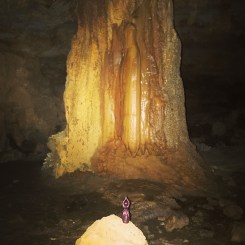
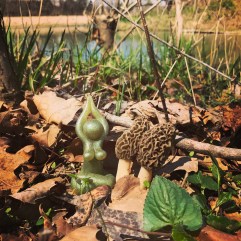 about two weeks in Missouri each spring and considered a delicacy by many). The afternoon suddenly becomes even more rewarding and we stoop and peer through fallen oak, sycamore, and elm leaves looking for the telltale conical form of these forest treats. We quickly discover that we must tune in and “listen” for the mushrooms, so to speak, or we’ll walk right by them, none the wiser. The moment I start thinking about anything else, I stop finding any. Once I settle into my body and the moment and really look at the world again, there another morel will be.
 Molly has been “gathering the women” to circle, sing, celebrate, and share since 2008. She plans and facilitates women’s circles, seasonal retreats and rituals, mother-daughter circles, family ceremonies, and red tent circles in rural Missouri and teaches online courses in
  It is, I think, quite common knowledge that most Jewish holidays relate to the seasonal cycles of the Earth. Sukkot celebrates the fall harvest. Chanukah sheds light on the winter darkness. Tu B’Shevat marks the end of the dry season and so begin the prayers for rain in Israel. For Purim, we throw off our winter doldrums and let off a little steam to settle our cabin fever. Pesach is no exception: welcome spring: birth, renewal and even creation. The leaves return to the trees, baby animals are born, flowers bloom, warmer weather arrives and somehow the possibilities of the coming summer are endless.
 “Deep in their roots, all flowers keep the light.” – Theodore Roethke
 In my garden blooming with native wildflowers, in nearby rivers and woods, across the New England landscape, the Earth is healing Herself. Two centuries ago, New England’s forests had been cleared for farms; myriad species of animals, birds, fish, and plants had disappeared; the network of waterways had been dammed to make power for mills.
 There is some very helpful guidance in the Qur’an for how we should and should not treat the earth. In my exploration of Qur’anic verse
 El Presidente was enlarging his war against his citizens. This meant the roads were more crowded than before with refugees fleeing the capital city for safety among the farmers on the plains and up in the hills. Some of these refugees arrived, of course, at the farm of the wicked witch.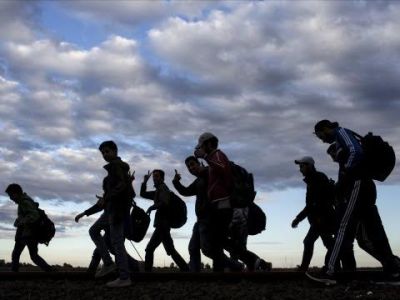
 I have been thinking about deserts lately, what places are desired, which ones are deserted, and by whom. Cabo de Gata of Andalusia is one of the four deserts in Spain. In 2010, it became public knowledge that the Ministry of Development planned to locate a nuclear waste dump there. The last I have heard was that they had ordered a feasibility survey with nuclear scientists, but I can find no other updates. Why would the government and academic institutions penetrate a protected region, sacred for its ecological richness and beauty? The dump would be created 1,000 meters below the surface where the radiation would be dissolved (so they said) and then carried into the sea. Whether we hide waste inside the earth or shoot it up into space or keep it in someone else’s backyard, when will we pause?
 Magnitude 5.2 earthquake Feb 6, 5:51 AM I awake to the sound of the windows and shutters rattling and the bed moving up and down beneath me for a few seconds.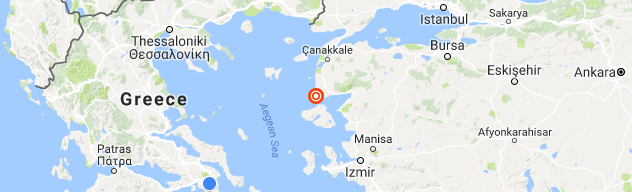
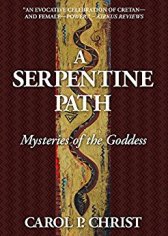
 using handspun wool yarn until the yarn releases, taking our burdens with them. Suddenly, we hear the sound of tires on the gravel. Slamming doors. The sound of loud men’s voices. The smell of cigarette smoke. A ripple of uncertainty passes through us. We are once again tentative and we feel a current of unease. What should we do? we whisper to one another. The voices draw nearer, there are calls and hoots. My friend looks at me and says: this is where we make our stand. We hold hands in a line at the edge of the cave roof, gazing out into the horizon. A hawk wheels overhead. We sing. The approaching voices quiet. We sing louder.
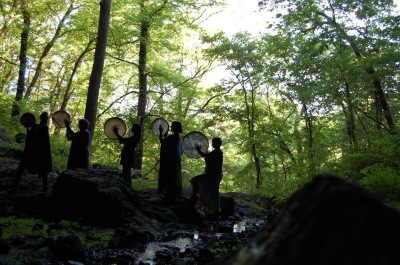 carvings of priestesses carrying drums as, “women carrying cakes to their husbands.”
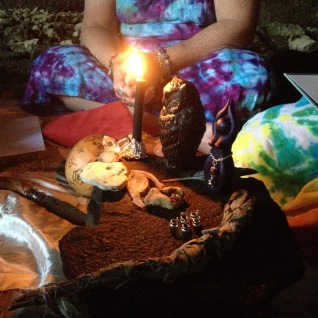 within which women try out what they want the macrocosm, the ‘big universe’ or real world to be. Within the safety and protected space of the cast circle, women create their idea of what the world would be like to live in under matriarchal/Goddess women’s values…The woman who in the safety of the cast circle designs the world as she would like it to be takes that memory of creation and success out into daily life…By empowering women through the microcosm of the ritual’s cast circle, change becomes possible in the macrocosm real world.” (p. 2-3)
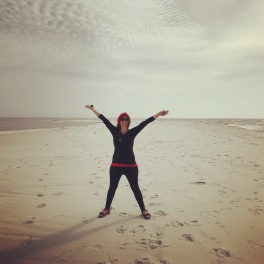 Molly has been “gathering the women” to circle, sing, celebrate, and share since 2008. She plans and facilitates
 Feminism and Religion