

 It seems like there is a perpetual debate over acquiring land for progress and growth versus the protection of land that has ties to religion, customs, and cultures. The history of America is littered with stories and events that deal with acquisition of land. The sake of growth, expansion, and progress takes precedence in the history of America. Our country’s geography is a road map of acquired land and the pushing aside sacrality.
Category: Earth-based spirituality
Dionysian Rites by Carol P. Christ
 In today’s blog, I offer an excerpt from A Serpentine Path: Mysteries of the Goddess. The setting is Zaros, Crete, the time of year is mid-October.
We had a scrumptious dinner of fresh fish, salad, fried potatoes, local amber-colored wine, and tiny olives. Later the two waiters, Themis and Nikos, bearing another pitcher of wine, sat down at our table.
They told us they were best friends and had just gotten out of the army. When they discovered that we were writers, the two young men were intrigued. “Our village has a very interesting history and many interesting customs,” they told us. “If you would like to come back and write about it, we will introduce you to all of the old people.” This conversation was in Greek, but I translated for Naomi. “This must indeed be a very interesting village,” I said to her, “because when they learn that I am a writer, most Greek men will say ‘write about me, I have a very interesting story.’ These men, in contrast, want us to write about their village.”
When we finished our wine, the young men offered to give us a lift back to our hotel on their motorbikes, suggesting we could have a coffee at the hotel bar. When we got to the hotel, they didn’t stop. “What happened?” I asked. “The bar wasn’t open at the hotel, so we’re looking for another place.” I wondered what Naomi, perched on the back of a motorbike and unable to speak Greek, must be thinking—especially since she was afraid of the unknown. We drove through the town and turned down a dirt road, arriving at the Zaros water factory. “We wanted to show you this,” they said sheepishly. “People drink our water all over Crete.” “O.K., “Naomi said, “but then you must take us back.” There were a few workers on the night shift, and the boys told us they had worked there too, before going into the army.
 Leaving the factory, we continued down the dirt road heading away from the town. “Where are we going?” I asked, wondering what we had gotten ourselves into. “Just a minute,” Themis said, as he got off the bike in front of what looked like a small house in the middle of nowhere. “We need to go back,” Naomi said definitively. “Yes, I already said that,” I answered. “Come inside,” Themis beckoned. “We want to show you how they make the raki (the colorless alcoholic drink that had been offered to us in shot glasses us after meals). This is the still,” he continued, as he showed us into a small dark room with a glowing fire. “After the wine is pressed, they put the skins and stems into barrels like those you see in the corner. The mixture takes six weeks to ferment, and then they bring it to a still, where it is heated over a fire. The steam that rises is directed through long curved pipes, and comes out as raki,” he said, pointing to various parts of the mechanism. Continue reading “Dionysian Rites by Carol P. Christ”
Mysteries by Carol P. Christ
 Savor an excerpt from A Serpentine Path: Mysteries of the Goddess:
Finding ourselves together in Crete after attending a conference, four friends and I set out to visit the caves of Eilitheia in Amnissos and Agia Paraskevi in Skoteino. As we drove along the coast toward Amnissos, I recalled that caves have been understood as sacred from the dawn of religion. When people knew the earth as their mother, the cave, the opening in the earth was her vagina and womb, the passageway to her deepest mysteries, the secrets of birth and rebirth.
 The Eilitheia Cave is in the hills above the ancient port of Amnissos. We arrived in the morning, accompanied by the guard who came with us to unlock the gate. The cave has one large, long room, with a wide mouth, and a low ceiling. There is a belly stone near the entrance that women rubbed to insure conception. Near the center of the cave, in shadowy darkness, are two stalagmites, one squat and the other tall, surrounded by the remains of ancient walls that enclosed the sacred space. The guard told us that they were worshipped as the Mother, seated, and the Daughter, standing. Their heads were chopped off with the blow of an ax. In the back of the cave there are small pools of water, used for healing
 As our eyes adjusted to the darkness, we felt that we too had entered into the womb of the Mother. Naomi sat by the Daughter stalagmite, while I leaned against the Mother. We chanted to Her and sang, aware of the bemused but accepting presence of the guard, who retreated to the entrance of the cave. As we turned to leave, Mara crouched at the cave’s entrance to take a picture, her short, full body the image of the Mother Goddess, her wispy blonde hair capturing the light, crowning her like a halo. Slowly, we emerged from the cool depths, the place of ancient mysteries, into the light and warmth of the midday sun.
We visited the Skoteino Cave late in the day, after lunch and a refreshing swim in the sea. To reach the cave, we ascended into the mountains, passed through the small village of Skoteino, and turned right down a dirt road. Above the cave is a small church dedicated to Agia Paraskevi, the patron saint of eyesight. I had been to the cave eleven years earlier with my husband, Roger, on the saint’s name day, July 26th. That day the locals celebrated first in the church, where they decorated the icon of Agia Paraskevi with flowers and lit candles, and then in the cave, where they roasted lamb, sang, and danced. It is likely that this cave has a continuity of worship from ancient times to the present day.
The first time I visited the cave of Skoteino, which means dark, I thought it was a single, huge, high-ceilinged, cathedral-like room, adorned with stalagmites and stalactites. In the meantime, I had learned that beyond the first room, there are three more levels, the final one, totally dark. Mardy offered to lead the way. Two young German men, emerging from the depths, told us the way down was not easy, as there was no clear path.
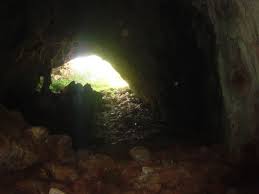 Marie, unsure of her footing, stayed near the entrance. Naomi, afraid of the unknown, perched on a rock at the back of the first room holding her candle. Mara, Mardy, and I braved the descent. We did not know what awaited us in the dark. With candles and small flashlights, we climbed and slid, sensing a way down. The rocks were cool, damp in some places, but not slippery. There were no sharp edges because the rocks had been smoothed by water. Encouraging each other we reached a place where it looked like the next descent would be though a hole or narrow opening. We still had faint light from the mouth of the cave. The final passageway was unknown, frightening, inviting. We paused, eyes fixed on the dark opening. Mardy broke the silence saying that we should turn back because the sun was about to set.
I made the ascent more rapidly than the others, my body urging me on until I reached the first level. As I walked slowly up the path that meandered through the first large room, I could see two women before me with candles, and two behind me coming up from the depths. I could almost see Persephone coming up from the underworld, torch in hand. Surely it was in a place like this that the Eleusinian Mysteries began.
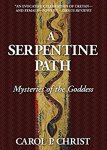 A Serpentine Path: Mysteries of the Goddess is available in kindle and paperback. Carol P. Christ leads the life-transforming Goddess Pilgrimage to Crete. Her books include: Goddess and God in the World: Conversations in Embodied Theology, written with Judith Plaskow and She Who Changes and and Rebirth of the Goddess; also with Judith Plaskow, the widely-used anthologies Womanspirit Rising and Weaving the Visions.
Updated on December 26, 2016.
Life’s a Garden by Jassy Watson
 Gardening is one of my greatest loves. The rhythm of the earth revealed in this little piece of Eden in sunny Queensland Australia, pulses in the cells of my being. Through close observation of the natural cycle of all life in my garden and atuning into the greater cosmological ebbs and flows, waxes and wanes I have come to know intimately not only this ‘outer’ space, but the inner as well.
Imagery and metaphor are effective tools for personal growth and transformation and the metaphor of gardening is a powerful way of looking at and experiencing the process of inner growth. I only need to look to my garden to see what needs tending, weeding, pruning, tilling, feeding, harvesting and composting in my life. Continue reading “Life’s a Garden by Jassy Watson”
The Great Dragon, Níðhöggr by Deanne Quarrie
 I am a student of the Northern European/Old Icelandic worldview known as Seidr. What I find particularly fascinating in my studies are not the deities but rather the creatures living on the World Tree, along with the Primordial Giants who predated the gods. One such creature is Níðhöggr, the “Derision Striker.” Níðhöggr is a great dragon who lives at the base of Yggdrasil, the World Tree. She gnaws on the roots of the tree, stimulating new growth. Her home stretches from icy Niflheim, near what is called the “Roaring Kettle”, the sacred well of all the rivers of Niflheim, all the way to Dead Man’s Shore in Helheim where she devours the piled corpses.
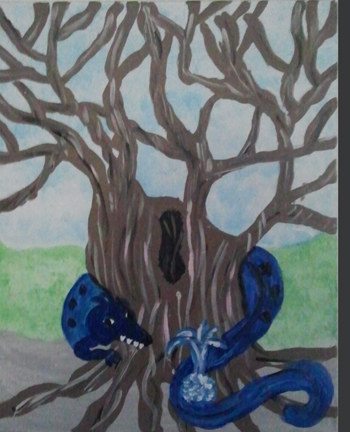 Níðhöggr embodies the principle of rot, which is that all things must decay to make room for those things that are new. It is Níðhöggr’s job to clean up the mess! She is involved in acts of undoing. She reminds us of the impermanence of life and that eventually, all that is must become undone. It is important to know this so that we can be prepared for unexpected or difficult changes in our lives.
Níðhöggr is there to devour nasty things in one’s self, both physical and emotional. She is there to take away anything that no longer serves us, as long as we are willing to give it to her. She also is there to help anyone working to clean up the environment, especially from our own pollution.
Many fear Nidhogg because of the job she must do but without this part of the life cycle there would be no cycle at all. We make every effort to hide things that are unpleasant. We flush our human waste into our water supply instead of simply giving back to the Earth where we can restore it and use it as nourishment for new life. Menstrual blood is hidden away as if somehow shameful. We hide all that is ugly or that which makes us uncomfortable. And so it is too, with creatures and characters in mythology. Somehow in our dualistic world, the lines between good and bad, negative and positive are clearly drawn. So often those things we suppress, hide and call negative are actually, what save our lives. They are the things in our basic natural spirit that propel us forward into becoming better human beings.
Níðhöggr also serves us as a moral agent, reminding us that our own cruelty, especially harmful acts that undermine another’s sense of self. Bullying behavior is a good example. She reminds us that our actions always have consequences to the energy of the whole, not just our own lives.
Her work is much like that of the vulture, a bird so ugly it is beautiful. I have always thought of vultures as the great recyclers, returning what is lifeless and no longer useful back to the Earth to make ready for new growth.
She is truly all about roots, and keeping them clean. As that, she reminds us that real strength is found in one’s roots.
In her story, at the end of days, Níðhöggr chews through a root and upends the World Tree. Clearly if this were the root upon which all else depended, the mighty tree would fall. Perhaps this would represent our own failure to clean up after ourselves, both in our own lives as well as here in this place we call home, the Earth.
Deanne Quarrie. D. Min. is a Priestess of the Goddess. She is the author of five books. She is the founder of the Apple Branch where she teaches courses in Feminist Dianic Witchcraft, Northern European Witchcraft and Druidic Shamanism. She mentors those who wish to serve others in their communities. She is also an Adjunct Professor at Ocean Seminary College and is the founder of Global Goddess, a worldwide organization open to all women who honor some form of the divine feminine.
Aine and the Giant Leap by Deanne Quarrie
For our full moon rites coming up on the first of July we will be honoring Aine, Goddess of Love, Light, and Fertility who is also Queen of the Faeries. Aine’s name means “Bright” and She is typically honored at the Summer Solstice when the sun is at its peak of power. The next full moon falls just after the Summer Solstice. The Solstice is associated with abundance, beauty and bounty. It is not necessarily about the harvest season, as that is yet to come. However, everywhere we look we can see the abundance of the Mother and so it is when we first acknowledge, with joy, what is before us.
In my Tradition, the Summer Solstice falls within the Oak Moon, the Moon in which we “court the lightning bolt.” What that means to us is that with our roots planted firmly in the ground, as does the Oak tree, now is the time to take all of our plans and put them into action. “Go for it” is what we are saying to ourselves and to the world. Continue reading “Aine and the Giant Leap by Deanne Quarrie”
Stoneflower by Molly
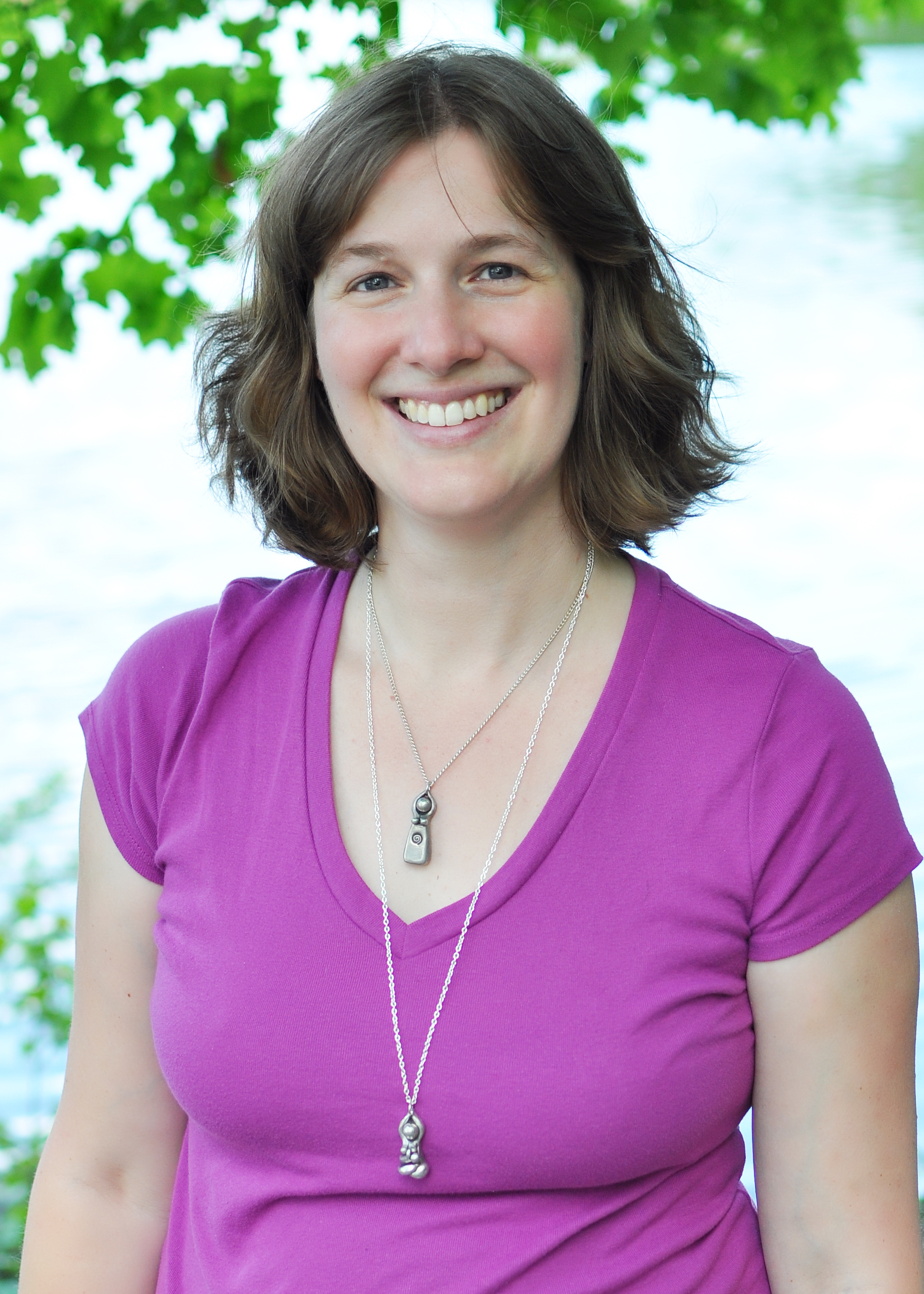
Like flower growing from rock
the world is full of tiny, perfect mysteries.
Secrets of heart and soul and landscape
guarded tenderly
taking root in hard crevices
stretching forth
in impossible silence.
Sleeping
resting
waiting
watching
knowing
that all one needs
is a crack in stone
and a seed of possibility…
One spring evening during my year-long woodspriestess experiment , I went for a walk through the woods with my husband and daughter and we discovered something that delighted and thrilled me. It was rock with a small, perfect flower growing out of it and it was a powerful symbol of what I learned from my time in the woods. Continue reading “Stoneflower by Molly”
‘Anjea’ – A Prayer in Paint for the the Protection of this Ancient Sacred Land by Jassy Watson
 ANJEA is an Australian Aboriginal fertility Goddess. She is an animistic spirit known to the tribesman of the Pennefather River, Queensland, Australia that is located on the Western Cape York Peninsula.
Not much is known about this Goddess or spirit. I happened to come across her when researching Australian Aboriginal Mother Earth Goddesses. I followed up with numerous inquiries including a member of our local indigenous community and spoke to a curator at an Aboriginal art gallery, and no one had heard of her. Continue reading “‘Anjea’ – A Prayer in Paint for the the Protection of this Ancient Sacred Land by Jassy Watson”
Restored in Beauty by Carol P. Christ
 The path leading to the Klapados Waterfall begins at the edge of an open meadow in the pine and oak woodlands of a mountain in the island of Lesbos. After driving several miles on a very rutted dirt track, we parked under an oak tree, crossed the meadow and scrambled down a winding path. After about 20 minutes, it ended at a stream surrounded by plane trees. From there, we climbed over rocks to reach a pool created by the seasonal waterfall.
 On the day we visited it, the waterfall was only a trickle of cascading drops that moistened its moss-covered path to the pool. The roots of a plane tree growing at the top of cliff followed the path of the water, weaving a web over the rockface all the way down to the pool.
Sitting on a rock at the edge of the pool I realized that the cliffs that embraced it on three sides were the remains of a crater formed twenty million (or so) years ago when a finger of molten lava pushed its way through the earth, exploding in clouds of dust and projectile rocks.
In Lesbos the volcanic activity came not from a single source–for example, from the highest mountain. Rather, like the plane trees in whose shade we rested, the volcano’s trunk with roots in the molten lava of the earth’s core, had many branches from which it erupted at different times. Huge boulders thrown out in the explosions can be seen in the meadows, while the trees in the forest curve their roots around them to reach the soil. The mountain was also shaped by the settling of volcanic dust that crumbles again into tiny fragments when exposed.
 As I was thinking of all of this my friend Cristina climbed over the roots of the plane trees that surrounded the pool, removed her clothes, and slipped into the water. Soon I followed her. We sensed that we were in a sacred place, and as we have done rituals together many times before, our ritual emerged spontaneously: it almost seemed as if our minds and bodies were moving as one.
We renewed ourselves in beauty, submerging our bodies under the water three times, while floating in the embrace of the pool, gazing up at the rock formations, admiring trees that looked like dancing women, moss that looked like pubic hair, and blue black damselflies that all together had created a most beautiful place that called to something deep within us on that day.
Later we would sing the English version of the song of the Navajo Beautyway:
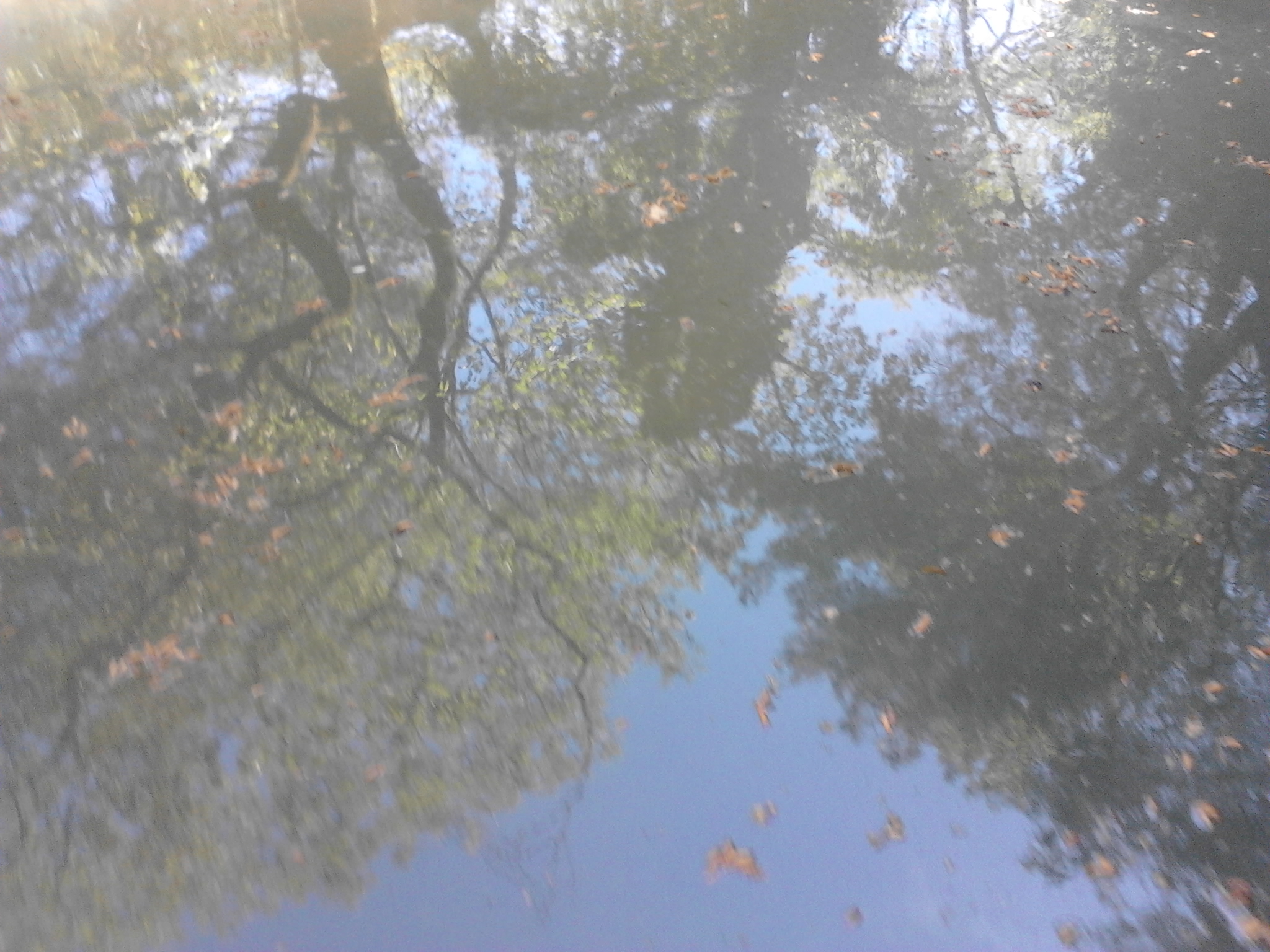
I walk with beauty before me.
I walk with beauty behind me.
I walk with beauty all around me.
As I walk the beauty way.
I walk with beauty above me.
I walk with beauty below me.
I walk with beauty inside me.
As I walk the beauty way.
We are the creative process of life.
We are restored in beauty.
Blessed be!
Carol leads the life-transforming Goddess Pilgrimage to Crete (facebook and twitter). Carol’s books include She Who Changes and and Rebirth of the Goddess; with Judith Plaskow, the widely-used anthologies Womanspirit Rising and Weaving the Visions and forthcoming next year, Goddess and God in the World: Conversations in Embodied Theology. Explore Carol’s writing.
Take Only What You Need and Give Away: Fundamental Principles of Sustainability Ethics
 Why is it so important to take only what we really need? Because everything we take harms another life. I included this Native American teaching as one of the Nine Touchstones I offered as a counterpoint to the Ten Commandments in Rebirth of the Goddess.
Recently, I have begun to realize that the concept of taking only what you need is the heart* of sustainability ethics, an ethical system that can orient us to living in harmony with others and the natural world. The practice of great generosity is its counterpoint. When you have worked for, received, or accumulated more than you need, you should give it away.
The reason these principles are important is because “taking what you need” is “taking” from the web of life. We “take” other lives (whether plants or animals) in order to eat, to clothe ourselves, to build houses, and in agricultural societies to clear land to plant, to remove unwanted plants (weeds) from cultivated land. In our industrial age, we “take” so much more to fuel our cars and to provide electricity. To take more than we need is to do unnecessary violence to the web of life. When we give away what we don’t need we help others to survive, and we also help to ensure that no more lives than necessary are taken.
On the first Goddess Pilgrimage to Crete, we decided to incorporate the give-away as part of our closing ritual. It is nice to give and receive a gift at the end of an intense two weeks spent with other pilgrims. However, I am coming to realize that in comparison with the deeper meaning and intention of the ritual, our give-away, like the practice of giving presents in our wider culture, is superficial. When we give gifts to friends we try not to give too much or too little. When we give to children we often do so without regard to what they really need. When we receive gifts, we may feel burdened with one more thing we don’t want or need.
Being raised in acquisitive and throw-away cultures, it is not surprising that few of us have any real idea what the principles of taking only what you need and giving away mean. In traditional cultures, there are constraints on accumulation. If women in your family had to weave and sew and embroider all of your clothing, and if this process was time-consuming and involved time taken from other tasks, you would not be likely to have been given or to have learned to demand more clothes than you really need. Similarly, if all of the food for a clan is produced by its own labor, people would be unlikely to grow more than they needed to eat and store for the winter.
I suspect that all of this changed when wars of conquest became integrated into social structures. When other groups were conquered, their precious goods, including ritual items and ritual clothing and jewelry, were appropriated by the victors as “the spoils of war.” Land and people too were “the spoils of war,” and with the introduction of slave labor and the acquisition of lands that belonged to others, an excess of everything could be produced for the benefit of the ruling class, or to be more accurate, the war lords. This is another story, and I have discussed it elsewhere.
To return to the question at hand, I am suggesting that if we wish to live sustainably on planet earth, we must return to the values of our ancestors, distant and not so distant, who practiced taking what you need and sharing what you don’t need. These values are not the exclusive property of Native Americans, but are the values of the ancestors of all of us, if we go back far enough. As I have discussed, these values are still practiced in rural Crete. And they are the foundation of living matriarchal cultures. Many of us who have traveled have met people in rural cultures who have little, yet seem happier than anyone we know at home.
At some level we know that accumulating things does not make us happy. At the same time, prodded by advertising, we continue to shop compulsively and to buy things we don’t need. It will not be an easy task to change our patterns of consumption. If we could do so, our economic system would collapse, because it is based on creating needs for more and more things. This is why chosen or forced “austerity” threatens the capitalist system. You and I may not need all of the things we are used to buying, but if large numbers of us stop spending, the makers and sellers of goods suffer. On the other hand, the world will not survive if we carry on as we are, because we are depleting the world’s resources.

What would happen if each of us, like the subjects on the popular reality programs on hoarding, went through each of the rooms of our homes and designated the things we really need and gave the rest away? What if we then took a good look at our homes and asked if we really need the space we have. I presume this would be a long term process in which we would continually discover that we don’t need things we have always thought we could not live without.

What if we stopped buying what we do not need and gave a large portion of our income and savings to others? Would we discover what it means to live in harmony with others and the whole web of life? Could we learn how to flourish with others, not at the expense of others?
*I am not saying these are the only ethical touchstones we need to build an ethics of sustainability, but I do believe they are at its center.
Carol leads the life-transforming Goddess Pilgrimage to Crete (facebook and twitter). Carol’s books include She Who Changes and and Rebirth of the Goddess; with Judith Plaskow, the widely-used anthologies Womanspirit Rising and Weaving the Visions and forthcoming next year, Goddess and God in the World: Conversations in Embodied Theology. Explore Carol’s writing.
 Feminism and Religion