Tree of Life: The Festival of the Trees in an Age of Treefall by Jill Hammer

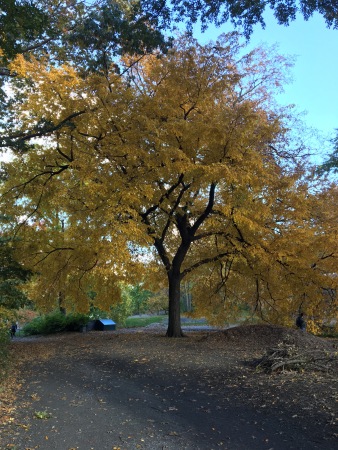
Almost every day, I walk in Central Park.  There are certain trees there I’ve come to know: the gnarled cherry trees by the reservoir, the bending willows and tall bald cypress by the pond, the sycamores that drop their bark each summer, the hawthorn not far from Central Park West.  Lately I’ve been taking photos of the trees to try to capture their essence, their posture in the world.  The trees around me feel like friends, which is what an ancient midrash (interpretation/legend) called Genesis Rabbah says about trees: that they are friends to humankind.  To me, they’ve always been a central manifestation of Mother Earth.

Currently, the national parks in the United States have no staff because of the government shutdown. Some people have taken the opportunity to cut down the rare and endangered Joshua trees in the Joshua Tree National Park—just for fun, I guess, or as a trophy of some kind.  Meanwhile, President Bolsonaro of Brazil recently has indicted that he wants to remove protection for the rainforest, in order to allow development.  It appears that my friends the trees have enemies.  Sometimes the enmity is for personal/corporate gain, and sometimes the enmity seems to have no reason at all.

Continue reading “Tree of Life: The Festival of the Trees in an Age of Treefall by Jill Hammer”

When “The Storm Left No Flowers” – A Review by Sara Wright

During the last year I have been struggling with the  catastrophic effects of Climate Change like never before as I witness the continuation of a drought that is withering plants, starving tree roots, shriveling our wildflowers and wild grasses, leaving our mountains barren of snow, and changing the face of the high desert for the foreseeable future. With forest fires leaving me literally breathless from plumes of thick smoke that turn the sun into a ball of orange flames at dawn, unable to cope with 100 plus degree heat, my body forces me to surrender: I will not be able to make my permanent home here. Instead I will migrate like the birds do – from south to north and back again.
Coming to terms with the ravages of Climate Change  brought me to my knees; it has been one of the most difficult adjustments I have ever had to make. I mourn the death of the trees, plants, the loss of precious frogs and toads, insects, birds, lizards – every plant and creature is under attack and few of us can thrive (let alone survive) in such an unforgiving climate. Continue reading “When “The Storm Left No Flowers” – A Review by Sara Wright”

Crow and The Pornographic Gaze by Sara Wright

Once she believed that
it was her fault
they came on to her,
that she owed them
something
They owned her?
Secretly the
girl was pleased
because any kind of attention
was better than none,
or being so “different” –
stitched into an Indian skin.

She was a pretty shell,
an abandoned spiral
worn down by waves –
assaulted from within
by the pornographic gaze.
How she hated being young. Continue reading “Crow and The Pornographic Gaze by Sara Wright”

We Might Need to Die by Tallessyn Zawn Grenfell-Lee

Last week was the first week of Advent – in my tradition, the week of lighting a candle for Hope. This year has felt uniquely intense as I enter into Advent. Hope, even as headline after headline continues to warn us of the climate crisis. Just this past week alone – the week of Hope – we read:

EPA Rolls Back Coal Rule Despite Climate Change Warnings (CNN)
Greenhouse Gas Emissions Accelerate Like a ‘Speeding Freight Train’ in 2018 (NY Times)
Climate Change and Marine Mass Extinction (Science Magazine)
David Attenborough Warns Of ‘Collapse Of Civilizations’ At U.N. Climate Meeting (NPR)
The Climate Apocalypse is Now, and it’s Happening to You (Wired)

Hope? In the midst of literally the greatest crisis in the history of the planet? We are facing alarmingly strong odds of annihilation. Hope? Hope for what?

Continue reading “We Might Need to Die by Tallessyn Zawn Grenfell-Lee”

Broken Pot by Sara Wright

When Emmy handed me the pot I held it gently in my palm, marveling over its rounded shape, the warm earth tones, the sparkling mica speckled through the smooth clay.

“It’s broken,” she said simply as I turned the small pot in my hands, laying my cheek again her soft skin. How did she manage to stretch the clay that thin?

“I think it’s beautiful just as it is,” I responded gazing at the lines where the clay had cracked in the fire – almost as if it was meant to be this way.” I peered inside the neck of the bowl to see two pieces of broken lip nestled in the bottom, two sisters asleep in the arms of their mother. Continue reading “Broken Pot by Sara Wright”

We Have 12 Years. Luckily, Climate Lovers Are Usually Feminist by Tallessyn Grenfell-Lee

Climate scientists have been screaming the alarm for literally decades. Despite global efforts, they now say we have 12 years left to contain the damage: the difference between 1.5°C and 2°C warming means tens of millions of lives lost, not to mention the death of all coral reefs and half the world’s plants and insects. In the USA, our oligarchic, oil-funded government seems determined to drive our country off a cliff and take the rest of the world with us. What on this good, green Earth are we to do?

I have been thinking about this a while. Below is a seven-fold strategy that I pray may bring help, comfort, and inspiration to those who, like me, can feel utterly overwhelmed.

Face Reality

It astonishes me to have to include this, but so much money has poured into distractions and strategies to discredit climatology that we must still spread the word. We now know which approaches actually bring people along; a little bit of doom and gloom goes a very long way. Focus on empowerment, action, and most importantly, connection: how do climate issues affect people directly? How do they intersect with issues people already care about? (Hint: the climate affects all life and every place on Earth!) Continue reading “We Have 12 Years. Luckily, Climate Lovers Are Usually Feminist by Tallessyn Grenfell-Lee”

EcoJustice and Our Relationship with God by Gina Messina

Version 2This semester I am teaching the course EcoJustice and chose Sallie McFague’s A New Climate for Theology as our foundational text. Something I greatly appreciate about McFague is that she continually calls us to radically redefine our understanding of the Divine and of our roles as human beings — fundamental questions that could easily lead to an existential crisis as one student reminded me. 

My class and I ponder these questions, discussing our own interpretations of God, why we exist, what it means to pray, and understandings of salvation. Not surprisingly, many of us have an anthropocentric theology — one that puts ourselves at the center. We are so focused on what we need from God, we forget to ask what God needs from us.  Continue reading “EcoJustice and Our Relationship with God by Gina Messina”

A Prophet in Our Midst: Vandana Shiva by Carol P. Christ

She is not crying in the wilderness. She is not railing in the streets.


She sits quietly and speaks softly and with absolute clarity and certainty.

To let all the water systems and food systems and planetary climate systems get destroyed. That is the stupidity which rules us today.

No fire and brimstone, no angry God.

I do not think the planet will die. I think the earth is too powerful.

A simple truth.

We need to protect our home.

Men have lost the way.

Going to war and killing was considered important. Making profits at the cost of others was considered important.

Women must lead.

The values we need are in the knowledge of how to live with nature. That’s what women’s knowledge is. We need knowledge of how to care. That’s knowledge: it’s … called emotional intelligence now. We need knowledge of how to share.

We are part of the earth.

Working with our hands is not a degradation.

Could it really be as simple as that?

Some gender scholars will protest. “This is essentialism,” they will say. “This will keep women in the home where they have always been,” they will say.

If they say this, they will miss the point. This is not gender essentialism. The situation Shiva describes is a product of history. A history in which powerful men determined that war, killing, and profit are the highest values. It may or may not be in women’s nature to know how to live with nature, to care, and to share. These values are part of “women’s knowledge”* because they derive from the work women have been doing while men were making war and making profit on the backs of others.

Shiva is not telling women to stay in the home. She is telling women to confront “deceitful, dishonest, brutal power.”  She is telling women to teach those who rule the world how to live with nature, how to share, how to care.

If women are can teach what they know, how to live with nature, how to care, how to share, women’s knowledge will become human knowledge once again and we may be able to save our home.

If not,

. . . we are dispensable. She’ll find a way.

A prophet is speaking. listen to her words. Etch them on your heart. And save the world.

*Shiva has stated that women do most of the farming in the world. Women who are not farmers care and share and may tend gardens. Women’s knowledge is a relative term. Some women in industrialized countries place ambition, competiton, and profit above caring and sharing. Even in this situation, women generally care for children. See Shiva’s Staying Alive: Women, Ecology, and Development.

Carol P. Christ is an internationally known feminist writer, activist, and educator currently living in Lasithi Prefecture, Crete. Carol’s recent book written with Judith Plaskow, Goddess and God in the World: Conversations in Embodied Theology, is on Amazon. A Serpentine Path: Mysteries of the Goddess is on sale for $9.99 on Amazon. Carol  has been leading Goddess Pilgrimage to Crete for over twenty years: join her in Crete. Carol’s photo by Michael Bakas. Carol will be speaking at the 25th Anniversary Celebration of the Re-Imagining Conference at Hamline University in St. Paul Minnesota on November 1 and 3 and at the Parliament of World Religions in Toronto, Canada on November 5.

Please, Let’s Give Feminists a Break by Sara Wright

Please, Let’s Give Feminists a Break.

I remember so vividly entering graduate school in my early forties and being told I was an “eco – feminist” by my professors. What does that phrase mean I asked having no relationship that I knew of to feminism. Feminists, I thought vaguely, naively, even stupidly, burned bras and hated men…

I was asked to read “Woman and Nature; The Roaring Inside Her” by Susan Griffin to help me see who I was, and after finishing this one book I submerged myself in feminist writings like a starved woman – child. My teachers were right. I was a feminist – an eco –feminist because I had already made the connection between what was happening to the Earth and what had happened to me. Every tree that was chopped down was a part of me, every stream that was polluted was a part of me, every animal that was slaughtered was a part of me because I was a part of Nature. I owed my life to Nature, the only mother I had ever had. I loved Her, honored her, became her fierce advocate and in the process She eventually taught me to love myself.

Continue reading “Please, Let’s Give Feminists a Break by Sara Wright”

Stories the Stones Tell by Sara Wright

A couple of days ago I was climbing a mesa with my friend Iren who is “a guide to the wild places” – those places off the beaten track where stories are told by the stones and the Earth that supports them.

As a severely directionally dyslexic person who cannot tell her left from right navigating this hidden world would be impossible without Iren’s deep knowledge of this land, her expertise, her extraordinary sensitivity and her love for Nature. No words can ever express my gratitude for this friendship without which I would feel bereft.

As we climbed through mountains of human garbage and four wheeler tracks we discovered potsherds at our feet. Picking up the predominantly black and white pieces for inspection I found myself wondering about the women (and children) who gathered the clay, shaped it into pots, and fired the vessels to store food. There are so many untold women’s stories hidden in these clay fragments… Continue reading “Stories the Stones Tell by Sara Wright”