Last week was the first week of Advent – in my tradition, the week of lighting a candle for Hope. This year has felt uniquely intense as I enter into Advent. Hope, even as headline after headline continues to warn us of the climate crisis. Just this past week alone – the week of Hope – we read:
EPA Rolls Back Coal Rule Despite Climate Change Warnings (CNN) Greenhouse Gas Emissions Accelerate Like a ‘Speeding Freight Train’ in 2018 (NY Times) Climate Change and Marine Mass Extinction (Science Magazine) David Attenborough Warns Of ‘Collapse Of Civilizations’ At U.N. Climate Meeting (NPR) The Climate Apocalypse is Now, and it’s Happening to You (Wired)
Hope? In the midst of literally the greatest crisis in the history of the planet? We are facing alarmingly strong odds of annihilation. Hope? Hope for what?
When Emmy handed me the pot I held it gently in my palm, marveling over its rounded shape, the warm earth tones, the sparkling mica speckled through the smooth clay.
“It’s broken,” she said simply as I turned the small pot in my hands, laying my cheek again her soft skin. How did she manage to stretch the clay that thin?
“I think it’s beautiful just as it is,” I responded gazing at the lines where the clay had cracked in the fire – almost as if it was meant to be this way.” I peered inside the neck of the bowl to see two pieces of broken lip nestled in the bottom, two sisters asleep in the arms of their mother.Continue reading “Broken Pot by Sara Wright”
Climate scientists have been screaming the alarm for literally decades. Despite global efforts, they now say we have 12 years left to contain the damage: the difference between 1.5°C and 2°C warming means tens of millions of lives lost, not to mention the death of all coral reefs and half the world’s plants and insects. In the USA, our oligarchic, oil-funded government seems determined to drive our country off a cliff and take the rest of the world with us. What on this good, green Earth are we to do?
I have been thinking about this a while. Below is a seven-fold strategy that I pray may bring help, comfort, and inspiration to those who, like me, can feel utterly overwhelmed.
Face Reality
It astonishes me to have to include this, but so much money has poured into distractions and strategies to discredit climatology that we must still spread the word. We now know which approaches actually bring people along; a little bit of doom and gloom goes a very long way. Focus on empowerment, action, and most importantly, connection: how do climate issues affect people directly? How do they intersect with issues people already care about? (Hint: the climate affects all life and every place on Earth!) Continue reading “We Have 12 Years. Luckily, Climate Lovers Are Usually Feminist by Tallessyn Grenfell-Lee”
This semester I am teaching the course EcoJustice and chose Sallie McFague’s A New Climate for Theologyas our foundational text. Something I greatly appreciate about McFague is that she continually calls us to radically redefine our understanding of the Divine and of our roles as human beings — fundamental questions that could easily lead to an existential crisis as one student reminded me.
My class and I ponder these questions, discussing our own interpretations of God, why we exist, what it means to pray, and understandings of salvation. Not surprisingly, many of us have an anthropocentric theology — one that puts ourselves at the center. We are so focused on what we need from God, we forget to ask what God needs from us.Continue reading “EcoJustice and Our Relationship with God by Gina Messina”
She is not crying in the wilderness. She is not railing in the streets.
She sits quietly and speaks softly and with absolute clarity and certainty.
To let all the water systems and food systems and planetary climate systems get destroyed. That is the stupidity which rules us today.
No fire and brimstone, no angry God.
I do not think the planet will die. I think the earth is too powerful.
A simple truth.
We need to protect our home.
Men have lost the way.
Going to war and killing was considered important. Making profits at the cost of others was considered important.
Women must lead.
The values we need are in the knowledge of how to live with nature. That’s what women’s knowledge is. We need knowledge of how to care. That’s knowledge: it’s … called emotional intelligence now. We need knowledge of how to share.
We are part of the earth.
Working with our hands is not a degradation.
Could it really be as simple as that?
Some gender scholars will protest. “This is essentialism,” they will say. “This will keep women in the home where they have always been,” they will say.
If they say this, they will miss the point. This is not gender essentialism. The situation Shiva describes is a product of history. A history in which powerful men determined that war, killing, and profit are the highest values. It may or may not be in women’s nature to know how to live with nature, to care, and to share. These values are part of “women’s knowledge”* because they derive from the work women have been doing while men were making war and making profit on the backs of others.
Shiva is not telling women to stay in the home. She is telling women to confront “deceitful, dishonest, brutal power.” She is telling women to teach those who rule the world how to live with nature, how to share, how to care.
If women are can teach what they know, how to live with nature, how to care, how to share, women’s knowledge will become human knowledge once again and we may be able to save our home.
If not,
. . . we are dispensable. She’ll find a way.
A prophet is speaking. listen to her words. Etch them on your heart. And save the world.
*Shiva has stated that women do most of the farming in the world. Women who are not farmers care and share and may tend gardens. Women’s knowledge is a relative term. Some women in industrialized countries place ambition, competiton, and profit above caring and sharing. Even in this situation, women generally care for children. See Shiva’s Staying Alive: Women, Ecology, and Development.
I remember so vividly entering graduate school in my early forties and being told I was an “eco – feminist” by my professors. What does that phrase mean I asked having no relationship that I knew of to feminism. Feminists, I thought vaguely, naively, even stupidly, burned bras and hated men…
I was asked to read “Woman and Nature; The Roaring Inside Her” by Susan Griffin to help me see who I was, and after finishing this one book I submerged myself in feminist writings like a starved woman – child. My teachers were right. I was a feminist – an eco –feminist because I had already made the connection between what was happening to the Earth and what had happened to me. Every tree that was chopped down was a part of me, every stream that was polluted was a part of me, every animal that was slaughtered was a part of me because I was a part of Nature. I owed my life to Nature, the only mother I had ever had. I loved Her, honored her, became her fierce advocate and in the process She eventually taught me to love myself.
A couple of days ago I was climbing a mesa with my friend Iren who is “a guide to the wild places” – those places off the beaten track where stories are told by the stones and the Earth that supports them.
As a severely directionally dyslexic person who cannot tell her left from right navigating this hidden world would be impossible without Iren’s deep knowledge of this land, her expertise, her extraordinary sensitivity and her love for Nature. No words can ever express my gratitude for this friendship without which I would feel bereft.
As we climbed through mountains of human garbage and four wheeler tracks we discovered potsherds at our feet. Picking up the predominantly black and white pieces for inspection I found myself wondering about the women (and children) who gathered the clay, shaped it into pots, and fired the vessels to store food. There are so many untold women’s stories hidden in these clay fragments…Continue reading “Stories the Stones Tell by Sara Wright”
For millennia, humans have told stories of goddesses who have decreed that, because terrible crimes have been committed against their female loved ones or those under their protection, our world would become a desolate wasteland. They withdrew their spiritual power that made life possible so that no fruits or vegetables would grow to nourish us or no sunlight would warm our bodies. Only when justice was done did these goddesses heal the wasteland so human life could continue.
In ancient Greece, the youthful daughter Persephone was kidnapped from her idyllic wildflower meadow to the Underworld by Hades. Her mother, the great Earth goddess Demeter, wandered the world in great despair seeking her daughter while the crops withered and the people starved. Only when Persephone was returned to live on the Earth was it again abundant. Amaterasu, the Shinto Sun Goddess, hid her life-giving light when she was angered by her brother’s desecration of her queendom that resulted in a friend’s death. Finally, when her brother was banished from heaven and she was lured from her cave and saw her sacredness and beauty in a mirror, the sun’s rays nourished the Earth once more. You may know of more stories from your own tradition.
On February 20, 2018, the Greek government issued a Presidential Decree mandating the formation of government bodies to monitor and protect the more than four hundred bird and wildlife habitats in Greece designated as part of the European law Natura 2000. This decision came after decades of government inaction regarding the enforcement of the Natura law it accepted as part of its entrance into the European Union.
Whether the Presidential Decree will result in protection on the ground remains to be seen, but it is an important step in the right direction. The Presidential Decree was issued after years of negotiations initiated by the European Commission to compel the Greek government to comply with the law. A Complaint to the European Commission regarding failure to protect the Natura wetlands of Lesbos on which I was the first author formed part of the basis of these negotiations.
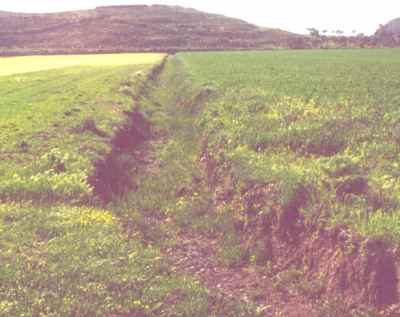
a ditch drains a wetland to produce agricultural land
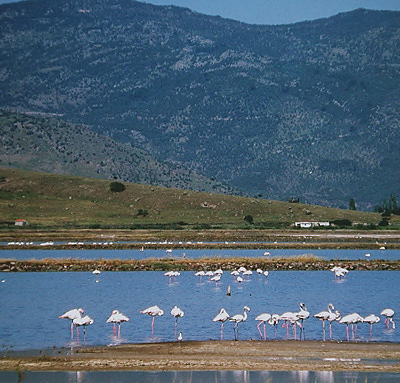
Almost as soon as I became a birdwatcher in 1999, I began to notice the degradation of bird habitats by dumping, drainage, and building, especially in wetland areas. Wetlands are seasonal bodies of water created by winter rains that dry out in the summer heat. Generally, they are shallow, which means that they are a perfect stopping over place for migrating birds. The most common visitors to wetlands are wading birds that stand in shallow pools and puddles without immersing their bodies in the water. Lesbos, the island where I began to watch birds, has some of the most important wetlands in Europe, visited by birds migrating from Africa to Europe in the spring for rest and feeding. Because of this, Lesbos is also a destination for birdwatchers.
Wetlands are not only important for birds. In rainy periods they act as a sponge between rivers and the sea and dry land, absorbing water that otherwise could cause flooding. The devastating flood damage to New Orleans in recent years is the result of building on wetlands. Similar damage occurs regularly wherever wetlands are drained, including on the island of Lesbos.
In 2001, I wrote a petition that was signed by over 600 birdwatchers and others urging the Greek government to protect the wetlands of Lesbos. I presented it at an open meeting in May 2001 organized by the Mayor of Kalloni, Lesbos, Aris Eleftheriou, to explain the plan to protect the wetlands of Kalloni which had been funded by the European Union. Instead of being congratulated for his work and vision, the mayor was met by an angry mob. Many of the Natura wetlands are privately owned fields traditionally used for grazing sheep and goats. As local economies were transitioning to tourism, landowners did not want any restrictions placed on their ability to drain and build on their land.
flamingos are now permanent residents of Lesbos
It was in this context that John Bowers, a longtime birdwatcher in Lesbos, an environmental economist, and the first to sign my petition, formed Friends of Green Lesbos, an international internet-based group dedicated to protecting the wetlands of Lesbos that soon counted over 800 members. I became its Vice President. In 2003, Friends of Green Lesbos, in co-operation with Idatinos, a local environmental group, drafted an internet letter and petition, that was automatically sent to the Greek government every time it was signed, asking the Greek government to fulfill its legal responsibility to protect the wetlands of Lesbos. The government responded that it was required to enforce the Natura law even though no specific Greek law had been passed specifying how this was to be done. A committee in the department of building and land development in Lesbos was created and charged with the responsibility of protecting the local wetlands.
We did not understand that this committee would not be monitoring the wetlands on a regular basis, but would only respond to complaints. This was clarified at a meeting organized by World Wildlife Fund in Athens in 2005. I was then put in touch with a new local environmental group, Nautilos en drasi that was also formed to save wetlands. Together with WWF, we began to draft complaints about the degradation of individual wetlands. These complaints, numbering well over fifty, were all decided in our favor. Fines were issued, but there was no mechanism to ensure compliance. Numerous meetings with the Governor of the island resulted in promises that were not kept. We finally realized that he was more interested in currying favor with landowners and developers than in enforcing the law.
In 2008 while lecturing at a conference in Ireland, I met a Green Party member of the European Parliament who encouraged me to write a complaint to the European Commission. After six months of intense effort, I completed a formal complaint of over 100 single-spaced pages, supported by two large files of documents, detailing the government’s failure to protect the wetlands under the Natura law. It was immediately approved by Friends of Green Lesbos and Nautilos en drasi, but it took over two years for World Wildlife Fund and Hellenic Ornithological Society to revise and sign it.
The complaint was submitted to the European Commission in September 2011. After several requests for additional documentation, the Commission found Greece in violation of the Natura law in Lesbos in October 2014. In August 2016 the Commission informed us that it had made our case part of horizontal negotiations with Greece regarding its failure to protect all of its Natura sites. The February 2018 Presidential Decree is the fruit of these negotiations. It is certain that the European Commission will continue to watch the situation in Greece to ensure that the government follows through with the monitoring and protection mandated by the new law.
This has been a long and tiring and often discouraging struggle of nearly two decades and it is still ongoing, but if the end result is the protection of all of the Natura sites in Greece, it will have been well worth it.
Others involved in Natura struggles in Lesbos besides John Bowers and myself include Eleni Galinou, Michael Bakas, Costas Zorbas, and Stellios Kraonakis, and in Athens, Foteini Vrettou, George Chassiotis, and Elias Tzirtzis of World Wildlife Fund Greece, and Malamo Korbeti of Hellenic Ornithological Society.
When I raise my eyes to a bird soaring over me in flight, I am no longer bound to the Earth by gravity. I stop my round of daily tasks and widen my vision to view myself and our world from above through birds’ eyes. For just a moment, as I observe beyond my usual narrow horizon, I perceive truths about myself and others that have been hidden and grasp wisdom that has previously eluded me.
From Neolithic times onwards in cultures stretching across the globe, as described by Judith Shaw, bird-shaped goddesses have embodied life, death, rebirth, and more. More recently, as noted by Miriam Robbins Dexter, these beautiful winged beings were perceived of as monsters and flying through the air was one of the accusations made against the women persecuted as witches in the Burning Times. What greater demonstration could there be of the intense terror this powerful relationship between women and birds creates in those who demand dominion over women’s bodies and souls?



 When Emmy handed me the pot I held it gently in my palm, marveling over its rounded shape, the warm earth tones, the sparkling mica speckled through the smooth clay.
  This semester I am teaching the course EcoJustice and chose Sallie McFague’s
  Carol P. Christ
 A couple of days ago I was climbing a mesa with my friend Iren who is “a guide to the wild places” – those places off the beaten track where stories are told by the stones and the Earth that supports them.
  For millennia, humans have told stories of goddesses who have decreed that, because terrible crimes have been committed against their female loved ones or those under their protection, our world would become a desolate wasteland. They withdrew their spiritual power that made life possible so that no fruits or vegetables would grow to nourish us or no sunlight would warm our bodies. Only when justice was done did these goddesses heal the wasteland so human life could continue.
 Feminism and Religion