The scent of balsam wafts through the room as I cut the boughs to make my annual wreath to honor all trees, those that still stand, those who are slaughtered. My intention each year is twofold – acknowledge my love for these sentient beings and to participate in the unfolding of the Great Round. Other intentions vary from year to year until recently when a prayer for protection from the dark forces that permeate the psyches of so many peoples of this earth becomes a yearly part of this winter ceremony, even as a multitude of others suffer intolerable losses.
Today’s American culture creates endless non-religious festivals to celebrate the entrance into this winter season that are totally devoid of meaning beyond consumerism – buy more ‘stuff’ – chop down more trees. These devourers can never be satiated because the chasm is too wide and deep.
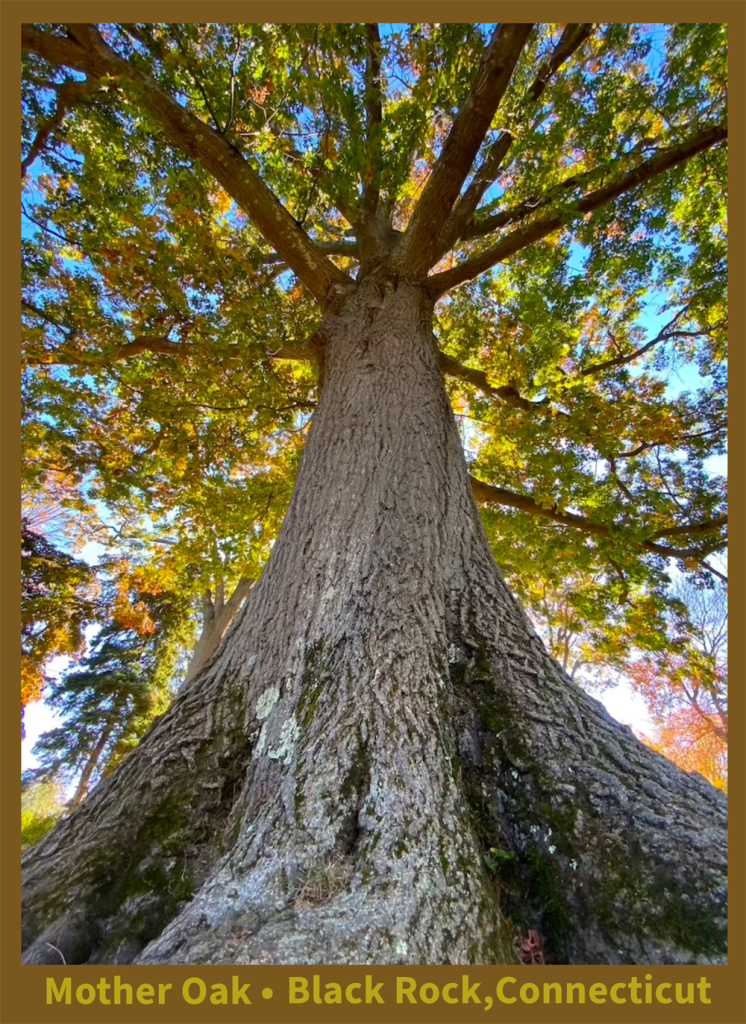
We sat on the in the leaves, my daughter and I, in the warm autumn sun under the Great Mother Oak. Here and there fallen leaves danced lightly in the breeze. It felt good to be directly connected to the ground, bent knees and bare feet on the land. We leaned back and looked up at the tree in all her glory. She was still filled with yellow green leaves… her canopy so high that from up there, she can “see” the other neighborhood trees with many years like she has.
She has been here in this place since the end of the 1700s or the beginning of the 1800s. She was here with the first European settlers of this place. Her mother had been here before that, with the last generations of the people who were of this land for 15,000 years or more: the Paugussett People. We could feel this history. We could feel the tree’s mother. And then, from beneath the ground where their energy remains steady, we heard the voice of the Paugussett. They thanked us for acknowledging their presence. They said that they can feel our profound love for this place where we live, here in Black Rock, Connecticut… our love for the trees, the leaves, the flowers, the osprey, the red tail hawks, the fox, the squirrels, the rabbits, the insects, the shore, the waters of coastal Connecticut (Long Island Sound), the shells, the sand, the sparkles, the historical homes, the families, the new babies. We love this land. We love our home. And the Paugussett saw this love. The Mother Oak saw this love.
Walk lightly pay keen attention… practice gratitude but not at the expense of truth take sparingly share
an Underground Web writes the Story but my roots belong to earth at the crossroad – I choose ‘both and’
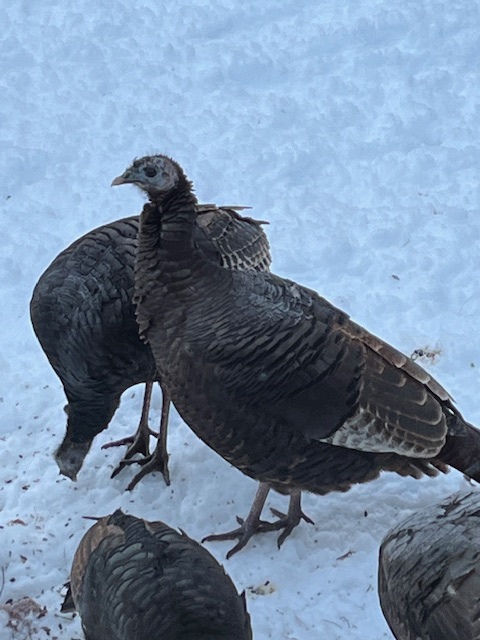
Listen to feathered voices keep breathing deep into the forest floor feel that luminous Light hidden beneath my feet Balance fear and pain with turkey flight.
Moderator’s note: While Samhain is past for this year, we are still in the section of the Celtic calendar which makes this blogpost, and its part 2 which will be posted tomorrow, relevant.
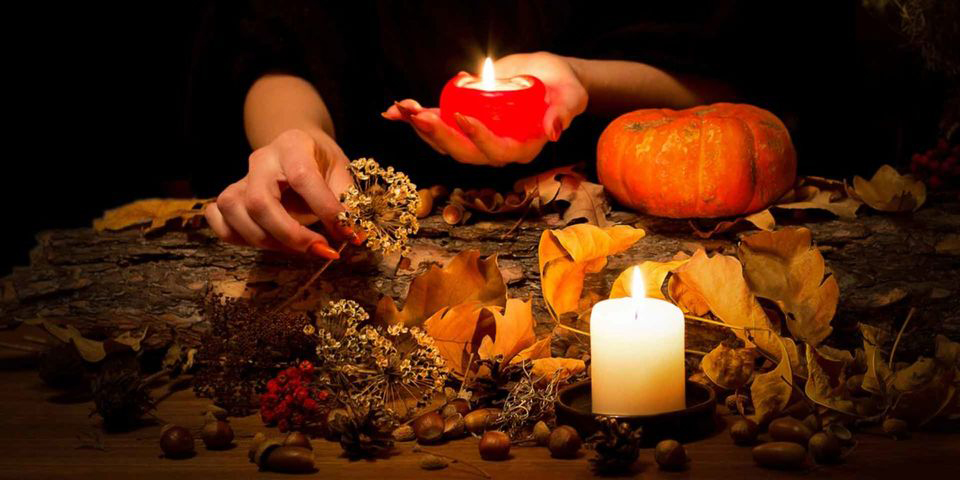
Samhain is an ancient Celtic festival, in fact the most sacred celebration in the Celtic year. Samhain is the New Year of the Celtic calendar. It is one of the eight holidays of the Celtic year—the solstices, equinoxes, and cross-quarter days—all of which mark the turnings of the seasons. Samhain is a time when the harvest had been completed; all the grains and late-maturing vegetables have been gathered in; the fields have been cleared, the old cast off, the fields lying fallow over the cold and dark of winter in order to make room for the eventual springing forth of new life. The New Year, begins in darkness at Samhain, is a reminder that all life emerges from the darkness, that death precedes rebirth. It is a time when the veil between the worlds of the dead and the living thinned, so that the presence of those who have gone before us is more clearly felt or even seen. It is a time to remember the ancestors as well as those newly departed—to grieve our losses, to let go so that we can move forward.
Samhain is the precursor of our Halloween. It was brought to this country by Irish immigrants during the potato famines in the 19th century. They brought their Celtic customs with them, but by that time Samhain was known as Hallows Eve, since the Irish were good Catholics. It struck a responsive chord with the American people, who called it Halloween. They adopted many of its customs, including lighting candles in gourds or pumpkins and dressing in costume. Today Halloween is celebrated as a spooky and fun time, observed with trick-or-treating and mischief-making, but originally it was a solemn holiday—a time to commune with the beloved dead, to honor the ancestors with food and drink, and to acknowledge death as part of a never-ending cycle of birth, death, and rebirth.
This post was originally published on May 28th, 2012
A green solution to the economic crisis insists that people and the environment can be saved together. We must dare to envision prosperity in conjunction with sustainability, social justice, nonviolence, and participatory democracy.
A rational analysis would make it clear that the Greek people did not “create” the economic crisis. Yet the poor and middle classes are being asked to “pay” for it. There is massive corruption in the public sector in Greece. But this should not blind us to the fact that the Greek people do not bear the major responsibility for creating the crisis. Those responsible include:
the international money interests (the 1%) who at this very moment are charging 26% interest on the Greek national debt and “hedging” their “bets” (betting for and against a complete collapse of the Greek economy) and hoping to “win” (make money on their bets) in either case;
the industrial interests in the larger countries in Europe which viewed the eurozone as an open market to sell their products (thus raising the GDP in industrialized countries like Germany);
European leaders who promote the interests of their own players in the international financial, military, and industrial marketplace above the good of the whole;
the Greek governmental elite (the 10%?) who have pocketed bribes and stolen money from public coffers;
This post was originally published on Aug. 26th, 2011
Carol P. Christ earned her BA from Stanford University and her Ph.D. from Yale University. She is a founding mother in the study of women and religion, feminist theology, women’s spirituality, and the Goddess movement and work has revolutionized the field of feminism and religion.She has been active in anti-racist, anti-war, feminist, and anti-nuclear causes for many years. Since 2001 she has been working with Friends of Green Lesbos to save the wetlands of her home island. She drafted a massive complaint to the European Commission charging failure to protect Natura wetlands in Lesbos. In 2010 she ran for office in Lesbos and helped to elect the first Green Party representative to the Regional Council of the North Aegean. She helped to organize Lesbos Go Green, which is working on recycling in Lesbos.
My hope for the new blog on Feminism and Religion is that it can become a place for real discussion with mutual respect of feminist issues in religion and spirituality.
I agree with Rosemary Radford Ruether who argued in a recent blog “The Biblical Vision of Ecojustice” that the prophets viewed the covenant with Israel and Judah as inclusive of nature. Indeed in my senior thesis at Stanford University on “Nature Imagery in Hosea and Second Isaiah,” in which I worked with the Hebrew texts, I argued that too. I also agree that the dualism Rosemary has so accurately diagnosed as one of the main sources of sexism and other forms of domination comes from the Greeks not the Hebrews. I agree that Carolyn Merchant is right that nature was viewed as a living being in Christian thought up until the modern scientific revolution. I agree with Rosemary that it is a good thing for Christians to use sources within tradition to create an ecojustice ethic. I am happy that there are Christians like Rosemary who are working to transform Christianity. Finally, I am pleased to admit that I have learned a great deal from her.
Twice a year, once in May for a few days and during the first week of October I can’t leave home because I’ll miss the next moment of spring flowering or scarlet flames.
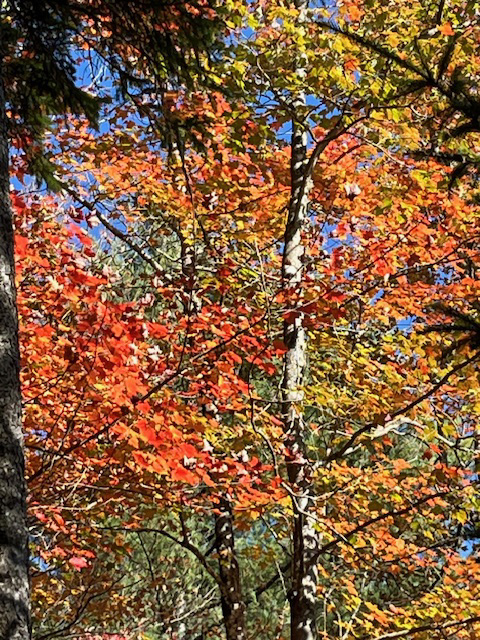
Last week I was captivated by how the golden morning light affects each deciduous leaf. For about five days I ran inside and out all morning to feast upon the astonishing leaf color changes as the sun rose higher. ‘Fire on the Mountain’, crimson, gold, seductive sultry salmon brilliance. In and out for hours. I drove my dogs crazy. Noting the bees on the blushing hydrangea, glad for dragonflies cruising around the house. Greeting little green frog framed against his log. Breathing in the Light. Infused by all too brief moments of swamp maple’s fierce fiery splendor.
The Torah portion for November 2, 2024 is Noach. The portion includes the stories of Noah’s ark and the tower of Babel and ends with Abraham and Sarai settling in the land of Canaan. In my feminist analysis of Noach, I will focus on the ecofeminist potential of divine acknowledgements and how the divine is portrayed.
As ecofeminists at the intersection with religion, one task we have is to interpret those sacred texts which have something to say about nature and animals. Within Judaism, there are numerous such texts, and parshah Noah is one of them. Afterall, most of Noach revolves around a great flood in which the deity destroys the earth and most of its inhabitants, animal and human.
The divine destruction of the material realm is problematic. The deity blames the divine decision to destroy creation on the rampant corruption of the flesh: human and animal alike (6:13). In feminist thinking, linking material existence to corruption is unsettling since patriarchy often disavows material existence by linking it to evil. In addition, in Noach, an aspect of the material world, water, is used in bringing about that destruction. However, water is also ironically what all flesh depends on for life.
Part 1 was posted last week. You can read it here.
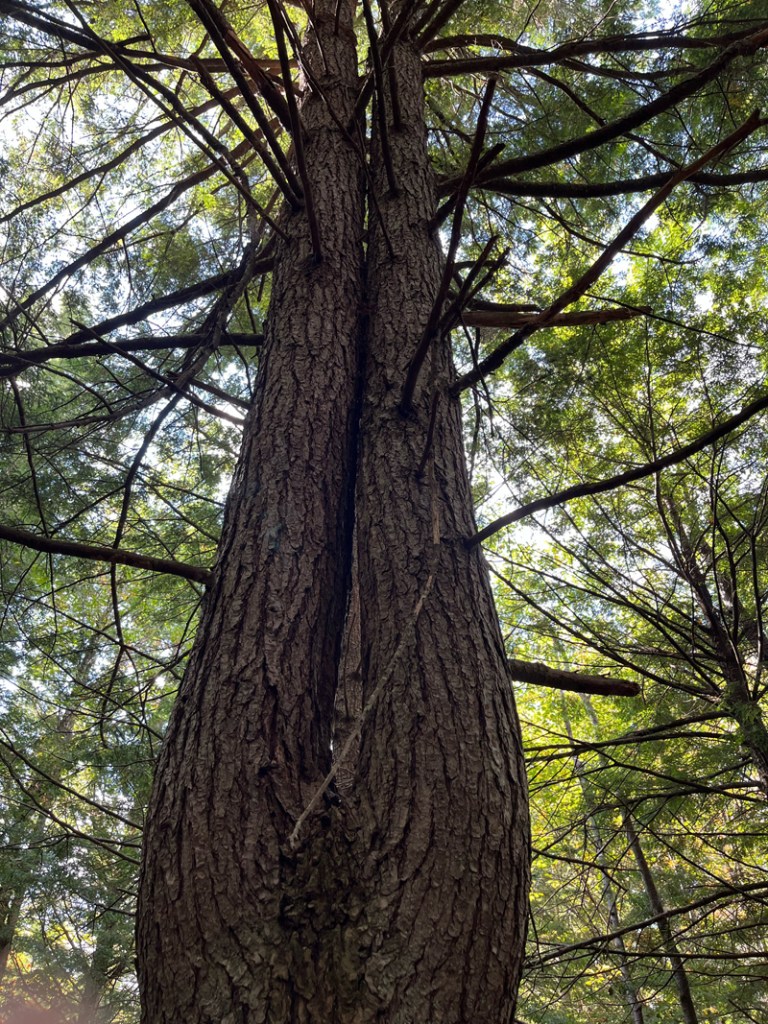
Yesterday on the day before the equinox I returned to my favorite hemlock forest after another morning of unproductive research on the mycelial web. The scarcity of information on this critical source of all life on land is troubling. As my frustration mounted I heard a little voice say, ‘Go visit with the hemlocks’. I did.
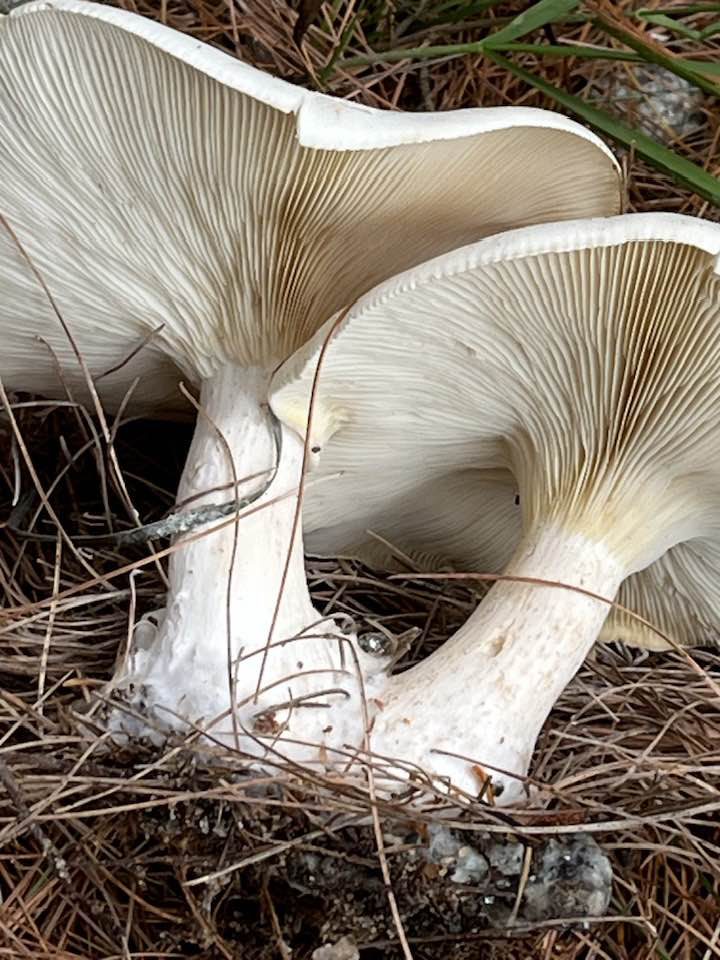
After I crossed the bridge into the forest something amazing happened. An invisible cloud of incredibly fragrant mushroom scent slipped over me like a shroud. I just stood there for a moment inhaling sweet earth, astonished and bewildered.
Walk lightly pay keen attention… practice gratitude but not at the expense of truth take sparingly share
an Underground Web writes the Story my roots belong to Earth
‘Listen to feathered voices, seek mushroom clouds keep breathing deep into the forest floor feel that luminous Light rooted beneath my feet’
(my fall equinox prayer)
During these days of mindless violence and fearful political upheaval, I feel driven to enter the woods on a daily basis. Lately, I haven’t even left my property. As I cross the bridge over the brook, I brush by the first lacy hemlocks and lovingly touch a branch of witch hazel whose lemony fingered flowers reach for mine. I am on the trail of mushrooms, but not as a forager.
I am drawn to these fungal fruiting bodies because I am trying to learn more about the complex relationships between certain fungi that emerge as mushrooms and their relationship to the trees around them. Some fungi that are in a symbiotic (or mycorrhizal) relationship with one tree or many, do fruit above ground but there are only about 20,000 mushrooms in all. The rest (which is most of the fungal world) fruit underground.




 Feminism and Religion