Body Talk by Kelly Brown Douglas

The more I reflect upon the complex and multiple ways in which various bodies are put upon and disregarded, the more I am persuaded that we have a body problem.

Our bodies communicate to us in many ways. They are a valuable source of knowledge in terms of our present realities and they are also valuable storehouses for memories. Long after the memories of the mind fade away, memories of the body linger. The mind may not remember, for instance, the details of a particular event, but the body remembers how it felt.  The memories of sadness, anxiety, hurt and pain as well as happiness, peace, healing and love are grafted upon our bodies. Feelings, sensations and instinctive reactions—things that are hard to explain—are oftentimes our bodies’ ways of communicating memories. These are embodied memories reminding us of what it means to feel torn apart or to feel whole. It is the body giving feedback at any given moment in time. Embodied memories certainly involve what Audre Lorde identifies as “erotic power.” This, Lorde says, is an “internal sense” and a “depth of feeling” “that is a source of  power and information” (Lorde, Sister Outside). Embodied memories are one of the ways in which our bodies speak to us and help us to know the good, right and just thing to do, from within ourselves and through depth of feeling. Continue reading “Body Talk by Kelly Brown Douglas”

Connection to Ancestors in Earth-based Theology by Carol P. Christ

carol p. christ 2002 color“I am Carol Patrice Christ, daughter of Jane Claire Bergman, daughter of Lena Marie Searing, daughter of Dora Sofia Bahlke, daughter of Mary Hundt who came to Michigan from Mecklenburg, Germany in 1854.  I come from a long line of women, known and unknown, stretching back to Africa.”

Like many Americans, my ancestral history was lost and fragmented due to emigration, religious and ethnic intermarriage, and movement within the United States.  Though one of my grandmothers spoke proudly of her Irish Catholic heritage and one of my grandfathers acknowledged his Swedish ancestry, I was raised to think of myself simply as “American,” “Christian” and “middle class.”  Ethnic and religious differences were erased, and few stories were told. 

Over the past two years, I have begun to discover details of my ancestral journey, which began in Africa, continued in the clan of Tara, and was marked by the Indo-European invasions.  In more recent times, my roots are in France, Holland, England, Germany, Ireland, Scotland, and Sweden.  In the United States, my family has lived in tenements in New York City and Brooklyn, in poverty in Kansas City, and on farms in Long Island, Connecticut, upstate New York, Michigan, and Pennsylvania.  My parents and grandparents settled in northern and southern California during the 1930s.  I have lived in southern and northern California, Italy, Connecticut, New York, Boston, and now Greece.

Learning details about family journeys has created a shift in my sense of who I am.  Continue reading “Connection to Ancestors in Earth-based Theology by Carol P. Christ”

Embody the Sacred – Engaging Through the Senses by Deanne Quarrie

The human body is designed to utilize all senses. We, human beings, have drifted away from our natural state through which, at one time, we engaged with all of life through our natural senses, including the intuitive.  This change has come about through our active, stress filled lives in which we seldom slow down to even appreciate what is around us.  We have ignored much of our sensory ability due to a change-over from right brain functioning, which is more imaginative, creative and intuitive, to left brain functioning, which is linear and analytical. Two of our senses are developed out of proportion to the others.  Many people grow up in an environment lacking in exposure to the natural world.  With television, computers and video games we have become residents of an indoor and often sedentary world.

In early civilization, humans and all other animals depended on finely tuned sensory awareness for survival.  We walked the Earth, using those senses for protection, to find food and to move around.  We did not just see and hear our way around but we felt, touched, tasted and smelled in order to survive. Continue reading “Embody the Sacred – Engaging Through the Senses by Deanne Quarrie”

Touching Roots: An Incredible Lightness Of Being by Carol P. Christ

carol p. christ 2002 colorA few days ago, a German-speaking friend spoke with an Eiloff relative of mine who lives in St. Nikolaus, Saarland.  My relative remembered hearing the story that Heinrich Eiloff, my 2x great-grandfather, emigrated to the United States in the mid-1800s.  Since we connected, I am experiencing an incredible lightness of being.

This is the first time my two years of genealogical research have led to a “Kunta Kinte” moment, a connection with a relative in “the old country.”  I have been unable to trace most of my ancestors back to the places of their birth. 

My relative in St. Nikolaus was perplexed by a call from Greece from a woman claiming to represent his American relative. But when she explained that I only want to find my roots and perhaps visit relatives in St. Nikolaus, he said, “that would be very nice.”  He promised to speak with other living relatives and said we should call in a month or two and he would tell us what he found.

According to my research, my 2x great-grandfather Heinrich Eiloff was born in 1820 in St. Nikolas, Saarland, in Prussia (now in Germany).

st nikolaus saarland

Continue reading “Touching Roots: An Incredible Lightness Of Being by Carol P. Christ”

Imix: Primal Mother and Dawn of a New Age by Michele Stopera Freyhauf

Michele FreyhaufIf you are reading this, then we survived another apocalypse.  People are fixated on end-times; especially predictions, prophecies, etc.  Specials on Nostradamus, the Book of Revelation, TV Evangelists looking for end signs plague television shows, movies, and writings.  Countdown clocks and reminders to repent are all around us.
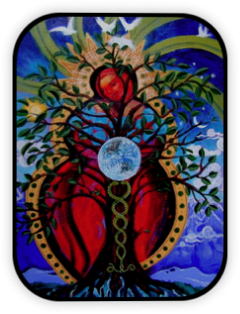
Original image found at http://www.dwayneedwardrourke.com/Pages/TIMEWAVE0728/page21/page21.html

What is unnerving is how we obsess about the end of the world instead of living in the world we have right now.

I would like to share a Mayan poem that I came across.  It is called “Imix”- a Mayan Oracle Interpretation translated by Ariel Spilsbury and Michael Bruner and I am drawn to it due to the imagery and symbolism:

I Am Imix, Primal Mother.

Still, dark womb of the patterned potential of becoming, sacred, interstellar genesis, I Am.

Nourishing, fertile abyss, I birth you.

Benevolent, my mighty cauldron of primal waters, enveloping the living seed. Eternal is my embrace. Continue reading “Imix: Primal Mother and Dawn of a New Age by Michele Stopera Freyhauf”

SPECIAL AAR SERIES Part 2: Gamer-Player/ Gamer-Avatar: The Potential of a Video-Gaming Body by Sara Frykenberg with introduction and response by Mary Hunt

Sara Frykenberg Mary HuntIntroduction:

This is one of four papers presented in Chicago at the Annual Meeting of the American Academy of Religion, November 17, 2012, in a session entitled  “Feminism, Religion and Social Media: Expanding Borders in the Twenty-First Century,” organized by Gina Messina-Dysert and chaired by Rosemary Radford Ruether with Mary E. Hunt as the respondent. What follows is the general response followed by, after each of the contributions, Hunt’s appreciative analysis. The first paper was posted here on Feminism and Religion, and the other two papers are posted here and here on the Feminism in Religion Forum

General Remarks by Mary Hunt:

The stated purpose of the panel is to discuss “how digital projects are remapping the feminist theological terrain and creating opportunities for a wide range of voices to participate in ongoing and new conversations related to feminist issues in religion.” These writers have done that and more. Continue reading “SPECIAL AAR SERIES Part 2: Gamer-Player/ Gamer-Avatar: The Potential of a Video-Gaming Body by Sara Frykenberg with introduction and response by Mary Hunt”