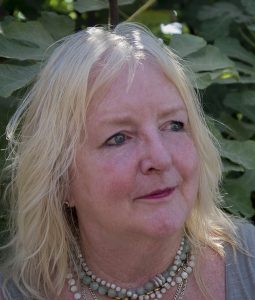
Goddess Pilgrimage to Crete – Reborn! by Laura Shannon

Thirty years ago, Carol P. Christ founded her Goddess Pilgrimage to Crete, which she wrote about in her book A Serpentine Path: Mysteries of the Goddess (original 1995 title Odyssey with the Goddess) and in numerous posts on this site over the years. She led over 40 groups of women Pilgrims to encounter the history and sacred sites of the peaceful, egalitarian civilisation of Bronze Age Crete. 

Here, the Goddess-honouring culture of Old Europe survived the longest, when patriarchal Indo-Europeans were taking over in the ‘Kurgan waves’ Marija Gimbutas has described. The sophisticated artworks of ‘Minoan’ Crete show women in positions of honour and authority, and do not depict violence, slavery, or war. People celebrated at ceremonial centres, made offerings at cave and mountain shrines, and worshipped the Goddess in sacred trees and stones.

Snake Goddess, Knossos, Crete, ca. 1600 BCE [photo: Heraklion Archaeological Museum]

As many readers know, before Carol passed away, she asked me to take on the leadership of her Goddess Pilgrimage, and to serve as her literary executor and the director of her Ariadne Institute for the Study of Myth and Ritual. Deeply moved by her trust in me, and guided by very clear dreams I received around the time of her death, I accepted Carol’s request. In October 2022, after a three-year delay due to the pandemic, the Goddess Pilgrimage to Crete was reborn. 

Continue reading “Goddess Pilgrimage to Crete – Reborn! by Laura Shannon”

Legacy of Carol P. Christ:“Ursula Niebuhr, Ursula Niebuhr”: Unacknowledged Co-author of Great Works of Theology?

This was originally posted on August 26, 2019. It fits in with our new project of Unsung Heroines.

A few days ago while watching the movie The Wife, I kept hearing the words “Ursula Niebuhr, Ursula Niebuhr,” in my mind. I knew the reason was Ursula’s unacknowledged collaboration on the work of Reinhold Niebuhr, which I discovered while writing an earlier blog on uncredited co-authors.

I had not been particularly interested in seeing The Wife because I assumed it was the familiar story of the woman who gives up her career interests when she marries. Want to become a rabbi? Marry one. Want to become an artist? Live with him and become his muse. This is a very old story, and for me, not a very interesting one.

Continue reading “Legacy of Carol P. Christ:“Ursula Niebuhr, Ursula Niebuhr”: Unacknowledged Co-author of Great Works of Theology?”

Willful Women, Feminist Killjoys, and Jesus: Reflections on Sara Ahmed’s Living a Feminist Life by Liz Cooledge Jenkins

I’ve been thinking about willful women and feminist killjoys—two main guiding images in feminist scholar Sara Ahmed’s book Living a Feminist Life (Duke University Press 2017).

The idea of the willful woman (or willful girl, or willful person) is something I can easily get behind. The way I understand it, it has to do with women getting in touch with our own wills and being willing to speak and act and live out of our wills. Particularly if these wills turn out to exist in opposition to the things other people might will for us.

It’s about learning to stand up for ourselves, learning to affirm our full humanity in a world that often expects…less. It’s a way of consciously, intentionally being willing to be called “willful” as a negative thing—as in, stubborn, selfish, antagonistic, difficult—because the affirmation of our own wills is worth it.

I like all of this and find it helpful. Be willful. Expect pushback and penalties for it. Be willful anyway.

Continue reading “Willful Women, Feminist Killjoys, and Jesus: Reflections on Sara Ahmed’s Living a Feminist Life by Liz Cooledge Jenkins”

The Problem of Jehosheba: Reading One Biblical Character in Two Different Feminist Ways by Jill Hammer

Tucked away in II Kings 11 is the story of a mother-daughter feud that is personal, political, and ultimately fatal. Jehu, a charismatic military commander, is anointed by Elisha as the next king of the northern kingdom of Israel. Jehu kills the previous king of Israel, Jehoram, and also Jehoram’s mother Jezebel (yes, that Jezebel—the famous/infamous queen). As part of his violent rise to power, Jehu also kills Ahaziah, king of the southern kingdom of Judah. Ahaziah’s death should mean that Athaliah (Atalya), who is queen mother of Judah as well as the daughter of Jezebel, cedes power to a new king and a new queen mother. Instead, according to the Book of Kings, Athaliah has the rest of the king’s sons and grandsons murdered, and seizes the throne for herself. 

All seems lost for the Judean line, except that Jehosheba (Yehosheva), wife of the high priest Jehoiada and sister of the murdered King Ahaziah, saves one of Ahaziah’s sons, along with the child’s wetnurse, and hides them both in the Temple. Jehosehba keeps the boy, Joash, and his nurse in the Temple until he is six years old. At that time, Jehosheba’s husband, the high priest, anoints Joash king, stages a coup, and executes Athaliah as a usurper. Jehosheba’s action saves the Davidic line. The collection of Jewish legends known as Otzar Midrashim lists Jehosheba as one of the righteous women of the Jewish people.

Continue reading “The Problem of Jehosheba: Reading One Biblical Character in Two Different Feminist Ways by Jill Hammer”

Legacy of Carol P. Christ: His Terror

Moderator’s Note: This was originally posted on March 25, 2019. AND the issues are still with us and as vivid as ever.

The first two parts of Susan Griffin’s Woman and Nature, “MATTER” and “SEPARATION,” are written in the authoritative voice of western philosophy and science that declares matter to be dead and the body an impediment to thought, and proceeds to separate the mind from the body. All of this, Griffin suggests, is based in the fear of death.

As Griffin notes, in this equation woman is identified with the body and her voice is silenced. Re-reading these parts of Woman and Nature for the umpteenth time for a class I am teaching felt even more painful than it had before. I was reliving parts of my own story.

I was brought up in the tract home suburbs of post-war Los Angeles in a world of women. Both of my grandmothers played central roles in my upbringing, introducing me to nature and the spirit of life they experienced as we explored trails the Los Angeles County arboretum before it was fenced or when we frolicked in the waves and picked up sand dollars at the seashore south of San Francisco. When I was ten years old my family moved to a new neighborhood that was almost entirely made up of families like ours with small children, fathers who worked, and mothers who stayed home.

Continue reading “Legacy of Carol P. Christ: His Terror”

Unsung Heroines: Self-Worth takes Time: The Transformation of Angela di Foligno by Elisabeth Schilling

Angela di Foligno was a 13th century Umbrian Franciscan mystic who began her initiation on the spiritual path when she was almost 40. She was officially declared as saint in October of 2013. Her works were dictated to a relative who was scribe and a Franciscan brother in the church, and so we unfortunately do not have access to the complete depth and intimacies of her ecstatic visions and commentary (both she and her scribe discuss how he was writing in such haste and fear from admonishment from his religious brothers that it is a “short and defective version” of her experience). Nevertheless, as readers, there is still so much for us to gain in terms of inspiration and commiseration.

In “The First Twenty Steps of the Blessed Angela in the Way of Penance and Spiritual Perfection,” the Franciscan saint details the arduous journey of mastering both fear and love, a requirement to evolving in our human consciousness to realize our divine spark and transform shame. I want to discuss three aspects of this journey that relate specifically, as I see it, to the challenges set forth by many women: love for the body, love for one’s relational boundaries, and love for one’s time and space. Most cultures fail to honor women in all of their desires and powers, and so we must learn to honor ourselves and each other. Angela, as we shall see, was fiercely willing to honor herself.

Continue reading “Unsung Heroines: Self-Worth takes Time: The Transformation of Angela di Foligno by Elisabeth Schilling”

Biblical Poetry – Trees by Janet Maika’i Rudolph

Image from an Egyptian tomb ca. 1314-1200 BCE. Isis is giving nourishment in the form of fruit and drink,

In many cultures of the world, including our own, trees are considered the ancestors of humanity – own our ancestors.

Trees are connected with great goddesses throughout antiquity. We see this in the bible where, as I’ve noted before, the Tree of Life is Eve’s tree for the word Eve means life. It is, in essence, the Tree of Eve. Goddesses in trees feeding humans were common themes in ancient Middle Eastern art. The tree was Hers to give freely of as she wished.  

Anthropologist and religious scholar, Mircea Eliade writes extensively about the associations of trees ancestral connection to humans. He calls them both mystical and mythical.[1] His examples include the Miao groups of Southern China and Southeast Asia who “worship the bamboo as their ancestor.” He also notes Australian tribes who view the mimosa as their progenitor. And there is a tribe from Madagascar, called Antaivandrika which means “people of the tree,” who considered themselves descended from the banana tree.

Continue reading “Biblical Poetry – Trees by Janet Maika’i Rudolph”

The Guru Question: Are Spiritual Hierarchies Inherently Oppressive?

Painting of a noblewoman seeking counsel from two Tantric yoginis, in the Mughal style, about 1750. From the British Museum’s recent exhibition, Tantra: Enlightenment to Revolution. A beautiful starting point to learn about Indian spirituality in its original context. May all our paths be crossed by wise teachers.

I’ve received a tremendous response to my essay on cults, published on Feminism and Religion in December last year. The topic continues to be a burning issue as more and more survivors break their silence on the spiritual abuse they suffered. Cults are a feminist issue because women and girls suffer the worst abuses at the hands of male cult leaders.

To fully understand how this cult dynamic works, I highly recommend watching Dan Shaw’s lecture on the subject, in which he explains how cult leaders are traumatizing narcissists whose goal is to subjugate their followers and “purify” them by utterly destroying their sense of self. Yet for me, the most haunting moment of his presentation came just near the end, during the Q & A session. An audience member and survivor of Siddha Yoga, the same cult that Shaw once belonged to, asked, “Are there gurus that people can trust?” She asked if guru-driven spirituality was “inherently subjugating.”  

Shaw, perhaps understandably not wanting to come across as a white man casting judgement on another culture’s deeply-rooted spiritual traditions, wiggled out of answering by saying that it was up to the individual to discern if a particular guru was safe or not.  

But I think this anonymous woman’s question deserves a more nuanced answer.

In Hinduism, since the age of the Upanishads, gurus have played a crucial role in preserving wisdom teachings in a religion with no centralized authority figure or governing body. The teachings are passed on orally to disciples who worship the guru as a divine being in order to realize their own innate divinity. I would love to hear from Indian feminists on how this guru-disciple relationship plays out in India today, particularly with female practitioners.

However legitimate and honorable these systems might be in their original cultural context, I think it’s fair to say something gets lost in translation when Eastern spirituality moves West. Great abuses have come to light. Katy Butler, in her article, “Encountering the Shadow in Buddhist America,” writes that guru abuse has become so prevalent due to the “unhealthy marriage of Asian hierarchy and American license that distorts the student-teacher relationship.”

It’s pertinent to point out that many of these misbehaving gurus, lamas, and swamis are white men. Spiritual hierarchies can be abusive across cultures—look at the sex abuse scandals in the Catholic Church. Cults are not necessarily “Eastern” or “foreign.” There are plenty of Christian cults, self help cults, and wellness cults.

Another thing that often gets lost in translation is what Eastern spirituality actually intends to offer the student. Many Western students turn to Eastern disciplines like meditation and mindfulness for stress reduction, but that is not their original purpose. These disciplines are intended to liberate the practitioner from the wheel of death and rebirth, to transcend this world of suffering and our worldly attachments, in order to enter an enlightened state—i.e. not to be reincarnated again, a goal some Western people might find world-denying and nihilistic.

Dr Willoughby Britton, professor of psychiatry at Brown University, speaking to Rachel Bernstein on IndoctriNation podcast asks, “How problematic or paradoxical is it if you believe that enlightenment is a destination that someone else can take you to? What dependence does that create?”

The goal is unmeasurable and the endpoint keeps shifting according to the power dynamics. You become much more dependent on the teacher who decides if you have reached this invisible destination. If you’re being charged a lot for the teachings, the teacher may decide that you don’t achieve the end result for a very long time.

Willoughby says practitioners can empower themselves by asking themselves the following questions:

Where do you want to go with this practice?

If you are seeking enlightenment, what does that mean for you?

You get to define your own outcomes and measure your success by what you want to show up in your life, i.e. better sleep, reduced anxiety, improved relationships, and inner peace.

In evaluating teachers and spiritual groups, ask yourself:

What were you initially promised?

Has it been achieved after all your hard work?

Do you feel you are closer to your goal?

Or have your initial reasons been shifted by the teacher into their reasons and their goals that are no longer yours?

Are you under pressure to perform for and please the teacher?

Are you expected to use scripted, stilted language to describe your experience?

If you question the teacher and the teacher retaliates, that’s your tipping point, says Britton. If you say that a practice isn’t working for you and the response you get is, “Well, that’s because you don’t have the right karmas/aren’t dedicated enough/haven’t reached the right level of spiritual maturity”  etc., you need to leave and find a different group.

In order for anyone to have a healthy experience with a teacher, you need the freedom to say, “I think this isn’t working for me, and, in fact, it’s hurting me and I need to move on.” Depending on how people respond to you setting your boundary, you’ll know if you’re in a healthy space or not.

As Dan Lawton says on another episode of IndoctriNation Podcast, a spiritual practice can only be as healthy as the person teaching you that practice. The endgame for a lot of teachers is often building a personal brand around the supremacy of a certain spiritual practice. Once you’re locked into that box, there are a lot of things you’re not going to be able to see and there’s a possibility of doing real harm to your students.

Good, ethical teachers, whether they call themselves gurus or not, are deserving of deep respect. But they need to be vetted and held accountable. And maybe in the West, at least, the obligation to see the teacher as enlightened or divine is indeed too subjugating. Maybe it would much healthier to look up to them as a wise elder or mentor. Surrendering our agency to another human is always going to be subjugating.

Perhaps we can follow the example of the female seeker in the 18th century painting above, who is taking counsel from two yoginis, female practitioners who live in the forest, outside the strictures and hierarchies of patriarchal society. Instead of placing all our hopes in one exalted individual, why not instead seek the deep wisdom of the female collective?

Mary Sharratt is committed to telling women’s stories. Please check out her acclaimed novel Illuminations, drawn from the dramatic life of Hildegard von Bingen, and her new novel Revelationsabout the mystical pilgrim Margery Kempe and her friendship with Julian of Norwich. Visit her website.

Legacy of Carol P. Christ: Practice Great Generosity

This was originally posted on August 20, 2018

Nurture life.

Walk in love and beauty.

Trust the knowledge that comes through the body.

Speak the truth about conflict, pain, and suffering.

Take only what you need.

Think about the consequences of your actions for seven generations.

Approach the taking of life with great restraint.

Practice great generosity.

Repair the web

In Rebirth of the Goddess, I offered Nine Touchstones of Goddess Spirituality as an alternative to the Ten Commandments. The Nine Touchstones are intended to inform all our relationships, whether personal, communal, social, or political.

The eighth touchstone asks us to practice great generosity.

Continue reading “Legacy of Carol P. Christ: Practice Great Generosity”

Legacy of Carol P. Christ: Restored in Beauty

This was originally posted on May 11, 2015

The path leading to the Klapados Waterfall begins at the edge of an open meadow in the pine and oak woodlands of a mountain in the island of Lesbos. After driving several miles on a very rutted dirt track, we parked under an oak tree, crossed the meadow and scrambled down a winding path. After about 20 minutes, it ended at a stream surrounded by plane trees. From there, we climbed over rocks to reach a pool created by the seasonal waterfall.

waterfall at klapados 1

On the day we visited it, the waterfall was only a trickle of cascading drops that moistened its moss-covered path to the pool. The roots of a plane tree growing at the top of cliff followed the path of the water, weaving a web over the rockface all the way down to the pool.

Continue reading “Legacy of Carol P. Christ: Restored in Beauty”