Sappy modern carols won’t cut it; Gritty Advent Hope is what we need this year. — by Trelawney Grenfell-Muir

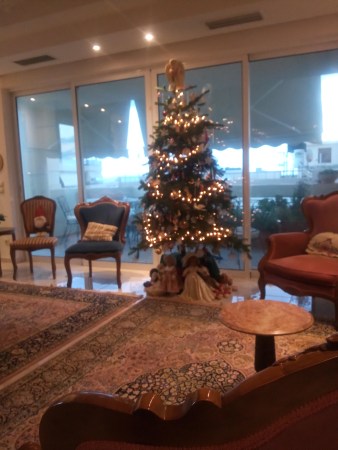
As we careen toward ever more terrifying surges in the Covid pandemic, with experts predicting apocalyptic catastrophes by Christmas time, I find myself reacting to the vast majority of modern Christmas songs, stories, movies, and cultural norms with increasing distaste. In these scary, painful weeks leading up to Christmas, my culture has very little to offer other than distraction and superficial jollity. Ho ho ho, Santa Claus is comin’ to town.
Distraction does help, a little. It’s addictive, of course. We turn more and more to social media, with its carefully designed dopamine boosts from each “like” and “love” reaction, each funny cat video, each smug political joke, to keep us from confronting the terror and trauma of our current reality. It’s a legitimate coping mechanism, a crutch that can be useful in many ways. Continue reading “Sappy modern carols won’t cut it; Gritty Advent Hope is what we need this year. — by Trelawney Grenfell-Muir”

Altars Everywhere, Part 2 by Carol P. Christ

This is a continuation of an earlier blog in which I discuss home altars as a way to bring beliefs about women’s spiritual power into the body and daily life.

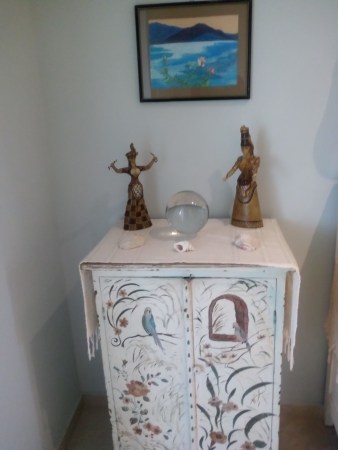
In my bedroom, images of the Snake Goddesses of Knossos sit on a cabinet painted by a Greek woman with images of birds and flowers. Between them is a crystal ball, while before them are three shells, the smaller of which was given to me by a Maori woman from New Zealand. Above them is an image of the sea in Molivos, Lesbos, painted by my friend Judith Shaw in the year we were both living in the village.

Continue reading “Altars Everywhere, Part 2 by Carol P. Christ”

Coyote Woman Unmasked….by Sara Wright

Four years ago I made a trip to New Mexico to spend the winter and returned for three more winters in a row. A true Night Journey through the Desert. I hadn’t been there three weeks before a Great Horned owl appeared at my door. My dead mother (with whom I had had a devastating relationship and who loved owls) was surfacing as a threat…and I just did not want to believe it.

After a few months I was thrilled to make what I believed to be a genuine woman friend. Ironically, I met her at a feminist gathering. Oh, at last!  Up until that point the only woman I currently had a close relationship with was a woman who was a former editor that became a virtual friend. I had only met her once (caveat–watch out for FB friends). My dearest friend Lise (we were thirty years strong) lived too far away for us to see each other although we talked and argued periodically! I was so lonely for a real woman friend that I could see regularly, and share my feelings with honestly … When this woman sought me out I could hardly contain myself. I was that excited. Continue reading “Coyote Woman Unmasked….by Sara Wright”

Altars Everywhere, Part 1 by Carol P. Christ

In a recent blog, Carolyn Boyd invited us to reflect on how our women’s spiritual power is activated through symbols that help us to remember and manifest the “deep well” of our inner knowing. According to historian of religion Mircea Eliade, the sacred and the profane were not separated in premodern cultures because all of life was considered to be sacred. Many in the Women’s Spirituality and Goddess communities have advocated this earlier more wholistic understanding. Although it is not always easy to overcome the dualism between sacred and profane, we attempt to do so.

One of the symptoms of my chemotherapy is neurasthenia or partial numbness in my right foot. When it first occurred, I fell three times in my apartment because I was not lifting my foot automatically. I became afraid to move without holding onto the walls or furniture. I resisted my friends’ advice to get a walker, but finally agreed that I needed some form of physical support. I arranged for my friend Eirini Kouraki to have a rubber tip added to the shepherd’s cane I sometimes use walking in the mountains. When she brought it too me, I decorated it with three ribbons I saved from rituals at the Holy Myrtle Tree at the Paliani monastery in Crete. The most recent were brown, the color of the earth, and red, the strong energy I will need to heal. I added a light green-blue ribbon, representing the calm and clear optimism I feel as I face a crisis of life and death. The ribbons remind me of the healing power of the Holy Tree that I have called upon many times, turning a symbol of my infirmity into a symbol of healing and hope.

In the past weeks as my cancer treatment continues, I have been feeling strong enough to finish unpacking (with the help of Vera, my cleaning lady) and organizing my new home in Crete. As I rediscover sacred objects, I create altars. Altars are physical reminders of our spiritual beliefs. Creating and tending them helps to create the embodied knowing that brings the spirit into our daily lives.

The living area of my new apartment has 3 glass shelving units. In one of them, I created a triple altar with images of the Goddess and female power from ancient Crete. Because the apartment is sleek and modern yet welcoming to my antique furniture, I kept the altar minimal.

On the top shelf I placed three pre-palatial “pitcher” Goddesses, two with breasts from which liquid pours and one that is holding a water jug from which liquid can also be poured. These images, dated before 2000 BCE, express the Old European insight that the Goddess represents the powers of birth, death, and regeneration in all of life. Though they have human qualities, they are more than human. The Goddess from Malia who sits in the center of this altar has a beaked face and wings and her triangular shape evokes the mountains from which water flows to villages and fields. These images remind me that the Goddess is the Source of Life, provider of gift of life that is our embodied being and the gifts of life—including food and water–that nourish us daily.

The second shelf holds one of the oldest images from ancient Crete, the Neolithic Goddess from Ierapetra. She is seated on massive buttocks, securely rooted in the earth. Her face is beaked, symbolizing her connection to the birds that fly in the air. Her body is decorated with lines identified by archaeologist Marija Gimbutas as the flowing water that nourishes all of life. Her body too is shaped like the mountain. She represents the never-ending powers of birth, death, and regeneration in all of nature.

In front of the Neolithic Goddess I placed a twig from Paliani with a dark blue ribbon reminding me that my friend Tina Nevans is sending the healing energy of the Blue Buddha to me in her daily meditations, as well as several handsewn triangles holding leaves from the Holy Myrtle tree, and a crystal extracted from the Trapeza Cave, found on the path outside of it. To Her right is a small image of the long-necked turtle Goddess from Myrtos who holds a pitcher recalling women’s daily visits to water sources, and a small copy of a Kamares ware pitcher used to pour libations in the Sacred Centers. To the left are a bronze copy of a labrys, originally the double sacred female triangle transformed into wings and also a happy little bull who reminds us that animals experience the joy of life.

On the lower shelf, copies of dancing women from post-Minoan Paliakastro symbolize the transmission of Old European values of community, lack of hierarchy, and most of all, celebration of the joy of life as Laura Shannon has written. The dancing women are surrounded by images of later Mycenaean Goddesses and of Aphrodite who was worshiped at the Minoan site of Kato Symi in classical times, and a small reproduction of the Neolithic Goddess from Catal Huyuk, who reminds us that Crete was settled c.7000 BCE by farmers from Anatolia.

In the hallway I placed a copy of a drawing of the Holy Myrtle Tree of the monastery of Paliani created by one of the nuns. According to the story told, the area where the monastery was later built was burned in a fire but a small myrtle bush survived. It was watered by girls who saw the image of the Panagia (Mary the Mother of Jesus) in its charred branches. So, the monastery which was known as ancient in 668 CE was built. The monastery is a sacred place for the surrounding villages. The sacred tree and the icon of the Panagia in the church are said to have performed many miracles. Below the drawing of the Sacred Myrle Tree is a small image of a face in a twig from tree given to me by German artist Carla Randel.

On a small table under the drawing, I placed an image of Aphrodite who was earlier associated with myrtle trees, along with a candle, a star, a blue glass paperweight, and a triton shell, symbolizing Aphrodite as the morning and evening star, and her relation to the sea.

When I light candles in translucent glass holders on the altar with the pitcher Goddesses as the day dawns and in the evening as day turns to night, and when I gaze at my other altars, I remember that I am always surrounded by the nurturing love of the Goddess. This love takes root in my body, and I am inspired to share it with others.

To be continued.

Covid in Greece by Carol P. Christ

Greece is on nationwide lockdown due to a surge in Covid cases in the fall. What does this mean? For three weeks until December 1, we can leave home only for essential reasons which include: going to a nearby supermarket; visiting the doctor or pharmacy; going to banks or public utility offices; helping someone in need; traveling to work if working from home is not possible; attending a funeral; traveling to see children when parents are separated; leaving home for physical exercise or to care for pets or strays. Masks must be worn at all times outside the house; SMS must be sent to a national number listing the reason for leaving home or a paper must be carried with the same information; a special document is required for work listing hours; the fine for violation is 300 euros and police are enforcing this, particularly in the cities. Restaurants and bars are closed; only a few categories of shops are open. A curfew from 12 am to 5 am was extended to begin at 9 pm; this is because young people have been congregating outside in groups. Travel in Greece is restricted; visits to second homes are not allowed. Primary schools are open, but secondary schools are using internet. Similar restrictions were in place in March and April in Greece and the country had one of the lowest virus rates in the world until recently. The hope is that the lockdown will stem the spread of the virus and that the restrictions will be lifted before the holidays.

This situation contrasts with the United States where the President has refused to acknowledge the extent of the health crisis or to take measures to restrict the spread of the Covid virus. Continue reading “Covid in Greece by Carol P. Christ”

Glimpsing La Vièio ié Danso – “The Untouchable Wild Goddess” – in Jóusè d’Arbaud’s Beast of Vacarés by Joyce Zonana

Nearly a century later, d’Arbaud’s words still have the power to startle and delight, vividly evoking Earth’s sacredness.


Early in Jóusè d’Arbaud’s 1926 Provençal novella, The Beast of Vacarés, the narrator, a 15th century gardian or bull herder, describes how in summer la Vièio ié danso—the Old Dancer— “can be glimpsed on the dazzling salt flats” that surround the Vacarés lagoon in the Camargue region of Southern France.

In a note, d’Arbaud explains that la Vièio is how locals refer to mirages in this liminal landscape where earth, sea, and sky merge. “Mirages are common in the Camargue,” he tells us:

They begin with a vibration in the air, a trembling that runs along the ground and seems to make the images dance; it spreads into the distance in great waves that reflect the dark thickets. How not to see in this mysterious Vièio, dancing in the desert sun, a folk memory of the untouchable wild goddess, ancient power, spirit of solitude, once considered divine, that remains the soul of this great wild land?

The untouchable wild goddess . . . once considered divine . . .”

Nearly a century later, d’Arbaud’s words still have the power to startle and move us, vividly evoking Earth’s sacredness. Here is a man, himself a bull herder in the region he so lovingly describes, who seems to have been a devotee of the Goddess, the “ancient power” he venerates and bring to life for his readers. Indeed, in an early poem, “Esperit de la Terro” — “Spirit of the Earth”— d’Arbaud explicitly dedicates himself to the old gods sleeping below the earth, vowing to “defend” and “aid” them. How extraordinary to discover this writer making such a commitment, well before the rise of our recent feminist spirituality and ecofeminist movements. D’Arbaud speaks directly to our current environmental, theological, social, and political concerns.

Continue reading “Glimpsing La Vièio ié Danso – “The Untouchable Wild Goddess” – in Jóusè d’Arbaud’s Beast of Vacarés by Joyce Zonana”

A Story to Inspire Hope by Elizabeth Chloe Erdmann

These days deep emotions seem to burst forth at unexpected moments.

While in the car between visiting a pumpkin farm owned by friends and the local cider mill, I decided to pull out a crumpled paper with my brief presentation on the history of Crete.  “Does anybody want to hear a story?” I asked my captive audience of one of my best friends and her three boys. “Yes!” As the fall foliage whirled by, I started reading, thinking that attention would wander soon, and I’d put it away. To my surprise the boys wanted me to keep reading and even asked that I continue the story when we returned to the car after a break to feed ducks.

When I finished, the youngest boy exclaimed “that was the best story I’ve ever heard!” I was thrilled I had related it in a way that he enjoyed so much and recognized in his giddy exclamation that mysterious emotional pull of the story of Crete that seemed to reach into his soul.  Later he said to me as we watched the moon together, “you have to finish that story and add more about hope and the positive.” I told him, “The hope is in those who hear this story and others like it and strive to create a better world.”

So would you like to hear a story? Continue reading “A Story to Inspire Hope by Elizabeth Chloe Erdmann”

Matriarchal Manifesta by Heide Goettner-Abendroth

What is the STATUS of WOMEN today?

To cite a brief summary of the 1980 UN Report:

 WOMEN make up half of the world population, work nearly two thirds of all hours worked, receive one tenth of worldwide income, and own less than one hundredth of worldwide property.                             (United Nations Report 1980)

What a SCANDAL that is! Yet no one seems to get worked up about it.

But if we women believe a lot has changed in the meantime, then we are mistaken.

In 2010, the President of the UN Economic and Social Council cited the following figures:

WOMEN work 66% of all hours worked worldwide and produce 50% of the  food.  But they get 10% of the world income, own 1% of the property and represent 60% of the world’s poorest.” (Hamidon Ali, UN Press Conference on June 25, 2010)

This was the sitaution in 2000, in 2010, in 2018. The U.N.report is published annually, but nothing changes.  The SCANDAL continues, and we are outraged! Continue reading “Matriarchal Manifesta by Heide Goettner-Abendroth”

Yes, there are Goddesses in the Bible, Part 5 by Janet Maika’i Rudolph


As I wrote my last blog post, the Great Goddess of the Canaanites, Ashera was honored and worshipped (according to the bible) within and through groves of trees. Ashera and El, the “great bull god” were deeply connected. In fact, in Canaanite mythology, El and Ashera were married.

But before delving into their relationship, I would like to start in a different (but connected) direction – the lovely archetype of the morning star and the evening star. The planet Venus, named for her namesake Goddess (or vice versa), is both the planetary vision of the morning star and the evening star. Whether She be Goddess, planet or evening/morning star, when She appears in one form, She embodies them all. Continue reading “Yes, there are Goddesses in the Bible, Part 5 by Janet Maika’i Rudolph”

“Fertility” and the Regeneration of Life by Carol P. Christ

Prehistoric and indigenous religious traditions are often disparagingly mischaracterized as primitive fertility religions, concerned not with higher morality, but rather with the processes of reproduction of humans, animals, and plants. When these religions feature a Great Mother Goddess, it may be assumed that these religions are primarily focused on birthing human babies. Nothing could be farther from the truth.

Indeed, archaeologist Marija Gimbutas discovered that in the symbol systems of Old Europe, the Goddess is only rarely imaged as pregnant or giving birth. Nor is She portrayed solely in human form. Rather, She is portrayed with a bird head, wings, and a plethora of other animal and plant features. If She is a Great Mother Goddess, She is revered as the Source of Life, not simply as a mother of human babies. Gimbutas states that in Old Europe the Goddess was worshiped in as a symbol of the powers of birth, death, and regeneration in all of life. Gimbutas said these societies were matrilineal and probably matrilocal. Continue reading ““Fertility” and the Regeneration of Life by Carol P. Christ”