Spiritual Practices for Summer Flourishing by Molly Remer

The spiritual life need not be
divorced from the physical.
It is with our hands that we make magic
It is with our breaths that we offer prayers. 
It is with our eyes that we see beauty. 
It is with our hearts that we know love. 
It is with our ears 
that we hear birdsong and ballads.
It is with these bodies 
that we reach out to touch the holy 
every day.

This morning, I watched the baby woodpeckers. Still nestled safe within their tree they stab wildly at their brave parents who cautiously poke snacks into the trunk and then dive away again, narrowly evading the enthusiasm of their progeny. I peek at the baby phoebes too, heads nearly full-feathered, no more room for a parent in the nest against the wall of our house. They peer back at me, black eyes solemn, while the hummingbirds dodge and weave and battle it out between branches. I hear the thin and persistent cry of a broad-winged hawk from somewhere in the oaks just outside my vision. Summer is settling into the woods, though spring seems just barely to have arrived. The woods are becoming heavy and green and closing to exploration as the bugs and brambles stake their claim and exact their blood prices for entry. The blackberries are in bloom, wild and riotous, their white flowers open gratefully to both rain and sun. The wild raspberries have already begun to set their fruits, hard knobs of green clustered hopefully on each cane. The mulberries were brave enough to try again after frost crisped their efforts to black, now re-leafed, small green flowers and starts of berries once more emerge to hang with delicate promise next to their ruined brethren. As I finish writing my poem and offer my prayers, I look up to see a bald eagle making great wide circles above the house. The sky is clear and blue and the air is sweet and fresh and full of promise. I sit, as I do, in this cocoon of green, my heart wide, my mind soothed, and my soul replenished by the magic of place and all it manages to hold and teach each day. 

Continue reading “Spiritual Practices for Summer Flourishing by Molly Remer”

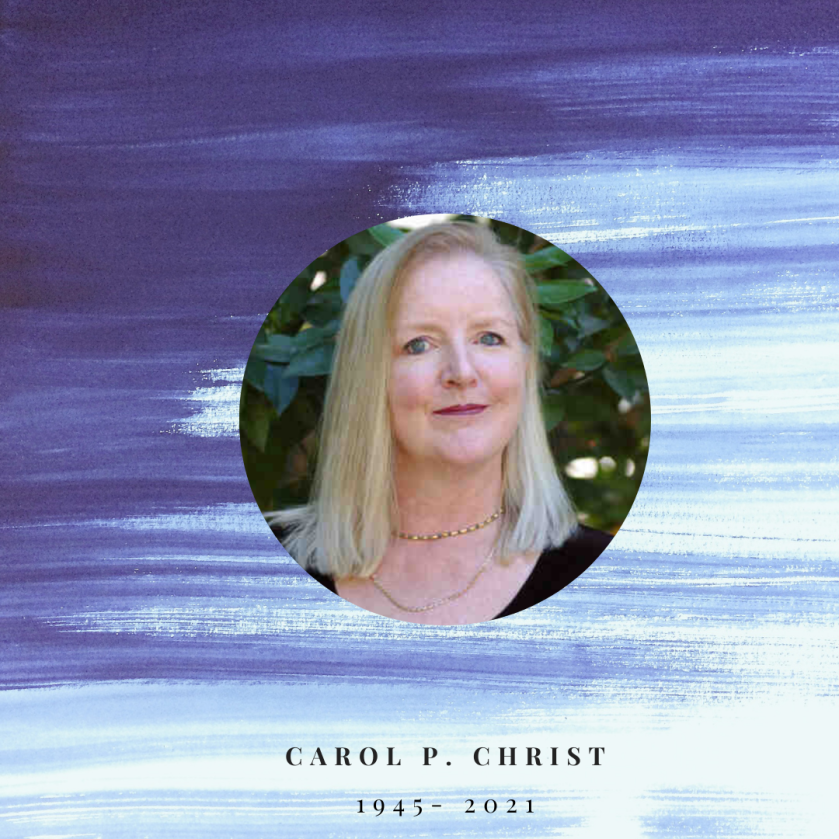
Legacy of Carol P. Christ: The Heraklion Museum: A Critique of the Neolithic Display

This was originally posted April 2, 2018

If I had been asked to write the words that introduce visitors to the Heraklion Archaeological Museum of Crete to its earliest inhabitants, I would have said something like this:

While there is evidence that human beings visited Crete as early as 150,000 years ago, the first permanent settlers arrived from Anatolia in the New Stone Age or Neolithic era, about 9000 years ago, bringing with them the secrets of agriculture and soon afterward learning the techniques of pottery and weaving. As the gatherers of fruits, nuts, and vegetables and as preparers of food in earlier Old Stone Age or Paleolithic cultures, women would have noticed that seeds dropped at a campsite might sprout into plants. Women most likely discovered the secrets of agriculture that enabled people to settle down in the first farming communities of the New Stone Age. As pottery is associated with women’s work of food storage and preparation, and as weaving is women’s work in most traditional cultures, women probably invented these new technologies as well. Each of these inventions was understood to be a mystery of transformation: seed to plant to harvested crop; clay to snake coil to fired pot; wool or flax to thread to spun cloth. The mysteries were passed on from mother to daughter through songs, stories, and rituals.

Continue reading “Legacy of Carol P. Christ: The Heraklion Museum: A Critique of the Neolithic Display”

Durga Rising: Feminism as Fierce Compassion By Beth Bartlett

In her FAR post earlier this year,[i] “Why Feminism Needs the Fierce Goddesses,” Susan Foster argues that a “flagging” feminist movement needs the revitalizing energy of the “fierce goddesses” of ancient times to challenge the patriarchal forces that seem to be on the rise as increasingly we find women’s lives and freedoms constrained. She writes, “the dark goddesses of ancient times have been submerged in our psyches, but they serve as a repository of fierce energy, of female rage against injustice.”  She continues, “It’s important and healthy for us as women to reclaim our anger, using it to protect ourselves and fight for our rights in systems that are oppressive.”

Reading this, I immediately thought of Beverly Wildung Harrison’s, “The Power of Anger in the Work of Love,” and China Galland’s, The Bond Between Women: A Journey to Fierce Compassion. Anger as the work of love; fierce compassion.  In this time of mass shootings, insurrection, the ongoing assault on women, LGBTQ, and BIPOC peoples, when rage seems so easily fueled by hate, envy, and greed, it is the rage based in love and compassion that is most needed.  This is the rage of the fierce dark goddesses who are moved to act against injustice, the rage of the feminism I love. With its source in love and compassion, it is a rage that rebels in the best sense of the word – that at once refuses injustice and affirms dignity and respect, that speaks truth to power, that is grounded in solidarity and friendship, and values the immanence of the earth, the water, the body, and the divine spark in all beings.[ii] 

Continue reading “Durga Rising: Feminism as Fierce Compassion By Beth Bartlett”

Legacy of Carol P. Christ: ALTERNATIVE IMAGES OF GOD with Emma Trout

This was originally posted on August 3, 2105

Carol Christ at the Conference of Women Theologians

Today I am publishing an early work on female language for God that I wrote with Emma Trout at the first Conference of Women Theologians in 1971. Highly contested at the conference, this essay is a foreshadowing of my subsequent work on the need for female imagery for divinity.

Rereading this essay more than four decades later, I am gratified to see that though we began our essay with the image of God giving birth (which I still view as an important image), Emma and I were aware of the danger that female imagery for God could reinforce “a false sexual polarity.” We insisted then that female imagery for God must not repeat sex role stereotypes, but rather must shatter them.

I am surprised that we also mentioned the need for a new non-static or process metaphysic, a theme I did pursue until I wrote Rebirth of the Goddess and then She Who Changes several decades later.

While the references in the essay are dated, the issues it raises are not. Though many mainline Christian and Jewish communities have adopted inclusive language, active experimentation with female language for God is relegated to the fringes of these groups. And while Goddess feminists resist gender stereotypes, some New Age teachers and Neo-Pagan groups perpetuate the idea that the Divine Feminine is receptive, loving, and giving, while the Divine Masculine is active, assertive, and aggressive.

Conference of Women Theologians 1971

ALTERNATIVE IMAGES OF GOD: COMMUNAL THEOLOGY BY CAROL CHRIST AND EMMA TROUT

How much better for theology to conceive of God the Creator as pregnant with the world, giving birth to it and nourishing it, than of God the divine Watchmaker who set the machine ticking millions of years ago. — Penelope Washbourne Chen in “Rediscovering the Feminine in God” The Tower alumni magazine

Even though we know that God Himself is not really a male, we have made use of no other images in talking about Him. As Mary Daly has pointed out, images have a way of perpetuating themselves even though we conceptually know better. (“After the Death of God the Father”) The image of God as a male authority figure serves to legitimize the structures of subordination (oppression) of women to (by) men. The problem is to conceive God in such a way that God’s masculinity does not function as a legitimation system for the oppression of women.

The imaging of God as male has two aspects: 1) the poverty of our language, and 2) the impoverishing of our vision of God by exclusive use of characteristics which our culture has attributed to and limited to the male in conceptualizing and imaging God. In the first of these two aspects we find images of God as Father, King, Lord; our language has no pronoun which is able to embrace and/or transcend both sexes. Our language forces us to think of God as male; we need words like “she-he,” “father-mother,” “daughter-son,” “brother-sister.” Regarding the second aspect: in the Western tradition, particularly the Christian theological tradition our ideas and images have been impoverished by almost exclusive use of “male” characteristics in conceptualizing and imaging God.

For example, initiative, transcendence, authority, primacy, leadership, control and order have all been conceived in static, self-sufficient, abstractly rational terms, in correspondence with masculine stereotypes. An alternative image of God suggested by Penelope Washbourne Chen, imaging God as pregnant, giving birth to, and nurturing the world, presents us with a more dynamic way of conceiving God. Philosophically, this image of God would find expression in the neo-classical metaphysics or process view of reality of Whitehead and Hartshorne, rather than the static ontology of the Greek tradition.

. . .

Let us now turn to the alternatives. Underlying the problem of choosing among the alternative conceptions/images of God is the problem of the evaluation of sexual differences. If, for example, one believes sexual differences are a fundamental polarity in human experience, she will find it appropriate to see this polarity reflected in the deity. If, on the other hand, one does not see sexual differences as a fundamental polarity, she will be wary of correcting a false male image/concept of God by introducing a “female” element which may serve to further legitimize a false sexual polarity.

If one is open to the possibility that sexual differences may not be fundamental, the real question is how to shatter the idol of a male deity without either 1) substituting a reverse idol of a female deity, or 2) legitimizing a false sexual polarity.

Read the entire essay Alternative Images of God-Carol P. Christ & Emma Trout (1971).

Photos of Carol speaking at the Conference of Women Theologians and of the Conference Participants from the Alverno College archives. Thanks to Sarah Shutkin for providing a copy of the essay from the Alverno College Library Archives.

From the Archives: Aren’t We All Divine Children? by Janet Maika’i Rudolph

This was originally posted March 18, 2021
Note from Janet: Thank you all who supported the launch of my book Desperately Seeking Persephone on May 19. Due to a printer’s error, the original books sent out were deeply damaged without formatting, editing and with uncertain content. If you received one of these books you are entitled to a free replacement. I have put instructions at the bottom of the post for anyone affected to receive their copy.

Consider the following four birth stories:

Continue reading “From the Archives: Aren’t We All Divine Children? by Janet Maika’i Rudolph”

Legacy of Carol P. Christ: The Beauty Way

This was originally posted on January 22, 2018

When I learned about the Navajo Beauty Way, I understood it to be a path in which human beings respect all beings in the web of life and live in harmony with them. But I didn’t understand why this path was called the “Beauty Way.” As a young woman, I knew that my worth was defined by many in terms of my ability to conform to ideals of female beauty promulgated in movies, tv, and advertising. I didn’t believe the Navajos were talking about beauty in that sense, but because of my conditioning, I was not yet able to fully grasp what they might mean by beauty. I would have called the way they were describing a “Way of Harmony” or a “Way of Respect for Life.”

Still, I wondered: why the Beauty Way?

Continue reading “Legacy of Carol P. Christ: The Beauty Way”

Legacy of Carol P. Christ: When Violence is Normal and Normalized

This was originally posted on January 14, 2019

Warning: this blog discusses spanking and bodily violence

“No Whips, No Punishments, No Threats: Women’s Control of Social Life” is the title of one of the chapters in Iroquoian Women, Barbara Alice Mann’s stunning reconstruction of female power in a matrilineal society. According to Mann, the European settlers were “unsettled” by the lack of strict punishment systems for children in Indian societies. “Spare the rod and spoil the child” was the backbone of European child-rearing practices. The settlers viewed Indian children as naughty, disobedient, disrespectful, and horror of horrors: self-possessed.

It is perhaps no coincidence that after reading this chapter, bodily memories of violence inflicted on me as a child began to resurface. My strongest bodily memory is of being hit repeatedly on my left upper arm by my younger brother’s fist. It is as if my arm is still stinging in that particular place. My mother wanted us to play together, but when we did, we usually ended up fighting. My brother, who was two and a half years younger, was later diagnosed with dyslexia and given “little red pills” to help him control his temper. I was a quiet child (there must have been reasons for that too), and though I soon realized that if I hit back I would only be hurt more, I learned to use my tongue against my brother. This too was a form of violence and my brother remembers my cruelty to this day. Once when I asked my mother what she wanted for her birthday, she responded, “Two children who do not fight.” I didn’t even try to give her that because I didn’t know another way.

Continue reading “Legacy of Carol P. Christ: When Violence is Normal and Normalized”

The Daughter, the Alliance-Maker (Women in the Book of Daniel, part 2) by Liz Cooledge Jenkins

Note: This is the second in a two-part series reflecting on women in the biblical book of Daniel. For part 1, see here.

The second female character I noticed while taking a deep dive into the book of Daniel appears even more briefly. Daniel 11:6-7 includes her story: “The daughter of the king of the South will go to the king of the North to make an alliance, but she will not retain her power, and he and his power will not last. In those days she will be betrayed, together with her royal escort and her father and the one who supported her. One from her family line will arise to take her place” (NIV). It is a brief story—and not a happy one, in the end. But I think it’s worth reflecting on.

In this chapter of Daniel, an unnamed supernatural messenger gives Daniel a detailed account of a long series of violent power struggles between various kings. Empires accumulate and then are broken up (vv. 3-4). One king is strong, but his commander proves stronger and overtakes him (v. 5). Attacks are victorious, and valuables are seized and carried off (vv. 7-8). Retreats are made (v. 9). Great armies are assembled (v. 10). Kings “march out in a rage” toward battle (v. 11). Armies are carried off, and thousands are slaughtered (v. 12). You get the idea. Everything is violent. Everything is bloody. Everything is one brutal war after another, one brutal kingdom after another, one brutal ruler after another. It all starts to blur together.

Continue reading “The Daughter, the Alliance-Maker (Women in the Book of Daniel, part 2) by Liz Cooledge Jenkins”

The Queen, the Memory-Keeper (Women in the Book of Daniel, part 1) by Liz Cooledge Jenkins

Note: This is the first in a two-part series reflecting on women in the biblical book of Daniel.

I recently had the chance to take a deep dive into the biblical book of Daniel. I think it’s the first time I’ve read the whole book of Daniel since I’ve started intentionally attending to the questions of feminist biblical interpretation: Where are women present? Where are women absent? What are they doing or not doing—perhaps prohibited from doing? How does this passage move its readers toward—or away from—gender equity and women’s empowerment? How does it speak to—or deny—women’s full humanity?

            The absence of women in most of the book of Daniel feels glaringly obvious to me.[1] The main characters include the Hebrew exile Daniel, Daniel’s three (male) friends, King Nebuchadnezzar, King Belshazzar, and King Darius. The angels look like men. The divinely appointed eschatological authority figure is described as being like a “son of man.” The particularly oppressive king who desecrates the temple, abolishes the ritual sacrifices, and sets up an “abomination that causes desolation”[2] is definitely male.

Where are the women?

Continue reading “The Queen, the Memory-Keeper (Women in the Book of Daniel, part 1) by Liz Cooledge Jenkins”

The Return of the Goddess to Our Human Consciousness by Caryn MacGrandle

One of the over 700 granodiorite statues made of the Goddess Sekhmet almost 3500 years ago, “the Lady of the Place of the Beginning of Time.” 

Molly Remer of Brigid’s Grove, a fellow contributor here at Feminism and Religion recently wrote on the Mother Well section of the divine feminine app: “I feel like Inanna & Enheduanna are all around in recent months!”

Yes. I do as well.

A year or two ago, I read a book by Lauren Sleeman entitled ‘Behold’.  The premise of the book has remained with me:  a telling of the Goddesses, in particular Lilith, the Great Mother and Crone of the Cosmos, and Hekate, Goddess of the Dark Moon and the Mysteries of Life, who have been silently watching and waiting these past few thousand years to return to our human consciousness. 

Continue reading “The Return of the Goddess to Our Human Consciousness by Caryn MacGrandle”