Feminism and Religion Project Intern – Job Description

Art work designed by Jaysen Waller - http://www.jaysenwaller.com/Project Summary
:
Feminism and Religion (FAR), feminismandreligion.com, is a project that brings together multiple feminist voices from around the world to dialogue about the “f-word” in religion and the intersection between scholarship, activism, and community. It was established in the hope that feminist scholars of religion — and all who are interested in these issues — would utilize this forum to share their ideas, insights, and experiences, so that the community of thinkers would be nurtured as diverse and new directions are explored. The project has been incredibly successful in offering such a space and continues to act as a medium for feminist community.

Position Overview:
Feminism and Religion is seeking a creative, industrious, responsible, and highly-organized intern interested in working for a community-oriented collaborative online feminist project. Strong knowledge of the field of feminism and religion, excellent writing and editing skills, and the ability to engage WordPress and other forms of social media is desired. Responsibilities may include website support, reviewing, editing and uploading posts, responding to comments and submission inquiries, recruiting new contributions, and sharing content.
This is an unpaid internship designed to be a learning opportunity for the intern. FAR co-founders will work closely with the intern to help provide a positive learning experience. This internship is a 6 month position, with the option to renew, and will require approximately 10 hours per week.

Values and Expectations:
We work to create and maintain a positive, encouraging, and collaborative environment for Feminism and Religion and its broader community. A FAR intern is expected to value:

  • diversity
  • dialogue
  • collaboration
  • community building
  • gender justice

To Apply:

Please e-mail FAR co-directors at (feminismandreligionblog@gmail.com) with:

  • Your resume, including 2 references who can speak to your reliability, diligence, organizational style, and responsibility (these can be professional, academic, or scholastic).
  • A cover letter indicating the reasons you are interested in working with FAR.  Please highlight your interest and background in feminism, religion, gender justice issues, and/or gender/race/sexuality issues in religion.
  • A writing sample between 1000-2500 words – a blog post is ideal.

Applications are due December 15th, 2016.  Candidates will be contacted for more information and to schedule interviews in January.

For more information, contact Xochitl Alvizo or Gina Messina: feminismandreligionblog@gmail.com
Turning One by Sara Frykenberg

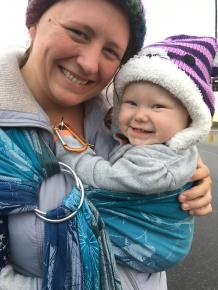
14724657_10154061354658546_8918956387379465095_nThis month I turn one as a mother. My daughter, consequently, is also turning one—a first birthday I am excitedly planning. Specifically, I want to make Hazel a rainbow cake with lots of colored layers and white frosting. I’m not even sure she’ll be able to eat the cake (avoiding lots of sugar for a one-year-old and all), but among those family pictures I treasure, my mother held a cake for her little ones. I want to be like my mother. I am going to make a cake.
But planning my daughter’s party, I realized that I am also going to have a kind of birth-day anniversary. Other moms have told me that it takes a year to really process the experience of giving birth. While I did consider the significance of my “birthing community,” in a blog last fall, I realized a couple of weeks ago that I wasn’t done understanding what I, what mothers, and what life givers of all kinds go through to bring life into the world. Continue reading “Turning One by Sara Frykenberg”

Are White Women Voters (As a Group) Waking Up? by Carol P. Christ

Carol P. Christ by Michael Bakas high resoultionI have been following the statistics on the gender gap in voting patterns for many years, often patting myself on the back for belonging to a group that on the whole votes Democratic or breathing a sigh of relief that I am not part of a group that votes Republican. Imagine my dismay when in 2012 I read that though the gender gap exists, I belong to a group—white women—that is likely to vote Republican. Since 1972 only Bill Clinton in 1996 took a majority of the white women’s vote.

The gender gap in 2008 and 2012 was created by the fact that over 96 percent of African-American women and over 2/3 of Hispanic women voted for Obama. In contrast, white women voted for McCain by a 7 percent margin and for Mitt Romney by 14 percent.

Breaking these statistics down further, I could consider myself “home free.” Continue reading “Are White Women Voters (As a Group) Waking Up? by Carol P. Christ”

Sex, Death and the Gods (Part II) by Vibha Shetiya

IMG_20160112_101035This continues my reflections on the Devidasis in Part 1.
The overall picture that emerged from the documentary “Sex, Death and the Gods” was that, in its current form, there were many layers to the Devadasi system. For one, the most heartbreaking of all, there were the helpless, underage girls protesting such an existence, pleading that they would rather be in school, instead of being trapped in what was essentially a form of sexual slavery. But then we also see the older Devadasis, women who had been dedicated as children themselves.

Within this latter bracket, there were two groups.Those that viewed the practice as evil, and those that saw it as empowering – they earned their own income and they didn’t have a man or mother-in-law to lord over them; in short, they were in-charge of their own households. To them, married life was akin to a life of servitude, sex was something they enjoyed, and they may have shared a more or less equal relationship with the men who were their customers, men who enjoyed their company and preferred being with a Devadasi rather than with spouses they never chose or couldn’t get along with. In the words of one Devadasi – “I am the boss.” Continue reading “Sex, Death and the Gods (Part II) by Vibha Shetiya”

The Tremble of Love: A Novel of the Baal Shem Tov by Ani Tuzman – Reviewed by Joyce Zonana

jz-headshotNever has it been more difficult for me to affirm that “love trumps hate” as during this unprecedented United States election season.  After watching the Republican Convention last July in mute horror, I took to bed for several days, overwhelmed by the presentiment that everyone–blacks, women, Jews, Latinos, Muslims, queers– other than a certain breed of white American males was doomed to shameless malignment and persecution.  The palpable hatred in Donald Trump’s acceptance speech seared me, arousing my ancestral memory of various persecutions of Jews, Muslims, and others–not something I usually think about or choose to foreground.  For several months now, I have been haunted (and almost paralyzed) by fear.
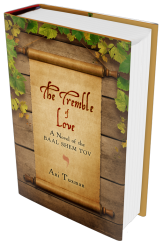
tremble-of-love-cover-3d-for-webHence Ani Tuzman’s The Tremble of Love: A Novel of the Baal Shem Tov has come as an especially welcome, healing antidote, affirming as it does the power of “unshakeable faith even in the presence of inhumanity” (473).  I cannot say that I fully have such faith, but this novel, if anything can, leads me towards it. Page after page is filled with compelling examples of love’s power to disarm hatred and assuage pain.

Early on, a tale is told of a young man fearlessly facing three would-be highwaymen who have stopped the wagon in which he is riding with a rabbi’s wife and her three children, one of whom is disabled:

Continue reading “The Tremble of Love: A Novel of the Baal Shem Tov by Ani Tuzman – Reviewed by Joyce Zonana”

Nominating Holy Women Icons by Angela Yarber

Who is your Holy Woman Icon?

When I began the academic study of religion in 1999, I was struck by the pantheon of male saints, venerated, honored, painted, adored, perhaps even worshipped. From virtually every tradition, men reigned supreme—in leadership, iconography, decision-making, worship—which is one of the myriad reasons groups like Feminism and Religion must exist. To combat this oppressive supremacy.

In 2010, I decided to put my wonder and this patriarchal dis-ease on canvas. I painted a triptych of Sophia, the feminine Greek word for wisdom often understood as the feminine face of Jesus, for a group triptych exhibition. Inspired stylistically by the art of Shiloh Sophia McCloud and He Qi, I endeavored to give traditional iconography a folk twist in an attempt to make it more accessible, perhaps a bit less brooding and intimidating. Emboldened by the works of womanist and feminist scholars in religion, my icons aim to subvert traditional—and often patriarchal—depictions of a virtually all-male sainthood. Though there are surely some women depicted Catholic and Orthodox iconography, and a robust number of women and goddesses in Hindu iconography, I found myself at a loss when it came to positive, affirming, and empowering icons of women across the vast spectrum of religious and spiritual traditions. Continue reading “Nominating Holy Women Icons by Angela Yarber”

Prayers to Black Madonna and Kali Rising by Natalie Weaver

Natalie Weaver editedThis past Saturday, I had an opportunity to sweat in a traditional Lakota sweat lodge for the first time.  It was, above all, an interesting cognitive experience for me.  I found myself sort of shaking hands with the ritual, the heat, the stones, the songs, and so on, saying, “Hi, I’m Natalie.  I have an open mind.  I am excited to know about you.  Thanks for letting me see what you are all about.”  I didn’t know whether I would pass out, have visions, or learn something new and wonderful about myself or the others.  I was curious, still, and grateful for the opportunity. I was gifted by generous people, good fellowship, and new ideas.  I will go back, even though I didn’t exactly find some thing… or maybe I did.  Maybe, I found someone, or, better, maybe someone found me.
Two days before the sweat, I received an email from one of my companions on the journey, saying something I still do not understand about the Constellation Sagittarius, the Galactic Center, and the Rising of the Black Madonna.  Although I did not understand the astronomy, I was intrigued by the call to recognize and confirm the Black Madonna.  For, without particular reason or impetus that I could identify in myself, I had been dreaming of a Black Madonna statue for some time.  After trying to find out what it was, I was able to identify it as the Black Madonna of Prague.  I have never been to Prague and was basically unaware of the rich tradition of Black Madonnas in Europe, despite four semesters of art history in college.  So, I made note of my dreams, with a promise to myself to seek them out whenever and wherever I travel.  I also purchased little trinket at a Canadian gift shop, which sits on my desk as a guide and companion.
Continue reading “Prayers to Black Madonna and Kali Rising by Natalie Weaver”

Women Beyond Belief by Karen L. Garst

karen_garst_imgIf you knew about me, you might ask, “Why does a former executive decide to abandon retirement and devote herself to writing a book about women leaving religion?” Of course if you knew me well, you would understand that I must have a worthwhile project. Idleness is not in my nature. But the path that led me to the publication of Women Beyond Belief: Discovering Life without Religion is, hopefully, an interesting one and reveals a shy girl, born in the nation’s hinterland, who matured into an ardent feminist and then moved on to expressing that feminism through writing about women and atheism.

When I mention in interviews that I grew up in Bismarck, North Dakota, most are able to guess that I was likely raised as a Lutheran. And they are correct. Trinity Lutheran Church, at the time a beautiful church with amazing stained glass windows, was the center of my life. Recently, my sister and I, who calls herself an agnostic, sang old hymns together on a road trip. With a 55,000 year history, it is no wonder that music leaves a deep impression on us. With long gowns, we walked down the aisle at Trinity singing “God’s Word is Our Great Heritage” in youth choir. It was a singular experience in my life that has no equal. This ALC church was fairly liberal though at the time there seemed to be a bit of a war going on with Catholics. Why else would I have asked my father at the tender age of seven if it would be okay if I married the Catholic boy who had just walked me home from school? Unpacking why I would think of marriage at seven must be left to another day. Learning Martin Luther’s catechism was arduous. I can honestly say I never understood it at all. Continue reading “Women Beyond Belief by Karen L. Garst”

The Restorative Act of the Rite-13 Ritual by Katey Zeh

carpeI had never heard of the Rite-13 Ritual until I saw it listed on my worship bulletin a few months ago. My first reaction was to become annoyed when I saw the additional program item and to begin to calculate the additional minutes we were going to be sitting in our pew. Our nearly two-year-old daughter had just had her weekly meltdown over being left in the nursery, and all I wanted was for this liturgical hour to be over so I could scoop her up in my arms and take her home.

Started by an Episcopal Church in the 1980s the Rite-13 Ritual is modeled on the Jewish bar and bat mitzvah and intends to recognize adolescence as a time of transition in a young person’s life. After the opening hymn, six gangly, slightly awkward teenagers and their slightly nervous parents made their way up to the front of the congregation. They began with a reading based on Psalm 139: “God, investigate my life, get all the facts firsthand.” Most of their voices were barely above a mumbled whisper, perhaps due to the sheer discomfort of being center stage at church. In between each passage the youth read, the congregation responded, “Your creation is wonderful, and we know it well!” I’m a strong advocate for participatory worship, but this kind of of responsive reading always feels a little odd to me.

The last portion of the ritual, however, caught me off guard and left me in tears. The youth knelt down as their parents prayed a blessing over them. We couldn’t hear what was said, but watching these parents lovingly speak words of affirmation and encouragement softly into their children’s ears was beautiful. Now that I’m a parent, I couldn’t help but imagine what it might be like to stand in their place one day and pray a blessing over my daughter. But I don’t think that’s what brought on the tears.

I had a flash of a memory of a similar scene. I was also thirteen standing at the front of my church with my mother and a group of other youth and parents. We were not there to receive a blessing or to be affirmed, however, but instead to proclaim our commitment to sexual purity until marriage. It was the late 1990s and the True Love Waits movement was just ramping up. I guess you could say my church was an early adopter.

Instead of reciting Psalm 139, we spoke these words instead: “Believing that true love waits, I make a commitment to God, myself, my family, my friends, my future mate and my future children to be sexually abstinent from this day until the day I enter a biblical marriage relationship.” In this evangelical church of my childhood the only readily available affirmation of me as a teenager was tied to an ill-informed, naïve promise I was pressured to make about sexual abstinence for the foreseeable future and beyond.

It was a perfect example of the contradictory theological messages I got constantly from my faith community: God created you, so you are good. But you are also sinful, so you are bad. I remember a church friend once jokingly said, “You totally suck. But Jesus is great through you.”

Twenty years have passed since that True Love Waits Sunday, but as Madeline L’Engle wrote, “I am still every age that I have been.” Over those two decades, I’ve internalized that message of earned and performative self-worth I got as a teenager. It shifted from worth rooted in sexual purity to one tied to academic achievement, transformed to professional success, and then on to marriage and parenthood and the illusive “balance” of doing all of it simultaneously. I still yearn to hear those words of acceptance that I needed then and need to this day.

As I see it, the heart of the Rite-13 Ritual is a commitment on the part of young people to seek divine wisdom throughout the journey of life and for the community of faith to pledge to be a place of unceasing support, friendship, and care for them. No strings attached. I’ve kept that bulletin insert, formerly a source of annoyance, on a prominent place on my desk. I turn to it on particularly hard days as a constant reminder of the truth of my own sacred worth that can’t be lost or earned. It simply is. “Your creation is wonderful, and we know it well!”

Katey Zeh, M.Div is a thought leader, strategiest, and connector who inspires intentionalKatey Headshot communities to create a more just, compassionate world through building connection, sacred truth telling, and striving for the common good.  She has written for outlets including Huffington Post, Sojourners, Religion Dispatches, Response magazine, the Good Mother Project, the Journal for Feminist Studies in Religion, and the United Methodist News Service. Her book Women Rising will be published by the FAR Press in 2017.  Find her on Twitter at @kateyzeh or on her website kateyzeh.com
Weaving and Spinning Women: Witches and Pagans by Max Dashu: Reviewed by Carol P. Christ

carol p. christ photo michael bakasMax Dashu’s  Witches and Pagans: Women in European Folk Religion 700-1000 challenges the assumption that Europe was fully Christianized within a few short centuries as traditional historians tell us. Most of us were taught not only that Europe became Christian very rapidly, but also that Europeans were more than willing to adopt a new religion that was “superior” to “paganism” in every way. Careful readers of Dashu’s important new work will be challenged to revise their views. When the full 15 volumes of the projected series are in print, historians may be forced to hang their heads in shame. This of course assumes that scholars will read Dashu’s work. More likely they will ignore or dismiss it, but sooner or later–I dare to hope–the truth will out. Continue reading “Weaving and Spinning Women: Witches and Pagans by Max Dashu: Reviewed by Carol P. Christ”